Category: News

Add your news
You can add news from your networks or groups through the website by becoming an author. Simply register as a member of the Generator, and then email Giovanni asking to become an author. He will then work with you to integrate your content into the site as effectively as possible.
Listen to the Generator News online

 
The Generator news service publishes articles on sustainable development, agriculture and energy as well as observations on current affairs. The news service is used on the weekly radio show, The Generator, as well as by a number of monthly and quarterly magazines. A podcast of the Generator news is also available.
As well as Giovanni’s articles it picks up the most pertinent articles from a range of other news services. You can publish the news feed on your website using RSS, free of charge.
 

  • Study: 5-meter rise in sea level would flood 23 federal buildings in ..

    Study: 5-meter rise in sea level would flood 23 federal buildings in
    Fierce Homeland Security
    Even though 5 meters exceeds the likely amount of sealevel rise for the next 100 years, the study (.pdf) says that level could be reached during storms. Affected buildings would include the FBI, the Internal Revenue Service, the Justice Department
    See all stories on this topic »
    There’s No Question: Climate Change Made Superstorm Sandy Worse
    The Atlantic Cities
    “I keep telling people the one lock you have here is sea level rise,” meteorologist Scott Mandia explained to me recently. “It’s the one thing that absolutely made the storm worse that you can’t wiggle out of.” Mandia is an expert on the subject at
    See all stories on this topic »

    The Atlantic Cities
    Climate Change Didn’t Cause Hurricane Sandy, But it Sure Made it Worse
    Mother Jones
    First of all, using Climate Central’s Surging Seas tool, [meteorologist Scott] Mandia estimated that 6,000 more people were impacted for each additional inch of sea level rise….Moreover, there is also reason to think that the second inch, so to speak
    See all stories on this topic »
  • Severe storms hit the city … again

    Channel nine news has reported that we can expect to receive another 50 of these storms over the warm periods.

    Severe storms hit the city … again

    4
    Storm

    The storm viewed rolling in over North Head. And now gone. Picture: John Grainger Source: The Daily Telegraph

    FOR the second day in a row Sydneysiders are battening down the hatches as a fierce storm lashes the city.

    The eastern suburbs and CBD have been hit with large hail and heavy rain, which rolled in with a thunderstorm, just before 2pm.

    Weather experts said the storm had quickly moved from Bankstown, and the south west, to the city and east.

    Storm

    Tourists take shots of the dramatic weather from North Head. Picture: John Grainger

    They then headed east to Bondi Beach, where Prince Charles and the Duchess of Cornwall were on the latest stage of their tour of Australia.

    Storm

    Rain hits Central Station. Picture: Twitter

    Lightning struck signalling equipment at Milson’s Point, in the city’s north, leading to delays on trains heading into the city from the northern shore.

    Westbound services were also affected.

    Sydneysiders were quick to take to Twitter to post pictures of the hail, with one user describing the hailstones as being the size of chickpeas.

    Michael Logan of the Bureau of Meteorology said severe thunderstorm warnings would remain in place for the northern suburbs of Sydney, as well as the Hunter Valley and the north coast of the state, for several hours.

    Areas that could be affected include Newcastle, Gosford, Cessnock, Maitland, Sydney, Liverpool, Penrith and Parramatta.

    It is expected to move off the coast by 3pm.

    The State Emergency Service has received more than 30 calls for help as a result of the storm, including one call to Petersham Police Station after reports of roof damage.

    It follows a storm that hammered the south and south-west parts of Sydney last night, bringing down trees, lifting roofs and cutting power to thousands of homes.

    Storms

    Hailstones after the storm today. Pic: Alexandra Adoncello via Twitter


    Storm

    The storm cell moves in over CentennialPpark. Picture: John Appleyard

    Capture any good pix of the storm? Send them to us @ news@dailytelegraph.com.au


    Yesterday more than 10 shops at Carnes Hill Marketplace in Sydney’s west suffered damage when the storm swept through in the afternoon.

    Some sustained major damage after roofs collapsed, bringing down air conditioning vents and electrical wires and causing flooding.

    Carnes Hill Marketplace Newsagent owner Natalie Nguyen said they ended up ankle deep in water when part of their roof collapsed from the heavy rain about 5pm.

    “I was talking to a customer about the change in weather. A few seconds later a customer told me the roof was leaking,” Ms Nguyen said.

    “And then 10 seconds later the whole roof collapsed. All the water came crashing down.”

    “It happened so quickly, I was so stunned. I had to get everyone out of the store. We were worried the other roof panels would collapse.”

    She said they estimate that more than $70,000 worth of stock has been destroyed including cards, magazines, Christmas stock and gifts. They have also lost trade, forced to close early last night and the whole of today.

    “This is the worst I’ve seen,” she said.

    “There was a little bit of hail, but mainly really heavy rain. It flooded within a few minutes.

    “I haven’t seen that much water all at once.”

    Owner of deli-licious catering Marianna Butros said she was trapped in the store when the roof collapsed and was helped by a worker from nearby CTC – Cigarettes, Tobacco, Cigars.

    “Water was starting to leak in one corner and then it came all along the shop. One thing at a time started to collapse and I was stuck inside,” Ms Butros said.

    “The man from the cigarette shop got me out otherwise the air conditioner would have fallen on me.”

    Another store that sustained major damage was K’s Kebabs.

    Owner Denis Chimen said his parents were working in the store at the time and there were about four customers.

    “From what they’ve told me the water started rushing through the roof,” Mr Chimen said.

    “They got the customers out just in time.”

    “The ceilings destroyed, all the electrical wiring. They’ll probably have to replace the whole thing.”


  • NSW announces commission into police handling of abuse claims

    This is long overdue, and should be extended to include ALL church run institutions.


    NSW announces commission into police handling of abuse claims

    ABCUpdated November 9, 2012, 3:04 pm

    New South Wales Premier Barry O’Farrell has announced a Special Commission of Inquiry into police handling of abuse by Catholic Church clergy in the Hunter Valley, after a senior detective aired claims of a cover-up.

    His move follows a call from Nationals MP Troy Grant for a royal commission and claims people in the Catholic Church are hindering police investigations.

    A senior Hunter Valley police officer, Detective Chief Inspector Peter Fox, alleges the church covers up for paedophile priests, silences investigations, and destroys crucial evidence to avoid prosecution.

    He outlined his claims in an open letter to Mr O’Farrell

    “I can testify from my own experience that the church covers up, silences victims, hinders police investigations, alerts offenders, destroys evidence and moves priests to protect the good name of the church. None of that stops at the Victorian border”, he said.

    Last night Detective Chief Inspector Fox told ABC TV’s Lateline that he encountered alleged serious issues of cover-up in his investigation of priest Father Denis McAlinden.

    The priest had arrived in Australia from Ireland in 1949 and for four decades he was transferred from parish to parish, and even outside Australia.

    The NSW Department of Public Prosecutions is now looking at whether McAlinden’s crimes were covered up by three senior members of the clergy, including the general secretary of the Australian Catholic Bishops conference, Brian Lucas, the Archbishop of Adelaide, Philip Wilson, and former bishop of Newcastle, Michael Malone.

    Chief Inspector Fox was in the middle of investigating the matter in 2010 when he was directed to hand over all his evidence to other officers, including a statement from a critical witness.

    He says the statement was “explosive”.

    “When I was directed to hand that statement over I described her statement as … explosive. And I still describe that statement as explosive,” he said.

    “What is disclosed in that is monumental.”

    Northern Region Commander Assistant Commissioner Carlene York told Lateline that Chief Inspector Fox was directed to hand over his work because the case was taken over by a new taskforce in a different Local Area Command (LAC).

    “It would be unusual for a crime manager from a neighbouring LAC to work on a Strike Force in another LAC,” he said.

    While similar to a royal commission, special commissions of inquiry are restricted to looking into possible offences which may justify prosecution, while royal commissions can have a wider scope.

    Special commissions are also required to observe the rules of evidence as applicable in a court of law, while royal commissions have no such restrictions.

    Mr O’Farrell’s move came as calls for a royal commission intensified in Victoria, where an ongoing parliamentary inquiry is looking into the handling of child abuse.

    Victims’ support group Broken Rites says it has evidence that two orphaned boys died while in the care of the Hospitaller Order of St John of God in Victoria – one of them after being thrown down a flight of stairs.

    Broken Rites says it will present its evidence to the ongoing parliamentary inquiry and says it wants a nationwide royal commission to look into abuse claims.

  • Barack Obama stokes expectations of climate change action in second term

    Barack Obama stokes expectations of climate change action in second term

    Hopes rise among green campaigners after president mentions ‘the destructive power of a warming planet’ in victory speech

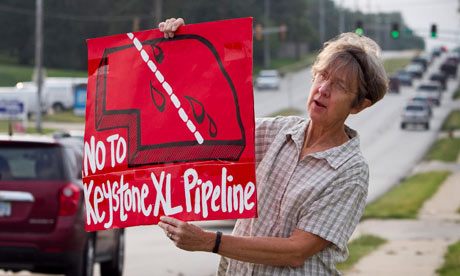
    protester opposed to the Keystone XL pipeline , TransCanada's second pipeline

    The first environmental decision for Barack Obama will be on the controversial Keystone XL pipeline. Photograph: Nati Harnik/AP

    Barack Obama‘s invocation of “the destructive power of a warming planet” in his victory speech has stoked expectation that he will act on climate change in his second term.

    Environmental campaigners are already mobilising to hold the president to that promise.

    They argued Obama’s re-election, amid the devastation of superstorm Sandy, was a clear mandate for action on climate change, in stark contrast to Mitt Romney, who turned sea-level rise into a laugh line in the biggest speech of his political career.

    Campaigners put Obama on immediate notice, calling an 18 November demonstration at the White House to demand he scrap the controversial Keystone XL pipeline.

    “In the wake of hurricane Sandy, as the warmest year in American history draws to a close, as the disastrous drought lingers on in the midwest, everyone is looking for ways to make a real difference in the fight to slow climate change,” said an open letter from 350.org and the Sierra Club.

    But a strategic decision by the White House in 2009 to downplay climate change, and Obama’s avoidance of the issue during the campaign, makes it tricky for the president to now claim that he was elected to act on the issue.

    The Republicans’ continued control of the House of Representatives will also continue to limit Obama’s scope for action.

    However, environmental campaigners said Sandy – and an endorsement from New York city mayor, Michael Bloomberg, due to Obama’s position on climate change – create public space for the president to act.

    “Of course president Obama certainly did not take up the cause in the way we had hoped but he has indicated in numerous events and in the New Yorker and Rolling Stone that climate will be a top priority for his second term,” said Betsy Taylor, president of the climate strategy firm Breakthrough Solutions. “There is reason to feel hope. We moved from silence to a growing mandate for action.”

    A number of newly elected Democrats in the Senate and the House of Representatives also owe their victories, in part, to support from environmental campaign groups, giving greens more allies in Congress.

    The president has a chance early on to show he intends to deliver on climate change.

    The first big decision will be on the Keystone XL pipeline, a project designed to expand production of the Alberta tar sands by pumping crude to Texas refineries. The administration is due to make its decision early next year and many believe that Obama will approve the pipeline.

    Environmental groups will also be watching whether Obama continues to fight to keep tax credits for the wind industry during the lame duck session of Congress. Their expiry at the end of the year has hurt the industry, leading to lay-offs. Obama has said he will continue to fight $46bn in subsidies to the fossil fuel industry.

    Then there are appointments. Obama came to the White House in 2009 with a green “dream team” including Nobel laureate, Steve Chu, as energy secretary. Obama will have to make new appointments in his second term.

    He must also decide whether to resurrect the post of White House climate adviser, which has been empty since early 2011 when Carol Browner stepped down. That could help push policies blocked by Congress.

    Now that Obama has a second term, the Environmental Protection Agency is also expected to move more aggressively on tightening rules on mercury and carbon dioxide emissions.

    But the environmental community will be looking for Obama to deliver the big changes that will move America towards a low-carbon future – and protect the country from the extreme weather, rising seas and other consequences of future climate change.

    At its most ambitious, that would involve some kind of carbon tax – an option that is now a topic of discussion at a number of Washington thinktanks, including the conservative American Enterprise Institute.

  • Dozens dead as big quake hits Guatemala

    Dozens dead as big quake hits Guatemala

    Updated 14 minutes ago

    The death toll from a huge earthquake in Guatemala rose to 39 this morning, President Otto Perez said, as he toured the disaster area in the south-west of the country.

    “We have to lament the death of 39 people. It is a tragedy,” Mr Perez told reporters, raising the toll after preliminary reports of 15 deaths.

    The magnitude 7.4 quake, which hit in the early hours of this morning (Australian time), destroyed buildings in several towns, shook the capital Guatemala City, and forced evacuations as far away as Mexico City.

    A local fire chief said the dead were buried under rubble in three different Guatemalan towns.

    Landslides were blocking roads in some areas, authorities said, and about 40 houses were severely damaged after the earthquake hit at 10:35 am local time.

    It was the strongest earthquake to hit Guatemala since a magnitude 7.5 quake in 1976 that claimed more than 20,000 lives.

    The quake struck off Guatemala’s Pacific coast, 24 kilometres south of Champerico, Guatemala, and 163 kilometres west-south-west of the capital, the US Geological Survey said.

    A witness in Guatemala City said people were returning to work after evacuations, which filled the streets with office workers, calling friends and relatives on their mobile phones.

    “It was really big, I felt quite nauseous,” Vanessa Castillo, 32, who was evacuated from her 10th-floor office in Guatemala City, said.

    The epicentre was 42 kilometres below the surface, according to the USGS, which initially reported the quake as magnitude 7.5.

    The quake was also felt in El Salvador and more than 1,000 kilometres away in Mexico City, where some office workers were also briefly evacuated.

    Mayor Marcelo Ebrard said the quake was felt strongly in a large part of the city of 20 million people.

    The Pacific Tsunami Warning Centre said a very small tsunami was registered on Guatemala’s coast, adding there was a risk of localised damage within a 100 kilometre radius.

    Map: Quake off Guatemala


    AFP/Reuters

    Topics:earthquake, disasters-and-accidents, guatemala, mexico

    First posted 1 hour 12 minutes ago

  • Earth on acid: Present & future of global acidification

    ScienceDaily: Earth Science News


    Strange diet for methane-consuming microorganisms

    Posted: 06 Nov 2012 08:41 AM PST

    Methane is formed under the absence of oxygen by natural biological and physical processes, e.g. in the sea floor. It is a much more powerful greenhouse gas than carbon dioxide. Thanks to the activity of microorganisms, this gas is inactivated before it reaches the atmosphere and unfolds its harmful effects on Earth’s climate. Researchers have now demonstrated that these microorganisms are quite picky about their diet.

    Earth on acid: Present & future of global acidification

    Posted: 06 Nov 2012 06:27 AM PST

    Climate change and extreme weather events grab the headlines, but there is another, lesser known, global change underway on land, in the seas, and in the air: acidification.
    You are subscribed to email updates from ScienceDaily: Earth Science News
    To stop receiving these emails, you may unsubscribe now.
    Email delivery powered by Google
    Google Inc., 20 West Kinzie, Chicago IL USA 60610