Category: News

Add your news
You can add news from your networks or groups through the website by becoming an author. Simply register as a member of the Generator, and then email Giovanni asking to become an author. He will then work with you to integrate your content into the site as effectively as possible.
Listen to the Generator News online

 
The Generator news service publishes articles on sustainable development, agriculture and energy as well as observations on current affairs. The news service is used on the weekly radio show, The Generator, as well as by a number of monthly and quarterly magazines. A podcast of the Generator news is also available.
As well as Giovanni’s articles it picks up the most pertinent articles from a range of other news services. You can publish the news feed on your website using RSS, free of charge.
 

  • Climate change affecting overall weather patterns, may affect water availability, in California

    ScienceDaily: Severe Weather News


    Satellite still shows Sandy’s remnant clouds over eastern Canada and the northeastern U.S.

    Posted: 02 Nov 2012 01:28 PM PDT

    Satellite imagery from Nov. 2 showed that Sandy’s remnant clouds continue to linger over Canada and the northeastern U.S.

    Disaster defense: Balancing costs and benefits

    Posted: 02 Nov 2012 12:19 PM PDT

    Do costly seawalls provide a false sense of security in efforts to control nature? Would it be better to focus on far less expensive warning systems and improved evacuation procedures? A father-son team have developed new strategies to defend society against natural disasters like Hurricane Sandy and the effects of climate change. The approach, which considers costs and benefits while identifying the best solution, is based on a mathematical technique called optimization.

    Climate change affecting overall weather patterns, may affect water availability, in California

    Posted: 02 Nov 2012 06:20 AM PDT

    Climate change is affecting overall weather patterns, scientists say, and could affect water availability in California.
    You are subscribed to email updates from ScienceDaily: Severe Weather News
    To stop receiving these emails, you may unsubscribe now.
    Email delivery powered by Google
    Google Inc., 20 West Kinzie, Chicago IL USA 60610
  • Urgent flood prevention measures needed for Warragamba Dam

    Urgent flood prevention measures needed for Warragamba Dam

    Date
    November 3, 2012 – 5:55PM
    • 41 reading now

    Tim Barlass

    A one in 1000 flood around the Hawkesbury Nepean, such as that in Queensland early last year, would cause up to $8 billion in total damages affecting 14,000 homes and requires urgent preventative measures, according to a group of 10 western Sydney councils.

    A one in 1000 flood is one that has a 0.1 per cent chance of happening each year.

    The Western Sydney Regional Organisation of Councils last night called on the state government urgently to address threats of potential floods around the Hawkesbury Nepean.

    A repeat of the 1867 flood would cause up to $1.7 billion in direct damages and $3 billion in total damages, the group said.

    “This would affect an estimated 7600 homes, with about 1200 of those destroyed, WSROC president Tony Hadchiti said.

    Flood prevention measures could include raising the wall of the Warragamba Dam, which filled to capacity in March, spilling water over the wall.

    Infrastructure NSW last month backed the implementation of Hawkesbury Nepean Flood Plain mitigation measures as a key recommendation of its 20-year strategy “First Things First”.

    Cr Hadchiti said the flooding was a serious concern for key western Sydney councils including Liverpool, Penrith, Blacktown and Hawkesbury.

    “Our councils have been calling for action on this issue for years,” he said.

    A study carried out as part of the strategy had shown there were 21,000 residential buildings on the floodplain – 5000 more than previously thought, and that an additional 143 hectares of commercial and industrial property had been built since 1990, he said.

    He said: “A flood of this magnitude would put 43,000 residents and 9000 employees of local business at risk.

    “These are risks that we simply cannot afford to take and the NSW government needs to act on these recommendations as a matter of urgency.”

    The issue was also raised at last week’s Local Government and Shires Associations conference in Dubbo with calls to both the NSW and federal governments for a study to determine the potential threat.

    WSROC vice-president, Tiffany Tree, who is also the deputy mayor of Hawkesbury, said she strongly supported the need for action to fund key mitigation initiatives such as raising the dam wall.

    “This is important because, although individual councils have conducted their own studies, we need an overall regional assessment in order to be truly effective,” she said.

    In his book Hawkesbury Heritage, Stan Stevens wrote that the 1867 flood “from Riverstone to the Blue Mountains, and from Pitt Town to Kurrajong extended a vast inland sea dotted only by the islands of Windsor, Richmond and Pitt Town.

    “Many residents of the Lowlands, as they were being taken to safety, watched heartbroken as uprooted trees, broken furniture and other debris smashed into their homes, pounding against walls and even caused some buildings to be swept off their foundations.”

    Residents all over the Hawkesbury, clinging to roofs of their homes, fired gunshots to alert rescuers in boats to their location, he said.

    Read more: http://www.smh.com.au/environment/water-issues/urgent-flood-prevention-measures-needed-for-warragamba-dam-20121103-28qgg.html#ixzz2B8vjYlwB

  • Rising sea a threat to riverside homes

    Rising sea a threat to riverside homes

    Date
    November 3, 2012
    • 15 reading now

    Nicole Hasham

    Rising ... the Paramatta River.

    Rising … the Parramatta River.

    WATER will swamp homes and businesses from Haberfield to Homebush as rising sea levels inundate the Parramatta River foreshore over the next century, a new analysis shows.

    The findings are critical as valuable river frontage becomes increasingly urbanised and former industrial sites are redeveloped into housing.

    Even under a limited sea level rise of 0.4 metres, predicted by 2050, the area of riverside land submerged every year would increase by 450 per cent on current levels.

    Once the sea level rises to 0.9 metres, which is forecast by the end of the century, residential land in the lower estuary, which covers suburbs including Haberfield, Rodd Point and Drummoyne, could be inundated annually.

    More homes at Haberfield and Drummoyne and residential land at Canada Bay and Meadowbank could be engulfed every 100 years, on average.

    Water would also threaten industrial land at Homebush Bay, Homebush, Rydalmere and Rosehill, golf courses at Five Dock and Concord, roads at Chiswick, open space at Lilyfield and parks in other suburbs.

    The report by consultants Cardno, presented to Parramatta Council late last month, is believed to be the first such coastal hazard assessment of the Parramatta River estuary.

    It is based on United Nations sea level forecasts previously used by councils to map hazard areas. Those benchmarks were dumped by the O’Farrell government in September, prompting criticism that the new policy would confuse councils trying to manage climate change effects.

    The report shows 1180 lots are at risk of inundation once a year. This would jump to 2270 lots under a 0.9-metre sea level rise.

    As well as damaging land and buildings, inundation could affect the estuarine ecology, disrupt the stormwater network and cause economic loss and “human injury or stress”, the report said.

    It could also render parks and open space unviable for public use and restrict emergency vehicle access.

    The findings are part of a broader draft plan to guide future management of the estuary, which recommended restriction of new foreshore developments in areas at risk of inundation, stormwater network upgrades and a more co-ordinated strategic planning approach.

    Eight councils and at least eight government agencies have responsibility for the river, complicating efforts to manage climate change impacts.

    The report showed significant inundation could occur at Wentworth Point, near Homebush Bay, part of which is zoned for homes.

    A spokesman for the Planning Department said it considered sea level rise when assessing approved residential development, including building setback and the location of basements and ground floors.

    The analysis also revealed inundation would be likely on residential land at Rhodes. A spokeswoman for Canada Bay Council said the images depicted the land before remediation was complete, and it was now “well above the sea level”.

    The Sydney Coastal Councils Group chief executive, Geoff Withycombe, said funding for councils to assess hazards posed by sea level rise was inadequate.

    “As land becomes more and more scarce we are increasingly pushing development into hazardous areas, and that’s a real concern,” he said.

    More sophisticated flooding and inundation maps would give councils “more evidence and justification to restrict development” and ensure appropriate dwellings were built on vulnerable land, he said.

    A former chairman of the Coastal Council of NSW and member of the Wentworth Group of Concerned Scientists, Bruce Thom, said theParramatta River was less vulnerable to sea level rise than other NSW waterways with larger catchments and more low-lying land.

    Read more: http://www.smh.com.au/environment/water-issues/rising-sea-a-threat-to-riverside-homes-20121102-28phj.html#ixzz2B7Dvguql

  • Ocean Currents Drive The World’s Climate

    Ocean Currents

    Ocean Currents Drive The World’s Climate

    From

    Ocean currents

    Ocean currents drive the water of the world ocean.

    Getty Images

    Ads

    Samoa Flights Salewww.virginaustralia.com/SaleFlights to Samoa fr $385 with Virgin Samoa. Limited time only!

    Electronic Calibrationwww.HKCalibrations.com.auNATA Accredited lab. ISO 17025. Calibration Service. Australia Wide

    Solar Hot Water Heaterswww.solahart.com.au/6MonthsSavingsSolahart finance offer! Install now and pay nothing before Easter 2013

    Ads

    Buy Data Logger Australiawww.testoaus.com.auData Loggers With Free Reporting Software. Large Memory. Buy Online!

    Orion Expedition CruisesOrionExpeditions.comTake the Path Less Travelled in 5 Star Luxury with Orion Cruises.

    Ocean currents are the vertical or horizontal movement of both surface and deep water throughout the world’s oceans. Currents normally move in a specific direction and aid significantly in the circulation of the Earth’s moisture, the resultant weather, and water pollution.

    Oceanic currents are found all over the globe and vary in size, importance, and strength. Some of the more prominent currents include the California and Humboldt Currents in the Pacific, the Gulf Stream and Labrador Current in the Atlantic, and the Indian Monsoon Current in the Indian Ocean. These are just a sampling of the seventeen major surface currents found in the world’s oceans.

    The Types and Causes of Ocean Currents

    In addition to their varying size and strength, ocean currents differ in type. They can be either surface or deep water.

    Surface currents are those found in the upper 400 meters (1,300 feet) of the ocean and make up about 10% of all the water in the ocean. Surface currents are mostly caused by the wind because it creates friction as it moves over the water. This friction then forces the water to move in a spiral pattern, creating gyres. In the northern hemisphere, gyres move clockwise and in the southern they spin counterclockwise. The speed of surface currents is greatest closer to the ocean’s surface and decreases at about 100 meters (328 ft) below the surface.

    Because surface currents travel over long distances, the Coriolis force also plays a role in their movement and deflects them, further aiding in the creation of their circular pattern. Finally, gravity plays a role in the movement of surface currents because the top of the ocean is uneven. Mounds in the water form in areas where the water meets land, where water is warmer, or where two currents converge. Gravity then pushes this water down slope on the mounds and creates currents.

    Deep water currents, also called thermohaline circulation, are found below 400 meters and make up about 90% of the ocean. Like surface currents, gravity plays a role in the creation of deep water currents but these are mainly caused by density differences in the water.

    Density differences are a function of temperature and salinity. Warm water holds less salt than cold water so it is less dense and rises toward the surface while cold, salt laden water sinks. As the warm water rises though, the cold water is forced to rise through upwelling and fill the void left by the warm. By contrast, when cold water rises, it too leaves a void and the rising warm water is then forced, through downwelling, to descend and fill this empty space, creating thermohaline circulation.

    Thermohaline circulation is known as the Global Conveyor Belt because its circulation of warm and cold water acts as a submarine river and moves water throughout the ocean.

    Finally, seafloor topography and the shape of the ocean’s basins impact both surface and deep water currents as they restrict areas where water can move and “funnel” it into another.

    The Importance of Ocean Currents

    Because ocean currents circulate water worldwide, they have a significant impact on the movement of energy and moisture between the oceans and the atmosphere. As a result, they are important to the world’s weather. The Gulf Stream for example is a warm current that originates in the Gulf of Mexico and moves north toward Europe. Since it is full of warm water, the sea surface temperatures are warm, which keeps places like Europe warmer than other areas at similar latitudes.

    The Humboldt Current is another example of a current that affects weather. When this cold current is normally present off the coast of Chile and Peru, it creates extremely productive waters and keeps the coast cool and northern Chile arid. However, when it becomes disrupted, Chile’s climate is altered and it is believed that El Niño plays a role in its disturbance.

    Like the movement of energy and moisture, debris can also get trapped and moved around the world via currents. This can be man-made which is significant to the formation of trash islands or natural such as icebergs. The Labrador Current, which flows south out of the Arctic Ocean along the coasts of Newfoundland and Nova Scotia, is famous for moving icebergs into shipping lanes in the North Atlantic.

    Currents plan an important role in navigation as well. In addition to being able to avoid trash and icebergs, knowledge of currents is essential to the reduction of shipping costs and fuel consumption. Today, shipping companies and even sailing races often use currents to reduce time spent at sea.

    Finally, ocean currents are important to the distribution of the world’s sea life. Many species rely on currents to move them from one location to another whether it is for breeding or just simple movement over large areas.

    Ocean Currents as Alternative Energy

    Today, ocean currents are also gaining significance as a possible form of alternative energy. Because water is dense, it carries an enormous amount of energy that could possibly be captured and converted into a usable form through the use of water turbines. Currently this is an experimental technology being tested by the United States, Japan, China, and some European Union countries.

    Whether ocean currents are used as alternative energy, to reduce shipping costs, or in their natural to state to move species and weather worldwide, they are significant to geographers, meteorologists, and other scientists because they have a tremendous impact on the globe and earth-atmosphere relations.

    Watch an narrated slide show about ocean currents and their global impact from the National Oceanic and Atmospheric Administration.

    Advertisement

  • A vote for a president to lead on climate change

    A vote for a president to lead on climate change

    The devastation that hurricane Sandy brought to New York city brought the stakes of the presidential election into sharp relief

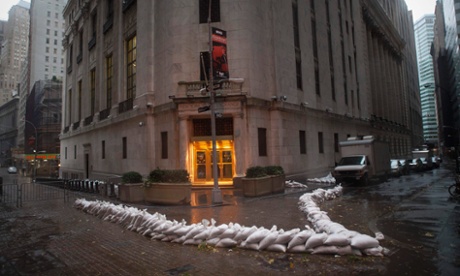
    Sandbags block the entrance of the New York Stock Exchange in downtown Manhattan as Hurricane Sandy approaches the city.

    Sandbags block the entrance of the New York Stock Exchange in downtown Manhattan as hurricane Sandy approaches the city. Photograph: Andrew Kelly KELLY/REUTERS

    The floods and fires that swept through our city left a path of destruction that will require years of recovery and rebuilding work. And in the short term, our subway system remains partially shut down, and many city residents and businesses still have no power. In just 14 months, two hurricanes have forced us to evacuate neighborhoods – something our city government had never done before. If this is a trend, it is simply not sustainable.

    Our climate is changing. And while the increase in extreme weather we have experienced in New York City and around the world may or may not be the result of it, the risk that it might be – given this week’s devastation – should compel all elected leaders to take immediate action.

    Here in New York, our comprehensive sustainability plan – PlaNYC – has helped allow us to cut our carbon footprint by 16 percent in just five years, which is the equivalent of eliminating the carbon footprint of a city twice the size of Seattle. Through the C40 Cities Climate Leadership Group – a partnership among many of the world’s largest cities – local governments are taking action where national governments are not.

    Leadership needed

    But we can’t do it alone. We need leadership from the White House – and over the past four years, President Barack Obama has taken major steps to reduce our carbon consumption, including setting higher fuel-efficiency standards for cars and trucks. His administration also has adopted tighter controls on mercury emissions, which will help to close the dirtiest coal power plants (an effort I have supported through my philanthropy), which are estimated to kill 13,000 Americans a year.

    Mitt Romney, too, has a history of tackling climate change. As governor of Massachusetts, he signed on to a regional cap- and-trade plan designed to reduce carbon emissions 10 percent below 1990 levels. “The benefits (of that plan) will be long-lasting and enormous – benefits to our health, our economy, our quality of life, our very landscape. These are actions we can and must take now, if we are to have ‘no regrets’ when we transfer our temporary stewardship of this Earth to the next generation,” he wrote at the time.

    He couldn’t have been more right. But since then, he has reversed course, abandoning the very cap-and-trade program he once supported. This issue is too important. We need determined leadership at the national level to move the nation and the world forward.

    I believe Mitt Romney is a good and decent man, and he would bring valuable business experience to the Oval Office. He understands that America was built on the promise of equal opportunity, not equal results. In the past he has also taken sensible positions on immigration, illegal guns, abortion rights and health care. But he has reversed course on all of them, and is even running against the health-care model he signed into law in Massachusetts.

    If the 1994 or 2003 version of Mitt Romney were running for president, I may well have voted for him because, like so many other independents, I have found the past four years to be, in a word, disappointing.

    In 2008, Obama ran as a pragmatic problem-solver and consensus-builder. But as president, he devoted little time and effort to developing and sustaining a coalition of centrists, which doomed hope for any real progress on illegal guns, immigration, tax reform, job creation and deficit reduction. And rather than uniting the country around a message of shared sacrifice, he engaged in partisan attacks and has embraced a divisive populist agenda focused more on redistributing income than creating it.

    Important victories

    Nevertheless, the president has achieved some important victories on issues that will help define our future. His Race to the Top education program – much of which was opposed by the teachers’ unions, a traditional Democratic Party constituency – has helped drive badly needed reform across the country, giving local districts leverage to strengthen accountability in the classroom and expand charter schools. His health-care law — for all its flaws — will provide insurance coverage to people who need it most and save lives.

    When I step into the voting booth, I think about the world I want to leave my two daughters, and the values that are required to guide us there. The two parties’ nominees for president offer different visions of where they want to lead America.

    One believes a woman’s right to choose should be protected for future generations; one does not. That difference, given the likelihood of Supreme Court vacancies, weighs heavily on my decision.

    One recognizes marriage equality as consistent with America’s march of freedom; one does not. I want our president to be on the right side of history.

    One sees climate change as an urgent problem that threatens our planet; one does not. I want our president to place scientific evidence and risk management above electoral politics.

    Of course, neither candidate has specified what hard decisions he will make to get our economy back on track while also balancing the budget. But in the end, what matters most isn’t the shape of any particular proposal; it’s the work that must be done to bring members of Congress together to achieve bipartisan solutions.

    Presidents Bill Clinton and Ronald Reagan both found success while their parties were out of power in Congress – and President Obama can, too. If he listens to people on both sides of the aisle, and builds the trust of moderates, he can fulfill the hope he inspired four years ago and lead our country toward a better future for my children and yours. And that’s why I will be voting for him.

    • Michael R Bloomberg is mayor of New York and founder and majority owner of Bloomberg News parent Bloomberg LP.

    • This article first appeared on Bloomberg View 2012. It is reproduced here with permission

  • Sandy worsened by climate change: report

    Sandy worsened by climate change: report

    AAPNovember 3, 2012, 8:54 am

    Australia’s Climate Commission says superstorm Sandy was made worse by climate change.

    The death toll in the United States has passed 90 in 10 states, bringing to more than 150 the number killed by Sandy since it swept across the Caribbean, including Haiti and Cuba.

    “The evidence suggests that climate change exacerbated the severity of Hurricane Sandy,” the chairman of the Climate Commission’s science advisory panel, Professor Matthew England, said in a new report.

    “The shifts in climate towards higher temperatures and more moisture in the air are becoming the new normal, which is influencing the nature and intensity of weather patterns around the world.”

    Prof England said storm surges had a particularly devastating impact on areas of the US coast and a warmer world, with higher sea levels, would make such surges worse.

    Before reaching land, Sandy was feeding off exceptionally warm surface waters in the Atlantic Ocean.

    The temperature of the surface waters from which Sandy was drawing energy was three to five degrees warmer than average, the commission reported.

    Also, the base sea level had risen by about 20cm over the past century.

    “A rise of 20cm may seem modest, but even small rises like this lead to a large increase in the probability of damaging floods,” the commission reported.

    “The primary reason for rising sea levels around the world is climate change, which warms and thus expands the oceans and adds more water to the ocean by melting glaciers and ice caps.”

    The commission brings together internationally renowned climate scientists with policy and business leaders.