  |
|||||||||||||||||
|
|||||||||||||||||
|


Add your news
You can add news from your networks or groups through the website by becoming an author. Simply register as a member of the Generator, and then email Giovanni asking to become an author. He will then work with you to integrate your content into the site as effectively as possible.
Listen to the Generator News online
The Generator news service publishes articles on sustainable development, agriculture and energy as well as observations on current affairs. The news service is used on the weekly radio show, The Generator, as well as by a number of monthly and quarterly magazines. A podcast of the Generator news is also available.
As well as Giovanni’s articles it picks up the most pertinent articles from a range of other news services. You can publish the news feed on your website using RSS, free of charge.
| |
|||||||||||||||||
|
|||||||||||||||||
|
Posted: 22 Oct 2012 06:31 AM PDT
| You are subscribed to email updates from ScienceDaily: Earth Science News To stop receiving these emails, you may unsubscribe now. |
Email delivery powered by Google |

Disaster … an aerial view of L’Aquila after the 2009 earthquake that killed more than 300 people. Photo: AP
Six Italian scientists and a government official have been found guilty of multiple manslaughter for underestimating the risks of a killer earthquake in L’Aquila in 2009.
They were sentenced to six years in jail in a case that has provoked outrage among scientists worldwide.
We cannot call this a victory. It’s a tragedy, whatever way you look at it.
The experts were also ordered to pay more than €9 million ($11.5 million) in damages to survivors and inhabitants. Under the Italian justice system, the seven will remain free until they have exhausted two chances to appeal against the verdict.

Aftermath …. a man walks past buildings destroyed in the earthquake. Photo: Reuters
Some commentators had warned that any convictions would dissuade other experts from sharing their expertise for fear of legal retribution.
The prosecutor, Fabio Picuti, had asked for jail sentences of four years for each defendant for failing to alert the population of the walled medieval town of L’Aquila to the risks, days before the 6.3-magnitude quake killed 309 people.
All seven were members of the Major Risks Committee, which met in the central Italian town on March 31, 2009, six days before the quake devastated the region, tearing down houses and churches and leaving thousands homeless.

Bernardo De Bernardinis … gave media interviews saying tremors “posed no danger”. Photo: AFP
“This is a historic sentence, above all for the victims,” said Wania della Vigna, a lawyer who represents 11 plaintiffs, including the family of an Israeli student who died when a student residence collapsed on top of him.
“It also marks a step forward for the justice system and I hope it will lead to change, not only in Italy but across the world,” she said.
The bright blue, classroom-sized temporary tribunal in L’Aquila – built on an industrial estate after the town’s historic court was flattened in the quake – was packed with lawyers, advisers and international media for the verdict.
Four of the defendants were in court, as well as a small group of survivors.
Aldo Scimia, whose mother was killed, wept as the verdict was read out.
“We cannot call this a victory. It’s a tragedy, whatever way you look at it, it won’t bring our loved ones back,” he said. “I continue to call this a massacre at the hand of the state, but at least now we hope that our children may live safer lives,” he said.
Mr Picuti had criticised the experts for providing “an incomplete, inept, unsuitable and criminally mistaken” analysis, which reassured locals and led many to stay indoors when the first tremors hit.
The government committee met after a series of small tremors in the preceding weeks had sown panic – particularly after a resident began making worrying unofficial earthquake predictions.
Italy’s top seismologists were called to evaluate the situation and the then-vice-director of the Civil Protection Agency, Bernardo De Bernardinis, gave media interviews saying the seismic activity in L’Aquila posed “no danger”.
“The scientific community continues to assure me that, to the contrary, it’s a favourable situation because of the continuous discharge of energy,” he said.
A government lawyer, Carlo Sica, who had called for the seven defendants to be acquitted, said that minutes from the March 31 meeting were not valid as evidence because they were written up only after the April 6 earthquake.
“They are not guilty of anything, the earthquake’s no one’s fault,” he said.
Filippo Dinacci, a lawyer for Mr Bernardinis and Mauro Dolce, the head of the Civil Protection’s seismic risk office, criticised the charges last week as something out of “medieval criminal law”.
“The ruling in my opinion is not fair. We will certainly be appealing,” said Alessandra Stefano, the lawyer for the expert Gian Michele Calvi, after the verdict.
Scientists were outraged when the charges were brought against the geophysicists in 2010. Many complained that they were merely scapegoats and warned against putting science on trial.
More than 5000 scientists sent an open letter to President Giorgio Napolitano denouncing the trial against colleagues for failing to predict a quake – something widely acknowledged to be impossible.
The seven include Enzo Boschi, who at the time was the head of Italy’s national geophysics institute; Giulio Selvaggi, head of the national earthquake centre in Rome; and Franco Barberi from Rome’s University Three.
The other scientists found guilty are Mr Dolce, Mr Calvi, the head of the European centre of earthquake engineering; and Claudio Eva from the University of Genoa.
Agence France-Presse
More than two-thirds of people would rather have a wind turbine than a shale gas well near their home
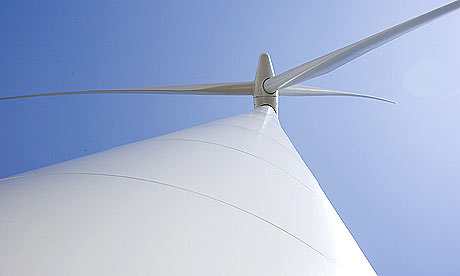
More than two-thirds of people would rather have a wind turbine than a shale gas well near their home, according to a new opinion poll published on Tuesday.
Asked to choose between having the two energy sources within two miles of their home, 67% of respondents favoured a turbine, compared to just 11% who would support the gas development.
The findings of the UK-wide ICM survey shows that only nuclear power and coal are less popular than shale gas developments.
The ICM poll, together with a second new poll from YouGov, show public opinion is against George Osborne’s push for a new “dash for gas” as the central plank of the government’s energy policy.
The polls come at a critical time for the government’s energy bill, which aims to deliver the £200bn required to replace and develop the nation’s ageing energy infrastructure, due to be published on 5 November. The investment required will be added to household energy bills that are already rising and proving a political headache for David Cameron.
“This [ICM] poll puts to the sword the myth that the public are set against onshore wind and wish to rush into a second dash for gas,” said Paul Monaghan, head of social goals at the Co-operative, which commissioned the ICM poll for the launch of the Co-op’s Manifesto for a community energy revolution which it is backing with £100m of investment.
The poll showed 49% of people would support a wind turbine being erected within two miles of their home, with 22% against. But if the project were community-owned, support rose to 68% and opposition plummeted to 7%. In Germany, where 65% of its huge renewable energy capacity is community-owned, opposition is much rarer than in UK where community ownership is less than 10%.
Onshore windfarms have become an increasingly divisive issue, with 100 backbench Conservative MPs demanding subsidy cuts from Cameron earlier this year. Negotiations over the energy bill have been severely hampered by a feud between Osborne and the Liberal Democrat energy secretary, Ed Davey.
But new energy minister and Tory MP, John Hayes, told the Guardian the onshore wind controversy has cast a shadow over the wider energy debate and that it could be resolved by the current consultation over community benefits from renewable energy projects, which could see local people getting lower bills, for example.
“Appropriately sited onshore wind has a role to play, but if we’re to make this work in a way that garners popular support, we’ve got to see a big improvement in how developers engage with local communities, new ways of ensuring a sense of local ownership and more obvious local economic benefits,” said Hayes, when launching the consultation.
“The new research demonstrates we need to see a stronger deployment of community-owned projects, especially in those parts of the country where a small, but highly vocal, minority are blocking progress,” said Monaghan. “The UK has made massive strides in recent years with its renewables generation capacity, and it’s essential this continue.”
In his battle with Davey, Osborne won a commitment to a new gas strategy, also due to be published on 5 November. But the chancellor’s enthusiasm for gas is not shared by the public, according to the poll.
Natural gas was the most preferred energy source of just 7% of people polled by ICM, behind solar, hydro and offshore wind power, although ahead of onshore windfarms.
The YouGov poll showed that 55% of people want more windfarms, compared to just 17% who want more gas power stations. It also showed that less than one in three people thinks the government should give the go-ahead to fracking. RenewableUK’s deputy chief exective, Maf Smith, said: “Support for renewable energy is consistently strong, in this and other independent polls. One stark message from this survey is the public’s evident disenchantment with fossil fuels, including the unpopularity of fracking.”
Osborne announced recently “generous” tax breaks for fracking and the environment secretary, Owen Paterson, pledged to make licensing as simple as possible by setting up a “one-stop shop”.
Independent experts argue that shale gas may make a small contribution to UK energy supply in a decade or so, but say it will not have the dramatic impact it has in the US. Former energy minister Charles Hendry, sacked in September’s reshuffle, said on Sunday: “Our future can’t depend on gas alone … betting the farm on shale brings serious risks of future price rises.”
The energy bill will also attempt to make building new nuclear power stations sufficiently attractive to investors, while attempting to keep the coalition’s pledge not to subsidise the reactors. But nuclear power remains deeply unpopular with the public, with the poll showing it is by far the least preferred energy source.
The poll showed significant differences between younger and older people, with 19% of those over 65 choosing nuclear power as their most preferred energy source compared to 6% of those aged 18 to 34. The over 65s showed far less support for local wind turbines (38%) versus those in the 18-34 age group (64%) and more enthusiasm for local shale gas rather than local wind (19% of over 65s, 10% of 18-34s).
Monbiot.com
|
|
Posted: 22 Oct 2012 12:24 PM PDT How conservatism turned into an orgy of destruction.
By George Monbiot, published in the Guardian 22nd October 2012 There was a time when conservatism meant what the word suggests. It was an attempt to keep things as they are: to arrest economic and social change, to defend the position of the dominant class. Today conservatism has become a nihilistic festival of destruction: a gleeful Bullingdon dinner party of upper class anarchists, smashing other people’s crockery and hurling the chairs through the windows. Yet its purpose is still to secure the position of the dominant class. It is no longer enough to own the land and most of the capital, to own the media and – through the corrupt system of party funding – the political process. To reinstate Edwardian levels of inequality, the feral elite must seek to reverse the political progress that has been made since then. This means dismantling the tax system, which redistributes wealth. It means ditching the rules which prevent the powerful from acting as they please. Both are being consumed in what British Conservatives proudly describe as a bonfire(1,2). Nowhere is deregulation more destructive than in its treatment of the natural world. If ash die-back takes root in Britain, it could be as damaging as Dutch elm disease was. This fungus is now raging across the Continent, consuming almost all the ash trees in its path(3). Few ashes – among which are some of the oldest and best-loved trees in Britain(4) – are expected to survive if the disease becomes established here. The only way the fungus can arrive in this country is through imports of infected saplings. In February the first case in the UK was reported, at a tree nursery in Buckinghamshire. The disease has now been found in ten places, and foresters are desperately trying to contain it(5). But – and this is the extraordinary thing – the government still refuses to ban imports of ash saplings. Instead, it has put the issue out to consultation, as if it had all the time in the world. It’s like spraying one side of a burning house with water while allowing petrol to be sprayed on the other. The government’s commitment to deregulating business outweighs the likely consequences. If ash dieback spreads through Britain, Cameron’s administration will be solely and unequivocally to blame. It cares just as little about what’s happening to the bees. A new study published this week in Nature provides yet more evidence of the devastating impacts of a class of pesticides called neonicotinoids(6,7.8). But, unlike other European nations, Britain refuses even to suspend their use. The same politics inform the planned mass slaughter of badgers, which seems mystifying until you understand that it’s an alternative to effective regulation. Far from controlling tuberculosis in cattle, it could, as Professor John Bourne (who led the previous government’s £49m scientific trial) says, “make TB a damn sight worse.”(9) In the 1960s, strict quarantine rules and the rigorous testing of cattle almost eliminated the disease from the UK(10). But farmers complained, so the rules were relaxed, and TB returned with a vengeance. Killing badgers creates an impression of action, without offending landed interests. In March the government published its kill list of environmental regulations(11). Among those being downgraded are the rules controlling hazardous waste, air pollution, contaminated land, noise, light and the use of lead shot(12,13). Ministers describe this as the shrinking of the state. In reality it’s the shrinking of democracy. Regulation is the means by which civilised societies resolve their conflicts. It prevents the selfish and the powerful from spoiling the lives of others. But this isn’t about only economic dominance. It is also about cultural hegemony. Uniquely perhaps, in Britain the right-wing culture war is waged largely in the countryside. Tory culture revolves around land owning: battle lines are drawn around the issue of who represents rural Britain. Writing in the Telegraph last month, Fraser Nelson, a reliable guide to the current state of thinking in the party, maintained that people who live in the countryside don’t care about “newts, trees and bats”: these are of interest only in London(14). He went on to describe David Cameron as “at heart, a rural Tory”, who “still grumbles to his wife about what, for him, are ‘banned activities’ – notably shooting”. Authentic rural people spend their adult lives in Notting Hill and drive out to their second homes for a shooting party at the weekend. Inauthentic rural people are those who live in the countryside and care about wildlife. They are, “at heart”, Londoners. The rural-urban divide, as formulated by Tory theorists, is nothing to do with location. It’s about class. Those who wish to restrain destructive activities are characterised – by the minister Greg Barker(15) and, apparently, George Osborne(16) – as “environmental Taliban”. Their attempt to associate democratic debate with people who shoot girls in the head tells you all you need to know about their sense of political entitlement. This conservatism does not care what it destroys. It does not care whom it hurts. It will sacrifice entire species rather than contemplate the slightest check on its own self-interest. All else can burn. References: 2. http://www.theyworkforyou.com/debate/?id=2012-02-21b.832.1 3. http://www.guardian.co.uk/world/2012/oct/07/disease-killing-denmarks-ash-trees 4. http://www.monbiot.com/2012/10/12/heart-rot/ 5. http://www.forestry.gov.uk/chalara 6. Richard J. Gill, Oscar Ramos-Rodriguez and Nigel E. Raine, 21st October 2012. Combined pesticide exposure severely affects individual- and colony-level traits in bees. Nature. http://dx.doi.org/10.1038/nature11585 7. See also Penelope R. Whitehorn, 20th April 2012. Neonicotinoid Pesticide Reduces Bumble Bee Colony Growth and Queen Production. Science.Vol. 336, no. 6079, pp 351-352. doi:10.1126/science.1215025 8. and Mickaël Henry et al. 20th April 2012. A Common Pesticide Decreases Foraging Success and Survival in Honey Bees. Science. Vol. 336 no. 6079, pp 348-350. doi: 10.1126/science.1215039 9. http://www.guardian.co.uk/environment/2012/oct/15/badger-cull-government-accused 10. John Bourne, 13th November 2010. pers comm. 11. http://www.guardian.co.uk/environment/2012/mar/16/environmental-regulations-slashed-red-tape 12. http://www.guardian.co.uk/environment/interactive/2012/mar/16/environment-red-tape-challenge 13. For some background to the lead shot issue, please read this: http://www.monbiot.com/2012/07/26/lead-soldiers/ 15. http://www.ft.com/cms/s/0/f0aa4d08-2d9f-11e1-b5bf-00144feabdc0.html#ixzz29fAwOv2q |
| You are subscribed to email updates from George Monbiot To stop receiving these emails, you may unsubscribe now. |
Email delivery powered by Google |
| Google Inc., 20 West Kinzie, Chicago IL USA 60610 | |
German industrial group to concentrate renewable energy business on wind and hydroelectric power
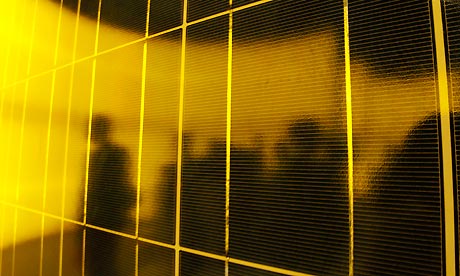
German industrial group Siemens is pulling out of its loss-making solar power business, in the latest sign of difficulties in the renewable energy market.
The company said on Monday it would concentrate its renewable energy business on wind and hydroelectric power in a bid to increase productivity. It hopes to sell the unit and is in talks with possible buyers.
Siemens said the solar business had not been as profitable as hoped. “Due to the changed framework conditions, lower growth and strong price pressure in the solar markets, the company’s expectations for its solar energy activities have not been met.” It said the solar and hydro division generated sales “in the low triple-digit millions” in the year to September and has “roughly 800 employees”.
Growing competition from manufacturers in Asia has caused the cost of solar panels to plummet. The industry has also been hit by weaker sales and falling government subsidies. Bruce Jenkyn-Jones, managing director at Impax, an environmental investor with £1.8bn of assets under management, said: “The cost has come down dramatically. There has been an influx of capital. It’s very, very competitive; it’s only going to be the lowest-cost producers that survive in the middle of this downturn.” Various German solar manufacturers have filed for bankruptcy in the past 12 months, including QE Cells and Solar Millennium.
The news comes shortly after General Electric said a poor performance at its wind unit contributed to disappointing third-quarter results. Wind-turbine orders at the industrial conglomerate plunged because a key US subsidy for wind power is scheduled to expire at the end of the year. The chief executive, Jeff Immelt, said GE is assuming “no market” in the US for wind turbines next year without the subsidy. He expects wind revenue to drop 40% next year.
Jenkyn-Jones said: “There’s definitely a cyclical element to some of this. In the long term, renewables still look interesting.” He said policy changes with regards to renewables posed a major challenge to investors in the industry. “The most important issue for governments is to provide stable frameworks for investors to make sensible decisions.”
 Email
Email