| Methane hydrates: a volatile time bomb in the Arctic The Conversation The risk with climate change is not with the direct effect of humans on the greenhouse capacity of Earth’s atmosphere. The major risk is that the relatively modest human perturbation will unleash much greater forces. The likelihood of this risk is … See all stories on this topic » |
||
| Pennsylvania investigating methane leaks in Sullivan County Akron Beacon Journal (blog) DUSHORE, PA – The Department of Environmental Protection is investigating two methane migration incidents near Chesapeake Energy drilling operations in Forks Township, Sullivan County. One incident occurred in the Black Creek area, and the other … See all stories on this topic » |
||
| Fracking’s Dark Side Gets Darker: The Problem of Methane Waste Energy Collective Fracking for oil in North Dakota is so lucrative that when natural gas bubbles up alongside the oil, most oil companies simply view it as waste. It’s cheaper, in the short term, to burn the gas than it is to build the infrastructure to pipe and sell it … See all stories on this topic » |
||
| Industry Issues Guidance on Methane Migration StateImpact Pennsylvania By now, videos of residents lighting their taps on fire are a familiar image. Those flames are caused by methane that migrated into a subsurface water supply and is known as methane migration, or “stray gas.” Perhaps the most famous incident of stray … See all stories on this topic » |
||
| Data-heavy project aims to move methane emissions research beyond ‘he said … Midwest Energy News Information wars have flared up around the question of how much methane leaks during hydraulic fracturing. Industry has protested against estimates by federal agencies, leading to a swirl of reports from industry and academia that tell contradictory … See all stories on this topic » |
||
| MSC Issues Guidance on Responding to Stray Gas Incidents NorthcentralPa.com Stray gas – which can originate from various sources, including coal beds, oil and natural gas wells, landfills, pipelines, naturally occurring methane and microbial gas – is the migration of gas from one of these sources into groundwater, a structure … See all stories on this topic » |
||
|
||
|
||
| New tech cuts coal gas well drilling by 33 percent Wyoming Business Report When accessed, these seams can sometimes explode because of major unreleased buildup, particularly of carbon dioxide and methane. These ignitions or ejections have claimed thousands of miners’ lives, according to WellDog. “This technology can save … See all stories on this topic » |


 Email
Email
-
- guardian.co.uk, Monday 15 October 2012 15.33 BST
- Jump to comments (31)
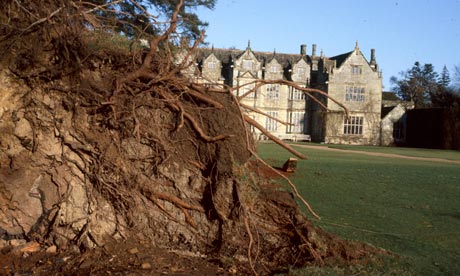
Uprooted trees at at Wakehurst Place following the 1987 storm. Photograph: Kew RBG
It came – famously unheralded by BBC weatherman Michael Fish – off the Atlantic. It roared over northern France and the West Country, howled through Berkshire and the Midlands. Finally, the storm turned its full, hurricane-force, 110mph gusts on south-east England.
In the wildest night in 300 years, whole landscapes were changed as woods were flattened, trees snapped and parks and gardens were devastated. An estimated 15 million mature trees were uprooted in what has become known as the “great storm”. Ferries ran aground, piers were smashed, thousands of cars were hit by falling boughs and 18 people died.
It was widely feared that it would take a century for nature to recover from the carnage. But 25 years on, not only has English woodland fully recovered, but ecologists and conservationists agree that the storm transformed thinking about managing nature, improved biodiversity and revised our ideas about beauty.
But in the immediate aftermath came only a sense of profound, emotional loss, says Andy Jackson, head of Wakehurst Place, the Sussex country estate of the Royal Botanic Gardens, Kew. “Colleagues cried. People were bewildered, truly shocked at the scale of what had happened,” he says.
“It looked like the whole place had been flattened. When I was walking around the gardens with colleagues the next day we got lost because all our bearings and landmarks had gone,” says gardens manager, Chris Clennett.
The storm was indiscriminate about which trees it felled and which were spared. A lone 600-year-old yew survived, as did giant coastal redwoods and a massive copper beech. But whole plantations of 80-year-old specimens (showcase tress) and giant 200-year-old oaks fell like matchsticks. Depending on how trees were sheltered by others, some of the oldest survived, but some of the youngest fell. Kew lost 1,000 specimen trees that night, but Wakehurst lost around 20,000, or 60% of its entire collection.
In place of dark woodland with closed canopy, came sky, new vistas and new ideas about how to manage nature.
Many historic houses and conservation bodies rushed to replant and clear up the devastation, but Wakehurst took four years to devise a plan. Jackson decided to leave one-third of its devastated 180 acres exactly as the trees had fallen and let the woodland regenerate itself. It was radical thinking for the time, but is now recognised as good conservation.
Today the wild wood is full of life with muntjac, roe and fallow deer, green woodpeckers and wild flowers growing in the glades created by the storm. The rotting beech and oak trunks have become seedbeds for foxgloves and brambles. In another 20 years, says Jackson, the trunks will provide the soil that will sprout lines of young trees.
One consequence of the storm for much of southern England was the explosion in deer numbers. As openings were made in the woodland canopy, new, young shoots sprung up that have encouraged deer to graze.
Ecological lessons were learned. Communities of trees with different ages fared better than those planted all at one time. Hollow trees proved as strong – if not stronger – than younger solid trees, while those with spreading roots survived best.
Few people who knew Wakehurst’s gardens and woodland before 1987 would recognise it now. More than 2,500 specimen trees from around the world have been planted, along with 11,000 that will act as a buffer zone against future massive storms. One eucalyptus is now 50 foot tall.
“The storm shocked conservationists into new thinking. Instead of trying to protect nature from change, they began to think more about adapting to it and encouraging biodiversity. We now see that it diversified woodland that was becoming over-mature,” Jackson says.
But the biggest change was to help bury the notion of ideal nature as flawless and perfectly arranged by man. “We recognise now that these events happen every 100 years or so and are part of a large-scale, dynamic process that allows change to happen. We’ve come to value dead wood more. That’s a big change. When I started, the boss would not tolerate even a dead branch on a tree. We have changed our view of the ideal,” says Jackson.
“We didn’t try to replace. Our idea was to try to keep the woodland dynamic. We have learned to size the opportunity for change that the storm presented. You would never wish this scale of damage, but it have us opportunities,” says Jackson.
“The storm was literally a wind of change. Until then, the thinking had been that forests were stable ecosystems. We now realise that woods are actually more characterised by instability and unpredictability,” says leading woodland ecologist George Peterken.
“It came as shock to conservationists who were brought up on the idea of protecting views and nature. It made some people think on a larger, landscape scale. The Scots were quite used to having their forests blow down but the English weren’t. Biologically, it did a whole lot of good,” he says.


