The Generator news service publishes articles on sustainable development, agriculture and energy as well as observations on current affairs. The news service is used on the weekly radio show, The Generator, as well as by a number of monthly and quarterly magazines. A podcast of the Generator news is also available.
As well as Giovanni’s articles it picks up the most pertinent articles from a range of other news services. You can publish the news feed on your website using RSS, free of charge.
Gas to energy Williamsport Sun-Gazette ALLENWOOD – It takes about two years for organic materials found in garbage dumps to decompose into methane, but the Lycoming County Landfill is using the waste byproduct right now to produce electricity and heat in an environmentally friendly way. See all stories on this topic »
Turning Gas in Landfill into Electricity WNEP-TV Methane gas from the landfill is being turned into enough electricity to power 4,000 homes per year. Truckloads of trash are trucked into the landfill near Montgomery every day. Over time, the garbage from homes decomposes creating methane gas. That … See all stories on this topic »
Quality not quantity … climate scientist Professor Kevin Trenberth. Photo: Sahlan Hayes
AS THE world’s elite global warming experts began poring over the drafts of the latest Intergovernmental Panel on Climate Change report this week, one leading scientist believes the process shouldn’t be happening at all.
”I think it will be less successful than the last assessment, and I think it will be blander – I’m disappointed in what I’ve seen so far,” said Kevin Trenberth, the head of the climate analysis section at the US National Centre for Atmospheric Research.
Professor Trenberth’s misgivings are not based on doubts about the strength of the science underpinning human-induced climate change but on frustration with the bureaucratic nature of the IPCC’s work.
Dozens of Australian scientists are among hundreds of international experts who started reviewing the IPCC’s fifth summary report this week, with the final version to be published next September. The previous IPCC report, released in 2007, declared global warming ”unequivocal” and said it was ”very likely” it was driven by human emissions of greenhouse gases.
Advertisement
But Professor Trenberth believes too many researchers and too much ”second tier” science are diluting the report’s quality, and science is jumping far ahead of the lumbering process.
”There are more people, it’s more diffuse, it’s harder to gain a consensus – quite frankly I find the whole process very depressing,” he said. ”The science is solid, but with a larger group it’s harder to reach a consensus, and updates every six years are just too slow. After the fifth assessment, we should push on with a different format.”
Two other scientists involved with the IPCC process, who asked to remain anonymous, said the coming report contained improvements on the previous edition but few ”breakthroughs” would be included. ”What you are dealing with is some superb work, and some that’s not so relevant or current, but the process makes it difficult to weight these appropriately,” one said.
Professor Trenberth is a bruised survivor of the ”climategate” scandal, which involved the theft and publication of thousands of emails that had been sent between some of the world’s most influential climate researchers. While he and his colleagues were cleared by investigations, the people who hacked the email system at Britain’s University of East Anglia have never been caught.
Professor Trenberth believes it had a big impact on public debates about climate science.
”It made an immense difference – the level of vitriol and hate we received,” he said. ”Not only do we have waves of attacks when we publish and it ends up on a denialist website but it has affected politicians.”
He believes some specific uncertainties in some of the climate change models scientists rely upon is being falsely inflated as a general uncertainty about the status of climate change science. ”With the links between weather and climate, for instance – we know they are there, but the specific numbers need work,” Professor Trenberth said.
”Human influences are overlaid on normal ranges of weather extremes. There’s more precipitation, and the rain’s a bit harder. There is more heat and water over the oceans. The question is how much is a ‘bit’.
”An example would be Hurricane Katrina in New Orleans, where there was about 11 inches [28 centimetres] of rain. About one inch of that was due to human influence. Maybe that extra inch was enough to cause the levee to break.”
a report on the SPA-sponsored Richard Heinberg Australian tour
an excerpt from the speech he gave in Canberra
an article by a Canadian Aboriginal about why immigration should be cut
an article by Bill Ryerson about why simply supplying contraception is not enough to bring down birth rates
three book reviews
a speech by Independent but Australian Democrat-endorsed candidate for the ACT elections, Darren Churchill, on population
a good news page (for a change!)
a message from the National President, Sandra Kanck, regarding the newsletter and communication requirements of SPA
branch reports
the latest statistics on Australia’s population
a graph about how much it costs to raise a child in the US.
All the best,
– Jenny Goldie, SPA Newsletter Editor
This email has been sent to you because you are on an SPA mailing list or are receiving a one-off group response to an action you’ve undertaken involving SPA. If you do not wish to receive emails from SPA, please unsubscribe . Please note that you may be on more than one SPA mailing list and un-subscription will remove you from all of these. If you have any queries regarding your subscriptions, please contact SPA. Contact details can be found at www.population.org.au/contact.
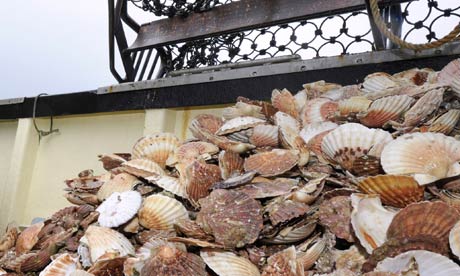
British fishermen were dredging for scallops in the Channel when rocks were thrown at them from nearby French boats. Photograph: Damien Meyer/AFP/Getty Images
You are receiving this email because you are a Green Light subscriber.
Click here if you do not wish to receive Green Light emails from the Guardian News and Media. Click here to find out about other Email Services from the Guardian.
Guardian News & Media Limited – a member of Guardian Media Group PLC. Registered Office: Kings Place, 90 York Way, London, N1 9GU. Registered in England No. 908396