The Generator news service publishes articles on sustainable development, agriculture and energy as well as observations on current affairs. The news service is used on the weekly radio show, The Generator, as well as by a number of monthly and quarterly magazines. A podcast of the Generator news is also available.
As well as Giovanni’s articles it picks up the most pertinent articles from a range of other news services. You can publish the news feed on your website using RSS, free of charge.
One of four sisters involved in an international custody case is led through Brisbane airport by police officers, who delivered her onto a plane bound for Italy. Image has been digital distored to protect her identity. Picture: Eddie Norbido. Source: Supplied
THEY cried for their mother, cried for home and begged uniformed officers to let them go.
As the four sisters at the centre of an international custody ruling were last night dragged screaming onto Emirates flight EK 433 to Dubai, uniformed officers were forced to lift and drag the girls to get them to the plane.
Passengers at gate 75 watched on in alarm as up to a dozen federal officers were used to move the girls to the nearby Emirates lounge to await boarding.
“Let me go, I want my mum, I want my mum,” one of the younger girls wailed, each arm held securely by a federal officer.
The mother of four sisters involved in an international custody dispute is comforted by a friend (left) at Brisbane International Airport as her girls are escorted onto a plane. Picture: Eddie Norbido
A JUDGE sending four Italian girls home against their wishes “sincerely hopes” their distraught mother will return with them after their father agreed not to lay criminal charges.
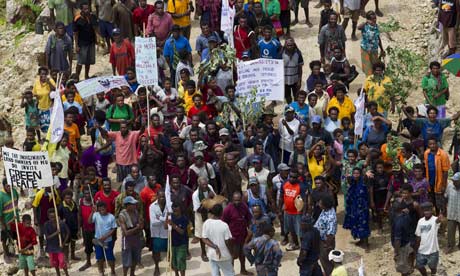
Last year, customary landowners from Pomio villages, in East New Britain province, protested against the biggest land grab in Papua New Guinea’s history. Photograph: Paul Hilton/Greenpeace
International land investors and biofuel producers have taken over land around the world that could feed nearly 1bn people.
Analysis by Oxfam of several thousand land deals completed in the last decade shows that an area eight times the size of the UK has been left idle by speculators or is being used largely to grow biofuels for US or European vehicles.
In a report, published on Thursday, Oxfam says the global land rush is out of control and urges the World Bank to freeze its investments in large-scale land acquisitions to send a strong signal to global investors to stop “land grabs”.
“More than 60% of investments in agricultural land by foreign investors between 2000 and 2010 were in developing countries with serious hunger problems. But two-thirds of those investors plan to export everything they produce on the land. Nearly 60% of the deals have been to grow crops that can be used for biofuels,” says the report.
Very few, if any, of these land investments benefit local people or help to fight hunger, says Oxfam. “Instead, the land is either being left idle, as speculators wait for its value to increase … or it is predominantly used to grow crops for export, often for use as biofuels.”
The bank has tripled its support for land projects to $6bn-$8bn (£3.7bn-£5bn) a year in the last decade, but no data is available on how much goes to acquisitions, or any links between its lending and conflict.
Since 2008, says Oxfam, 21 formal complaints have been brought by communities affected by World Bank investments, in which they claim that these have violated their land rights.
Oxfam’s chief executive, Barbara Stocking, said: “The rush for land is out of control and some of the world’s poorest people are suffering hunger, violence and greater poverty as a result. The World Bank is in a unique position to help stop land grabs becoming one of the biggest scandals of the century.”
She added: “Investment should be good news for developing countries – not lead to greater poverty, hunger and hardship.”
According to the International Land Coalition, 106m hectares (261m acres) of land in developing countries were acquired by foreign investors between 2000 and 2010, sometimes with disastrous results.
Nearly 30% of Liberia has been handed out in large-scale concessions in the past five years, and up to 63% of all arable land in Cambodia has been passed over to private companies.
Oxfam dismisses the claim made by the World Bank and others that lots of available land is unused and waiting for development. “It is simply a myth. Most agricultural land deals target quality farmland, particularly land that is irrigated and offers good access to markets.
“It is clear that much of this land was already being used for small-scale farming, pastoralism and other types of natural resource use.”
A 2010 study by the Independent Evaluation Group (IEG) – the World Bank’s official monitoring and evaluation body – stated that about 30% of bank projects involved involuntary resettlement. The IEG estimated that at any one time, more than 1 million people are affected by involuntary resettlement in active World Bank-financed projects.
Oxfam urged the UK government, one of the bank’s largest shareholders, to use its influence to persuade it to implement the freeze. “It can also play a crucial role as president of the G8 next year by putting food and hunger at the heart of the agenda, and addressing land grabs as part of this. Critically, it can also press the EU to reverse biofuels targets – a key driver of land grabs.”
Stocking said: “The UK should also show leadership in reversing flawed biofuels targets, which are a main driver for land and are diverting food into fuel.”
In a statement to the Guardian, the International Finance Corporation, the World Bank’s private lending arm, said: “IFC does not finance land acquisitions for speculative purposes. We invest in productive agricultural and forestry enterprises that can be land intensive to help provide the food and fibre the world needs. IFC has roughly a $4.85bn portfolio of agri-related investments. Of that, roughly $600m has a land component. Total land holding related to those investments total 0.7m hectares.
“Competition for scarce land resources has spurred rising investment in land. This competition can fuel conflict with existing users. Inevitably, bank group involvement in forestry and agriculture is not without risk, particularly given the fact we are operating in imperfect governance environments. But the total number of complaints received gives no explanation as to their validity.”
Images are not displayed.Display images below – Always display images from hcec@hcec.org.au
Good morning ,
Last Tuesday, we kicked off our fundraising appeal to raise $20,000 for air quality monitoring. With a fourth coal terminal proposed for Newcastle, we want to know how much coal dust is in the air we’re breathing in suburbs between the mines and the port. Seventy people have so far donated $3,000. Thank you so much!
We’ve received a generous offer to match our fundraising dollar for dollar. If we reach $10,000, our donor will match every dollar and double it to $20,000!
Doubling our funds will double how many locations we can monitor. In the Hunter Valley, more than 25,000 children attend school within 500 metres of the coal corridor. We urgently need to know how coal trains are contributing to local air pollution. Newcastle is already the world’s biggest coal exporting port. If the fourth coal terminal (T4) is approved, we’ll have twice as many coal trains and twice the coal pollution where we live, work and play.
Since August, our alliance of 16 community groups has met with several politicians to express our concerns about T4, including the NSW Planning Minister Brad Hazzard and Member for Newcastle Tim Owen. Both have declined our invitation to speak at a public meeting in Newcastle. That isn’t slowing us down, though, and we’ve been getting excellent media coverage and community support.
We hope you can make a donation. Every little bit helps.
Thanks for your involvement in this campaign.
Warmly,
Annika (for the Coal Terminal Action Group)
Ps. For regular updates, ‘like’ our Facebook page. And please spread the word!
The O’Farrell government said today it would set aside $1.8 billion for the WestConnex motorway to run from Parramatta to Sydney Airport.
The 33-kilometre extension of the M4 in Sydney’s west, which will connect with another M5 East tunnel, were the major projects in a $30 billion infrastructure plan for the state released this morning.
This afternoon, the NSW Premier, Barry O’Farrell, said he would back the project.
Advertisement
“Even though times are tough, we recognise the need to invest in economic infrastructure to help boost productivity and create jobs,” Mr O’Farrell said.
“We said we would start work on one of Sydney’s missing motorway links in this term of government and WestConnex is that project,” he said.
“Today I can announce the next important phase in this project – the immediate establishment of the Sydney Motorways Project Office, within Roads and Maritime Services, which will be responsible for the detailed work required to make this road a reality.
The Infrastructure NSW plan, called “First Things First”, also proposes a motorway connection between the F3 and M2 motorways in northern Sydney to be built in the next five years.
The plan, released by Infrastructure NSW chairman Nick Greiner and chief executive Paul Broad at a press conference this morning, would require $20 billion in government funding in the next 20 years. Another $10 billion can be raised in tolls, the plan suggests.
The combined M4 and M5 extensions, dubbed WestConnex, are said to cost $10 billion, with just $2.5 billion in government funding.
The plan also proposes pushing buses underground in Sydney’s CBD to clear road space.
This would hinge on new underground interchanges at Wynyard and Town Hall stations, to be built within five to 10 years.
The report recommends light rail from Central to the University of NSW, but not in the city centre.
It says the next train line to be built could be an extension of the eastern suburbs line to Randwick and Maroubra.
The chairman of Infrastructure NSW said he hoped the community would regard the report as “independent of the politics of both sides, of the bureaucracy and of the various interest groups”.
Mr Greiner said he hoped people would see the plan as “coherent” and “practical”.
“The last thing the average person in NSW [wants] is another theoretical exercise that has no likelihood of being achieved.”
He said that he hoped that “people see it as a step towards good things happening in infrastructure in NSW.”
The Infrastructure NSW plan proposes that $10 billion of the estimated $30 billion cost of the projects be funded through user charges.
The project proposes tolling on motorways but only on new and upgraded roads.
It also supports the idea of “value capture” to impose new taxes on properties that will benefit by being close to newly built infrastructure.
The report also proposes the government consider public private partnerships, including so-called “availability PPPs” where the risk is carried by the taxpayer, not the private sector.
Tale of two plans
The Infrastructure NSW report departs, in a number of respects, from a separate master plan released last month by Transport for NSW.
The Infrastructure NSW report is meant to be independent advice, which the government is free to accept or reject.
It remains unclear how the O’Farrell government will weigh the differences in the two reports.
The major difference between the two documents is that the Transport for NSW report argues that a second rail crossing for Sydney Harbour is needed within the next 20 years to add capacity to the city’s train system.
But the Infrastructure NSW report argues this project would deliver little benefit for great expense.
Instead, it says Sydney’s train capacity could be increased by converting to single-deck trains.
The two reports also depart on the question of light rail in the CBD. Transport for NSW is pushing the project, but today’s report warns against it.
Mr Greiner said it could constipate the city and that light rail had a dubious record as a mass transport option.
The report says: “A high capacity light rail service on George Street is likely to be incompatible with a high quality pedestration boulevard, and the negative impacts on bus passengers from inner suburbs may be considerable.”
Mapping sea–level rise Deccan Herald The research will help scientists to tease out the scale of the various contributions, to long-term sea–level rise and understand better the annual and interannual changes that can occur. It is crucial to identify the extent to which sea–level rise may … See all stories on this topic »
Sea level alert for councils Auckland stuff.co.nz Sea levels are rising by about 1.5 millimetres a year. The United Nations Intergovernmental Panel on Climate Change forecasts a rise of 180mm to 590mm by the end of the century. Guidelines and advice to help coastal communities adapt to climate change … See all stories on this topic »
NC’s coast can live with warming News & Observer According to the state Coastal Resources Commission, each passing year brings an even greater threat, thanks to rising sea levels. The CRC scared everybody by predicting a median of 38 additional inches of sea–level rise in the next 86 years. See all stories on this topic »
This is a misguided comment from the minister concerned, From a railway working perspective, this will be an adminstrative nightmare. To tranship passengers onto services already at peak capacity is not a solution. Spare us from idiots not conversant with peak rail capacities.
Chatswood will cope with rail link passengers: minister
There are mixed opinions from commuters at Chatswood station over the government’s plan to build the north-west rail link as a shuttle between Epping and Chatswood, instead of a straight run to the city.
The Transport Minister, Gladys Berejiklian, has dismissed concerns raised by her own department that Chatswood station will not be able to cope with an influx of passengers transferring off the north-west rail link.
The Herald this morning revealed analysis showing almost half of passengers in the morning peak hour would not fit on connecting services to the city because of the need to change off the north-west rail link at Chatswood.
The analysis was conducted by consultants from the engineering firm Arup, at the request of the Transport Projects Division within Ms Berejiklian’s Transport for NSW.
Crowd concern … rail passengers at Chatswood station. Photo: James Brickwood
But speaking on 702 ABC Sydney this morning, Ms Berejiklian said the analysis was based on incomplete information.
“It did not take into consideration all the operational changes that will happen on the rail line between now and then,” the minister said.
“It didn’t take into consideration that we will be increasing the number of services from the north shore to the city to 24 an hour; currently we are getting about 17 or 18 across, so that will increase substantially by the time the rail line is open.”
However, Ms Berejiklian has not explained in detail how she will be able to add another six services an hour to the North Shore Line.
She has said there will be a new, simpler timetable, and technology upgrades on the existing rail system.
“I have every single confidence that, once the north-west rail line opens, commuters everywhere else in Sydney will be saying ‘Can I have that in my area because it will be world class.’ “
The opposition transport spokeswoman, Penny Sharpe, said: “Commuters will come last under the Hills to Chatswood shuttle.”
“[Premier] Barry O’Farrell promised a fully integrated direct rail link between the north-west and the CBD, but, instead, commuters will get a service slower than the bus and will be standing all the way to the city with no chance of a seat,” she said.
The Greens transport spokeswoman, Cate Faehrmann, said the plans for the rail link would be a disaster.
“The government’s obsession with building and privatising the link will come at the expense of improving services across the network,” Ms Faehrmann said.
“A shuttle service to Chatswood simply won’t provide residents in the north-west with a genuine alternative to driving,” she said.
“Apart from the fact that commuters will be forced to travel long distances standing, Sydney’s rail system needs a boost to capacity that can only be provided by integration with a heavy rail second harbour crossing.”
At Chatswood station this morning, commuters were divided about whether the station could handle the impact of more interchange.
“It’s already overcrowded; it doesn’t surprise me that it could become more overcrowded in the future,” one commuter, Caroline Bathje, said.
Another, Kevin Adams, said: “I think this is a brilliant station. I can’t see any major issue with people disembarking … the station is big enough. Just as long as we get this new link done, that’s all that matters. I think the government are very, very proactive in finally getting things done.”
 1
1


 Email
Email