Category: News

Add your news
You can add news from your networks or groups through the website by becoming an author. Simply register as a member of the Generator, and then email Giovanni asking to become an author. He will then work with you to integrate your content into the site as effectively as possible.
Listen to the Generator News online

 
The Generator news service publishes articles on sustainable development, agriculture and energy as well as observations on current affairs. The news service is used on the weekly radio show, The Generator, as well as by a number of monthly and quarterly magazines. A podcast of the Generator news is also available.
As well as Giovanni’s articles it picks up the most pertinent articles from a range of other news services. You can publish the news feed on your website using RSS, free of charge.
 

  • Climate change is already damaging global economy, report finds

    Climate change is already damaging global economy, report finds

    Economic impact of global warming is costing the world more than $1.2 trillion a year, wiping 1.6% annually from global GDP

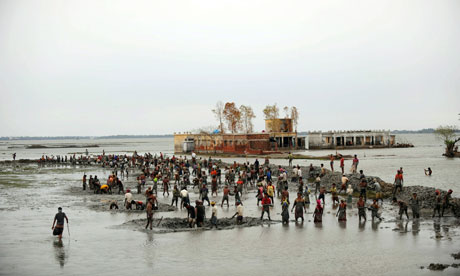
    rising sea levels and coastal erosion in Bangladesh

    Bangladeshi villagers rebuild an embankment after cyclone Aila hit in 2009. Bangladesh faces total losses of about 3-4% of GDP due to climate change. Photograph: Munir Uz Zaman/AFP/Getty Images

    Climate change is already contributing to the deaths of nearly 400,000 people a year and costing the world more than $1.2 trillion, wiping 1.6% annually from global GDP, according to a new study.

    The impacts are being felt most keenly in developing countries, according to the research, where damage to agricultural production from extreme weather linked to climate change is contributing to deaths from malnutrition, poverty and their associated diseases.

    Air pollution caused by the use of fossil fuels is also separately contributing to the deaths of at least 4.5m people a year, the report found.

    The 331-page study, entitled Climate Vulnerability Monitor: A Guide to the Cold Calculus of A Hot Planet and published on Wednesday, was carried out by the DARA group, a non-governmental organisation based in Europe, and the Climate Vulnerable Forum. It was written by more than 50 scientists, economists and policy experts, and commissioned by 20 governments.

    By 2030, the researchers estimate, the cost of climate change and air pollution combined will rise to 3.2% of global GDP, with the world’s least developed countries forecast to bear the brunt, suffering losses of up to 11% of their GDP.

    Sheikh Hasina, prime minister of Bangladesh, said: “A 1C rise in temperature [temperatures have already risen by 0.7C globally since the end of the 19th century] is associated with 10% productivity loss in farming. For us, it means losing about 4m tonnes of food grain, amounting to about $2.5bn. That is about 2% of our GDP. Adding up the damages to property and other losses, we are faced with a total loss of about 3-4% of GDP. Without these losses, we could have easily secured much higher growth.”

    But major economies will also take a hit, as extremes of weather and the associated damage – droughts, floods and more severe storms – could wipe 2% of the GDP of the US by 2030, while similar effects could cost China $1.2tr by the same date.

    While many governments have taken the view that climate change is a long-term problem, there is a growing body of opinion that the effects are already being felt. Scientists have been alarmed by the increasingly rapid melting of Arctic sea ice, which reached a new record minimum this year and, if melting continues at similar rates, could be ice free in summer by the end of the decade. Some research suggests that this melting could be linked to cold, dull and rainy summers in parts of Europe – such as has been the predominant summer weather in the UK for the last six years. In the US, this year’s severe drought has raised food prices and in India the disruption to the monsoon has caused widespread damage to farmers.

    Connie Hedegaard, the European Union’s climate chief, warned that extreme weather was becoming more common, as the effects of climate change take hold. “Climate change and weather extremes are not about a distant future,” she wrote in a comment for the Guardian last week. “Formerly one-off extreme weather episodes seem to be becoming the new normal.”

    Michael Zammit Cutajar, former executive secretary of the UN Framework Convention on Climate Change, said: “Climate change is not just a distant threat but a present danger – its economic impact is already with us.”

  • Report shows climate change danger

    Report shows climate change danger
    Gold Coast Bulletin News
    A worst-case 1.1m sea level rise would put at risk 4750 homes, up to 243 commercial buildings and 408km of local roads by 2100. Even conservative predictions of a 50cm rise are expected to gobble up 2300 homes. The damage bill is estimated to be
    See all stories on this topic »

  • Caught in the cross fire of futility and cant

    Caught in the cross fire of futility and cant

    Mike Carlton :

    THE scene is now all too familiar. There is the coffin draped in the Australian flag and topped by a slouch hat and medals, borne from the aircraft by solemn young men in khaki.

    A chaplain in vestments and a lone piper walk before it, past the saluting colonels and captains. Somewhere in the background there are grandparents struggling to hold it together for the sake of a grieving widow and her stricken, bewildered children.

    The rest of us watch this on television for our one minute, 45 seconds of couch compassion and then get on with the really important news: the Roosters have sacked their coach, a celebrity chef has lost a Good Food Guide hat, and halfwits have trolled a TV star on Twitter.

    When are we going to cry out that enough is enough? When are we going to rise up to demand that not one more husband, father, brother, mate, should die in this bloody, treacherous and futile war in Afghanistan?

    When will we, the Australian people, shout with one voice that the war is lost and it’s time to bring our soldiers home, not in 2014 but now. I have seen too much of this in my lifetime. In World War II we fought for a noble cause, the defeat of German Nazism, Italian Fascism and Japanese militarism.

    Since then, from Korea to Afghanistan via Vietnam and Iraq, we have become enmeshed in failed conflicts fomented in folly and ignorance, and buttressed by the lies and deceit of politicians, generals and, yes, the media.

    Korea, the so-called forgotten war, was to stop the march of godless communism.

    It ended with 340 Australian dead, although not in a permanent peace but an armistice in which great armies still confront each other.

    Vietnam, you will remember, was justified by the domino theory, which held that if South Vietnam fell the rest of south-east Asia would topple to communism as well, all the way to Indonesia. Better to stop them there than here, was the cry.

    We lost 521 men killed for that lie.

    In Iraq, it was to wipe out al-Qaeda and to seize Saddam Hussein’s weapons of mass destruction. It would be a “cakewalk”; the US Marines would be garlanded with flowers in the streets of Baghdad, “greeted like liberators”, we were told. Australia’s chief contribution to that war was to pump $221.7 million into Saddam’s bank account for “transportation costs” in the still-unpunished Australian Wheat Board scandal.

    Afghanistan was to go after al-Qaeda yet again. When Osama bin Laden was caught not there but, magically, a stone’s throw down the road from the Pakistan Military Academy, the war somehow morphed into a fight against the Taliban, a murderous bunch of Islamic fanatics to be sure, but of no conceivable security threat to Australia. So far it’s 38 Australians killed and counting – dying not for their country, as our mealy-mouthed leaders would have us believe, but in defence of the venal and thuggish Karzai regime.

    The cant and the hypocrisy keep coming. We are there to get the job done, to see the mission through. But we learn nothing from history. When we eventually quit Afghanistan, as the British did in the 19th century and the Soviet Union in the 20th, the place will revert to what it always was , a violent wasteland of warlords growing opium poppies. What fools we are.

    IT’S not only the dead. It’s the wounded, too, the hundreds if not thousands of men who carry the physical and mental scars of battle for life.

    At Christmas 1966 I was an ABC war correspondent in Vietnam, tape-recording greetings from our Diggers to be broadcast to their families on their hometown radio stations.

    There was one bloke lying in an American military hospital outside Saigon. Drips and drains trailed from the bed covers tented over him and he was groggy from the painkillers, but he was glad to hear an Australian accent among all the Yanks and he managed to mumble a cheerful greeting to mum and dad and his little sister somewhere in the Riverina. Don’t you worry, getting better, be home soon.

    When I left his room I asked a nurse what had happened to him. “His balls were blown off by a landmine,” she said. “But he doesn’t know it yet.”

    I saw worse in that war. Corpses fried by napalm; a village well in Cambodia filled with a reeking stew of human remains; dying soldiers crying out for their mothers, as dying soldiers do. But I am haunted today by the memory of that young man because he was my own age, just 20, and I have wondered ever since what happened to him. Perhaps he made it OK. Perhaps he committed suicide like so many of his fellow Vietnam vets. I do not know.

    We treat our wounded veterans differently these days. They and their families are better cared for. But the terrible toll accumulates still, hidden from our sight and our minds. In a couple of weeks, one of our former commanders in Afghanistan, retired Major-General John Cantwell, will publish a book of his memoirs, Exit Wounds.

    I’ve seen an advance copy. Read it and weep.

  • Migration pushing population growth higher

    Migration pushing population growth higher
    Sydney Morning Herald
    As suggested here back in May, the federal budget appeared to miss the population growth story. On the performance of the first seven months of this year, population growth for 2012 will be 1.6 per cent – and that’s before rumoured policy initiatives
    See all stories on this topic »

  • Magnitude-8.7 quake was part of crustal plate breakup

    Magnitude-8.7 quake was part of crustal plate breakup

    Posted: 26 Sep 2012 10:26 AM PDT

    Seismologists have known for years that the Indo-Australian plate of Earth’s crust is slowly breaking apart, but they saw it in action last April when at least four faults broke in a magnitude-8.7 earthquake that may be the largest of its type ever recorded.
    You are subscribed to email updates from ScienceDaily: Earth Science News
    To stop receiving these emails, you may unsubscribe now.
    Email delivery powered by Google
    Google Inc., 20 West Kinzie, Chicago IL USA 60610
  • Mapping Arctic Resources

    (NYT)

    The World Wildlife Fund says countries should pursue immediate needs without squandering other values.

    More Articles On This Topic »