Category: News

Add your news
You can add news from your networks or groups through the website by becoming an author. Simply register as a member of the Generator, and then email Giovanni asking to become an author. He will then work with you to integrate your content into the site as effectively as possible.
Listen to the Generator News online

 
The Generator news service publishes articles on sustainable development, agriculture and energy as well as observations on current affairs. The news service is used on the weekly radio show, The Generator, as well as by a number of monthly and quarterly magazines. A podcast of the Generator news is also available.
As well as Giovanni’s articles it picks up the most pertinent articles from a range of other news services. You can publish the news feed on your website using RSS, free of charge.
 

  • Central Coast faces worst sea level rises in NSW

    Central Coast faces worst sea level rises in NSW

    The Minister for Human Services and Social Inclusion Tanya Plibersek talking to seniors at the Peninsula Community Centre about the Federal Government’s Carbon Tax.

    The Minister for Human Services and Social Inclusion Tanya Plibersek talking to seniors at the Peninsula Community Centre about the Federal Government’s Carbon Tax.

    THE Central Coast faces the greatest risk from sea level rise in NSW if no action is taken against climate change.

    That’s what Human Services Minister Tanya Plibersek told residents during her visit to the coast on Tuesday to sell the government’s carbon tax.

    “We know the science tells us that we need to act on dangerous climate change,” Ms Plibersek said.

    “The science shows us that the Central Coast faces the highest risk of inundation from sea level rise in NSW.

    “The Federal Government is taking action to tackle dangerous climate change and move Australia towards a clean energy future while supporting jobs and providing assistance to households and pensioners.”

    According to the 2009 report Climate Change Risks to Coastal Buildings and Infrastructure, Lake Macquarie, Wyong and Gosford Local Government Areas LGAs were the top three areas estimated to see the highest number of homes in NSW at risk of inundation from a sea level rise.

    Lake Macquarie alone may see between 5100 and 6800 residential buildings affected by sea level rise and storm inundation by 2100.

    Climate group demands action on sea level rises

    Climate group demands action on sea level rises

    BY 2100 you will need a snorkel and flippers if you want to reach Pretty Beach Public School. 7 comments

    Angry home owners to fight sea level climate laws

    Angry home owners to fight sea level climate laws

    ANGRY property owners will continue to fight new government planning laws on sea level rises and coastal storm damage. 14 comments

    Mayor not surprised by sea level claims

    Mayor not surprised by sea level claims

    GOSFORD Mayor Laurie Maher said he was not surprised to hear the Central Coast rated highest in the number of homes predicted to be affected by sea level rise. 7 comments

    mick writes:
    Posted on 30 Jul 11 at 02:22pm

    We have the 2 camps on this topic. But I venture to say that the sceptics are in complete denial clinging to statements made by non-science spruikers and one or two scientists who have tried to put a time frame on events. The problem with those folk who live their lives using the flat earth policy is that they will most likely be the first to crow as the water begins to rise. It never ceases to amaze me that some people believe that you can add another 50 billion people to this planet, and then more again, and that she’ll be right. Most scientists have reached agreement on climate change coming after all available evidence was scrutinised and peer evaluated…. not becaust Tony Abbott and the big business lobby (which funds the re-election of politicians) says so. Our granchildren will pay the price for those of us who live on a ‘flat earth’ when this generation is long gone. What a legacy to leave one’s descendants.

    Ashley McCallum writes:
    Posted on 29 Jul 11 at 12:55pm

    Well if Tanya is correct in her outlandish, baseless and alarmist predictions, she should have told her fellow discredited alarmist friend Tim Flannery before he bought his new house on the water at Coba Point, off the Hawkesbury River. Isn’t it odd how they say one thing with their mouths yet another with their wallets. You are being lied to people.

    Dave writes:
    Posted on 29 Jul 11 at 10:27am

    More Labor/Green lies to scare us into accepting an unjust and unnecessary tax. As the child once said “The King is in the altogether”. I am so glad that there are enough people in this country with the self confidence and intellect to stand up and call this for what it is; scare mongering, lies and deceit in the interest of a political agenda that can only be called extremist.

    Matt writes:
    Posted on 19 Jul 11 at 12:20pm

    Can you picture those IPCC projections, with different lines on the graph, with the ‘best case’ prediction at the lowest and the ‘worst-case’ prediction at the highest? Those projections were first done in 1992 and re-done about ten years later. Since then, the real data has tracked right along the ‘worst-case’ line for just about everything they measured, including sea level. Yelling about the worst case scenario isn’t scaremongering. It’s happening already.

    Peggy writes:
    Posted on 17 Jul 11 at 03:22pm

    I think Tanya doesn’t know the difference between sea level rise and erosion. Wave action of the ocean erodes the sea shore. It’s been doing that long before global warming/climate change was ever invented.

  • Department issues coal seam gas emissions warning

    This is an issue that needs much more research before making any unsubstantiated claims.

    Department issues coal seam gas emissions warning

    Date
    September 21, 2012 – 1:17PM
    • 2 reading now
    • 1

    No one knows precisely how much methane leaks from Australia’s growing coal seam gas fields, and more research is needed to back up industry claims about greenhouse emissions, a report produced for the federal government has found.

    Methane is a far more potent gas than carbon dioxide, so accurate measurements are needed to work out the industry’s contribution to global warming, said the report commissioned by the Department of Climate Change and Energy Efficiency.

    “There is effectively no public information about methane emissions associated with unconventional gas production in Australia,” it said. “This is a matter of some public policy concern, given the projected large growth in production of CSG.”

    The issue was a “growing source of controversy in Australia”, according to the report, prepared at consultancy Pitt & Sherry by Hugh Saddler, an adjunct professor at the Australian National University’s Energy Change Institute.

    The government is calling for public submissions on the best methods for measuring emissions from coal seam gas drilling. The deadline for submissions has been extended to October 19.

    The report found that greenhouse emissions from Australian gas wells were likely to be lower, on average, than those of US gas wells, because of different geological conditions and the more frequent use in America of hydraulic fracturing, or fracking.

    There is no published data on methane emissions, and no systematic emissions measurement program under way, but both the CSIRO and the University of Queensland are proposing to do research.

    The coal seam gas industry is marketing itself as “up to 70 per cent cleaner than coal”.

    The industry body, the Australian Petroleum Production and Exploration Association, said the report showed that gas drilling in the US was not relevant to Australia.

    “The key thing to note is that the review does not conclude emissions in Australia are underreported or misreported,” a spokesman for the association said.

    “APPEA also thinks that moves to allow for more accurate measurement of emissions from other and all industry sources across the Australian economy, is positive.”

    The Department of Climate Change and Energy Efficiency said the report was a “positive contribution” to debate as it worked to refine better methods for measuring coal seam gas emissions.

    Read more: http://www.smh.com.au/environment/energy-smart/department-issues-coal-seam-gas-emissions-warning-20120921-26b47.html#ixzz276LVxPTD

  • Green News Round-up (The Guardian)

    Green news roundup: Arctic sea ice, badger cull and mega mine

    The week’s top environment news stories and green events

    If you’re not already receiving this roundup, sign up here to get the briefing delivered to your inbox

    • Environment editor
    • guardian.co.uk, Thursday 20 September 2012 11.22 EDT
    Arctic Iceberg

    An iceberg off Alaska, 30 miles long and 12 miles wide, halted Shell’s oil drilling operation. It is expected to resume soon. Photograph: Raimund Linke/Getty Images

    Environment news

    • Arctic ice shrinks 18% against record, sounding climate change alarm bells
    • Arctic expert predicts final collapse of sea ice within four years
    • Australian ‘mega mine’ plan threatens global emissions target
    • Mass slaughter of farm animals set to push food prices up 14%
    • UK windfarms generate record amount of power
    • Man-made English saltmarshes ‘failing to meet European plant standards’
    • First badger cull licence issued in England

    On the blogs

    Bike blog : An exemple of iconographic use of a bicycle : Dishroom restaurant in London

    • Is there even less Arctic sea ice than the satellites show?
    • Get used to ‘extreme’ weather, it’s the new normal
    • New cycle safety campaign says: it’s everyone’s responsibility
    • Donald Trump anti-wind power fundraiser fails to get off the ground

    Multimedia

    Week in wildlife : Wild flowers in South Africa

    • Morocco’s renewable energy future – video
    • Arctic sea ice before and after record low – interactive map
    • The week in wildlife – in pictures

    • Life on the shoreline – your Green shoots photographs

    • Surviving off rubbish in Kenya’s slums – in pictures

    … And finally

    • How a smartphone could become an endangered cicada detector
    • Scottish anti-wind turbine group’s ad rapped for using images of Hawaii

    • SKY_Int_Dev_Achievement_Award_Voting_071012
    • Button_Sustainable_Business_NY_101012
    • Button_Guardian_ebooks_230812


    You are receiving this email because you are a Green Light subscriber.

    Click here if you do not wish to receive Green Light emails from the Guardian News and Media.
    Click here to find out about other Email Services from the Guardian.

    Guardian News & Media Limited – a member of Guardian Media Group PLC. Registered Office: Kings Place, 90 York Way, London, N1 9GU. Registered in England No. 908396

  • Climate change: the inside story

    Climate change: the inside story

    Date
    September 21, 2012 – 5:40AM
    • 12 reading now
    • 1

    Video settings

    Please Log in to update your video settings

    Video settings

    Please Log in to update your video settings

    Could the Arctic be free of ice by 2030?

    Arctic sea ice has been shrinking each year, raising concerns that Arctic summers might be free of ice by the 2030s.

    Video will begin in 1 seconds.

    The figures speak for themselves. Earth’s veil of atmosphere has warmed by 0.8 degrees since the middle of the 18th century when smoke billowing from furnaces of the Industrial Revolution began.

    The temperature rise might not sound like a great deal, but make no mistake: the carbon dioxide being churned out today will linger for centuries to come, scientists say.

    The polar icesheets, in particular, are vulnerable to a positive feedback loop that tends to boost the speed at which melting occurs. This, in part, is why the Arctic sea ice has shrunk to its smallest extent yet, raising concerns that Arctic summers might be largely free of ice by the 2030s.

    Melting of sea ice does not, in itself, lead to a rise in sea level – but the melting of continental ice sheets, such as the Greenland ice cap in the Arctic, does, explains Monash University plant physiologist Roslyn Gleadow.

    Advertisement

    “Ice is white and reflects sunlight, ensuring that our polar regions keep cold,” Associate Professor Gleadow explains. “Areas that are ice-free are darker in colour and thus absorb sunlight; they also warm faster than if they were covered with ice.” This positive feedback mechanism serves to increase the initial warming.

    To discuss these and related matters, the Royal Society of Victoria is hosting a climate change symposium that opened last night in Melbourne with a free public lecture entitled “Addressing the myths of climate change”.

    Today, the symposium begins in earnest with world experts discussing each of three key areas of research: science, impacts and adaptation.

    “The symposium aims to provide a forum where experts can engage with the community about issues without the need for overly technical language or political hype,” says co-organiser Associate Professor Gleadow.

    The first session this morning will review the welter of evidence for climate change, how it is measured and what is understood about these changes. It will then move to describe projections for the future.

    The second session will address impacts on Victoria, along with matters such as water supply, sea-level inundation, agricultural productivity and extreme-weather expectations.

    The symposium’s final session will consider options for adaptation to reduce exposure to climate-change impacts. “This is really important because there are opportunities as well as challenges ahead, and we need people from all walks of life to be engaged in this process if we are to arrive at the best possible outcomes,” Associate Professor Gleadow says.

    Likely impacts

    The projected effects of sea level rise are of intense interest worldwide.

    NASA satellite measurements show that coastal regions of the East Antarctic ice sheet, including long stretches of the Australian Antarctic Territory, have been losing about 57 billion tonnes of ice each year for the past three years. The complete loss of the sheet, the world’s biggest expanse of frozen water, would raise sea levels by roughly 50 metres, polar scientists believe.

    The West Antarctic ice sheet, in particular, is losing about 132 billion tonnes of ice a year. Global ice losses now contribute an estimated 1.8 millimetres a year to rises in sea level.

    Such calculations have given rise to reports suggesting that more than 250,000 homes in Australia could be damaged or lost due to storm surge and sea level rise in coming decades.

    Claims that up to 45,000 homes in Victoria alone – worth more than $10 billion – would be threatened by rising sea levels by 2100, were followed by two CSIRO reports that suggest sea levels during storms are likely to be about 15 centimetres higher in 2030 than today.

    Another report will consider four sea-level scenarios by 2100, including two based on rises of 80 centimetres, one of 110 centimetres and one of 140 centimetres. Victorian planning regulations currently forecast a rise in sea level of 80centimetres by the end of the century.

    Australia contributes significantly to its own potential problems. The nation’s “ecological footprint” is estimated to be something like 7.8 global hectares per person – 2.8 times the average global footprint.

    Links

    • Find out what’s on today at the Royal Society’s climate change symposium here

    • Learn more about environmental chemistry here

    • Discover the effects of chemical compounds on the atmosphere here

    Read more: http://www.smh.com.au/technology/sci-tech/climate-change-the-inside-story-20120921-26ahf.html#ixzz2754qoHpd

  • MPs demand moratorium on Arctic oil drilling

    MPs demand moratorium on Arctic oil drilling

    Commons environment committee urges halt to exploration until safety improves, and calls for unlimited pollution penalties and creation of ‘no-drill zone’

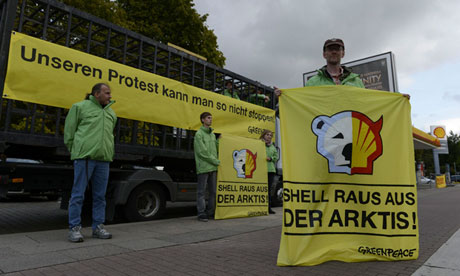
    Greenpeace protesters in Germany

    Greenpeace protesters in Germany demonstrate against Shell’s Arctic oil drilling. Photograph: Reuters

    British MPs are calling on Shell and others to halt “reckless” oil and gas drilling in the Arctic until stronger safety measures are put in place.

    Politicians also want to impose “unlimited” financial liability on operators and the creation of a “no-drill zone” in a new environmental sanctuary.

    The uncompromising demands have angered the energy industry but come just days after alarming new evidence has emerged about Arctic sea ice melting at record levels. They also come on the day that an environment committee of MEPs in Brussels called for tougher financial guarantees from oil companies to ensure they could pay for spills in European waters.

    The British initiatives are contained in a report published on Thursday from the cross-party environmental audit committee (EAC) of the House of Commons, which warns that the vulnerable Arctic region is being endangered by a misguided search for hydrocarbons.

    “The shocking speed at which the Arctic sea ice is melting should be a wake-up call to the world that we need to phase out fossil fuels fast,” said the committee chair, Joan Walley MP. “Instead we are witnessing a reckless gold rush in this pristine wilderness as big companies and governments make a grab for the world’s last untapped oil and gas reserves.”

    She told Radio 4’s Today programme on Thursday: “I think the particular problem is that when you are talking about offshore drilling and you are talking about drilling in such harsh circumstances as the Arctic, we have to have proven techniques in place first of all, and we’re not convinced that that is currently the case. It is for that reason that we want to see all drilling halted until we’ve got the highest available environmental standards in place.”

    The EAC said it had heard “compelling evidence” from experts during several months of hearings that if a blowout occurred just before the dark Arctic winter returned it would not be possible to cap any oil spill until the following summer.

    Shell is currently in the middle of an exploration attempt in the Chukchi Sea, Alaska, but has had to call off immediate drilling due to dangers from ice and a faulty safety dome, which would be used for capping wells in the event of a blowout. The Anglo-Dutch group has already been heavily criticised for allegedly failing to properly test a new dome.

    ExxonMobil, Gazprom and others are either already working or preparing to operate in the Arctic region off Russia, Greenland or Alaska.

    The first report by MPs into the new rush for resources, entitled “Protecting the Arctic”, says there should be a drilling moratorium until “the highest available” environmental standards can be imposed right across the far north.

    The committee believes that a “preferably unlimited” financial liability regime should be imposed for all oil and gas operations in the area. And it says the petroleum industry should set up a special group to peer-review and publicly report on all safety-related operating practices.

    The British government has no legal rights to limit drilling around the waters of the far north but is an observer on the Arctic Council. However the committee believes that the UK should be pushing for a special zone to be created that would be off limits for all drilling – as in Antarctica: “We see the development of such a sanctuary as a prerequisite for further development of the Arctic’s natural resources.”

    But the committee also expresses deeper concerns about the British government’s support for UK companies drilling worldwide at a time when it is trying to reduce carbon emissions at home.

    The energy industry argues that new oil reserves must be found to meet growing demands worldwide and says it can operate safely, having learned lessons from BP’s catastrophic accident with the Deepwater Horizon rig in the Gulf of Mexico in 2010.

    “Our record throughout 50 years’ experience of operating in Arctic and sub-Arctic regions demonstrates that we have the technical expertise to explore for and produce oil and gas safely and responsibly,” said a Shell spokesman.

    Cairn Energy, which has been at the forefront of drilling off Greenland, said British MPs should not interfere. “Cairn believes that governments and their people have the right to explore for natural resources in their sovereign territory, with the potential to strengthen both their energy security and economy,” it added.

    But the Green party MP Caroline Lucas, another member of the EAC who has campaigned hard on the issue for many years, believes otherwise.

    She said: “The UK government now has a responsibility to respond to this EAC report and show vital leadership on the issue by doing all it can to urgently secure a moratorium on Arctic drilling – starting with companies registered in this country.”

  • US warns citizens of more Sydney unrest as Muslim leaders back police actions

    US warns citizens of more Sydney unrest as Muslim leaders back police actions

    Date
    September 21, 2012
    • 23 reading now
    • 27

    Rachel Olding, Nick Ralston

    Video settings

    Please Log in to update your video settings

    Video settings

    Please Log in to update your video settings

    ‘I told them not to go’

    Sheikh Feiz Mohammed speaks out against the violence at the anti-Islamic film protests in Sydney last weekend.

    Video will begin in 1 seconds.

    THE United States has advised its citizens to keep away from Martin Place and Hyde Park this weekend amid fears of another outbreak of anti-American violence.

    The deputy Police Commissioner, Nick Kaldas, said yesterday he had no intelligence to suggest there would be protests this weekend, but the Herald has learnt a special operation is in place to ensure there is no repeat of last Saturday’s unrest.

    Officers from 10 squads, including mounted police, the dog unit and riot squad, will be supported by the force’s helicopter as part of Operation Waterman over the weekend.

    text

    Deputy Commissioner Kaldas and Sheikh Mousselmani. Photo: Sahlan Hayes

    There have been messages circulating on Facebook encouraging further retaliation against the anti-Islamic film Innocence of Muslims and the police who quelled last week’s demonstration.

    And a letter, titled ”Emergency Message for US Citizens” and sent to all those registered with the US consulate, states that ”law enforcement authorities” have warned of possible demonstrations tomorrow or Sunday.

    ”Fast-forming anti-American protests in Australia remain possible,” the letter states.

    A similar warning has been issued in 33 other countries including Afghanistan, Egypt, Indonesia and Lebanon. One US citizen living in Sydney said he had never received such a specific warning in his five years overseas.

    And the publication of cartoons of a naked Prophet Mohammed in a French magazine has prompted the French consulate in Sydney and the embassy in Canberra to increase security measures.

    Police said last night that Sydney remained ”one of the safest cities in the world” and the city centre would be open for tourists and locals this weekend.

    However, one message posted by a Muslim woman on Facebook has attracted hundreds of comments and states: ”This Sunday 23 September 1 pm at Hyde Park we can all bring own pepper spray!”

    Another says: ”This Sunday at Hyde Park 23 September we show the kufar [non-believers] what we can do again!”

    Some of the country’s most senior Muslim leaders met police yesterday to affirm their support for the police actions during and after the protests.

    The grand mufti of Australia, Dr Ibrahim Abu Mohamed, who has never fronted the media in such a way, said Muslims who wanted to protest again were turning themselves from ”victim to criminal”.

    Their show of support for the police is likely to anger some Muslims who have insisted police baited protesters in Hyde Park and responded heavy-handedly.

    Meanwhile, claims by a controversial sheikh that he had nothing to do with the protest have been slammed by a Muslim activist, Jamal Daoud, as ”cheap lies”.

    After days of speculation that he or his students were linked to the protests, Sheikh Feiz Mohammad broke his silence yesterday to tell the Muslim Village website that the protests were ”against every facet and tenor of the Islamic teachings” and that none of his students was involved.

    But Mr Daoud, a refugee advocate, said the majority of violent protesters came from the mosques and musallahs of ”extreme Wahabi sheikhs” like Sheik Feiz and Sheikh Abdel Salam Zoud.

    Ahmed Elomar, one of the men arrested over the riot, was a former student of Sheikh Feiz and messages urging people to go to the rally were posted in forums for the Ahlus Sunnah wal Jama’ah group that Sheikh Feiz leads.

    Police last night charged a ninth person over the weekend riots. A 19-year-old man was charged with affray and throwing missiles at police and was granted bail to appear in court next month.

    Read more: http://www.smh.com.au/nsw/us-warns-citizens-of-more-sydney-unrest-as-muslim-leaders-back-police-actions-20120920-269kg.html#ixzz273ZSl5Ja