Category: News

Add your news
You can add news from your networks or groups through the website by becoming an author. Simply register as a member of the Generator, and then email Giovanni asking to become an author. He will then work with you to integrate your content into the site as effectively as possible.
Listen to the Generator News online

 
The Generator news service publishes articles on sustainable development, agriculture and energy as well as observations on current affairs. The news service is used on the weekly radio show, The Generator, as well as by a number of monthly and quarterly magazines. A podcast of the Generator news is also available.
As well as Giovanni’s articles it picks up the most pertinent articles from a range of other news services. You can publish the news feed on your website using RSS, free of charge.
 

  • Arctic ice shrinks 18% in a year, sounding climate change alarm bells

    Arctic ice shrinks 18% in a year, sounding climate change alarm bells

    Scientists and environment groups say the fall is unprecedented and the clearest signal yet of global warming

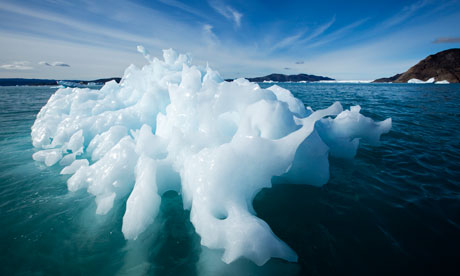
    Arctic melting ice : Icebergs, Disko Bay, Greenland

    ‘Our response [so far] has not been alarm, or panic, or a sense of emergency. It has been: ‘Let’s go up there and drill for oil’. There is no more perfect indictment of our failure to get to grips with the greatest problem we’ve ever faced,’ says author and environmental campaigner Bill McKibben. Photograph: Paul Souders/Corbis

    Sea ice in the Arctic shrunk a dramatic 18% this year to a record low of 3.41m sq km, according to the official US monitoring organisation the National Snow and Ice Data Centre in Boulder, Colorado.

    Scientists and environment groups last night said the fall was unprecedented and the clearest signal yet of climate change.

    The data released showed the arctic sea beginning to refreeze again in the last few days after the most dramatic melt observed since satellite observations started in 1979.

    This year’s sea ice extent was 700,000 sq km below the previous minimum of 4.17m sq km set in 2007.

    “We are now in uncharted territory,” said Nsidc director Mark Serreze. “While we’ve long known that as the planet warms up, changes would be seen first and be most pronounced in the Arctic, few of us were prepared for how rapidly the changes would actually occur.”

    Julienne Stroece, an Nsidc ice research scientist who has been monitoring ice conditions aboard the Greenpeace vessel Arctic Sunrise, said the data suggested the Arctic sea ice cover was fundamentally changing and predicted more extreme weather.

    “We can expect more summers like 2012 as the ice cover continues to thin. The loss of summer sea ice has led to unusual warming of the Arctic atmosphere, that in turn impacts weather patterns in the northern hemisphere, that can result in persistent extreme weather such as droughts, heatwaves and flooding,” she said.
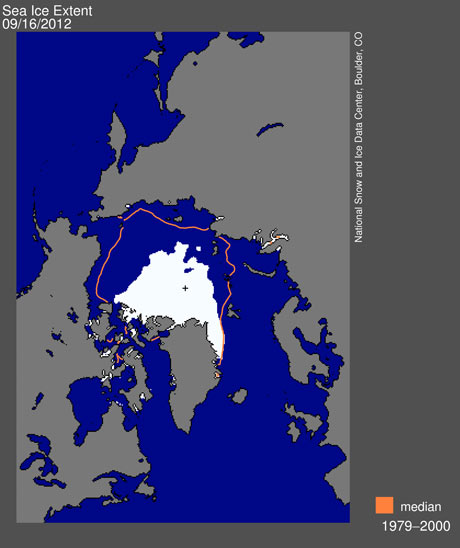
    Arctic sea ice Arctic sea ice extent for September 16, 2012 was 3.41m sq km. The orange line shows the 1979 to 2000 median extent for that day. The black cross indicates the geographic North Pole. Photograph: National Snow and Ice Data Center

    Other leading ice scientists this week predicted the complete collapse of sea ice in the Arctic within four years. “The final collapse … is now happening and will probably be complete by 2015/16,” said Prof Peter Wadhams of Cambridge University.

    Sea ice in the Arctic is seen as a key indicator of global climate change because of its sensitivity to warming and its role in amplifying climate change. According to Nsidc, the warming of Arctic areas is now increasing at around 10% a decade.

    Along with the extent of the sea ice, its thickness, or volume, has also significantly decreased in the last two decades. While this is harder to measure accurately, it is believed to have decreased around 40% since 1979.

    The collapse of the ice cap was last night interpreted by environment groups as a signal of long-term climate warming caused by man.

    “I hope that future generations will mark this day as a turning point, when a new spirit of global cooperation emerged to tackle the huge challenges we face. We must work together to protect the Arctic from the effects of climate change and unchecked corporate greed. This is now the defining environmental battle of our era,” said Kumi Naidoo, director of Greenpeace International.

    Other groups called on the UK government, and industries across the world to heed the warning signs from the Arctic and act “with urgency and ambition” to tackle climate change.

    Rod Downie, polar expert at WWF-UK said: “With the speed of change we are now witnessing in the Arctic, the UK government must show national and global leadership in the urgent transition away from fossil fuels to a low carbon economy.

    “This is further evidence that Shell’s pursuit of hydrocarbons in the Arctic is reckless. It is completely irresponsible to drill for oil in such a fragile environment; there are simply too many unmanageable risks.”

    Author and environmental campaigner Bill McKibben said: “Our response [so far] has not been alarm, or panic, or a sense of emergency. It has been: ‘Let’s go up there and drill for oil’. There is no more perfect indictment of our failure to get to grips with the greatest problem we’ve ever faced.”

    Arctic sea ice follows an annual cycle of melting through the warm summer months and refreezing in the winter. It has shown a dramatic overall decline over the past 30 years.

    Sea ice is known to play a critical role in regulating climate, acting as a giant mirror that reflects much of the sun’s energy, helping to cool the Earth.

    The UN Environment programme warned that the extra shipping and industry likely to result from the thawing of sea ice could further accelerate sea ice melting.

    “There is an urgent need to calculate risks of local pollutants such as soot, or black carbon, in the Arctic. Soot darkens ice, making it soak up more of the sun’s heat and quickening a melt,” said UNEP spokesman Nick Nuttall in Nairobi.

  • Asia’s Millionaires Increase as Growth Adds Wealth

    Asia’s Millionaires Increase as Growth Adds Wealth
    Businessweek
    The population of ultra-high net worth individuals — those with investable assets of at least $30 million — in Asia-Pacific fell 3.9 percent to 21,700, the report showed. Their wealth dropped 5.2 percent. The number of people in the region with
    See all stories on this topic »

  • Sea surface temperatures reach record highs on Northeast continental shelf

    Sea surface temperatures reach record highs on Northeast continental shelf

    Posted: 18 Sep 2012 09:15 AM PDT

    During the first six months of 2012, sea surface temperatures in the Northeast Shelf Large Marine Ecosystem were the highest ever recorded. The annual 2012 spring plankton bloom was intense, started earlier and lasted longer than average. This has implications for marine life from the smallest creatures to the largest marine mammals like whales. Atlantic cod continued to shift northeastward from its historic distribution center.

  • Extreme temperatures may raise risk of premature cardiovascular death

    Extreme temperatures may raise risk of premature cardiovascular death

    Posted: 18 Sep 2012 03:48 PM PDT

    Extreme temperatures during heat waves and cold spells may increase the risk of premature cardiovascular disease (CVD) death, according to new research.

  • Erosion management changes rushed: Greens ABC Online

    The Very Real Threat of Sealevel Rise to the United States
    Huffington Post (blog)
    Until the very end of the Republican Convention in Tampa, the issue of climate change was a no-show. Even the Democrats have not made as much of this issue as many in the scientific community would like. But the issue did come up when Governor
    See all stories on this topic »
    Erosion management changes rushed: Greens
    ABC Online
    “What this will do is pit landowner against landowner, right up and down our coasts. “We’ll have people fortifying their front lawns against incoming sea level rise, against incoming coastal inundation. “What we need for coastal erosion and sea level
    See all stories on this topic »


    Blogs 1 new result for SEA LEVEL RISE
    Scientists converge in La Jolla to discuss rising sea levels | La Jolla
    By Pat Sherman
    This report is the first in a two-part series chronicling an international workshop on sealevel rise, held at UC San Diego last week.
    La Jolla Light


    Tip: Use a minus sign (-) in front of terms in your query that you want to exclude. Learn more.

    Delete this alert.
    Create another alert.
    Manage your alerts.

  • NSW same-sex marriage bill likely to pass

    NSW same-sex marriage bill likely to pass

    By Toby Mann and Sophie Tarr, AAPUpdated September 19, 2012, 5:11 pm

    A same-sex marriage bill should pass NSW parliament after party leaders announced they will let members have a conscience vote, members of a cross-party working group say.

    The working group will soon draft a same-sex marriage bill for NSW, expecting similar legislation to be defeated in the federal parliament.

    The group includes Nationals MP Trevor Khan, Liberal MP Bruce Notley-Smith, the Greens’ Cate Faehrmann, Labor’s Penny Sharpe and Sydney independent Clover Moore.

    Federal Labor backbencher Stephen Jones’ bill to legalise same sex marriage, one of three before federal parliament, was defeated on Wednesday by 98 votes to 42.

    But unlike their federal colleagues, NSW coalition MPs have been granted a conscience vote by Premier Barry O’Farrell and Nationals Leader Andrew Stoner, which will help the bill win support.

    Opposition Leader John Robertson has also allowed Labor MPs a conscience vote.

    Ms Moore, who will retire from parliament this week after she was re-elected as Sydney Lord Mayor earlier this month, said she was optimistic the legislation would be supported by state parliament.

    “I believe that if there is a conscience vote in NSW Parliament that bill could be as successful as my same-sex adoption bill was,” she said.

    “I’m very optimistic about that.”

    In a joint statement, members of the working group said they wanted change to the final area of law that discriminates against GLBTI (gay, lesbian, bisexual, transgender and intersex) people.

    “We believe that the best result that would deliver marriage equality would be for the federal parliament to pass one of the bills currently before it. However, we recognise that this may not be achieved the first time.”

    Mr Notley-Smith, who is openly gay, told ABC Radio on Wednesday that although numbers had not been counted yet, he was “optimistic” that a same-sex marriage bill would pass.

    While many people are predicting the bill will pass, NSW Opposition Leader John Robertson said it was too early to call the outcome of the vote.

    “What I do know is that a conscience vote will allow people to vote based on what they believe, and for a lot of people it’s an opportunity for them to talk to their constituency as well and get a reflection on the views of the people they represent,” he said.

    A spokesman for Ms Faehrmann said the working group would probably use a same-sex marriage bill drafted in Tasmania as a starting point.