Category: News

Add your news
You can add news from your networks or groups through the website by becoming an author. Simply register as a member of the Generator, and then email Giovanni asking to become an author. He will then work with you to integrate your content into the site as effectively as possible.
Listen to the Generator News online

 
The Generator news service publishes articles on sustainable development, agriculture and energy as well as observations on current affairs. The news service is used on the weekly radio show, The Generator, as well as by a number of monthly and quarterly magazines. A podcast of the Generator news is also available.
As well as Giovanni’s articles it picks up the most pertinent articles from a range of other news services. You can publish the news feed on your website using RSS, free of charge.
 

  • Australian ‘mega mine’ plan threatens global emissions target

    Australian ‘mega mine’ plan threatens global emissions target

    ‘Unprecedented’ increase in the scale of Australian mining would nullify an internationally agreed goal, Greenpeace warns

    Damian blog : coal in Australia BHP Billiton Announces Record Financial Results

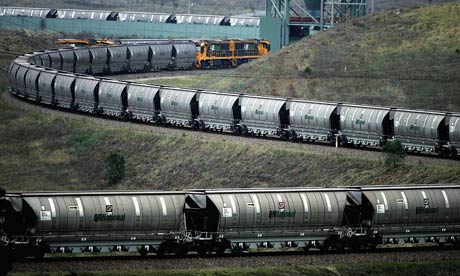
    A coal train awaits loading. Photograph: Ian Waldie/Getty Images

    Plans to open up a new Australian “coal export rush” would turn a single Queensland region into the seventh largest contributor of carbon dioxide emissions on the planet, undermining international efforts to keep global warming below 2C, a new report has warned.

    Nine proposed “mega mines” in the Galilee Basin would, at full capacity, result in 705m tonnes of CO2 released into the atmosphere, according to a Greenpeace Australia analysis. This level of emissions would surpass those of all but six nations in the world. By comparison, the UK emitted 549.3 million tonnes of CO2 from all sources in 2011.

    Greenpeace said that the nine mines’ production capacity of 330m tonnes of coal a year for export would represent an “unprecedented” increase in the scale of coal mining in Australia. The mines’ maximum output, primarily aimed at servicing the burgeoning Chinese and Indian markets, would nearly double Australia’s total 2010/11 coal production of 352m tonnes and eclipse its export total of 283m tonnes.

    The Greenpeace report states that the mines will only be able to launch and operate at capacity if global appetite for coal continues to grow strongly. This scenario would in effect nullify an internationally agreed goal to keep the increase in average global temperatures below 2C from pre-industrial levels.

    Greenpeace warns that a growth in coal-fired emissions represented by the nine Queensland mines would be in line with the International Energy Agency’s model of a “catastrophic” 6C rise in temperatures.

    “At a time when the science could not be clearer on the need to reduce global carbon emissions, and when governments worldwide are shifting to a low-carbon economy, exploiting the Galilee Basin is a reckless proposition,” the report states. “It is imperative that the Galilee Basin coal reserves remain in the ground.”

    The Alpha coal mine, a joint venture between Indian conglomerate GVK and Gina Rinehart’s Hancock Coal, last month became the first major Galilee Basin project to be given state and federal government approval, despite protests from environmentalists and farmers.

    The mine, which will bring an estimated AU$1bn (£642m) into the Queensland economy, will have the capacity to create 64.7m tonnes of CO2 – the equivalent of Israel’s entire 2009 emissions from fuel combustion.

    The other eight mines are yet to be given the green light by ministers. Adani, another Indian mining firm, hopes to build a new town for 12,000 people to service its big Carmichael mine, which would produce up to 60m tones of coal a year.

    Greenpeace’s report argues that the expansion in Queensland coal mining will damage the nearby Great Barrier Reef through coral bleaching from increased temperatures, but also in the shorter term due to the development of new ports and shipping lanes in order to transport the coal overseas.

    In June, a UN report expressed “extreme concern” over the level of development along the Great Barrier Reef coast, calling for all building to cease until an assessment of the ecosystem’s health was carried out.

    The Greenpeace Australia campaigner Georgina Woods, author of the new coal report, said: “Australia has just pretended up until now that coal exports aren’t part of the problem but it’s time that we started talking about it if we want to keep treasures like the Great Barrier Reef.”

    “These proposed mines need to be taken off the table and development along the Great Barrier Reef coast needs to be ruled out. The topic of coal exports is a very immature conversation in Australia but we need to start that conversation.”

    Australia is itself a heavy user of coal, as well as a leading exporter. Although the country has committed to cutting its own carbon emissions by 5% on 2000 levels by 2020 and introduced carbon pricing in July, the federal government has been accused of botching its attempts to move the country away from fossil fuels. This month, the government abandoned plans to pay five of Australia’s dirtiest coal-fired power generators to close down, despite already handing them $1bn in taxpayer money to cushion the impact of carbon pricing.

  • Future of Shell Vic refinery in doubt

    Future of Shell Vic refinery in doubt

    Updated: 20:31, Tuesday September 18, 2012

    An executive of Shell has said the future of the oil company’s Geelong refinery is ‘borderline’.

    Shell global downstream director Mark Williams said the operation of the refinery at Geelong was ‘questionable’ given the challenges faced.

    ‘It’s borderline,’ Mr Williams told the Australian Financial Review.

    ‘It depends a lot on how it performs over the next few years whether or not it will ultimately be a survivor.

    ‘I think you can see the rest of the industry struggling with the same dynamics.’

    In a statement, Shell said Australian refining was part of a highly competitive global market and the Geelong refinery faced challenges.

    ‘Geelong Refinery faces challenges, including increased competition from new mega-refineries in Asia,’ company spokesman Paul Zennaro said.

    ‘Shell employees are working to make the refinery more competitive with a continued focus on safety while enhancing profitable niche products including Avgas, bitumen and solvents.’

    Shell had recently invested $47.5 million in a new water processing plant and $20 million in new bitumen facilities at the Geelong plant.

    The plant, one of the largest hydrocarbon refineries in Australia, employs more than 400 people on site.

    Shell in June decided to close its refinery in Clyde, Sydney.

    The 79,000 barrel refinery will stop from September 30 and will be converted into a fuel terminal.

    Caltex Australia announced in July that it would convert its Sydney refinery into an import terminal.

    The Kurnell refinery will close in 2014 at the expense of 330 jobs.

    The decision follows a review of the company’s operations announced in August last year.

    The Victorian government committed $4 million to a Geelong-focused assistance fund in June, a spokeswoman said.

    ‘The Australian refining sector, like others, is facing major challenges,’ she said.

    ‘Remaining competitive is a key part of dealing with those challenges.

    ‘That’s why we have been calling on the Gillard government to address issues that impact Australia’s competitiveness.’

    She said issues undermining the nation’s competitiveness included rising energy prices and the carbon tax.

    ‘Our focus is on assisting regional communities to transition,’ she said.

    When asked whether the government was in talks with Shell the government spokeswoman said the coalition regularly met major employers and those discussions were commercial in confidence.

  • Re: Stop T4: Reject the PWCS proposal to construct a fourth coal terminal in Newcastle

    Re: Stop T4: Reject the PWCS proposal to construct a fourth coal terminal in Newcastle

    Inbox
    x

    ElectorateOffice Newcastle ElectorateOffice.Newcastle@parliament.nsw.gov.au
    11:00 AM (52 minutes ago)

    to me
    Thank you for your email to the Office of Tim Owen AM MP, State Member for Newcastle.

    The office receives a very high volume of emails daily and we kindly ask that you please be patient while we address your inquiry.

    If you are a constituent of the Newcastle electorate, to ensure a timely response please provide your current electoral address and daytime contact telephone number.

    Kind regards,

    Office of Tim Owen AM MP
    Member for Newcastle

  • taking action against coal in Australia, 350 org

    Aaron Packard – 350.org organizers@350.org
    10:21 AM (33 minutes ago)

    to me

    Ready to see 350.org Australia dive deeper into the fight to move beyond coal?

    Join us as we get started:

    1. Sign the Coal Terminal Action Group Petition

    2. Send us your ideas

    Sign on Now

    Dear friends,

    There’s something we simply can’t wait any longer to email you about. At one stage or another, I’m sure you’ve thought about it already, and perhaps you’ve even wondered why 350.org isn’t more actively doing something about the situation.

    What’s “it…?” Coal.

    If there’s one particular burden that Australia bears when dealing with climate change, it’s coal. For any of you who read Bill McKibben’s recent article in Rolling Stone magazine know, there’s a very finite amount of carbon that can be put in the atmosphere if we’re going to have any chance of limiting global warming to 2 degrees C, let alone return back to 350 ppm. Australian coal alone holds 182.1 gigatonnes of potential CO2 emissions — carbon that needs to remain in the ground. And, with proposals for massive new coal ports and countless mine expansions around Australia, the coal industry plans to ensure every last bit we have burns.

    This isn’t likely to be news to you. Australian coal has loomed large for the climate change movement domestically and internationally. So what’s been holding us back? Well, simply that we wanted to be able to communicate about the issue with the strongest plan possible at the most timely moment possible. That combined with the fact that 350.org as a global campaigning organization has very limited resources to put towards any one particular country, and we’re truthfully not sure what resources we can bring to the coal struggle in Australia.

    Yet we write to you now, not because we’ve resolved these questions — we don’t have a detailed plan in place, nor do we have resources secured for scaling up a campaign. We write to you now because we simply couldn’t go another week receiving more news from you — friends, partners and organisers — about the latest coal mining, coal export proposals and infrastructure build up or failed government policy meant to reduce domestic coal use. Put simply, we needed to let you know that we’re stepping up to find ways to reduce the climate and health impacts of coal, promoting clean energy solutions and working with individuals and organisations interested in helping.

    For starters, if you agree that there’s no time to waste in taking action against coal in Australia, here are two things we ask you do:

    1) Sign this petition letter that our friends at the Coal Terminal Action Group have organised to stop a fourth coal terminal in Newcastle (which would double the volume of coal exports through Newcastle). Their representatives need to hear from as many people as possible!

    2) Let us know your ideas for how to move Australia beyond coal(including exports), and how 350.org can play a role in educating the public and working for alternatives to polluting coal. Email us at australia@350.org.

    350.org Australia and other organisations are already working on reducing our dependence on coal. Over the next few months, we will be asking for your support — both political and financial — and your participation to bring new capacity and strategies to address this urgent issue.

    Thanks to everyone ready to take on this enormous challenge. We look forward to working on this issue together.

    Onwards,

    Aaron Packard, Blair Palese, and the 350.org team


    350.org is building a global movement to solve the climate crisis. Connect with us on Facebook and Twitter, and sign up for email alerts. You can help power our work by getting involved locally, sharing your story, and donating here.

    To stop receiving emails from 350.org, click here.

  • Why the world needs a renaissance of small farming

    Why the world needs a renaissance of small farming

    The greed for profit is ruining agriculture – and the world – but the trend for local shops and farmers’ markets offers real hope

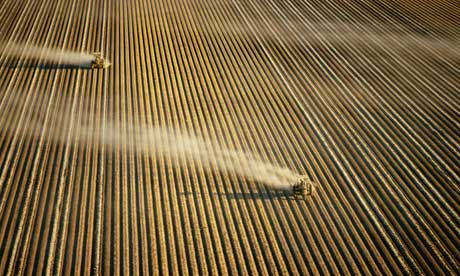
    Tractors ploughing vast field

    ‘Mainly because of industrial farming, half of all species on Earth could be extinct by the end of the century.’ Photograph: Charles O’Rear/Corbis

    British farmers can’t produce pigs as cheaply as the Poles, or cattle feed as cheaply as the Brazilians, or milk as cheaply as the Americans, or fruit as cheaply as the Spanish, and if they can’t pull their socks up, the market dictates, they will just have to go. According to a recent survey by the National Pig Association, about 100 small- to medium-sized pig farmers are likely to quit this year – which is 10% of them. We are losing dairy farmers by the score every month. Horticulture has long since gone by the board (whatever happened to “the garden of England“, aka Kent?). Only about 1% of people in Britain now work on the land.

    But it’s the same everywhere. The traditional farmers of Africa and Asia are urged to give up growing food for their own people and raise commodity crops for us, in exchange for our money, which we make by banking. Of course farms should be as big as possible to achieve economies of scale, and labour must be reduced to cut costs, so most of the existing small farmers, men and women, must go. Hundreds of thousands have committed suicide in India, but most flee to the cities to join the estimated billion rural exiles who now live in urban slums (almost a third of the urban population of the country).

    Objective data, of the kind that the scientists and economists who advise the powers-that-be claim to base their ideas upon, suggests that the new ways aren’t working – not, at least, if we feel that the job of agriculture is to produce good food. Worldwide, 1 billion people of the present 7 billion are chronically undernourished, while another billion are chronically overnourished – such that according to an article in Nature in May the world population of diabetics now exceeds the combined population of the US and Canada, and almost all because of diet. Damage to the world at large is huge. Mainly because of industrial farming, half of all species on Earth could be extinct by the end of the century. Agriculture occupies 40% of the planet’s land, but its pollution endangers creatures everywhere, including the seas, where farming run-off is destroying the coral reefs.

    But the corporate-government complex that runs our lives is committed to the all-out financial competition of the neoliberal global market. So British farmers in British conditions in a British social context are head to head with peasant Africans and US mega-corporates and Ukrainian grain barons (or would be were it not for the EU subsidies) – while farming as a whole must compete for investment with cars, weapons, casinos and hair-dressing.

    If British farmers can’t produce more cash in the short term than the Poles or the Brazilians (or the corporates who are billeted in their countries) then they just have to go. Indeed, Tony Blair’s government just a few years ago seriously mooted that British farming should go the way of its mining. It may seem hard, even vile, but, as Lady Thatcher assured us all those years ago, “there is no alternative” – and all British governments since, even those with “Labour” in the title, have taken this as gospel. The strangely-titled National Farmers Union is firmly committed to big business.

    The deep trouble is the huge clash between morality, biological reality, and the present economy. Until and unless we bring the three into line, we are bound to be in trouble. More than that, we need to acknowledge that morality (what is good) and biological reality (what is necessary and possible) must lead, and the economy must be secondary. As John Maynard Keynes said many decades ago: economics must “take the back seat” and we should focus first on “our real problems, of life and human relations, of creation, and of behaviour and religion”.

    If we don’t acknowledge the moral obligation to provide good food for everyone without wrecking the rest, then what does morality mean? There is no excuse for the present failure – for sound biological thinking shows that good food for everyone should be eminently possible. But report after report – the kind governments and big organisations choose to override – tells us that the best way to ensure that everyone is well fed, sustainably and securely, is through farms that are mixed, complex and low-input (quasi-organic). These must be labour-intensive (or there can be no complexity), so there is no advantage in them being large scale. Such farms are traditional in structure, but they need not be traditional in technology. They would benefit from good technologies and science.

    But the small-to-medium mixed farms that could feed us well and provide good jobs are absolutely at odds with the modern perceived imperative to maximise wealth. To survive in the fight for profit, skilled labour must be replaced with big machines and agrochemistry; the husbandry must be simplified – monoculture rules – and all must be done on the largest possible scale. Although industrial farming doesn’t feed everybody, has led to mass unemployment and the poverty and despair that go with it, and is wrecking the fabric of the world, it must prevail because it produces piles of short-term cash for the people who are calling the shots.

    We need to turn things round and fast. And we means us, all of us – ordinary Joes, because the governments and corporates who run the world, and their attendant experts and intellectuals, are not going to. The standard ways to bring about change are by reform or revolution – but reform is too slow and today’s politicians and the big business they are beholden to cannot change course. Revolution is too chancy and too dangerous.

    So we need the third route – renaissance: build something better in situ. In effect, a people’s takeover. All over the world individuals and communities are starting small mixed farms of the kind the world really needs, while others are starting small shops and farmers’ markets and delivery services to serve those new farms. Thousands of organisations worldwide are seeking to promote and co-ordinate these efforts.

  • Windsor calls for investigation into Cubbie bids

    Windsor calls for investigation into Cubbie bids

    Updated 1 hour 23 minutes ago

    Independent MP Tony Windsor is calling for an investigation into claims Australian investors offered a higher price for Queensland’s Cubbie Station than its eventual foreign buyers.

    Yesterday the ABC’s PM program revealed that at least a dozen Australian bidders expressed interest in buying Cubbie Station, but were rejected.

    The station’s eventual sale to a Chinese-led consortium was approved by the Federal Government at the end of last month on the advice of the Foreign Investment Review Board.

    PM was told some of the rejected bids came from local businesses offering more money, but that they were rejected by the station’s administrator.

    Now Mr Windsor says Parliament and the Review Board should be told about any higher bids for Cubbie Station – Australia’s largest cotton farm and the biggest irrigation operation in the southern hemisphere.

    Mr Windsor says the administrator must be careful not to ditch a guaranteed bid.

    But he says he must also consider whether it is the best bid to maximise returns to those who are owed money.

    “If the administrator was to have accepted a lower bid than he’d been offered, a real offer, then obviously he could be in some degree of legal strife for taking a lower bid,” he said.

    “So, obviously the administrator is obliged to get the highest bid.

    “If people are suggesting that he didn’t I think that’s something that could be well worth looking at.”

    Lawyer James Loell, who represents an Australian investor who wanted to buy Cubbie Station, told PM about a conversation he had with Lachlan Edwards of Goldman Sachs, who is negotiating the sale for the administrator.

    “Lachlan Edwards rang me and I stated my business, told him I had a purchaser, a client who was extremely interested in purchasing Cubbie Station,” he said.

    “His words to me were to the effect that it was too late, they were in the final stages of negotiating a deal with the same parties that the Treasurer had recently announced, he’d given FIRB approval to.

    “I said, ‘Are you sure it’s too late?’ and he said, ‘Look, this has been going on for a long time. We’ve got to take the bird in the hand, and they are the bird in the hand’.”

    Mr Loell says Mr Edwards told him he had had at least 12 approaches from different parties with similar interests.

    “I wouldn’t use the word necessarily ‘bids’, but parties similar to my client with an interest in owning the property. At least a dozen of them had approached him,” he said.

    ‘Bloody disgrace’

    Three years ago Cubbie Station was placed in administration with debts of around $300 million.

    If the sale goes ahead, the 93,000-hectare property will initially be 80 per cent owned by RuYi, a textile manufacturer owned by a consortium of Chinese and Japanese investors.

    As part of the sale conditions, the company will sell down its stake to 51 per cent within three years.

    Queensland LNP Senator Barnaby Joyce has branded the decision to sell Cubbie Station to foreign investors “a bloody disgrace”.

    He is calling on the administrators to re-open the sale’s process.

    “The administrators’ role is to make sure that they do the best job for the National Australia Bank, and the National Australia Bank’s role is to make sure they get the best return back for their shareholders,” he said.

    “And you can only get the best return if you’re absolutely certain there wasn’t a better return out there in the marketplace.

    “Now, if there are another 12 bids, there are 12 things that is encumbent upon both the receivers and the National Australia Bank to properly investigate.”

    Critics have labelled Senator Joyce’s stance xenophobic, but he denies there are racist undertones to his position.

    “I completely and utterly reject that. It is always so easy to basically impute a character with a taunt of a xenophobe. It stands in proxy for a dedicated and discerning argument,” he said.

    Cubbie’s administrator, John Cronin of McGrathNichol, did not return return the ABC’s calls.

    A spokesman from a public relations firm hired by the administrator said the sales process was not yet finalised.

    But he would not comment on whether rival parties offering more money had now come forward.

    There is a case to say that ditching the Chinese-led consortium’s bid now could undermine Australia’s reputation as a country open to foreign investment.

    But there is also little doubt that many would like to see Cubbie Station, and its vast water resources, remain in Australian hands.

    Topics:agribusiness, business-economics-and-finance, rural, government-and-politics, agricultural-policy, qld, nsw, dirranbandi-4486, st-george-4487, australia

    First posted 1 hour 38 minutes ago