Category: News

Add your news
You can add news from your networks or groups through the website by becoming an author. Simply register as a member of the Generator, and then email Giovanni asking to become an author. He will then work with you to integrate your content into the site as effectively as possible.
Listen to the Generator News online

 
The Generator news service publishes articles on sustainable development, agriculture and energy as well as observations on current affairs. The news service is used on the weekly radio show, The Generator, as well as by a number of monthly and quarterly magazines. A podcast of the Generator news is also available.
As well as Giovanni’s articles it picks up the most pertinent articles from a range of other news services. You can publish the news feed on your website using RSS, free of charge.
 

  • FOCUS ON…. ARCTIC BIG MELT

    FOCUS ON…. ARCTIC BIG MELT

    Arctic warning: As the system changes, we must adjust our science
    http://www.climatecodered.org/2012/09/as-arctic-system-changes-we-must-adjust.html
    David Spratt, ReNewEconomy, 12 September 2012
    The Arctic sea-ice big melt of 2012 “has taken us by surprise and we must adjust our understanding of the system and we must adjust our science and we must adjust our feelings for the nature around us”, according to Kim Holmen, Norwegian Polar Institute (NPI) international director.

    Ice loss shifts Arctic cycles
    http://www.nature.com/news/ice-loss-shifts-arctic-cycles-1.11387
    Quirin Schiermeier, Nature News, 12 September 2012
    Record shrinkage confounds models and portends atmospheric and ecological change.

    ‘Astonishing’ Ice Melt May Lead to More Extreme Winters
    http://www.climatecentral.org/news/astonishing-arctic-sea-ice-melt-may-lead-to-extreme-winter-weather-14989
    Climate Central, September 12, 2012
    The record loss of Arctic sea ice this summer will echo throughout the weather patterns affecting the U.S. and Europe this winter, climate scientists said on Wednesday, since added heat in the Arctic influences the jet stream and may make extreme weather and climate events more likely.
    AND
    Arctic sea ice melt ‘may bring harsh winter to Europe’
    http://www.guardian.co.uk/environment/2012/sep/14/arctic-sea-ice-harsh-winter-europe

    Arctic melt down: Scientists Speak Out (audio)
    http://www.ecoshock.info/2012/09/arctic-melt-down-scientists-speak-out.html

    EcoShock, 10 September 2012
    In 2012, the Arctic Sea Ice hit a stunning new record low. Rutgers scientist Jennifer Francis explains how this changes weather for billions of people in the Northern Hemisphere. Plus the Director of the Snow and Ice Data Center, Mark Serreze on record and what it means, and analysis from polar scientist Jennifer Bitz, U of Washington. In depth, direct from top scientists. Radio Ecoshock 120912 1 hour.

    The staggering decline of sea ice at the frontline of climate change
    http://www.guardian.co.uk/environment/2012/sep/14/decline-sea-ice-arctic
    John Vidal, Guardian, 14 September 2012
    Scientists on board Greenpeace’s vessel exploring the minimum extent of the ice cap are shocked at the speed of the melt.

    How Fast Can Ice Sheets Respond to Climate Change?
    http://www.sciencedaily.com/releases/2012/09/120913141136.htm
    Science Daily, Sept 13, 2012
    A new Arctic study in the journal Science is helping to unravel an important mystery surrounding climate change: How quickly glaciers can melt and grow in response to shifts in temperature.
    AND
    New Study Shows How Fast Ice Sheets Can Change
    http://www.climatecentral.org/news/new-study-shows-how-fast-ice-sheets-can-change-14996

    History of sea ice in the Arctic (pdf)
    http://bprc.osu.edu/geo/publications/polyak_etal_seaice_QSR_10.pdf
    Polyak, Alley et al, QSR29: 1757-1778 (2010)
    Although existing records are far from complete, they indicate that sea ice… consistently covered at least part of the Arctic Ocean for no less than the last 13–14 million years. Ice was apparently most wide-spread during the last 2–3 million years, in accordance with Earth’s overall cooler climate.

    Significant contribution to climate warming from the permafrost carbon feedback
    http://www.nature.com/ngeo/journal/vaop/ncurrent/full/ngeo1573.html
    Andrew H. MacDougall, Christopher A. Avis & Andrew J. WeaverNature Geoscience, 9 September 2012
    Permafrost soils contain an estimated 1,700 Pg of carbon, almost twice the present atmospheric carbon pool1. As permafrost soils thaw owing to climate warming, respiration of organic matter within these soils will transfer carbon to the atmosphere, potentially leading to a positive feedback.

    Limitations of a coupled regional climate model in the reproduction of the observed Arctic sea-ice retreat
    http://www.the-cryosphere.net/6/985/2012/tc-6-985-2012.html

  • Nation needs a fusion of science and politics

    Nation needs a fusion of science and politics

    0

    THERE is nothing like looking at a galaxy billions of years old or the light from a star that has long ceased to exist as it destroyed itself in a supernova explosion to give you some perspective about your place in the universe.

    Since winning the Nobel Prize for physics I’ve been fortunate to travel the country sharing my passion for the mysteries and beauty of the universe with people from all walks of life.

    Last night I conducted one of my more unusual lectures when I invited our federal politicians on to the roof of Parliament House in Canberra for a bit of stargazing.

    We set up telescopes on the rooftop and took a tour of the planets, stars, nebulae and galaxies – the awe-inspiring objects that make up our universe.

    I talked our political leaders through some of the ideas that have helped build my career, such as what stuff really makes up our universe; what happened to the universe in the past; and what is going to happen in the future.

    We pondered the imponderable questions – “what happened before the Big Bang” and “if the universe is expanding, what is it expanding into?” We even considered life on other planets.

    But what’s really important in explaining my work is not what I think and what I know, it’s how I, and other scientists, think.

    Last night was a great opportunity for our leaders to leave the structure and constraints of politics and indulge their curiosity. It was a chance to move beyond Question Time, and to imagine, explore and play with ideas – to understand the process of discovery.

    You see, science is not about being 100 per cent right and showing other people are 100 per cent wrong – it’s about having ideas, putting them to the test and extending our collective understanding of our world. It’s our most powerful way of thinking, where the answers to questions are judged by the painstaking collection of evidence, not by our preconceptions and prejudices.

    Science and politics do not always have an easy partnership. Politicians talk in absolutes, they use their skills of communication for persuasion – they are often driven by ideology and the short-term imperatives of maintaining public support.

    Scientists are different beasts. We question everything, we never prove theories, we just attempt to disprove them until they exist beyond doubt, and even then waves of questioning continue.

    Our work is peer-reviewed, analysed, replicated and refined. It is no surprise that science is sometimes deemed ‘too hard’ for politics – it never gives black-and-white answers.

    So science is often sidelined as some abstract concept rather than an essential tool for making better decisions. You only have to look back at the climate debate to see these issues in action. Politicians and the public alike remain confused by the complex debate over the finer points of how we model the Earth’s climate.

    Despite the vast majority of experts endorsing the view that human activities are causing the Earth’s climate to change, there remain scientists who attack this prevailing view, and this will never change, no matter how strong the evidence is. Scientists are trained to challenge everything.

    But this does not mean we know nothing, and we cannot afford to have the widely established climate science outcomes treated as just “one side of the argument” against what is often uninformed opinion latching on to the skepticism inherent to our discipline.

    Politicians need expert bodies of scientists that they can trust, who can given honest assessments of what we know – and what we don’t know.

    This week is a big week for science. Science Meets Parliament brings together some 200 of Australia’s top scientists and puts them face to face with the country’s leaders in Canberra.

    It’s a much-needed opportunity for our profession to walk the corridors of parliament house and engage with the nation’s decision-makers. While last year’s Science Meets Parliament was over-shadowed by attacks on science, including death threats against scientists, this year the story is much more positive.

    As I’ve engaged with the public after receiving the Nobel Prize I have been heartened by the enthusiasm of people around the country to understand science and what we scientists do.

    The public understands our message to the politicians this week: For the benefit of the nation, Australia needs to have science front and centre in the public debate.

    Here are three important things I would like to see:

    MORE evidenced-based policy making – each proposal should consider the best available evidence and be nuanced by the political considerations of the day – not the other way around;

    MORE scientists in government – we don’t have to have a parliament full of lawyers and political practitioners. More diversity of backgrounds would strengthen our democracy, and this does not just include MPs but also advisers and government officials; and

    WE need a steady hand when it comes to funding science.

    Science is a long-term investment and feeding it one year and starving it the next will lead to a poor return. We need to nurture a love of science in schools, keep students engaged and interested enough to become not just the scientists and Nobel Prize winners of tomorrow, but citizens able to thrive in an increasingly sophisticated world.

    I hope last night starts a conversation about getting our leaders to see the world from outside their bubble and better appreciate how science can contribute. Maybe our MPs will continue to reach for the stars years after this night has passed.

    Professor Brian Schmidt was awarded the 2011 Nobel Prize in Physics

  • CSIRO study projects climate change effects across Australia

    CSIRO study projects climate change effects across Australia

    1
    Sydney disaster

    It probably won’t be Hollywood-blockbuster bad like this scene from the movie 2012, but dramatic change is coming to the Australian landscape. Picture: Sony Source: The Daily Telegraph

    CLIMATE change will alter the Australian landscape so dramatically and so quickly that our grandchildren could live in a very different country, according to a landmark CSIRO study.

    And the study’s lead researchers fear Australians may not be ready to accept the new way their country may soon smell, sound and look.

    The Commonwealth’s science and research body has produced the first “Australia-wide assessment of the magnitude of the ecological impact that climate change could have on biodiversity” and how the changes could be managed.

    It says totally new environments will emerge while others vanish and there will be a decline in forest environments, which will give way to shrubs and grasslands.

    “Climate change is likely to start to transform some of Australia’s natural landscapes by 2030,” said lead researcher Dr Michael Dunlop, from the CSIRO’s Ecosystem Sciences division.

    “By 2070, the ecological impacts are likely to be very significant and widespread.

    “Many of the environments our plants and animals currently exist in will disappear from the continent. Our grandchildren are likely to experience landscapes that are very different to the ones we have known.”

    The changes will be so profound that they will have major implications for management of the environment and, in particular, Australia’s national parks and nature reserves.

    “If future generations want to experience and enjoy our distinctive plants and animals and the wonders of the Australian bush, then we need to give biodiversity the greatest opportunity to adapt naturally in a changing and variable environment, rather than trying to prevent ecological change,” Dr Dunlop said.

    The study identified a range of management options, including ensuring there is plenty of habitat of different types available for plants and animals.

    “But one of the biggest challenges could be the community accepting the levels of ecological change that we could experience,” Dr Dunlop said.

    “Familiar species declining, and species from different areas turning up and establishing; ecosystems people grew up with gradually changing and becoming something new; looking, sounding smelling different.

    “I don’t know if we are ready to accept this level of change.

    “This is also a challenge for conservation science and policy. Current conservation is largely focused on keeping things the same, or restoring their condition. That is quite different from managing ecological change, maintaining the health of an ecosystem as it changes from one type of ecosystem to another.”

    Wary of past criticism, the CSIRO says it is confident in the accuracy of the complex computer models it used.


  • Caroline Flint: ‘Conservatives don’t show climate change the respect it deserves’ – video

    Caroline Flint: ‘Conservatives don’t show climate change the respect it deserves’ – video

    Caroline Flint, the shadow secretary of state for energy and climate change, criticises the Conservative leadership for trying to reap the PR benefits of environmentalism while lacking the imagination to deliver on their promises. She argues that climate change should be discussed in terms of the opportunities the green economy offers to people in the UK

    Source: guardian.co.uk

  • UK windfarms generate record amount of power

    UK windfarms generate record amount of power

    4.1GW total from wind turbines is enough to light and heat more than 3m British homes

    Little Cheyne Court wind farm in Camber, Kent

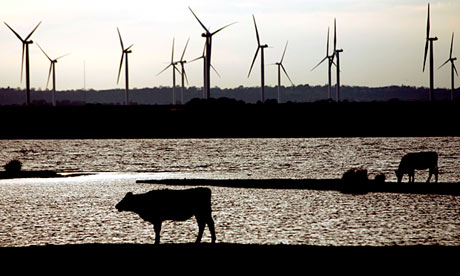
    A wind farm in Kent. The 4.1GW generated by Britain’s wind turbines on Friday compares with Drax, the UK’s largest coal and biomass-fired power station. Photograph: Haydn West/Rex Features

    Britain’s windfarms broke a new record on Friday by providing over four gigawatts of power to the National Grid – enough to light and heat more than 3m British homes.

    It beats a previous high of 3.8GW set in May and comes as a further 4GW of wind turbines are being installed, half on land and half offshore.

    Just before 10am, wind turbines were supplying 10.8% of the total amount of electricity going into the grid while an additional 2.2GW of “green” power was going directly into local electricity networks.

    “This record high shows that wind energy is providing a reliable, secure supply of clean electricity to an ever-greater number of British homes and businesses,” said Maria McCaffery, chief executive at the campaign group RenewableUK. “As our wind energy capacity increases, the need to import expensive fossil fuels starts to diminish. The transition to a low-carbon economy is well under way and harnessing this bountiful, free resource will help us to drive down energy bills for all users in the long term.”

    Critics will point out that the 4.1GW total compares with the UK’s largest coal and biomass-fired power station, Drax in North Yorkshire, which produces almost that amount of power on its own.

  • UNBELIEVABLE HERO MOM

    What a story. We could learn a lot from our fatthful 4 legged friends,


    Subject: FW: : UNBELIEVABLE HERO MOM

    isnt she just so devoted & caring

    UNBELIEVABLE HERO MOM
    During an early morning response to a house fire in Santa Rose de Temuco, Chile , firefighters witnessed the unbelievable. A mother dog risked her life to save her puppies from the fire surrounding the burning house, which started because of a car bomb.

    The mother dog, Amanda, raced back and forth between the house, putting her 10 day old puppies in the safest place she could find – a firetruck!

    She didn’t stop racing back into the fire until all of her puppies were safely away from the fire. The firemen on scene could not believe their eyes. Most people have never seen a dog this smart or this brave!

    After rescuing all of her pups from the blaze, Amanda sat down next to them, protecting them with her body. Onlookers called an emergency veterinary service and she and her pups were rushed to the hospital. Aside from one puppy being treated for serious burns, the entire family are alive and well – thanks to the bravery of Amanda! What a heroic mother! 🙂

    HOW AMAZING IS THAT STORY? AND PEOPLE CALL THEM DUMB!!!


    Email correspondence to and from this address is subject to the North Carolina Public Records Law and may be disclosed to third parties by an authorized State official. Unauthorized disclosure of juvenile, health, legally privileged, or otherwise confidential information, including confidential information relating to an ongoing State procurement effort, is prohibited by law. If you have received this e-mail in error, please notify the sender immediately and delete all records of this e-mail.