Category: News

Add your news
You can add news from your networks or groups through the website by becoming an author. Simply register as a member of the Generator, and then email Giovanni asking to become an author. He will then work with you to integrate your content into the site as effectively as possible.
Listen to the Generator News online

 
The Generator news service publishes articles on sustainable development, agriculture and energy as well as observations on current affairs. The news service is used on the weekly radio show, The Generator, as well as by a number of monthly and quarterly magazines. A podcast of the Generator news is also available.
As well as Giovanni’s articles it picks up the most pertinent articles from a range of other news services. You can publish the news feed on your website using RSS, free of charge.
 

  • tHEY’RE FORCING US OFF OUR LAND (avaaz)

    Dear friends,


    Middle Eastern kings and princes are about to force up to 48,000 people in Tanzania from their land to make way for corporate-sponsored big game hunting. But Tanzanian President Kikwete has shown before that he will stop deals like this when they generate negative press coverage. Click to deliver a media blitz that will push President Kikwete to stop the landgrab and save these Maasai.


    At any moment, a big-game hunting corporation could sign a deal which would force up to 48,000 members of Africa’s famous Maasai tribe from their land to make way for wealthy Middle Eastern kings and princes to hunt lions and leopards. Experts say the Tanzanian President’s approval of the deal may be imminent, but if we act now, we can stop this sell-off of the Serengeti.


    The last time this same corporation pushed the Maasai off their land to make way for rich hunters, people were beaten by the police, their homes were burnt to a cinder and their livestock died of starvation. But when a press controversy followed, Tanzanian President Kikwete reversed course and returned the Maasai to their land. This time, there hasn’t been a big press controversy yet, but we can change that and force Kikwete to stop the deal if we join our voices now.


    If 150,000 of us sign, media outlets in Tanzania and around the world will be blitzed so President Kikwete gets the message to rethink this deadly deal. Sign the petition now and send to everyone:


    http://www.avaaz.org/en/save_the_maasai_a/?bhPqncb&v=17057


    The Maasai are semi-nomadic herders who have lived in Tanzania and Kenya for centuries, playing a critical role in preserving the delicate ecosystem. But to royal families from the United Arab Emirates, they’re an obstacle to luxurious animal shooting sprees. A deal to evict the Maasai to make way for rich foreign hunters is as bad for wildlife as it is for the communities it would destroy. While President Kikwete is talking to favoured local elites to sell them on the deal as good for development, the vast majority of people just want to keep the land that they know the President can take by decree.


    President Kikwete knows that this deal would be controversial with Tanzania’s tourists — a critical source of national income — and is therefore trying to keep it from the public eye. In 2009, a similar royal landgrab in the area executed by the same corporation that is swooping in this time generated global media coverage that helped to roll it back. If we can generate the same level of attention, we know the pressure can work.


    A petition signed by thousands can force all the major global media bureaus in East Africa and Tanzania to blow up this controversial deal. Sign now to call on Kikwete to kill the deal:


    http://www.avaaz.org/en/save_the_maasai_a/?bhPqncb&v=17057


    Representatives from the Maasai community today urgently appealed to Avaaz to raise the global alarm call and save their land. Time and again, the incredible response from this amazing community turns seemingly lost causes into legacies that last a lifetime. Lets protect the Maasai and save the animals for tourists that want to shoot them with camera lenses, rather than lethal weapons!


    With hope and determination,


    Sam, Meredith, Luis, Aldine, Diego, Ricken and the rest of the Avaaz team


    For More Information:


    The Guardian: “Tourism is a curse to us”

    http://www.guardian.co.uk/world/2009/sep/06/masai-tribesman-tanzania-tourism


    News Internationalist Magazine: “Hunted down”

    http://www.newint.org/columns/currents/2009/12/01/tanzania/


    Society for Threatened People: Briefing on the eviction of the Loliondo Maasai

    http://lib.ohchr.org/HRBodies/UPR/Documents/session12/TZ/STP-SocietyThreatenedPeople-eng.pdf


    FEMACT: Report by 16 human rights investigators & media on violence in Loliondo

    http://www.pambazuka.org/en/category/advocacy/58956/print


    Voices of Loliondo: Short film from Loliondo on impact of eviction on Maasai


    Support the Avaaz Community!


    We’re entirely funded by donations and receive no money from governments or corporations. Our dedicated team ensures even the smallest contributions go a long way.


    Avaaz.org is a 15-million-person global campaign network that works to ensure that the views and values of the world’s people shape global decision-making. (“Avaaz” means “voice” or “song” in many languages.) Avaaz members live in every nation of the world; our team is spread across 19 countries on 6 continents and operates in 14 languages. Learn about some of Avaaz’s biggest campaigns here, or follow us on Facebook or Twitter.


    You are getting this message because you signed “Save our dying planet!” on 2011-12-08 using the email address nevilleg729@gmail.com.

    To ensure that Avaaz messages reach your inbox, please add avaaz@avaaz.org to your address book. To change your email address, language settings, or other personal information, https://secure.avaaz.org/act/index.php?r=profile&user=6be3e9aa63582c9b1397464fcc49baa9&lang=en, or simply go here to unsubscribe.


    To contact Avaaz, please do not reply to this email. Instead, write to us at www.avaaz.org/en/contact or call us at +1-888-922-8229 (US).
  • Why the EU will not Survive

    Why the EU will not Survive


    Posted: 10 Aug 2012 03:35 PM PDT


    The problem, I think, is much more serious than Rajoy’s flunking hard choices, and I don’t think there was anything he could do to increase the country’s credibility in a significant way. We have long passed that stage.?Why? Because, as I have been suggesting for the last six to twelve months, Spain has already started on its downward spiral and there is almost nothing Rajoy or anyone else can do to prevent all parts of the economy – workers, small businesses, large businesses, creditors, depositors, and yes, policymakers…

    Read more…

  • CLIMATE CODE RED Extensive melt over the Greenland Ice Sheet.

    Climate News

    Posted: 11 Aug 2012 08:13 PM PDT

    Week ending 12 August 2012

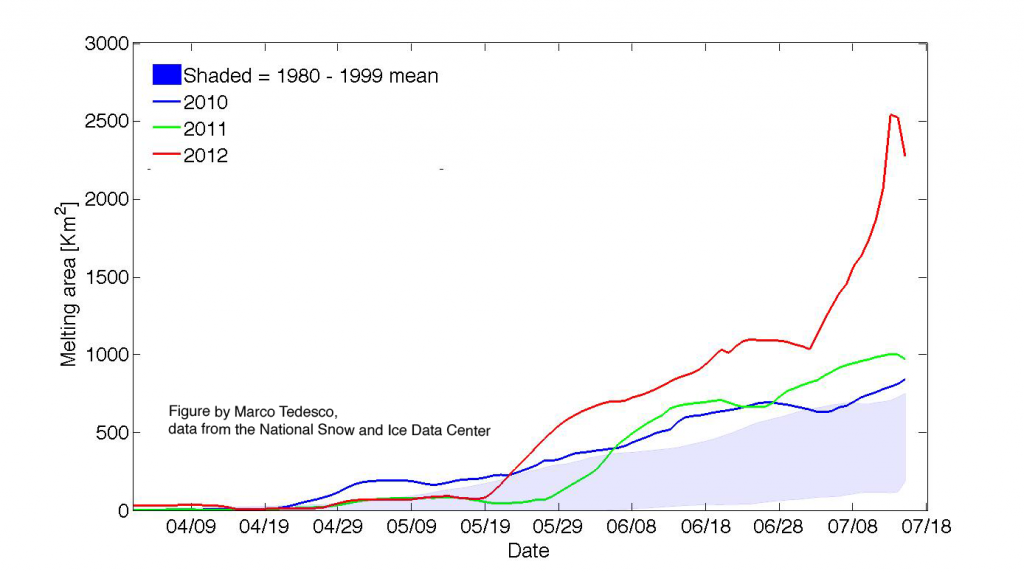
    Extensive melt over the Greenland Ice Sheet. This figure shows the daily, cumulative area of the Greenland ice sheet showing surface melt for 2012, 2011, 2010 and for the 1980 to 1999 mean. While melt was unusually extensive through May and June of 2012, the melt area increased rapidly in early July in response to an unusually warm weather event. Source: http://nsidc.org/arcticseaicenews/2010/08/a-most-interesting-arctic-summer/figure6-2/
  • Greenpeace head urges climate consensus

    Greenpeace head urges climate consensus

    Daniel Fogarty, AAPAugust 12, 2012, 2:40 pm


    Australia faces serious trouble from climate change unless our politicians can reach consensus on the issue and lead the global fight to reduce emissions, the new CEO of Greenpeace says.

    David Ritter has urged Opposition Leader Tony Abbott to rethink his promise to repeal the carbon tax if he becomes prime minister, and says Australia must follow its tradition of punching above its weight when it comes to finding solutions to climate change.

    Tackling climate change must also involve Australia exerting diplomatic pressure on other nations, he says.

    Perth-born Mr Ritter has returned to Australia after five years working for Greenpeace in the UK, to take up the position as CEO of Greenpeace Australia Pacific.

    The former commercial lawyer first developed a passion for native title issues before turning his focus to the environment.

    In London, he worked for Greenpeace on global campaigns on oceans, rainforests and climate change.

    There the tone of debate on climate change is “very, very different”, with a push for action from all major political parties, he says.

    As leader of the opposition, now British Prime Minister David Cameron once launched a policy from the Greenpeace warehouse.

    Mr Ritter is urging Mr Abbott to follow the UK Conservatives’ bipartisan approach and not repeal the carbon tax.

    “Obviously I hope whoever leads the Liberal Party, whether it is Abbott or anyone else, if they do succeed in becoming prime minster I obviously hope they don’t repeal the carbon tax,” he told AAP.

    “I know that statements have been made to that effect, but you would like to hope that a different view would be taken in government.”

    Instead, Mr Ritter hopes Australia can be a leader in the global response to climate change.

    “I’d like to see an Australia which takes an ambitious view on climate change, not only in terms of targets but in terms of things that people feel much more tangibly,” he said.

    “I would like to see an Australia that took on foreign policy initiatives that were about saying `Look, if climate change is not halted, is not tackled effectively, Australia is in really serious trouble.’

    As Greenpeace CEO, Mr Ritter hopes to continue to do as he did in the UK and work with big companies on environmental issues.

    During his time in London he built working relationships with retail giants Marks and Spencer and Sainsbury’s.

    “You can’t expect people to act outside of their role,” he said.

    “People who work within companies will always have to put the company first. But there’s an awful lot of room to look for solutions and to look for where we can make progress.

    “I see the role of Greenpeace as tapping into the extraordinary energy, emotion and willingness and goodwill that exists among people to really get moving and change things.”

  • HANSEN Increasing Climate Extremes and “The New Climate Dice”

    Increasing Climate Extremes and “The New Climate Dice”
    New quantitative results and discussion of “The New Climate Dice” are available on my web site or directly here.

    Jim Hansen
    10 August 2012

    Click here to ReplyReply to all, or Forward
  • Rate of arctic summer sea ice loss is 50% higher than predicted

    Rate of arctic summer sea ice loss is 50% higher than predicted

    New satellite images show polar ice coverage dwindling in extent and thickness

    Graphic: shrinking ice caps. Credit: Giulio Frigieri

    The view from a yacht’s mast

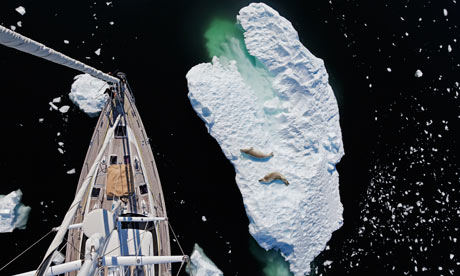
    The view from a yacht’s mast. Summer pack ice is showing a rate of loss 50% higher than anticipated. Photograph: Mike Powell/Corbis

    Sea ice in the Arctic is disappearing at a far greater rate than previously expected, according to data from the first purpose-built satellite launched to study the thickness of the Earth’s polar caps.

    Preliminary results from the European Space Agency‘s CryoSat-2 probe indicate that 900 cubic kilometres of summer sea ice has disappeared from the Arctic ocean over the past year.

    This rate of loss is 50% higher than most scenarios outlined by polar scientists and suggests that global warming, triggered by rising greenhouse gas emissions, is beginning to have a major impact on the region. In a few years the Arctic ocean could be free of ice in summer, triggering a rush to exploit its fish stocks, oil, minerals and sea routes.

    Using instruments on earlier satellites, scientists could see that the area covered by summer sea ice in the Arctic has been dwindling rapidly. But the new measurements indicate that this ice has been thinning dramatically at the same time. For example, in regions north of Canada and Greenland, where ice thickness regularly stayed at around five to six metres in summer a decade ago, levels have dropped to one to three metres.

    “Preliminary analysis of our data indicates that the rate of loss of sea ice volume in summer in the Arctic may be far larger than we had previously suspected,” said Dr Seymour Laxon, of the Centre for Polar Observation and Modelling at University College London (UCL), where CryoSat-2 data is being analysed. “Very soon we may experience the iconic moment when, one day in the summer, we look at satellite images and see no sea ice coverage in the Arctic, just open water.”

    The consequences of losing the Arctic’s ice coverage, even for only part of the year, could be profound. Without the cap’s white brilliance to reflect sunlight back into space, the region will heat up even more than at present. As a result, ocean temperatures will rise and methane deposits on the ocean floor could melt, evaporate and bubble into the atmosphere. Scientists have recently reported evidence that methane plumes are now appearing in many areas. Methane is a particularly powerful greenhouse gas and rising levels of it in the atmosphere are only likely to accelerate global warming. And with the disappearance of sea ice around the shores of Greenland, its glaciers could melt faster and raise sea levels even more rapidly than at present.

    Professor Chris Rapley of UCL said: “With the temperature gradient between the Arctic and equator dropping, as is happening now, it is also possible that the jet stream in the upper atmosphere could become more unstable. That could mean increasing volatility in weather in lower latitudes, similar to that experienced this year.”

    CryoSat-2 is the world’s first satellite to be built specifically to study sea-ice thickness and was launched on a Dniepr rocket from Baikonur cosmodrome, Kazakhstan, on 8 April, 2010. Previous Earth monitoring satellites had mapped the extent of sea-ice coverage in the Arctic. However, the thickness of that ice proved more difficult to measure.

    The US probe ICESat made some important measurements of ice thickness but operated intermittently in only a few regions before it stopped working completely in 2009. CryoSat was designed specifically to tackle the issue of ice thickness, both in the Arctic and the Antarctic. It was fitted with radar that can see through clouds. (ICESat’s lasers could not penetrate clouds.) CryoSat’s orbit was also designed to give better coverage of the Arctic sea.

    “Before CryoSat, we could see summer ice coverage was dropping markedly in the Arctic,” said Rapley. “But we only had glimpses of what was happening to ice thickness. Obviously if it was dropping as well, the loss of summer ice was even more significant. We needed to know what was happening – and now CryoSat has given us the answer. It has shown that the Arctic sea cap is not only shrinking in area but is also thinning dramatically.”

    Sea-ice cover in the Arctic varies considerably throughout the year, reaching a maximum in March. By combining earlier results from ICESat and data from other studies, including measurements made by submarines travelling under the polar ice cap, Laxon said preliminary analysis now gave a clear indication of Arctic sea-ice loss over the past eight years, both in winter and in summer.

    In winter 2004, the volume of sea ice in the central Arctic was approximately 17,000 cubic kilometres. This winter it was 14,000, according to CryoSat.

    However, the summer figures provide the real shock. In 2004 there was about 13,000 cubic kilometres of sea ice in the Arctic. In 2012, there is 7,000 cubic kilometres, almost half the figure eight years ago. If the current annual loss of around 900 cubic kilometres continues, summer ice coverage could disappear in about a decade in the Arctic.

    However, Laxon urged caution, saying: “First, this is based on preliminary studies of CryoSat figures, so we should take care before rushing to conclusions. In addition, the current rate of ice volume decline could change.” Nevertheless, experts say computer models indicate rates of ice volume decline are only likely to increase over the next decade.

    As to the accuracy of the measurements made by CryoSat, these have been calibrated by comparing them to measurements made on the ice surface by scientists including Laxon; by planes flying beneath the satellite’s orbit; and by data supplied by underwater sonar stations that have analysed ice thickness at selected places in the Arctic. “We can now say with confidence that CryoSat’s maps of ice thickness are correct to within 10cm,” Laxon added.

    Laxon also pointed out that the rate of ice loss in winter was much slower than that in summer. “That suggests that, as winter starts, ice is growing more rapidly than it did in the past and that this effect is compensating, partially, for the loss of summer ice.” Overall, the trend for ice coverage in Arctic is definitely downwards, particularly in summer, however – a point recently backed by Professor Peter Wadham, who this year used aircraft and submarine surveys of ice sheets to make estimates of ice volume loss. These also suggest major reductions in the volume of summer sea ice, around 70% over the past 30 years.

    “The Arctic is particularly vulnerable to the impact of global warming,” said Rapley. “Temperatures there are rising far faster than they are at the equator. Hence the shrinking of sea-ice coverage we have observed. It is telling us that something highly significant is happening to Earth. The weather systems of the planet are interconnected so what happens in the high latitudes affects us all.”