Category: News

Add your news
You can add news from your networks or groups through the website by becoming an author. Simply register as a member of the Generator, and then email Giovanni asking to become an author. He will then work with you to integrate your content into the site as effectively as possible.
Listen to the Generator News online

 
The Generator news service publishes articles on sustainable development, agriculture and energy as well as observations on current affairs. The news service is used on the weekly radio show, The Generator, as well as by a number of monthly and quarterly magazines. A podcast of the Generator news is also available.
As well as Giovanni’s articles it picks up the most pertinent articles from a range of other news services. You can publish the news feed on your website using RSS, free of charge.
 

  • New battery technology means more power for electric cars

    New battery technology means more power for electric cars

    chevy volt

    New battery technology means electric cars such as Chevrolet’s Volt could have double the range. Source: Getty Images

    A SMALL battery company backed by General Motors is working on breakthrough technology that could power an electric car more than 300km on a single charge in the next two-to-four years, GM’s CEO says.

    Speaking at an employee meeting, CEO Dan Akerson said the company, Newark, California-based Envia Systems, has made a huge breakthrough in the amount of energy a lithium-ion battery can hold.

    GM is sure that the battery will be able to take a car 100 miles (160km) within a couple of years, he said. It could be double that with some luck, he said.

    “I think we’ve got better than a 50-50 chance,” Mr Akerson said, “to develop a car that will go to 200 miles (320km) on a charge,” he said. “That would be a game changer.”

    GM’s current electric car, the Chevrolet Volt, goes about 56km on a charge and has a small petrol motor that generates power to keep the car going after that.

    Few competitors have electric cars with more than 160km of range.

    Can you drift an electric car?

    On a test track in the UK, a battery powered car is pushed past it limits.


    Tesla Motors’ Model S can go up to 480km, but it has a much larger battery and can cost more than twice as much as a Volt. Nissan’s Leaf and Ford’s Focus electric cars both claim ranges of around 160km, but that can vary with temperature, terrain and speed.

    Envia said earlier this year that its next-generation rechargeable lithium-ion cell hit a record high for energy density. The company said the new battery could slash the price of electric vehicles by cutting the battery cost in half.

    GM Ventures LLC, the automaker’s investment arm, put $US7 million ($6.6m) into Envia in January of 2011.

    The GM meeting, which was broadcast on a conference call to employees, lasted about an hour. A participant allowed a reporter from The Associated Press to listen.

    “These little companies come out of nowhere, and they surprise you,” Mr Akerson said in response to a question about GM’s strategy on gas-electric hybrid vehicles.

    Mr Akerson said the company is looking at hybrids, all-electric cars, hydrogen fuel cell vehicles and natural gas vehicles, as well as developing more efficient petroleum-powered engines.

    “We can’t put all of our chips on one bet,” he said. “We’ve got to look at them all.”

  • Drivers of marine biodiversity: Tiny, freeloading clams find the key to evolutionary success

    Drivers of marine biodiversity: Tiny, freeloading clams find the key to evolutionary success

    Posted: 09 Aug 2012 06:03 AM PDT

    What mechanisms control the generation and maintenance of biological diversity on the planet? It’s a central question in evolutionary biology. For land-dwelling organisms such as insects and the flowers they pollinate, it’s clear that interactions between species are one of the main drivers of the evolutionary change that leads to biological diversity.
    You are subscribed to email updates fromScienceDaily: Oceanography News
    To stop receiving these emails, you may unsubscribe now.
    Email delivery powered by Google
    Google Inc., 20 West Kinzie, Chicago IL USA 60610

    Posted: 09 Aug 2012 06:03 AM PDT

    What mechanisms control the generation and maintenance of biological diversity on the planet? It’s a central question in evolutionary biology. For land-dwelling organisms such as insects and the flowers they pollinate, it’s clear that interactions between species are one of the main drivers of the evolutionary change that leads to biological diversity.
    You are subscribed to email updates fromScienceDaily: Oceanography News
    To stop receiving these emails, you may unsubscribe now.
    Email delivery powered by Google
    Google Inc., 20 West Kinzie, Chicago IL USA 60610
  • PRB’s 2012 World Population Data Sheet

    PRB’s 2012 World Population Data Sheet
    New Security Beat
    “The most rapid population growth in many ways [occurs in] the countries that can least afford it,” said Carl Haub in a webinar on July 19 to launch the Population Reference Bureau’s (PRB) 50th annual World Population Data Sheet. This year, the report 
    See all stories on this topic »

  • New global warming culprit: Methane emissions jump dramatically during dam drawdowns

    New atmospheric compound tied to climate change, human health

    Posted: 08 Aug 2012 10:27 AM PDT

    Scientists have discovered a surprising new chemical compound in Earth’s atmosphere that reacts with sulfur dioxide to form sulfuric acid, which is known to have significant impacts on climate and health. The new compound, a type of carbonyl oxide, is formed from the reaction of ozone with alkenes, which are a family of hydrocarbons with both natural and human-made sources.

    New global warming culprit: Methane emissions jump dramatically during dam drawdowns

    Posted: 08 Aug 2012 05:14 AM PDT

    Researchers have documented an underappreciated suite of players in global warming: dams, the water reservoirs behind them, and surges of greenhouse gases as water levels go up and down. In separate studies, researchers saw methane levels jump 20- and 36-fold during drawdowns.
    You are subscribed to email updates from ScienceDaily: Earth Science News
    To stop receiving these emails, you may unsubscribe now.
    Email delivery powered by Google
    Google Inc., 20 West Kinzie, Chicago IL USA 60610
  • Unusual weather events identified during 2009 Black Saturday bushfires in Victoria, Australia

    Unusual weather events identified during 2009 Black Saturday bushfires in Victoria, Australia

    Posted: 08 Aug 2012 07:45 AM PDT

    Research has revealed that the extremely hot, dry and windy conditions on Black Saturday in the Australian state of Victoria combined with structures in the atmosphere called ‘horizontal convective rolls’ — similar to streamers of wind flowing through the air — which likely affected fire behavior.

  • America’s drought of political will on climate change

    America’s drought of political will on climate change

    With US politics paralysed by the partisan divide on climate change, public concern about extreme weather cannot bear fruit

    Indiana, drought, corn

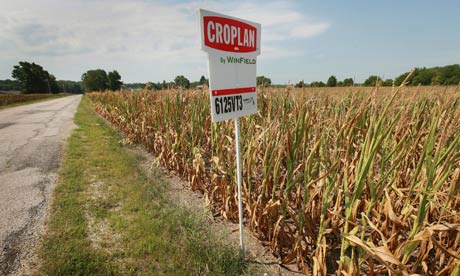
    A field of corn drying up in a drought-stricken field near Vincennes, Indiana, July 2012. Photograph: Scott Olson/Getty Images

    As the US faces record drought and an Old Testament-level pestilential heatwave in the midwest, American environmental denialism may be starting to change. The question is: is it too late?

    America has led the world in climate change denial, a phenomenon noted with amazement by Europeans, not to mention thinking people around the world. Year after year, the US has failed to sign global treaties or curb emissions, even as our status as a source of a third of the world’s carbon emissions goes unchanged.

    It is fairly well-known what has been behind that climate change denial in America: vast sums pumped into an ignorance industry by the oil and gas lobbies. Entire thinktanks to obfuscate manmade climate change have been funded by these interests, as have individual congressmen and women. Entirely typical, for instance, is Louisiana Representative John Fleming, whose campaigns, according to blogger John Henry, accept about $200,000 a year from oil and gas lobbyists, and who uses his social media pages to deny global warming.

    It is weird to live inside that US denial about climate change. Last year, for example, as tropical storm Irene approached New York, we duly boarded up windows, put in emergency supplies, and heard endless alarming bulletins from the mayor’s office about which neighborhoods were likely to be submerged if the tides surged – without ever hearing from local officials or the media a word connecting rising sea levels with manmade global warming. All the more weird because New Yorkers weren’t writing off portions of their downtown neighborhoods to overflowing seawater a century ago.

    It is weird, too, to watch the leaves turn red earlier and earlier in the fall in the American northeast and have absolutely everyone say, “the weather is strange” – yet never see mainstream media reflect any interest in the connection between human industrial activity and that strangeness. And this weather map shows how widespread and extensive that extreme weather is in the US.

    But could our denial be cracking, this summer, as, in the heartland – that most iconic of American landscapes – broiling temperatures injure humans and cook fish in the water? This summer a crisis has occurred (though one that, again, is seldom reported on in terms of our outsize contribution to the disaster), as midwestern farmers lost vast swaths of their corn crop to scalding heat and drought. In the American unconscious of wishful ignorance, this disaster and loss was to be borne, as usual, by other people far away.

    But we face some serious problems in rising out of our torpor. In “Shifting Public Opinion on Climate Change: An Empirical Assessment of Factors Influencing Concern over Climate Change in the US, 2002–2010”, John Wihbey shows that Gallup surveys reveal Americans’ level of concern varying widely:

    “In 2004, 26% of respondents said they worried “a great deal” about the issue; in 2007 that number rose to 41%; by 2010, it had fallen to 28%. This variation comes despite consensus among scientists about the underlying data patterns and virtual unanimity of scientific opinion.”

    Wihbey and colleagues’ study found that this fluctuation was caused by, among other factors, political polarization. In other words, when one party says global warming is a crisis and the other says all that is nonsense, and there is no cooperation between political elites at both ends of the spectrum, the net result is apathy.

    “The two strongest effects on public concern are Democratic congressional action statements and Republican roll-call votes, which increase and diminish public concern, respectively. This finding points to the effect of [a] polarized political elite that is emitting contrary cues, with resulting (seemingly) contrary levels of public concern.”

    They found, ominously, that the level and quality of good information in the general media at large had little effect on people’s levels of concern – indeed, weather events themselves had little bearing on people’s levels of climate-related anxiety or interest. Only the combination of media coverage and expressed alarm from political leaders bumped up public concern.

    With the oil and gas lobbies pumping money into Congress to blunt any professed concern among the political class, that motivating union of genuine concern and honest messaging can scarcely be relied on. The authors conclude, dispiritedly:

    “Given the vested economic interests reflected in this polarization, it seems doubtful that any communication process focused on persuading individuals will have much impact.”

    I spent part of this summer looking at glaciers in Alaska; in Juneau, in Tongass National Forest, park rangers expect that a glacier there will withdraw, from effects of anticipated climate change, in 50 years. So, the federal government is planning for the effects of manmade climate change, even as the White House and US Congress remain paralysed from doing anything to arrest the warming: the very definition of denial. If we don’t snap out of this stasis of stupidity, nothing can change for good.