Category: News

Add your news
You can add news from your networks or groups through the website by becoming an author. Simply register as a member of the Generator, and then email Giovanni asking to become an author. He will then work with you to integrate your content into the site as effectively as possible.
Listen to the Generator News online

 
The Generator news service publishes articles on sustainable development, agriculture and energy as well as observations on current affairs. The news service is used on the weekly radio show, The Generator, as well as by a number of monthly and quarterly magazines. A podcast of the Generator news is also available.
As well as Giovanni’s articles it picks up the most pertinent articles from a range of other news services. You can publish the news feed on your website using RSS, free of charge.
 

  • Earth’s oceans and other ecosystems still absorbing about half the greenhouse gases emitted by people

    ScienceDaily: Earth Science News


    Northwest earthquake risk in U.S. looms large: 40% chance of major earthquake within 50 years

    Posted: 01 Aug 2012 10:27 AM PDT

    A comprehensive analysis of the Cascadia Subduction Zone off the Pacific Northwest coast confirms that the region has had numerous earthquakes over the past 10,000 years, and suggests that the southern Oregon coast may be most vulnerable based on recurrence frequency.

    Earth’s oceans and other ecosystems still absorbing about half the greenhouse gases emitted by people

    Posted: 01 Aug 2012 10:24 AM PDT

    Earth’s oceans, forests and other ecosystems continue to soak up about half the carbon dioxide emitted into the atmosphere by human activities, even as those emissions have increased, according to a new study. The scientists analyzed 50 years of global carbon dioxide measurements and found that the processes by which the planet’s oceans and ecosystems absorb the greenhouse gas are not yet at capacity.

    Tropical climate in the Antarctic: Palm trees once thrived on today’s icy coasts 52 million years ago

    Posted: 01 Aug 2012 10:23 AM PDT

    Given the predicted rise in global temperatures in the coming decades, climate scientists are particularly interested in warm periods that occurred in the geological past. Knowledge of past episodes of global warmth can be used to better understand the relationship between climate change, variations in atmospheric carbon dioxide and the reaction of Earth’s biosphere. Scientists have discovered an intense warming phase around 52 million years ago in drill cores obtained from the seafloor near Antarctica — a region that is especially important in climate research.

    Lower hybrid drift waves in Earth’s magnetosphere investigated

    Posted: 01 Aug 2012 08:44 AM PDT

    Scientists have detected and characterized lower hybrid drift waves, a special kind of plasma waves that develop in thin boundaries both in space and in the laboratory. The measurement of fundamental properties of these waves was possible when two of the spacecraft were flying very close to one another in the tail of Earth’s magnetosphere. With wavelengths of about 60 km, these waves appear to play an important role in the dynamics of electrons and in the transfer of energy between different layers of plasma in the magnetosphere.

    Auroras and thin current sheets in space

    Posted: 01 Aug 2012 06:37 AM PDT

    Around Earth, the processes accelerating electrons which hit the atmosphere and cause beautiful auroras are often initiated in thin current sheets. Similar processes, auroras and thin current sheets are found around other planets such as Jupiter and Saturn. Plasma regions close to the hot solar surface are separated by thin current sheets, and similar boundaries should also be common around distant stars.
    You are subscribed to email updates fromScienceDaily: Earth Science News
    To stop receiving these emails, you may unsubscribe now.
    Email delivery powered by Google
    Google Inc., 20 West Kinzie, Chicago IL USA 60610
  • Tropical climate in the Antarctic: Palm trees once thrived on today’s icy coasts 52 million years ago

    ScienceDaily: Oceanography News


    Tropical climate in the Antarctic: Palm trees once thrived on today’s icy coasts 52 million years ago

    Posted: 01 Aug 2012 10:23 AM PDT

    Given the predicted rise in global temperatures in the coming decades, climate scientists are particularly interested in warm periods that occurred in the geological past. Knowledge of past episodes of global warmth can be used to better understand the relationship between climate change, variations in atmospheric carbon dioxide and the reaction of Earth’s biosphere. Scientists have discovered an intense warming phase around 52 million years ago in drill cores obtained from the seafloor near Antarctica — a region that is especially important in climate research.
    You are subscribed to email updates fromScienceDaily: Oceanography News
    To stop receiving these emails, you may unsubscribe now.
    Email delivery powered
  • Forget blizzards and hurricanes, heat waves are to die for

    ScienceDaily: Severe Weather News


    Forget blizzards and hurricanes, heat waves are to die for

    Posted: 01 Aug 2012 12:47 PM PDT

    When it comes to gnarly weather, tornadoes, blizzards and hurricanes seem to get most of our attention, perhaps because their destructive power makes for imagery the media can’t ignore. But for sheer killing power, heat waves do in far more people than even the most devastating hurricane.
    You are subscribed to email updates fromScienceDaily: Severe Weather News
    To stop receiving these emails, you may unsubscribe now.
    Email delivery powered by Google
    Google Inc., 20 West Kinzie, Chicago IL USA 60610
  • Impact of storms on beach erosion: Broadbeach (Gold Coast …

    FEATURED ON CHANNEL 7 NEWS THIS AFTERNOON/GRAPHIC PICTURES OF DAMAGE FROM SURGING TIDES THREATENING DWELLINGS.

    Impact of storms on beach erosion: Broadbeach (Gold Coast

    Journal of Coastal Research. SI 50. 534 – 539. ICS2007 (Proceedings). Australia. ISSN 0749.0208. Impact of storms on beach erosion: Broadbeach (Gold Coast,

    www.griffith.edu.au/conference/ics2007/pdf/ICS102.pdf
  • Drought strains U.S. oil production

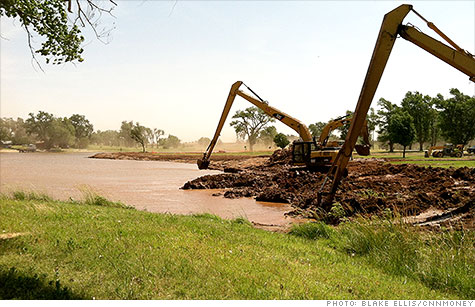
    Drought strains U.S. oil production

    @CNNMoneyJuly 31, 2012: 4:55 AM ET

    Excavators prepare water for the oil industry in Kansas. The drought is restricting water available for fracking, which could harm U.S. oil production.

    Excavators prepare water for the oil industry in Kansas. The drought is restricting water available for fracking, which could harm U.S. oil production.

    NEW YORK (CNNMoney) — One of the worst droughts in U.S. history is hampering oil production, pitting farmers against oilmen and highlighting just how dependent on water modern U.S. energy development has become.

    Over 60% of the nation is in some form of drought. Areas affected include West Texas, North Dakota, Kansas, Colorado and Pennsylvania, all of which are part of the recent boom in North American energy production.

    That boom is possible partly by hydraulic fracturing. Known as fracking for short, the controversial practice gets oil and natural gas to flow by cracking shale rock with sand, chemicals, pressure and water.

    Lots of water. Each shale well takes between two and 12 million gallons of water to frack. That’s 18 Olympic-sized swimming pools worth of water per well.

    “We’re having difficulty acquiring water,” said Chris Faulkner, CEO of Breitling Oil and Gas, an oil company with operations in many of the new shale regions including Bakken in North Dakota and Marcellus in Pennsylvania.

    Faulkner said officials in two Pennsylvania counties have stopped issuing permits for oil companies to draw water from rivers, forcing them to go further afield to obtain the crucial resource.

    In Kansas, he said much of the industry’s water comes from wells owned by farmers. Farmers used to sell him water for 35 cents a barrel. Now, he said, they are turning down offers of 75 cents or more.

    As a result, between 10% and 12% of the wells Breitling planned on fracking have been put on hold.

    “As the drought continues, those numbers will rise,” said Faulkner.

    Similar problems are happening at companies industry-wide, said Neal Dingmann, an analyst SunTrust Robinson Humphrey in Houston who covers many of the smaller and mid-sized companies that operate in the new shale plays.

    Dingmann said he expects to see maybe a 5% reduction in new wells by the companies he covers.

    Those numbers aren’t expected to have a meaningful impact on oil or gasoline prices.

    Oil from shale rock is just a small portion of overall U.S. oil production, which in turn contributes just a fraction to global oil supplies, the main determinant in prices.

    Plus, the drought is not expected to continue forever.

    But shale oil is playing an important part in new U.S. supply growth, and the drought illustrates how vulnerable that production is to disruptions in the availability of water.

    Other segments of the energy chain are also being hit by the drought.

    Much of the country’s natural gas is produced by fracking. Unlike oil, natural gas can’t be easily shipped around the world, so its price is more closely tied to local conditions.

    Natural gas prices have surged some 70% over the last couple of months. The runup is mostly due to increased demand for air conditioning during the heat wave and a switch to natural gas from coal by many utilities. But at least one analyst puts part of the blame on drought-induced production problems.

    “Another rally in natural gas as drought concerns may lead to a cessation of non-conventional shale production,” Stephen Schork, an energy trader and publisher of the industry newsletter the Schork Report, wrote in a note last week.

    Corn-based ethanol prices have jumped roughly 30% since the start of June, in step with corn prices that have reached record highs. Ethanol makes up about 10% of a gallon of gas in most parts of the country.

    The recent rise in gasoline prices has more to do with rising oil prices, which are being driven by the standoff with Iran and hopes for a looser monetary policy rather than drought conditions the United States. But the higher ethanol prices are probably playing a small part, said Brian Milne, refined fuels editor at the information provider DTN.

    Another water-dependent link in the nation’s energy supply chain is transport — specifically, barges on the nation’s canals and rivers.

    Andrew Lebow, an broker at Jefferies Bache in New York, said people are concerned that some energy terminals will have a hard time getting supplies if low water levels make routes impassable.

    “I don’t think the impact will be widespread,” said Lebow. “But you could see prices rise in some areas.” To top of page

  • Nuclear power is too dangerous to continue

    Nuclear power is too dangerous to continue
    Post-Bulletin
    Nuclear weapons production is joined at the hip to nuclear power plantsNuclear weapons useplutonium (produced as high-level radioactive waste at these power plants). Nuclear weapons proliferation around the world relies first and foremost on a country 
    See all stories on this topic »
    Fukushima disaster tour visits Ukiah
    Ukiah Daily Journal
    Yamada’s monthlong, U.S. tour includes stops in Northern California, Los Angeles, Chicago, Washington, D.C. and New York City and is intended to raise awareness about the ongoing danger at the FukushimaNuclear Power Plant, the offer of retired 
    See all stories on this topic »
    Are Fast-Breeder ReactorsNuclear Power Panacea?
    CounterCurrents.org
    technology to burn plutonium in a new generation of “fast” reactors. That could dispose of the waste problem, reducing the threat of radiation and nuclear proliferation, and at the same time generate vast amounts of low-carbon energy.  Fast reactors could do the same for the U.S. Under the presidency of George W. Bush, the U.S. launched a Global Nuclear Energy Partnership aimed at developing technologies to consume plutonium in spent fuel. But President Obama drastically cut the partnership’s funding, while 
    See all stories on this topic »


    Tip: Use quotes (“like this”) around a set of words in your query to match them exactly. Learn more.

    Delete this alert.
    Create another alert.
    Manage your alerts.