Category: News

Add your news
You can add news from your networks or groups through the website by becoming an author. Simply register as a member of the Generator, and then email Giovanni asking to become an author. He will then work with you to integrate your content into the site as effectively as possible.
Listen to the Generator News online

 
The Generator news service publishes articles on sustainable development, agriculture and energy as well as observations on current affairs. The news service is used on the weekly radio show, The Generator, as well as by a number of monthly and quarterly magazines. A podcast of the Generator news is also available.
As well as Giovanni’s articles it picks up the most pertinent articles from a range of other news services. You can publish the news feed on your website using RSS, free of charge.
 

  • It’s great to have a conscience, now tell us how we’ll pay for it

    It’s great to have a conscience, now tell us how we’ll pay for it

    Date
    August 1, 2012
    Category
    Opinion

    Gittins: Inability to talk disability

    If Tony Abbott wins the next election the newly agreed upon disability insurance scheme will cause him serious budgetary pains.

    Video will begin in 1 seconds.

    You may not have noticed, but last week was among the most significant of the Gillard government’s term. The commitments made may do great good, but they will also cause much pain and gnashing of teeth in the years ahead.

    Last week the nation made it crystal clear to its political leaders – federal and state – it wanted them to get on with implementing the national disability insurance scheme. After decades of turning a blind eye to the difficulties faced by the disabled and their carers, last week conscience struck.

    Fine. You’re a believer; so am I. But the scheme is very expensive: when fully implemented in 2018, an additional $8 billion a year. Or, as the politicians and the media usually prefer to put it, $32 billion over four years.

    Advertisement

    So how will the disability scheme be paid for? No one has any idea. The pollies were arguing about that very question when – urged on by the same radio shock jocks who on other days rail against ”debt and deficit” – the electorate put a rocket under them: Just do it!

    That’s why I have reservations. We behaved like a teenager with his first pay packet who goes out and buys a car on the never-never, without a moment’s thought about how he’ll fit the repayments into his budget.

    Perhaps this was the only way an increasingly self-centred nation was ever going to commit to something so caring but expensive. Had we dwelt on how much it would cost and how we’d be paying for it, we might have made an excuse and passed on.

    Even so, the accountant in me remains uneasy. Sometimes in politics, good deeds aren’t born of the purest motives. The Productivity Commission report that recommended the scheme called for the pilot programs to begin in 2014.

    I suspect Julia Gillard brought it forward a year because she wanted to be seen doing something worthwhile – and something that didn’t have Kevin Rudd’s fingerprints on it. She committed to spending just $1 billion over the four-year trial phase.

    If Gillard has a clear idea of how she would afford the scheme when fully implemented, she’s given no hint of it. All we know is that, contrary to the commission’s advice, she expects the states to bear some of the cost.

    I suspect she’s fingered the states as a red herring, intending to draw attention away from her own lack of forethought. That’s where we got to last week. She put the wood on the premiers to make a small contribution to the cost of their state’s pilot scheme, but many declined. This could have been the usual story – whenever the feds require the premiers’ co-operation, their hands go out: What’s it worth to you?

    If that was the premiers’ motivation, I’m sympathetic. Though the states are responsible for provision of many costly public services – law and order, roads and transport, schools and hospitals – their taxing powers have been greatly constrained by the High Court, leaving them heavily dependent on the feds.

    John Howard’s decision to grant them the full proceeds from the goods and services tax was intended to solve their problem, but it’s no longer the ”growth tax” it was. Our consumer spending no longer outstrips our income the way it did, and an ever-growing proportion of our spending goes on items excluded from the tax, particularly private education and health.

    So the premiers can’t reasonably be expected to stump up for anything much. And, indeed, it’s the feds who’ll have to come up with a solution to their chronic revenue problem. This week a poll shows 84 per cent of respondents oppose increasing the rate of the GST to 12.5 per cent.

    But only the Liberal premiers jacked up last week. The remaining Labor state and territory leaders played along. So maybe it wasn’t the standard premiers’ money-motivated bail-up.

    There isn’t a politician in the country with the courage to openly oppose the disability scheme. Gillard’s lack of courage comes in telling us how she proposes to pay for it. Maybe she’s decided she’ll worry about that only if she wins the next election.

    Tony Abbott’s more likely to win it, of course. I suspect the hard-heads on his side had been intending to relegate implementation of the full scheme to the status of an ”aspiration” to be afforded only when finances permit.

    That now would be a lot harder to do, following the surge of public pressure that forced the premiers of NSW and Victoria to back down after just a day or so. Such forceful expressions of the public’s will stay burnt on politicians’ brains long after you and I have forgotten them.

    Abbott’s shadow treasurer, Joe Hockey, is saying it would be cruel to offer hope to the disabled when there was no guarantee the money could be found. In contrast, his more slick-tongued finance spokesman, Andrew Robb, says the full scheme would be introduced in 2018, but this ”probably would require the removal or scaling back of other programs”.

    Don’t forget Abbott would first have to cover the cost of abolishing the carbon tax and the mining tax. This is a man who professes to believe taxes must go down and may never go up. Now he’s got to find a further $8 billion a year in spending cuts.

    I find it hard to believe this would happen. But whatever happens, I foresee much pain and gnashing of teeth.

    Ross Gittins is the economics editor.

    Follow the National Times on Twitter


    Read more: http://www.smh.com.au/opinion/politics/its-great-to-have-a-conscience-now-tell-us-how-well-pay-for-it-20120731-23cut.html#ixzz22FV9gBMG

  • 620 MILLION WITHOUT POWER: INDIA’S EMERGY CRISIS AS GRIDS COLLAPSE

    620 million without power: India’s energy crisis as grids coPassengers describe deadly train fire (Video Thumbnail)Click to play video

    Video settings

    Please Log in to update your video settings

    Commercial blackout hits India

    Grids supplying electricity to half of India’s 1.2 billion people collapse for the second day in succession.

    Video will begin in 1 seconds.

    India’s energy crisis cascaded over half the country on Tuesday when three of its regional grids collapsed, leaving 620 million people without government-supplied electricity for several hours in, by far, the world’s biggest blackout.

    Hundreds of trains stalled across the country and traffic lights went out, causing widespread traffic jams in New Delhi. Electric crematoria stopped operating, some with bodies half burnt, power officials said. Emergency workers rushed generators to coal mines to rescue miners trapped underground.

    The massive failure – a day after a similar, but smaller power failure – has raised serious concerns about India’s outdated infrastructure and the government’s inability to meet its huge appetite for energy as the country aspires to become a regional economic superpower.

    Kolkata is plunged into darkness.

    Kolkata is plunged into darkness. Photo: AP

    Power Minister Sushil Kumar Shinde blamed the new crisis on states taking more than their allotted share of electricity.

    “Everyone overdraws from the grid. Just this morning I held a meeting with power officials from the states and I gave directions that states that overdraw should be punished. We have given instructions that their power supply could be cut,” he told reporters.

    The new power failure affected 620 million people across 20 of India’s 28 states – about double the population of the United States. The blackout was unusual in its reach, stretching from the border with Myanmar in the northeast to the Pakistani border about 3000 kilometres away. Its impact, however, was softened by Indians’ familiarity with frequent blackouts and the widespread use of backup generators for major businesses and key facilities such as hospitals and airports.

    Passenger stranded inside a stalled train.

    Passenger stranded inside a stalled train. Photo: AP

    Shinde later said power was fully restored in the northeast grid four hours after it went down, and that the north grid had 45 per cent power and the east grid 35 per cent. R.N. Nayak, chairman of Power Grid, which runs the nation’s power system, said he expected to have full power later in the evening.

    Oddly, as the crisis dragged into the evening, Shinde was promoted, becoming India’s home minister, its top internal security official. The promotion had been planned previously as part of a greater Cabinet shuffle before he presided over the world’s two worst power outages.

    The outages came just a day after India’s northern power grid collapsed for several hours. Indian officials managed to restore power several hours later, but at 1:05 pm on Tuesday the northern grid collapsed again, said Shailendre Dubey, an official at the Uttar Pradesh Power in India’s largest state. About the same time, the eastern grid failed and then the northeastern grid followed, energy officials in those regions said. The grids serve more than half India’s population.

    In West Bengal, express trains and local electric trains were stopped at stations across the state of West Bengal on the eastern grid. Crowds of people thronged the stations, waiting for any transport to take them to their destinations.

    Chief Minister Mamata Banerjee said it would take at least 10 to 12 hours to restore power and asked office workers to go home.

    “The situation is very grave. We are doing everything to restore power,” West Bengal Power Minister Manish Gupta said.

    New Delhi’s Metro rail system, which serves about 1.8 million people a day, immediately shut down for the second day in a row. Police said they managed to evacuate Delhi’s busy Rajiv Chowk station in under half an hour before closing the shutters.

    S.K. Jain, 54, said he was on his way to file his income tax return when the Metro closed and now would almost certainly miss the deadline. Hours later, the government announced it was giving taxpayers an extra month to file because of the chaos.

    Tuesday’s blackout eclipsed Monday’s in India, which covered territory including 370 million people. The third largest blackout affected 100 million people in Indonesia in 2005, according to reports by The Associated Press.

    India’s demand for electricity has soared along with its economy in recent years, but utilities have been unable to meet the growing needs. India’s Central Electricity Authority reported power deficits of more than 8 per cent in recent months.

    In addition, vast amounts of power are pirated through unauthorized wiring that taps into the electrical system.

    The power deficit was worsened by a weak monsoon that lowered hydroelectric generation and kept temperatures higher, further increasing electricity usage as people seek to cool off.

    But any connection to the grid remains a luxury for many. One-third of India’s households do not even have electricity to power a light bulb, according to last year’s census.

    AP

    Read more: http://www.smh.com.au/world/620-million-without-power-indias-energy-crisis-as-grids-collapse-20120801-23dtk.html#ixzz22FSip9pa

  • Logging companies gain easy access to PNG’s forests, says Greenpeace

    Logging companies gain easy access to PNG’s forests, says Greenpeace

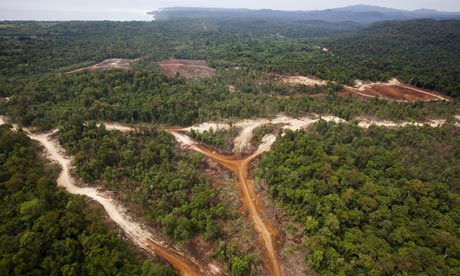
    Deforestation and land sales have blighted Papua New Guinea, but new prime minister ‘is progressive figure’, says Greenpeace

    MDG : Land grab in Papua New Guinea : logging and deforatation

    Roads to logging concessions in West Pomio, East New Britain province, Papua New Guinea. Photograph: Paul Hilton/Greenpeace

    More than 5m hectares (12.35m acres) of customary-owned land in resource-rich Papua New Guinea have been signed over to unrepresentative landowner companies and foreign-owned corporations for up to 99 years, according to a report by Greenpeace.


    Of the total 5.1m hectares covered by special agricultural and business leases (SABLs), 75%, or 3.9m hectares, are controlled by foreign-owned companies under 54 subleases or development agreements. Malaysian and Australian firms control at least 3m hectares through 32 SABLs.


    PNG has the world’s third largest tropical forest, but demand for its logs has led to extensive deforestation. A satellite study in 2008 said the forests of this south Pacific country were being chopped down so quickly that more than half of its trees could be lost by 2021.


    The 5.1m hectares of customary-owned land represent 11% of the country and more than 16% of accessible commercial forests. PNG log exports grew by almost a fifth in 2011, largely due to logging under SABLs. Since 2006, logging companies have exported more than 1.5 cubic metres of whole logs, netting $145m (£92m) for the mostly Malaysian companies involved. Almost all the logs were exported to China.


    The Greenpeace report, Up for Grabs, is highly critical of the previous government of Sir Michael Somare for allocating forests to industrial logging companies, which often occured against the wishes of people who live in PNG’s forests and customary landholders.


    “The previous Somare government continued this predatory relationship with customary landholders by actively facilitating the granting of SABLs with legislative amendments that enabled logging companies to gain easy access to customary-held forested land,” said Greenpeace.


    In May 2011, the PNG government announced a commission of inquiry into SABLs following international condemnation. The commission completed its inquiry in May this year, but will not be made public until it is tabled in parliament by the newly elected prime minister this year.


    Last week, PNG’s rival prime ministers ended a political feud that had left the country with two leaders for most of the past year. Somare, the elder statesman of South Pacific politics at 76 and the country’s first prime minister in 1975, recontested his seat despite being ill for much of last year. Peter O’Neill was voted in as prime minister after Somare was ruled ineligible due to his prolonged absence from parliament.


    Although O’Neill had the support of parliament, the supreme court twice ruled that Somare was the legitimate prime minister, leaving the country with rival leaders. Last week’s agreement means O’Neill is likely to head the new government and form a coalition with backing from Somare. O’Neill’s People’s National Congress party is expected to win most of the seats in parliament – 3,500 candidates stood for 100 seats. Votes are still being counted.


    Despite PNG’s mineral wealth, successive governments have been unable to deliver infrastructure or services to a country of 6.5 million people, with about 80% of the population living on subsistence village farming and small cash crops. The general elections were PNG’s eighth since independence from Australia in 1975.


    Greenpeace said O’Neill’s leadership could be a turning point in PNG’s land policy. “He is a progressive figure and is best placed to implement the findings of the commission of inquiry,” said Paul Winn, author of the report. “But he’s had to team up with Somare’s party, with vested interests, so he might find it difficult to implement the recommendations in full.” Winn said the commission had done a thorough job. “We believe it is a hard-hitting report, saying how elites have benefited from corruption.”


    The Greenpeace report said the single biggest issue highlighted during the commission’s inquiry was the lack of fair representation of customary landholders in agreeing to SABLs being granted over their land. The report pointed out that the Department of Lands and Physical Planning, the agency responsible for evaluating and granting SABL applications and registering subleases, was described by judicial authorities as grossly incompetent and entirely corrupt. In many cases, said Greenpeace, it was the corporations applying for logging or agricultural development that financed the government approval process.


    To address many of the underlying issues that led to PNG’s “land grab”, Winn said it was vital for the new government to seek international help – possibly from Norway, Japan and Australia – to develop a national land planning process to identify land to be used for development, conservation or tourism and to ensure that land use benefited all of the population.

  • ABS – AUSTRALIAN BUREAU OF STATISTICS : Melbourne dominates 4-traders

    News 10 new results for POPULATION GROWTH
    Big population growth in outer suburbs
    The Australian
    Melbourne beat the other capital cities with the largest population growth with over half a million new people (647200), mostly filling up the city’s outer areas, according to the Australian Bureau of Statistics (ABS). Outer suburbs across the country are 
    See all stories on this topic »
    Urbanization, Population Growth Fuel Waste-to-Energy Projects
    SustainableBusiness.com
    Urbanization, Population Growth Fuel Waste-to-Energy Projects. SustainableBusiness.com News. Even though many businesses and municipal governments have policies requiring reductions in waste sent to landfills, more than three-quarters of what 
    See all stories on this topic »
    Regional Qld growth above average
    Fraser Coast Chronicle
    The latest regional population growth figures, collected during the 2011 Census, show Brisbane had the second-highest population growth in the nation – up 25% – between 2001 and 2011, behind only Perth, Western Australia on 26%. Several regional areas 
    See all stories on this topic »
    ABS – AUSTRALIAN BUREAU OF STATISTICS : Melbourne d ominates
    4-traders
    Population growth in Australia between June 2001 and June 2011 was strongest in the outer suburbs, according to the Australian Bureau of Statistics (ABS). The five areas with the largest growth in the country were all on the outskirts of Melbourne, with the 
    See all stories on this topic »
    Big growth in outer suburbs population
    Sky News Australia
    Melbourne has beaten Australia’s other capital cities in population growth with almost 650 thousand new people, mostly filling up the city’s outer areas. Outer suburbs across the country are experiencing a boom as more land opens up for development, but 
    See all stories on this topic »
    Melbourne’s population boom
    Weekly Times Now
    In Western Australia, Perth had the fastest growth of all of Australia’s capital cities and the Pilbara had the largest and fastest population increase with 23300 people or 59 per cent of any region outside of Perth. In Queensland, Brisbane’s population increased 
    See all stories on this topic »
    Women Call for Policies to Regulate Population Growth
    AllAfrica.com
    The Social Democratic Party’s women committee called on the new government to set clear policies to regulate population growth in order to fulfill social justice, establish sustainable development and enhance the standards of economic and social 
    See all stories on this topic »
    ACT’s population soars by almost 50000
    ABC Online
    The Bureau says in the ten years to June 2011 the ACT’s population reached 368 thousand people. Almost all of the Territory’s population growth was in the north, where Gungahlin’s population more than doubled. Tuggeranong’s population had the biggest 
    See all stories on this topic »
    Population increases in Fraser Coast
    Fraser Coast Chronicle
    It was the sixth-highest growth rate across all local government areas in Queensland. When broken down by electorate, the figures showed a 41% population growth in Hervey Bay over the past decade and a 22% growth in Maryborough. The report also 
    See all stories on this topic »
    Hong Kong Population Projections 2012-2041
    7thSpace Interactive (press release)
    In the updated set of projections, the Hong Kong Resident Population is projected to increase at an average annual rate of 0.6%, from 7.07 million in mid 2011 to 8.47 million in mid 2041.The average annualgrowth rate over the ten-year period from 
    See all stories on this topic »


    This once a day Google Alert is brought to you by Google.

    Delete this alert.
    Create another alert.
    Manage your alerts.

  • 250 years of global warming: Berkeley Earth releases new analysis

    ScienceDaily: Earth Science News


    Tiny airborne pollutants lead double life

    Posted: 30 Jul 2012 12:50 PM PDT

    Researchers have provided visual evidence that atmospheric particles separate into distinct chemical compositions during their life cycle. Observations could have important implications for modeling global climate change and predicting air quality conditions.

    250 years of global warming: Berkeley Earth releases new analysis

    Posted: 30 Jul 2012 11:25 AM PDT

    According to a new Berkeley Earth study released July 29, the average temperature of Earth’s land has risen by 1.5 °C over the past 250 years. The good match between the new temperature record and historical carbon dioxide records suggests that the most straightforward explanation for this warming is human greenhouse gas emissions.

    Cooling, not population loss, led to fewer fires after 1500 in New World

    Posted: 30 Jul 2012 06:41 AM PDT

    After Columbus’ voyage, burning of New World forests and fields diminished significantly – a phenomenon some have attributed to decimation of native populations. But a new study suggests global cooling resulted in fewer fires because both preceded Columbus in many regions worldwide.
    You are subscribed to email updates fromScienceDaily: Earth Science News
    To stop receiving these emails, you may unsubscribe now.
    Email delivery powered by Google
    Google Inc., 20 West Kinzie, Chicago IL USA 60610
  • Billions of dollars of mining projects in doubt

    Billions of dollars of mining projects in doubt

    Updated July 31, 2012 15:39:59

    A report has found the nation’s mining industry is in survival mode and $200 billion worth of planned resources projects are in doubt.

    The report, by Newport Consulting, has found falling commodity prices and surging operating costs are the major reasons why companies are becoming less optimistic about the future of the resources boom.

    The report involved interviews with dozens of miners about their willingness to invest in future projects.

    It found only 25 per cent of companies are planning to invest in capital expenditure projects this year, compared with 52 per cent last year.

    Newport’s David Hand says many miners are thinking twice about investment decisions.

    “We believe that $200 billion worth of investment is in jeopardy and in doubt,” he said.

    Meanwhile iron ore prices continue to slump, yesterday falling to a two and a half year low.

    Topics:mining-industry, perth-6000, karratha-6714

    First posted July 31, 2012 14:34:57