Category: News

Add your news
You can add news from your networks or groups through the website by becoming an author. Simply register as a member of the Generator, and then email Giovanni asking to become an author. He will then work with you to integrate your content into the site as effectively as possible.
Listen to the Generator News online

 
The Generator news service publishes articles on sustainable development, agriculture and energy as well as observations on current affairs. The news service is used on the weekly radio show, The Generator, as well as by a number of monthly and quarterly magazines. A podcast of the Generator news is also available.
As well as Giovanni’s articles it picks up the most pertinent articles from a range of other news services. You can publish the news feed on your website using RSS, free of charge.
 

  • Anti-nuclear campaigners launch Japan’s first green party

    Anti-nuclear campaigners launch Japan’s first green party

    Greens Japan promises voters to put environment first and abolish nuclear power plants

    Members of Greens Japan (Japan green party)

    Members of Greens Japan during their inaugural party meeting. The party wants to emulate other green parties of Europe and influence Japan’s energy policy. Photograph: Greens Japan

    Anti-nuclear campaigners in Japan have launched the country’s first green party, more than a year after the triple meltdown at Fukushima Daiichi power plant created a groundswell of opposition to atomic energy.


    Greens Japan, created by local politicians and activists, hopes to satisfy the legal requirements to become an officially recognised political party in time for the general election, which must be held by next summer but could come much earlier.


    The party said it would offer voters a viable alternative to the two main parties, both of which have retained their support for nuclear power, particularly after the recent decision to restart two nuclear reactors in western Japan.


    The ruling Democratic party of Japan and the minority opposition Liberal democratic party [LDP] both supported the nuclear restart, which came after Japan was briefly left without nuclear power for the first time in more than 40 years.


    Akira Miyabe, Greens Japan’s deputy leader, said voters had been deprived of the chance to support a party that puts nuclear abolition and other green policies at the top of its agenda. “We need a party that puts the environment first,” he said at a launch event in Tokyo.


    The 1,000-member party is still a gathering of disparate groups and local politicians, but believes it can emulate green parties in Germany and other parts of Europe and influence the national debate over energy policy.


    Nao Suguro, a co-leader of the party who sits on a local assembly in Tokyo, said the aim was “to create a broad network to accommodate calls for the abolition of nuclear power plants.”


    The party will struggle to field any candidates if, as some predict, the prime minister, Yoshihiko Noda, calls a snap lower house election. But it said it was prepared to put up about 10 candidates in next summer’s upper house elections.


    Recent demonstrations in Tokyo suggest Japan’s anti-nuclear movement has broken free of its long association with socialist and pacifist movements to include younger campaigners, many of whom are protesting for the first time.


    The protests are among the biggest Japan has seen in decades, although they have not succeeded in forcing Noda to reconsider his support for the restart of several reactors to avoid power cuts and lessen Japan’s dependence on expensive fossil fuel imports.


    While thousands of demonstrators held a candlelit vigil and formed a chain around the parliament building in Tokyo on Sunday night, voters in Yamaguchi prefecture in south-west Japan elected a pro-nuclear governor in a poll that some saw as a litmus test of Japan’s enthusiasm for atomic energy.


    Shigetaro Yamamoto, a former bureaucrat who was supported by the conservative LDP, defeated three rivals, including Tetsunari Iida, who had campaigned against the proposed construction of a nuclear power plant in the area. That vote came after other recent wins for pro-nuclear candidates in local elections.


    The government is currently sounding out public opinion on three options for nuclear energy’s share of the country’s energy mix in 2030: zero, 15% or 20-25%. Japan depended on nuclear power for about a third of its energy needs before the 11 March disaster.

  • Studying Evolution With an Eye on the Future

    Studying Evolution With an Eye on the Future

    Jane Charlesworth

    GLIMPSING THE FUTURE Sinéad Collins studies evolution in marine algae.

    Charles Darwin came to many of his ideas by observing the wild creatures of South America. The biologist Sinéad Collins elaborates on his work by actually creating evolution in her laboratory at the University of Edinburgh. Dr. Collins, 36, sets up experiments to uncover evolution’s basic rules. She then uses the information to help work on solutions to contemporary environmental problems like global warming and marine acidification.

    We spoke for two hours at last winter’s annual meeting of the American Association for the Advancement of Science in Vancouver, British Columbia, and then again last month by telephone. An edited and condensed version of the conversations follows.

    When people get algae in their swimming pools or their ponds, they do their best to get rid of it. Why do you deliberately grow it in Scotland?

    Oh, my gosh! We grow it only for the best of reasons. In my lab, we do something called “experimental evolution.” That’s a way of trying to figure out how evolution works by observing it. We do that by taking very small creatures — unicellular green algae — and breeding hundreds and thousands of generations of them in different environments.

    With ocean warming and acidification proceeding at an ever-growing pace, we grow the algae in high CO2 environments — which is something like what a future ocean might be like. We then say, “Hello, algae, tell us how you are different.” And from this we can get a projection of how they might be in 200 years. It’s important to know because microbes such as algae are the starting point of the marine food chain.

    Of course, we’re doing this in a laboratory. So it’s a super-simplified version of a future ocean. We’re not trying to replicate reality — the actual ocean is a complex and turbulent environment. We’re more trying to figure out the rules reality plays by.

    Is experimental evolution new?

    No. In the 1880s, there was a guy named the Rev. William Dallinger, and he did an experiment that could be published today — it was that cool. He took microbes that could live only at temperatures under 68 degrees Fahrenheit, and over several years evolved them to live at 158 degrees!

    What is new is applying evolution to current problems. I first came to the field in the 1990s while studying biochemistry at McGill. I was volunteering at a gay telephone hot line in Montreal. At the time there were all these super-strains of H.I.V. emerging. That got me interested in how viruses evolve because retroviruses like H.I.V. have this incredibly fast mutation rate.

    That was part of what pushed me to do my doctorate in experimental evolution. Right away, I could see how experimental evolution was creating tools for understanding the effects of climate change. Who survives in a warmed-up environment? How will they be different from their ancestors? Dallinger’s microbes, after years of selection, couldn’t survive at 68 degrees Fahrenheit anymore.

    Today I do Dallinger-ish experiments in my own lab. I take the results to an institute in Germany where I help their oceanographers plan their own experiments in real marine environments.

    What have your algae taught you so far?

    Let me tell you about one experiment we did. There are people who say that all the carbon we’re putting into the seas might not have a devastating effect. They posit that it won’t lead to an over-acidified marine environment because microbes will eat all that extra carbon, store it and spit it out as oxygen.

    At first glance, this makes sense because many microorganisms are photosynthesizers. They gobble up carbon, store it, use it like food for growth and transform it into oxygen.

    So to test this, we grew algae in the lab in a high CO2 environment, and 1,000 generations later we saw some really weird syndromes. Some of the algae, if you gave them more CO2, weren’t storing it anymore. Others photosynthesized many times faster than any of their ancestors had, though they were no longer able to use the extra carbon to become bigger.

    What do you make of this?

    That this hope that ocean plants will efficiently sop up all the extra CO2 may be overly optimistic.

    We did another experiment where we found that genetically identical algae evolved differently when they are part of a community than when alone. In fact, the algae that evolved the most on their own and were most adapted to the new environment got driven to extinction when they were put together with algae that had evolved in a community.

  • Chaos predicted as Port Botany container cap ends

    Chaos predicted as Port Botany container cap ends

    By NSW political reporter Sarah Gerathy, ABCJuly 31, 2012, 9:01 am


    The New South Wales Opposition has slammed a move to allow unrestricted container movements from Sydney’s Port Botany terminal.

    Treasurer Mike Baird says removing the current cap of 3.2 million container movements will make Port Botany a more attractive prospect for private sector companies bidding for a 99-year lease on the site.

    “The decision has been taken to remove that cap, but it’s only being done on the basis of the significant mitigants we have put in to remove congestion in that precinct,” Mr Baird said.

    But shadow treasurer Michael Daley, who is also the local MP for the area around the port, says it is an outrageous idea.

    “The M5 East is already clogged with heavy vehicles and there is a cap on Port Botany. Imagine what it will be like with no cap at all into the future,” Mr Daley said.

    Mr Baird says the Government will be adopting further measures to reduce congestion when Infrastructure NSW releases its report in September.

  • What evidence will it take to convince climate sceptics?

    What evidence will it take to convince climate sceptics?

    Prof Richard Muller’s research showing the world is warming and humans are largely to blame is being rejected by climate sceptics

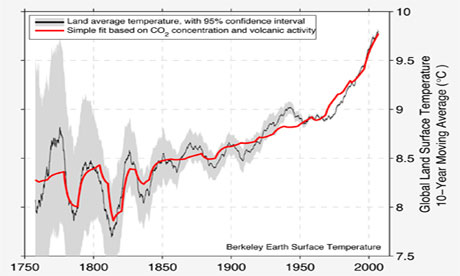
    Leo Blog : on BerkeleyEarth land surface temperature conpared to CO2 concentration

    The annual and decadal land surface temperature from the BerkeleyEarth average, compared to a linear combination of volcanic sulfate emissions and the natural logarithm of CO2. Photograph: BerkeleyEarth

    So, that’s it then. The climate wars are over. Climate sceptics have accepted the main tenets of climate science – that the world is warming and that humans are largely to blame – and we can all now get on to debating the real issue at hand: what, if anything, do we do about it?

    If only. Yesterday’s announcement by Prof Richard Muller that, as a result of his Berkeley Earth Surface Temperature (Best) project’s research, he had undergone a “total turnaround” in his views on climate science and now accepted that the Earth’s land has warmed by 1.5C over the past 250 years and that “humans are almost entirely the cause”, might be seen by many as a watershed moment in this long, often bitter debate. But not, it would appear, for climate sceptics – the very people he designed his project to please.

    Rather than join Muller on his road to Damascus, many climate sceptics have predictably been tempted by the neon signs directing them to turn back instead. Muller, as a result of his “conversion“, is now being painted as a figure of distrust and scorn, in much the same way that they have viewed many climate scientists over the years. His research methodologies and results are being mocked and slammed for being simplistic and “agenda driven”.

    Climate sceptics know better, of course, and are heralding (at first, via a bizarrely histrionic preview) a conveniently timed piece of research of their own, which they say, “devastatingly” undermines all other known work in this field. The tills at Hubris ‘R Us have certainly been ringing loudly over the past few days.

    In one sense, you could say all of this is symptomatic of healthy scientific enquiry. Claim and counter claim are being tested, reviewed and published online to allow full transparency and scrutiny. There are no hiding places. Our scientific understanding of the planet’s climate – and the forces that drive it – are advancing incrementally, yet assuredly. The truth will out.

    I would like to hug this idealistic vision tightly to my chest, but I know – as the saying goes – it’s a bit more complicated than that. There are far more factors at play (on both “sides” of the debate) than mere “science” and that murky soup includes – to name just a few ingredients – ideology, vested interest, confirmation bias and a suite of formal and informal fallacies. I can’t comment on either of the latest results being presented by both Muller and Watts et al (who claim that US temperature trends over the past few decades have been “spuriously doubled”). Neither has been peer-reviewed or published in an academic journal so any conclusions seem premature.

    What is clear, though, is that Muller’s results are largely symbolic, as opposed to representing a genuine leap forward in scientific understanding. His team’s results are broadly in synch with what mainstream climate science has been claiming for well over a decade.

    The power of his findings lay in the journey he has undertaken to arrive at his conclusions. He has sought to address key concerns of climate sceptics about temperature reconstructions (many of which he had himself), as well as investigate why the world has warmed in the way it has over the past couple of centuries. In effect, he has laid down a challenge to climate sceptics (who, I admit, come in many flavours) to come up with a better-evidenced theory than mankind’s emissions being the key reason why temperatures have risen. As he himself says: “To be considered seriously, an alternative explanation must match the data at least as well as carbon dioxide does.”

    The key question for me is whether climate sceptics actually want to tackle that all-important question. What evidence will it take to convince them? Are they forever destined to keep saying “it’s not enough for us”? When does the balance of risk tip over in favour of them accepting that pumping ever more greenhouse gases into the atmosphere is not a wise thing to keep on doing?

  • Magnetic field, mantle convection and tectonics

    Magnetic field, mantle convection and tectonics

    Posted: 29 Jul 2012 11:21 AM PDT

    On a time scale of tens to hundreds of millions of years, the geomagnetic field may be influenced by currents in the mantle. The frequent polarity reversals of Earth’s magnetic field can also be connected with processes in the mantle. New results show how the rapid processes in the outer core, which flows at rates of up to about one millimeter per second, are coupled with the processes in the mantle, which occur more in the velocity range of centimeters per year.
    You are subscribed to email updates fromScienceDaily: Earth Science News
    To stop receiving these emails, you may unsubscribe now.
    Email delivery powered by
  • Researchers analyze melting glaciers and water resources in Central Asia

    ScienceDaily: Oceanography News


    Researchers analyze melting glaciers and water resources in Central Asia

    Posted: 29 Jul 2012 11:23 AM PDT

    Scientists have analyzed climate changes and glaciation in the Tien Shan Mountains (Central Asia), and explained their consequences.

    New discovery of how carbon is stored in the Southern Ocean

    Posted: 29 Jul 2012 11:22 AM PDT

    Scientists have discovered an important method of how carbon is drawn down from the surface of the Southern Ocean to the deep waters beneath. The Southern Ocean is an important carbon sink in the world – around 40 percent of the annual global CO2 emissions absorbed by the world’s oceans enter through this region.
    You are subscribed to email updates fromScienceDaily: Oceanography News
    To stop receiving these emails, you may unsubscribe now.
    Email delivery powered by Google
    Google Inc., 20 West Kinzie, Chicago IL USA 60610