Category: News

Add your news
You can add news from your networks or groups through the website by becoming an author. Simply register as a member of the Generator, and then email Giovanni asking to become an author. He will then work with you to integrate your content into the site as effectively as possible.
Listen to the Generator News online

 
The Generator news service publishes articles on sustainable development, agriculture and energy as well as observations on current affairs. The news service is used on the weekly radio show, The Generator, as well as by a number of monthly and quarterly magazines. A podcast of the Generator news is also available.
As well as Giovanni’s articles it picks up the most pertinent articles from a range of other news services. You can publish the news feed on your website using RSS, free of charge.
 

  • X-Rays Show Origins of Volcano Hot Spots

    X-Rays Show Origins of Volcano Hot Spots
    iScienceTimes.com
    Most volcanoes are found where continental tectonic plates push or pull against one another, but volcanic hot spots are formed completely differently because they are found far away from plate boundaries. The chain of Hawaiian islands are thought to
    See all stories on this topic »

    iScienceTimes.com
    Volcano activity of July 18, 2012 – Merapi, Nyiragongo, Bagana, Dukono 
    Earthquake Report
    Volcano-tectonic seismicity remains high at Popocatepetl (Mexico) today (events on the seismogram between 15 UTC and 18 UTC are repeating due to a software “glitch”, not natural causes). Exhalations of gas and ash are also more numerous, averaging 
    See all stories on this topic »

    Earthquake Report
  • Environmental concerns increasing infectious disease in amphibians, other animals

    ScienceDaily: Earth Science News


    Environmental concerns increasing infectious disease in amphibians, other animals

    Posted: 18 Jul 2012 11:36 AM PDT

    Climate change, habitat destruction, pollution and invasive species are all involved in the global crisis of amphibian declines and extinctions, researchers suggest in a new analysis, but increasingly these forces are causing actual mortality in the form of infectious disease.

    X-rays illuminate the origin of volcanic hotspots

    Posted: 18 Jul 2012 10:17 AM PDT

    Scientists have recreated the conditions at Earth’s core-mantle boundary 2,900 km beneath the surface. Using X-rays at the European Synchrotron Radiation Facility, they probed tiny rock samples at extreme temperature and pressure showing for the first time that partially molten rock under these conditions is buoyant and should segregate towards the surface. This observation is strong evidence for the theory that volcanic hotspots like the Hawaiian Islands originate from mantle plumes generated at the core-mantle boundary.
    You are subscribed to email updates from ScienceDaily: Earth Science News
    To stop receiving these emails, you may unsubscribe now.
    Email delivery powered by Google
    Google Inc., 20 West Kinzie, Chicago IL USA 60610
  • Dumping iron at sea can bury carbon for centuries, study shows

    Dumping iron at sea can bury carbon for centuries, study shows

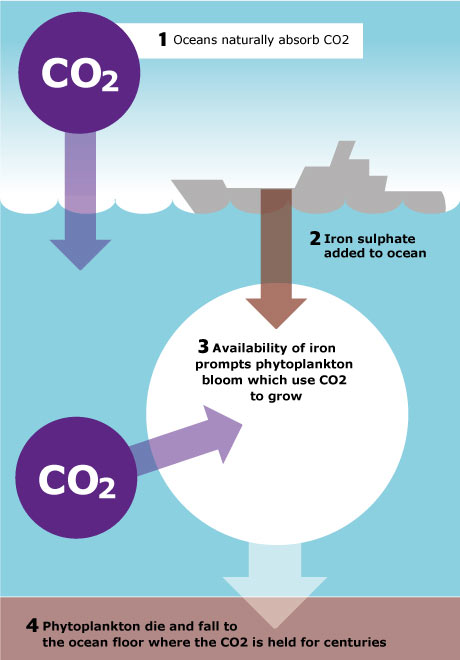
    Iron fertilisation creates algae blooms that later die off and sink, taking the absorbed carbon deep towards the ocean floor

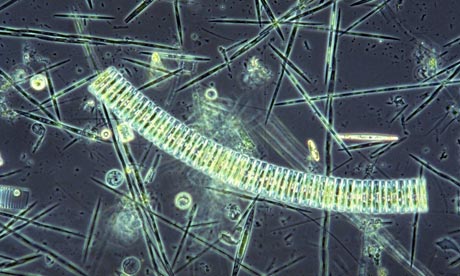
    Damian on Plankton  fertilisation with iron on the research vessel 'Polarstern' of the AWI

    A magnified view of the plankton three weeks after its fertilisation with iron. Photograph: Philipp Assmy/Awi/EPA

    Dumping iron into the sea can bury carbon dioxide for centuries, potentially helping reduce the impact of climate change, according to a major new study. The work shows for the first time that much of the algae that blooms when iron filings are added dies and falls into the deep ocean.

    Geoengineering – technologies aimed at alleviating global warming – are controversial, with critics warning of unintended environmental side effects or encouraging complacency in global deals to cut carbon emissions. But Prof Victor Smetacek, at the Alfred Wegener Institute for Polar and Marine Research in Germany, who led the new research, said: “The time has come to differentiate: some geoengineering techniques are more dangerous than others. Doing nothing is probably the worst option.”

    Dave Reay, senior lecturer in carbon management at the University of Edinburgh, said: “This represents a whole new ball game in terms of iron fertilisation as a geoengineering technique. Maybe deliberate enhancement of carbon storage in the oceans has more legs than we thought but, as the scientists themselves acknowledge, it’s still far too early to run with it.”

    A 2009 report from the Royal Society, the UK’s science academy, concluded that while cutting emissions is the first priority, careful research into geoengineering was required in case drastic measures – such as trying to block sunlight by pumping sulphate into the atmosphere – were one day needed.

    Prof John Shepherd, chair of the report, said on Wednesday: “It is important that we continue to research these technologies but governance of this research is vital to protect the oceans, wider environment and public interests.”

    Smetacek’s team added seven tonnes of iron sulphate to the ocean near Antarctica, where iron levels are extremely low. The addition of the missing nutrient prompted a massive bloom of phytoplankton to begin growing within a week. As the phytoplankton, mostly species of diatom, began to die after three weeks, they sank towards the ocean floor, taking the carbon they had incorporated with them.

    The scientists chose the experiment location carefully, within a 60km-wide self-enclosed eddy in the ocean that acted as a giant “test tube”. This meant that it was possible to compare what happened within the eddy with control points outside the eddy. After a month of monitoring nutrient and plankton levels from the surface to the depths the team concluded at least half of the bloom had fallen to depths below 1,000m and that a “substantial portion was likely to have reached the sea floor” at 3,800m.

    The scientists conclude in the journal Nature that the carbon is therefore likely to be kept out of the atmosphere for many centuries or longer.

    A dozen other experiments have shown that iron can prompt phytoplankton blooms, but this is the first study to show that the carbon the plants take up is deeply buried. Other researchers recognise the significance of this but warn of other issues that might prevent the iron fertilisation of the ocean as being a useful geoengineering technique.

    “The ocean’s capacity for carbon sequestration in low-iron regions is just a fraction of anthropogenic CO2 emissions, and such sequestration is not permanent — it lasts only for decades to centuries,” said Ken Buesseler, at the Woods Hole Oceanographic Institution in the US.

    Smetacek said ocean iron fertilisation could bury at most 1 gigatonne of CO2 per year compared to annual emissions of 8-9Gt, of which 4Gt accumulates in the atmosphere. But sequestering some CO2 could make the difference between crossing a climate “tipping” point, where feedback effects lead to runaway global warming, he said: “I don’t see what will stop Arctic sea ice from decreasing.”

    Michael Steinke, director of marine biology at the University of Essex, said: “Will this open up the gates to large-scale geoengineering using ocean fertilisation? Likely not, since the logistics of finding the right spot for such experiments are difficult and costly.”

    Smetacek responded that ocean iron fertilisation is much cheaper than other possible geoengineering techniques. He acknowledged more experiments were needed over longer periods to examine, for example, how many of the diatoms were eaten by krill, and then by whales, meaning they did not fall to the ocean floor.

    On the ethics of geoengineering, Smetacek, who is a vegetarian, told the Guardian: “We could reduce emissions significantly and increase the scope for sequestration on land [by freeing grazing land for forestry] if we managed to convert the global population to vegetarianism. Would that be geoengineering?”

    Iron filings and carbon burial Iron filings and carbon burial Illustration: guardian.co.uk

  • Number of boat arrivals tops 6,000 for year

    Number of boat arrivals tops 6,000 for year

    Updated July 19, 2012 10:56:51

    Immigration Department figures show more than 6,000 asylum seekers have arrived by boat this year.

    A boat carrying 25 people was stopped near Christmas Island last night – the eighth to be intercepted in the past six days.

    More than 4,000 people are in detention.

    Darwin’s Wickham Point facility and the Christmas Island Centre both hold more than 1,000 asylum seekers.

    The passengers from the latest boat are being taken to Christmas Island for health and security checks.

    Topics:refugees, christmas-island-6798, australia, darwin-0800

    First posted July 19, 2012 10:31:47

    Updated July 19, 2012 10:56:51

    Immigration Department figures show more than 6,000 asylum seekers have arrived by boat this year.

    A boat carrying 25 people was stopped near Christmas Island last night – the eighth to be intercepted in the past six days.

    More than 4,000 people are in detention.

    Darwin’s Wickham Point facility and the Christmas Island Centre both hold more than 1,000 asylum seekers.

    The passengers from the latest boat are being taken to Christmas Island for health and security checks.

    Topics:refugees, christmas-island-6798, australia, darwin-0800

    First posted July 19, 2012 10:31:47

    Updated July 19, 2012 10:56:51

    Immigration Department figures show more than 6,000 asylum seekers have arrived by boat this year.

    A boat carrying 25 people was stopped near Christmas Island last night – the eighth to be intercepted in the past six days.

    More than 4,000 people are in detention.

    Darwin’s Wickham Point facility and the Christmas Island Centre both hold more than 1,000 asylum seekers.

    The passengers from the latest boat are being taken to Christmas Island for health and security checks.

    Topics:refugees, christmas-island-6798, australia, darwin-0800

    First posted July 19, 2012 10:31:47

  • Stocks of in-house supermarket brands on the rise

    Stocks of in-house supermarket brands on the rise

    Updated July 18, 2012 18:26:02

    A business forecaster expects private label products to make up around a third of supermarket sales within five years.

    IBIS World’s figures indicate that private label, or no-name, groceries currently account for around a quarter of supermarket sales, generating revenue of $21.6 billion.

    That is around double IBIS World’s estimate for 2007-08 of $10 billion in revenue and a 13.5 per cent share of sales.

    While it expects growth in home brand spending to slowdown over the next five years, the major supermarkets’ own products are expected to hold a 33 per cent market share and account for almost $32 billion in sales by 2017-18.

    IBIS World general manager Karen Dobie says the global financial crisis has contributed to the rise in no-name sales.

    “The recessive economic climate has been a strong driver of private label growth. Households have been reining in spending, paying off debt and increasing savings,” she observed in the report.

    “This, coupled with an increase in the range of private-label products available, has led many consumers to make the shift to home brands.”

    The major supermarkets have been increasingly turning to in-house brands to boost margins by controlling more of the supply chain, and also to counter the arrival of foreign competition such as Aldi and Costco.

    Bread and butter

    Private labels have had varying degrees of success in different categories of grocery.

    Over the past decade, the share of private label sales in supermarkets has risen from 24 to 68 per cent of butter, 18 to 56 per cent of bread, 56 to 67 per cent of sugar and 51 to 55 per cent of fresh milk.

    Liquor has also moved strongly towards in-house brands, with their share rising from 2 to 8 per cent over the past 10 years.

    Ms Dobie says some types of products are more suited to being marketed as private label products.

    “Products with a high degree of homogeneity that are staples of grocery baskets have shown the strongest private-label growth,” she noted.

    “A particularly interesting product category is eggs. While private-label egg sales still account for over 50 per cent of market share, this has fallen from 61 per cent over the past ten years.

    “The decline is mainly due to a switch towards free-range, a segment not adequately represented by private-label players.”

    Areas that have a particularly low private label penetration are chocolate, soft drinks, cosmetics and sanitary products.

    Under pressure

    In those sectors where private label brands are already dominant, or expanding rapidly, Ms Dobie says the most common response has been for the manufacturers of branded goods to lower their prices.

    “Branded producers have responded to private-label growth by discounting their products to remain competitive,” she said.

    “However, the dominance of Coles and Woolworths means that they are likely to give preference to their own brands in terms of spacing and design allocations – placing continued pressure on the big brands.”

    She says, while consumers are getting lower prices in the short-term, in the longer-run primary producers, manufacturers and consumers are all likely to lose out to the benefit of Coles and Woolworths.

    However, consumers seem increasingly willing to risk the long-term pain of reduced choice and competition for the immediate gain of lower prices in the short-term.

    Those most likely to look for private label savings are unsurprisingly households on low-incomes (less than $44,000 per annum), for whom no-name products make up more than 40 per cent of their grocery spending.

    Those households earning more than $75,000 per year typically direct around 15 per cent of their grocery spending to no-name products.

    However, this income group is being increasingly targeted by supermarkets offering more expensive private label products that often imitate their branded competitors.

    “Major supermarkets are spending big bucks on activities aimed at blurring the lines between branded products and their own in-house fare,” added Ms Dobie.

    “These retailers are introducing premium, organic and fair trade products… to attract private-label buyers from all walks of life.”

  • How the carbon tax rebate is going up in smoke


    The Vicorian and Queensland gaming commissions reported a similar spike in poker machine takings with the previous $900 given to pensioners

    How the carbon tax rebate is going up in smoke

    0
    pokies carbon

    The rise of the machines. Source: The Daily Telegraph

    POKER machine spending surged by up to 12 per cent in some areas after the federal government handed out its carbon tax compensation payments.

    Amid fears the assistance packages are being swallowed up by the pokies, the money pumped into the machines in NSW jumped by 5 per cent since the introduction of the payments.

    Figures from the NSW Office of Liquor, Gaming and Racing showed a 5.05 per cent rise, year on year, in the April to June quarter in hotel poker machine profits — from $393 million to $413 million. The figures also showed a 5 per cent rise quarter on quarter.

    In western Sydney the figures appeared even higher, with hoteliers contacted by The Daily Telegraph pointing to double digit rises in pokie profits in areas such as Mt Druitt, CabramattaFairfield, Campbelltown and Penrith.

    Hotel sources said there were reports gambling profits in Mt Druitt and CabramattaFairfield were up 11 per cent in May and June while in Campbelltown and Penrith they were up 10 per cent.

    North of the border the situation was even more dire, with Queensland pokies revenue jumping by 12 per cent in June.

    At The Star casino, revenue was up 20 per cent in May and June.

    The figures were from the period when householders received the Clean Energy payouts, which began for pensioners in May and were then rolled out to other households. The $820 schoolkids bonus also arrived at the end of June.

    Club Liverpool chief executive Ray Stewart, confirmed an increase in poker patronage at his establishment in the past two months: “When you give people free money it’s better given to schools or given in the form of food vouchers or school equipment.

    “Just giving people cash, they can do whatever they like with it. They can gamble, they can take drugs, they can excessively partake in alcohol.”

    Hoteliers said the economic stimulus package in 2009 produced an 8 per cent rise in pokies turnover in NSW — but in many areas the carbon tax compensation appeared to be higher than that.

    The figures appear to support Tony Abbott’s comments in May when he said of the government’s Schoolkids bonus: “You can go and blow it on the pokies.”

    Prime Minister Julia Gillard attacked Mr Abbott over his comments at the time: “That’s Mr Abbott’s way of saying he doesn’t trust working families to look after their kids. What an insult.”

    Yesterday, Ms Gillard defended the carbon tax handouts, saying the majority of the cash had gone to the good of families.

    “I trust the vast majority of families to do what they do every day, which is get up and show love and care and concern for their children and spend their income for the benefit of their kids,” she said.

    Small Business Minister Brendan O’Connor went further, claiming only a “negligible amount” from the compensation payments had been spent on the pokies.

    He said the extra cash being pumped into the machines was a sign the government’s fiscal policies were working.

    “We are seeing an increased level of confidence in the economy,” he said.

    “That will then show up in the way in which people spend discretionary income.”

    But opposition climate change spokesman Greg Hunt said the money should have been delivered “when the higher electricity bills arrive”. Anti-pokies Senator Nick Xenophon said: “Pokies barons have been overcompensated by the introduction of the carbon tax”.