Green Light: Geoengineering, fracking and flooding
|
Inbox
|
x |

|
|
9:06 PM (18 minutes ago)
 |
|
||
|
|
||||
Add your news
You can add news from your networks or groups through the website by becoming an author. Simply register as a member of the Generator, and then email Giovanni asking to become an author. He will then work with you to integrate your content into the site as effectively as possible.
Listen to the Generator News online
The Generator news service publishes articles on sustainable development, agriculture and energy as well as observations on current affairs. The news service is used on the weekly radio show, The Generator, as well as by a number of monthly and quarterly magazines. A podcast of the Generator news is also available.
As well as Giovanni’s articles it picks up the most pertinent articles from a range of other news services. You can publish the news feed on your website using RSS, free of charge.
|
Inbox
|
x |
|
|
9:06 PM (18 minutes ago)
|
|
||
|
|
||||
Posted
A former human rights commissioner has warned that hundreds – if not thousands – of asylum seekers will almost certainly drown on their way to Australia unless something is done to stop people-smuggling boats.
In a submission to the Federal Government’s expert panel on asylum seekers, Dr Sev Ozdowski says Labor’s decision to wind back the Howard government’s so-called Pacific solution and temporary protection visas created an undeniable pull factor for people trying to flee Sri Lanka, Afghanistan and Iraq.
“If the current trend continues, boat arrivals for 2012 will be well over 10,000,” he wrote in his submission.
“The increased boat people arrivals will almost certainly result in hundreds or thousands of people drowning on the way to Australia.
“This statement is not alarmist – it will happen.”
But he says a return to the Pacific solution is unlikely to stop the boats because it is “common knowledge” the vast majority of people who were detained at Nauru and Manus Island ended up in Australia.
Instead, Dr Ozdowski has suggested setting up a regional processing centre in Indonesia, and in return Australia should consider accepting tens of thousands of refugees to clear the bottleneck.
“A regional cooperation framework, if skilfully established and implemented, would help prevent most of the boats departing Indonesia for Australia by establishing a queue for the orderly processing of refugees in the region.”
“Following the creation of a regional framework for refugees, there should be consequences for people who choose not to join the queue in Indonesia.
“Any asylum seekers who arrive on boat without proper travel documents should not be given a right to permanent residency but instead be offered temporary protection visas if they are found to be genuine refugees.”
Dr Ozdowski’s submission is among a large number of contributions received by the expert panel which has been set up to reassess Australia’s border protection policies.
The panel, led by former Defence Force chief Angus Houston, is now working through the submissions and liaising with a parliamentary reference group with the aim of reporting back to the Government before Parliament resumes next month.
Despite Labor and the Coalition both advocating offshore processing of refugee claims, the current political stalemate means most asylum seekers are being processed through the detention centre at Christmas Island.
The Greens today released their plan to stop asylum seeker boats.
It involves processing refugee claims onshore if asylum seekers make their way to Australia.
But it argues for a significantly larger humanitarian intake from countries such as Malaysia and Indonesia at the same time as working towards a regional plan that would allow asylum seekers to have their refugee claims assessed where they are.
Topics:refugees, immigration, community-and-society, federal-government, federal-parliament, australia
ScienceDaily: Earth Science News
|
|
The electric atmosphere: Plasma is next NASA science target Posted: 17 Jul 2012 03:34 PM PDT Two giant donuts of this plasma surround Earth, trapped within a region known as the Van Allen Radiation Belts. The belts lie close to Earth, sandwiched between satellites in geostationary orbit above and satellites in low Earth orbit (LEO) are generally below the belts. A new NASA mission called the Radiation Belt Storm Probes (RBSP), due to launch in August 2012, will improve our understanding of what makes plasma move in and out of these electrified belts wrapped around our planet.
|
|
Posted: 17 Jul 2012 10:12 AM PDT A new analysis of the common accretion-disk model explaining how planets form in a debris disk around our Sun uncovered a possible reason for Earth’s comparative dryness. The study found that our planet formed from rocky debris in a dry, hotter region, inside of the so-called “snow line.” The snow line in our solar system currently lies in the middle of the asteroid belt, a reservoir of rubble between Mars and Jupiter; beyond this point, the Sun’s light is too weak to melt the icy debris left over from the protoplanetary disk. Previous accretion-disk models suggested that the snow line was much closer to the Sun 4.5 billion years ago, when Earth formed.
|
|
NASA’s Landsat Data Continuity Mission becomes an observatory Posted: 17 Jul 2012 07:37 AM PDT Engineers at Orbital Sciences Corporation, Gilbert, Ariz., have installed the Thermal Infrared Sensor (TIRS) instrument back onto to the Landsat Data Continuity Mission (LDCM) spacecraft. With both the Operational Land Imager (OLI) and TIRS instruments now on the spacecraft, LDCM is a complete observatory.
|
|
Glacier break creates ice island twice size of Manhattan Posted: 17 Jul 2012 07:00 AM PDT An ice island twice the size of Manhattan has broken off from Greenland’s Petermann Glacier, according to researchers. This marks the second massive break in two years.
|
|
What we know and don’t know about Earth’s missing biodiversity Posted: 17 Jul 2012 05:48 AM PDT Most of the world’s species are still unknown to science although many researchers grappled to address the question of how many species there are on Earth over the recent decades. Estimates of non-microbial diversity on Earth provided by researchers range from 2 million to over 50 million species, with great uncertainties in numbers of insects, fungi, nematodes, and deep-sea organisms.
|
| You are subscribed to email updates from ScienceDaily: Earth Science News To stop receiving these emails, you may unsubscribe now. |
Email delivery powered by Google |
| Google Inc., 20 West Kinzie, Chicago IL USA 60610 | |
ScienceDaily: Severe Weather News
|
|
The electric atmosphere: Plasma is next NASA science target Posted: 17 Jul 2012 03:34 PM PDT Two giant donuts of this plasma surround Earth, trapped within a region known as the Van Allen Radiation Belts. The belts lie close to Earth, sandwiched between satellites in geostationary orbit above and satellites in low Earth orbit (LEO) are generally below the belts. A new NASA mission called the Radiation Belt Storm Probes (RBSP), due to launch in August 2012, will improve our understanding of what makes plasma move in and out of these electrified belts wrapped around our planet.
|
|
Soil moisture and hot days examined globally Posted: 17 Jul 2012 05:48 AM PDT For the first time, scientists in Switzerland have examined globally the connection between soil moisture and extreme heat with measured data. Their study shows that precipitation deficits increase the probability of hot days in many regions of the world. The results will help to better assess heat risks.
|
| You are subscribed to email updates from ScienceDaily: Severe Weather News To stop receiving these emails, you may unsubscribe now. |
Email delivery powered by Google |
| Google Inc., 20 West Kinzie, Chicago IL USA 60610 | |
 |
Click here to Reply or Forward
|
|
||
|
climate code red
|
|
A sober assessment of our situation (2) Posted: 16 Jul 2012 08:03 PM PDT by David Spratt
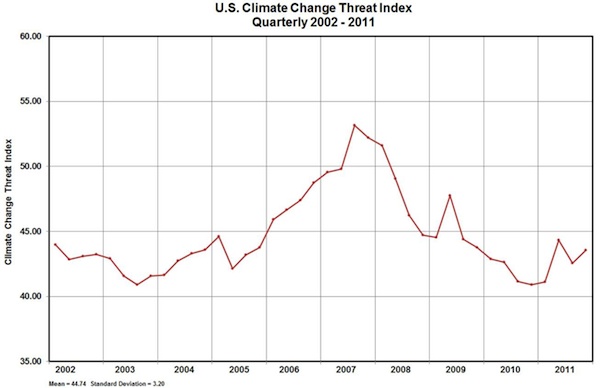
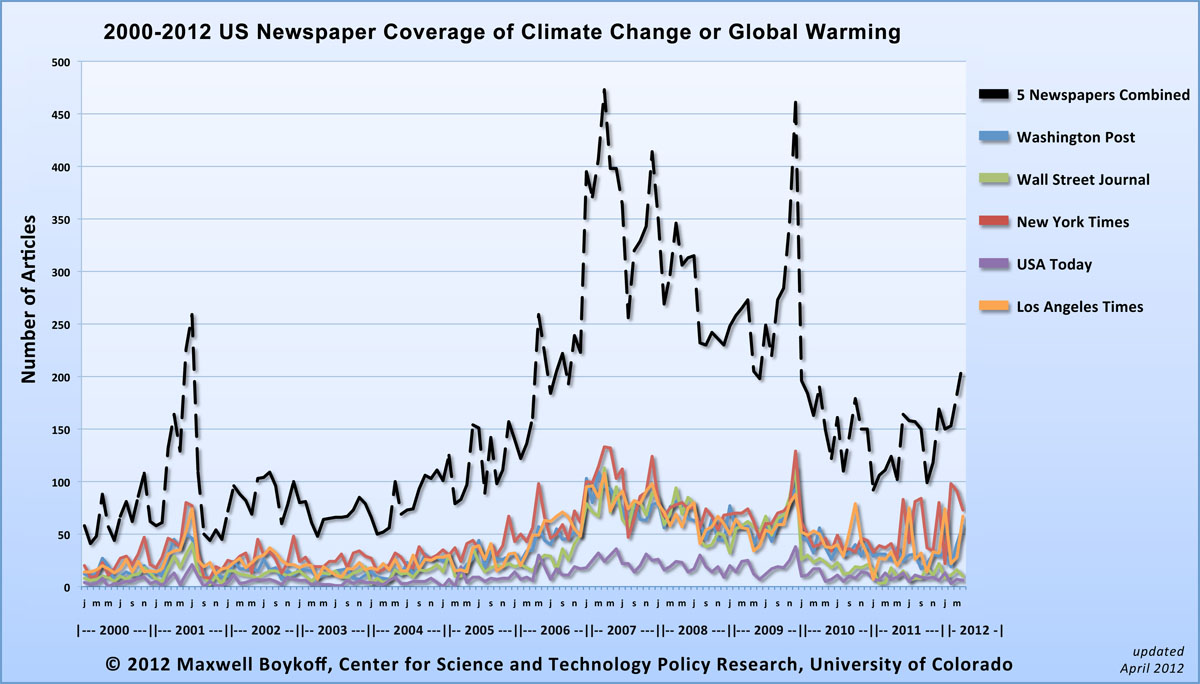
The first part in this series described some characteristics of the climate debate and the climate action advocacy movement in Australia. 2. How we got to here [Part 2 in a series of 3] 2.1 Climate in the media In the USA (and Australia too), concern about climate change (as measured by the climate change threat index – see chart below) peaked around 2007. Research studies find that media coverage of climate change directly affects public concern levels, and that the actions of political elites turn out to be the most powerful driver of public concern. Concern in the USA was at its heightat the time of media focus on the IPCC’s 2007 fourth assessment reports and Al Gore’s “The Inconvenient Truth”.
As partisan and ideological divides kicked in, concern fell and opinion became more polarised. Now in the US, public understanding of climate is on the rebound despite the deniers’ assault, with Americans attributing their increased belief in global warming to their (correct) perception that the planet is warming and the weather is getting more extreme. The extreme heat wave and wildfires in the US in spring and early summer July 2012 havefurther contributed to the rebound. And a new poll finds that most Americans say they believe temperatures around the world are going up and that weather patterns have become more unstable in the past few years.
The bright-siding of climate advocacy by the Australian government, eNGOs and some community campaigns – talking about clean energy and jobs and not talking about climate impacts – meant that for these organisations the story of climate science and impacts was simply off the agenda, and hence also for electors. This was an unfortunate positive feedback loop that reinforced in the media’s and the public’s mind the notion that the climate threat had diminished. It remains the most spectacular own goal in recent years (which is belatedly being recognised in some circles), though the effort of the Say Yes campaign in 2011 in giving an exclusive drop on the “Cate Blanchett” TV ad to the Murdoch media runs a close second.
In Australia, by comparison, most of the climate movement was asleep at the wheel when presented with similar opportunities. 2.2 Labor’s vast political incompetence Labor in government could not have handled the issue more incompetently:
2.3 It’s the … economy (stupid) It a country such as Australia, where net economic growth now is due largely to expansion of the mining industry, the power of the fossil fuel lobby is always on show: threatening; trashing proposed mining and carbon taxes; buying the media (literally) who are not sufficiently compliant; and funding delay-or-deny campaigns and industry organisations. Mining and energy ministers are rarely other than vassals rendering homage. Guy Pearce’s book High and Dry and his Quarterly Essay on Quarry Vision tell the story. With the recurring threat of international financial disorder, and most of Australia’s non-mining economy treading water, political dependence on the mining industry cargo cult may increase, foolish though that will be.
2.4 A moment’s reflection Looking at all these factors, it’s not difficult to see (following Hugh Mackay’s analysis) that public support for action was at its height as Labor came to power in December 2007 and has been sliding ever since 2008, abetted by the denier and Murdoch media campaigns, the GFC and Labor’s incompetence. A recent Lowry Institute poll reflects this view (below). Walking Against Warming was probably at is biggest and brightest in 2007-08. Commitments to carbon pricing and increasing the RET were made before Labor won power. 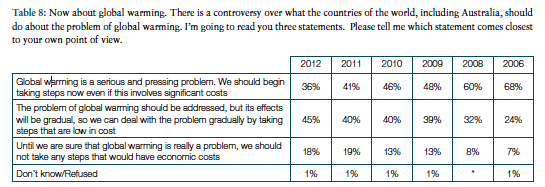 The sun was shining brightly for urgent climate action in 2007-2008, when carbon pricing in Australia started its journey. By the time it was legislated in 2011, the light was fading. If that is the case, the climate and energy policies now legislated may have less to do with what eNGOS and the climate movement did in 2008–2011 that what happened in 2007 when Rudd in opposition appointed Garnaut, and what happened after the hung parliament result in 2010. It was Garnaut who drive the process (with limited terms of reference) from 2007 onwards, with a quirk of history in 2010 thrown in. It was the Greens and the two independents who put climate back on the agenda and made the passage of the climate legislation possible. 2.5 Climate campaigning It was clear after Copenhagen and Rudd’s backflip that the game had changed, but the big NGOs were slow to recognise it. If they had, they would have devoted significant resources to re-invigorating public concern through community education and organising (perhaps in the manner of Your Rights at Work), but they did not. A priority on operating inside the Canberra beltway and managing the media cycle continued to take precedence over spending serious resources in the field to build community support. Such activity received little or no assistance from the national eNGOs and their e-lists of contributors and supporters continued to be treated as money-and-tick-a-box fodder. 2.6 Dissonance Cognitive dissonance is growing because what needs to be donecannot be achieved in today’s neo-conservative capitalist economy. A rapid transition will required a great deal of planning, coordination and allocation of labour and skills, investment, and materials and resources, that can’t just be left to markets and pricing. There is a choice between two dystopias: some very significant social and economic disruptions now while we make the transition quickly, or a state of permanent and escalating disruption as the planet’s climate heads into territory where most people and most species will not survive. Our task now is to chart the “least-worst” outcome.
 |
| You are subscribed to email updates from climate code red To stop receiving these emails, you mayunsubscribe now. |
Email delivery powered by Google |
| Google Inc., 20 West Kinzie, Chicago IL USA 60610 | |