The Generator news service publishes articles on sustainable development, agriculture and energy as well as observations on current affairs. The news service is used on the weekly radio show, The Generator, as well as by a number of monthly and quarterly magazines. A podcast of the Generator news is also available.
As well as Giovanni’s articles it picks up the most pertinent articles from a range of other news services. You can publish the news feed on your website using RSS, free of charge.
We will see longer queues at the Social Security offices. Reskilling perhaps???
Updated: 19:47, Wednesday July 4, 2012
Treasury documents show 3600 jobs will be cut from NSW hospitals and 2400 are set to be axed from schools and TAFE colleges.
Treasury documents show 3600 jobs will be cut from NSW hospitals and a further 2400 are set to be axed from schools and TAFE colleges over the next four years, according to Mr Robertson.
‘What we see is a premier who is hiding and each day we see a little more trickle out in regards to these job losses,’ he told reporters in Sydney on Wednesday.
‘The fact is that if you cut 6000 jobs across health and education you are impacting frontline services.
‘What you’ll see is public sector workers and the wider community start to express their frustration with Barry O’Farrell.’
The cuts are part of the 1.2 per cent annual labour expense cap announced in last month’s budget, which could result in the loss of 10,000 public-sector jobs over the next four years.
This is on top of 5000 redundancies announced in September.
The government on Tuesday conceded the numbers were not capped, and there were no guarantees that more jobs would not be lost.
The news prompted calls from the opposition on Wednesday for Premier Barry O’Farrell to explain fully the extent and nature of the cuts.
‘It’s time for the premier to come clean and tell the public exactly which workers will be sacked and which public services will axed,’ Mr Robertson said in a statement.
He said the cuts would have patients waiting longer at hospitals and would make it harder for teachers, with support staff including teachers’ aides and school counsellors set to lose their jobs.
The government has repeatedly said that frontline jobs will not be axed.
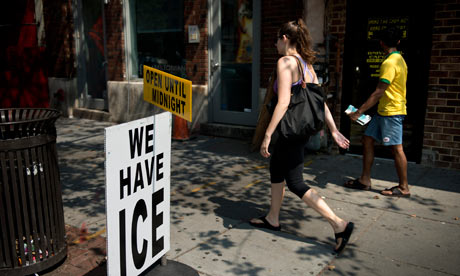
A liquor store advertises ice in Washington DC. Photograph: Brendan Smialowski/AFP/Getty Images
Britain and northern Europe are dripping their way into what is already being called a “lost summer”. We have had our wettest April and June and our coldest spring, and there is no end in sight of the abnormal weather. But we can take some comfort in the fact that we are not alone.
In the US, 100 million people in 17 states have now had to be warned about the dangers of one of most intense heatwaves of the last century. Life in many US cities has become unbearable, with temperatures well over 100F (38C) lasting for many days now. More than 40,000 temperature records have already been set in the US this year and freak storms, record rainfall and giant forest fires have left millions suffering. Many old people will certainly die in the heatwave and food prices are bound to rise.
But this extreme weather is far more widespread than just northern Europe or the US. May was the second warmest ever recorded worldwide and the warmest on record for the northern hemisphere. The link between a warming atmosphere and individual climatic events is unclear but no one should doubt the physical turmoil. In the last few weeks we have seen the Arctic sea ice melting at a record pace, the Amazon reaching its highest level on record, massive forest fires in Siberia and the Russian east, temperatures climbing to a barely imaginable 48C in northern India, and an abnormally strong monsoon which has so far left many hundreds dead and nearly 7 million people homeless from floods in Assam and southern Bangladesh.
There’s always been freak weather, but climatologists increasingly think these events are becoming less unusual. Instead of taking place every 10 or 20 years, they are happening every two or three. This, they are beginning to say, is the new normal, a taste of the future as the planet warms.
Last year was the 35th consecutive year since 1976 that the yearly global temperature was above average. Since 2000 we have had 11 of the 13 warmest years in 132 years and the patterns of global warming that scientists warned about – such as more droughts, sudden downpours, more widespread wildfires, volatile heat, violent storms and more frequent heatwaves – are all here now. This, say the scientists with increasing conviction, is what the early stages of global warming looks like.
So how much more extreme weather does it take for governments and individuals to act, or for the oil companies to withdraw from the Arctic, or the media to link global warming with the events now being witnessed around the world? Must the sea boil, the Seine run dry, New York flood and the London Olympics be consumed by fire before countries are shocked into taking concerted action? The reality is that even as the world experiences increasing numbers of weather-related disasters and extreme events, climate change has dropped off the rich countries’ political and media agendas, and public concern is said to be waning – to the cheers of the sceptics and industry.
This is a most dangerous period. We still have a very good chance of avoiding the worst of climate change but the collective will to try to do anything appears to be weakening and confidence in politicians is at rock bottom. Unless the climate of opinion changes, the present economic storms may seem as nothing.
Those of us who pay insurance should not have pay a tax to subsidise those who do not!!! How would Govt’s identify insured householders before levying such a tax????
The New South Wales Government is considering a new tax for property owners as part of an overhaul to how emergency services are funded.
Currently a tax on insurance companies provides about 74 per cent of the funding for Fire and Rescue NSW, the State Emergency Service and the Rural Fire Service.
The remaining costs are covered by the State Government and local councils.
But Treasurer Mike Baird says the system is unfair, because property owners who insure their homes are subsidising those who do not.
He says it also contributes to higher insurance premiums.
“It is a fair thing to ask that everyone in the state contribute to the provision of emergency services, rather than just a proportion of them,” Mr Baird said.
“So we’re asking for everyone to contribute, not just those that take out insurance, and we think that is a fairer thing for every family in the state and we think it is a better way to design a levy.”
The Government is now seeking community feedback on the plan, with a three-month consultation period on a discussion paper that is being released today.
Mr Baird is adamant there will be no change to the overall level of funding for emergency services.
It’s on. We were just served by Woolworths and tomorrow we will be heading to the Federal Court.
Why? GetUp members who are Woolworths shareholders have exercised their shareholder power under corporations law, calling an Extraordinary General Meeting to vote on making the company’s poker machines safer for communities.
Woolworths is the largest operator of dangerous high-loss poker machines in the country. But rather than simply hold a meeting to discuss reform, they’re using an expensive legal team to avoid scrutiny and prevent their own shareholders from holding them accountable.
I’m talking about shareholders like Karen, a GetUp member from Melbourne, who has owned Woolies shares for years. Karen lost her partner to suicide spurred by problem gambling. Today an unnamed Woolworths media spokesperson called her action a “stunt”. We call it “standing up for what’s right.”
We’ve pulled together a top legal team to take on Woolworths tomorrow – and help members like Karen hold them accountable – but it won’t be cheap, and we urgently need a legal fund. Can you chip in?
We don’t yet know how exactly much it will cost to fight this move through the courts. So, if we raise more funds than are needed for this legal battle, I’ll write back to let you know and offer a refund of your donation, or ask if you’d like to put it toward the next move in our campaign for pokies reform
Woolworths is using the classic corporate tactic: when faced with community action, pull in expensive lawyers and tie the process up in legal action. From Gunns to James Hardie, we’ve seen it before. Often it doesn’t matter whether their case is strong. The point is to out-spend community activists – to intimidate them into giving up.
We must prove that won’t work. Whether we win or lose this court battle – and we intend to win – one thing is for sure: we have to fight.
Tomorrow’s court action is simply about trying to prevent Woolworths from getting court permission to ignore its shareholders’ meeting request. Woolworths is crying poor, saying the meeting is too expensive but the meeting will cost less than what we estimate Woolworths takes from addicted problem gamblers in a single day.
Please chip in a contribution now to help defend the right of members like Karen, and hold Woolworths accountable:
This all came about because GetUp members used corporations law to legitimately call an Extraordinary General Meeting of the company. That means that all 423,000 Woolworths shareholders will receive a letter explaining that the company is the largest operator of dangerous poker machines in Australia; and be invited to participate in a binding vote to limit the harm these machines can cause problem gamblers.
Under the proposed reforms, gamblers wouldn’t be able to bet more than $1 per spin, or lose more than $120 during an hour on a single machine. Because Woolworths is the biggest player in this industry, it would be a huge change to the pokies business as whole, and help problem gamblers and their families nationwide.
We think it’s a fight worth standing for.
Thanks for being with us, Simon, for the whole team at GetUp.
PS – On a personal note, thank you so much to everyone who sent in messages of concern and support over the last few days. On Monday night I collapsed while on the panel of ABC’s Q&A program, but I’m recovering well. ABC took very good care of me and got me straight to hospital. The doctors gave me the all clear; I’ve been reeling from influenza and was exhausted. We’ve had a lot of campaigns on the go recently, and I clearly pushed myself too hard. Collapsing on live TV was a pretty embarrassing way to learn a lesson, but it got through.
Fortunately, I’m just a small part of GetUp. We have a great team of staff and volunteers, who continued to work on our campaigns (actually we were served by Woolworths while I was recovering in hospital). Most importantly, there are hundreds of thousands of GetUp members across the country behind the campaigns. My wife read me messages from GetUp members and it meant the world to me. Thank you. I wish you and yours great health.
GetUp is an independent, not-for-profit community campaigning group. We use new technology to empower Australians to have their say on important national issues. We receive no political party or government funding, and every campaign we run is entirely supported by voluntary donations. If you’d like to contribute to help fund GetUp’s work, please donate now! If you have trouble with any links in this email, please go directly to www.getup.org.au. To unsubscribe from GetUp, please click here. Authorised by Simon Sheikh, Level 2, 104 Commonwealth Street, Surry Hills NSW 2010
A Council on the New South Wales Central Coast has voted to repeal its controversial sea level rise policy, just months after hundreds of waterfront property owners rallied against it.
Two months ago, crowds of residents from the Coast and Lake Macquarie took to the streets, angry at state legislation and their councils’ actions in response to the projected sea level threat over the next 90 years. They argue they are being unfairly burdened by sea level warnings attached to their property certificates, which are driving down house prices and hiking up insurance premiums. Last night, Gosford City Council voted to remove those notifications. Labor Councillor Jim Macfadyen says the matter is now in the State Government’s hands. “There is no stability in the matter unless it is regulated across New South Wales,” he said. Councillor Macfadyen hopes other coastal councils, who’s residents are affected by such sea level rise policies, follow Gosford Council’s lead. “There are only 16 that have issued the 1495 certificates so I think we are sending a clear message now to the State Government that they need to regulate or legislate.” Pat Aitken from the Coast Residents Association has welcomed Council’s decision but agrees the Government must now act. “The policy framework is at the root of the problem and that requires the State Government to make changes,” he said. “Now they promised to make changes in 2010…and they have been in government for two years now.” “They own this.”
A Council on the New South Wales Central Coast has voted to repeal its controversial sea level rise policy, just months after hundreds of waterfront property owners rallied against it.
Two months ago, crowds of residents from the Coast and Lake Macquarie took to the streets, angry at state legislation and their councils’ actions in response to the projected sea level threat over the next 90 years. They argue they are being unfairly burdened by sea level warnings attached to their property certificates, which are driving down house prices and hiking up insurance premiums. Last night, Gosford City Council voted to remove those notifications. Labor Councillor Jim Macfadyen says the matter is now in the State Government’s hands. “There is no stability in the matter unless it is regulated across New South Wales,” he said. Councillor Macfadyen hopes other coastal councils, who’s residents are affected by such sea level rise policies, follow Gosford Council’s lead. “There are only 16 that have issued the 1495 certificates so I think we are sending a clear message now to the State Government that they need to regulate or legislate.” Pat Aitken from the Coast Residents Association has welcomed Council’s decision but agrees the Government must now act. “The policy framework is at the root of the problem and that requires the State Government to make changes,” he said. “Now they promised to make changes in 2010…and they have been in government for two years now.” “They own this.”
PUBLIC support for the carbon price has plunged to a record low of 33 per cent, as Prime Minister Julia Gillard faces the fight of her political life to try to reconcile the public to her deeply unpopular tax.
An Age/Nielsen poll taken in the days leading up to the launch of the tax yesterday found one in two Australians believe it will leave them worse off.
The poll also shows the Coalition has consolidated its massive two-party lead over Labor, and would win an election held now with an 8 per cent swing.
Advertisement: Story continues below
As the carbon tax came into force yesterday, politicians hit the campaign trail, with Ms Gillard declaring that ”our nation is seizing a new future” and Opposition Leader Tony Abbott renewing his pledge to repeal the tax if he wins the next election, due late next year.
”On day one of a new Parliament, the carbon tax repeal legislation will be introduced. That is my pledge to the people of Australia,” he said.
”If you elect a Coalition government, there will be no carbon tax – and I can be believed when I say there will be no carbon tax under a government I lead”.
The Nielsen poll shows Mr Abbott’s message resonating with more voters. Opposition to pricing carbon has risen three points to 62 per cent, while support is down four points in a month, according to the poll of 1400 people taken from Thursday to Saturday.
Despite the government cash splash already delivered to families and pensioners, and income tax cuts for more than seven million Australians that started yesterday, 51 per cent of people say they will be worse off under the carbon tax (up one point in a month).
Only 5 per cent think they will be better off with the carbon price, and 37 per cent said it would make no difference to them (down 4 points).
In practice, on the government’s figures, three million households will be left worse off, receiving partial or no compensation, although most people will get something.
One third of Labor voters oppose the carbon price and almost a third say it will leave them worse off. Only 11 per cent of Coalition supporters are in favour of the tax and two thirds say they will be worse off. Two thirds of Greens voters back the carbon price but three in ten Greens supporters says they will be worse off.
Amid controversies over the carbon tax and asylum seekers, the Coalition has slightly widened its two-party lead to 58 per cent to 42 per cent.
Labor’s primary vote is up two points, but it remains at a woeful 28 per cent. The Coalition’s primary vote is steady on 48 per cent while the Greens have dropped 2 points to 12 per cent.
Ms Gillard’s approval is down one point to 35 per cent; Mr Abbott’s approval is steady at 39 per cent
Ms Gillard and Mr Abbott were both in Melbourne yesterday as they campaigned for and against the new tax. ”As Australians go about their ordinary Sunday, our nation is seizing a new future,” Ms Gillard said.
”From today, we will be seizing a clean energy future. And from today millions of Australians will see tax cuts.”
She said Mr Abbott would have to look people in the eye at the election ”and explain to them how he’s taking their tax cuts away, their family payment increases, their pension increases”.
But she also claimed that if Mr Abbott became PM, he would not remove the tax. ”He won’t take carbon pricing away. He’ll engage in a little fiddle, a little fudge to kind of pretend but carbon pricing will still be here.”
As Labor homed in on Mr Abbott’s claims, Treasurer Wayne Swan shopped for groceries on Saturday and Sunday and found no difference in the prices.
Special Minister of State Gary Gray interviewed his mother, who lives in Whyalla – the South Australian steel town which Mr Abbott had said would be wiped out by the carbon tax.
Ms Gillard said that ”Australians can look round and see the sky hasn’t fallen in”.
Greens leader Christine Milne is convinced the public will finally accept the tax. ”I think people will shrug their shoulders and say ‘what was all that about’,” she said. ”People will start to get angry with the Coalition for having made all the claims they’ve made.”
The government’s new mining tax also started yesterday. Ms Gillard said that with it ”we seize a future of better sharing of the benefits of the mining boom.
Minerals Council of Australia chief Mitch Hooke said that a time of global economic uncertainty, both new taxes eroded the minerals industry’s international competitiveness.
 Email
Email