Category: News

Add your news
You can add news from your networks or groups through the website by becoming an author. Simply register as a member of the Generator, and then email Giovanni asking to become an author. He will then work with you to integrate your content into the site as effectively as possible.
Listen to the Generator News online

 
The Generator news service publishes articles on sustainable development, agriculture and energy as well as observations on current affairs. The news service is used on the weekly radio show, The Generator, as well as by a number of monthly and quarterly magazines. A podcast of the Generator news is also available.
As well as Giovanni’s articles it picks up the most pertinent articles from a range of other news services. You can publish the news feed on your website using RSS, free of charge.
 

  • Tropical cyclones to cause greater damage, researchers predict

    Tropical cyclones to cause greater damage, researchers predict

    Posted: 01 Feb 2012 07:52 AM PST

    Tropical cyclones will cause $109 billion in damages by 2100, according to researchers in a new paper. That figure represents an increased vulnerability from population and especially economic growth, as well as the effects of climate change. Greater vulnerability to cyclones is expected to increase global tropical damage to $56 billion by 2100 — double the current damage — from the current rate of $26 billion per year if the present climate remains stable.

  • Green News Round-up (The Guardian)

    Green Light: Arctic sea ice, Lonesome George and Rio+20

    Inbox
    x

    The Guardian info@mail.guardian.co.uk
    7:53 PM (5 minutes ago)

    to me
    Images are not displayed. Display images below – Always display images from info@mail.guardian.co.uk

    Having trouble viewing this email?
    The Guardian home
    • Green Light email banner

    Green news roundup: Arctic sea ice, Lonesome George and Rio+20

    The week’s top environment news stories and green events

    If you’re not already receiving this roundup, sign up here to get the briefing delivered to your inbox

    Actic sea ice

    Climate scientists believe the Arctic sea ice is on course to plummet to its lowest levels ever this year. Photgraph: Steven J Kazlowski/Alamy

    Environment news

    Arctic sea-ice levels at record low for June
    Gabon burns ivory stockpiles
    US court upholds EPA’s greenhouse gas rules
    Plans for carbon-capture power station abandoned
    • Sir David King: quantitative easing should be aimed at green economy
    Badger cull ‘not legal or scientific’, high court will hear

    On the blogs

    Gina Rinehart, chairwoman of Hancock Prospecting

    Is Gina Rinehart planning to use Fairfax to push her climate scepticism?
    Fuel duty U-turn highlights need for full service of motoring policy
    Farewell to Lonesome George, who never came out of his shell
    Why there’s only one honest objection to wind farms

    Multimedia

    Lonesome George

    Last giant tortoise Lonesome George dies aged 100 – video
    Sumatran rhino born in captivity – video
    Lonesome George, the last giant tortoise of his kind, dies – in pictures
    The week in wildlife – in pictures

    Rio+20

    Copacabana beach as the United Nations Conference on Sustainable Development, or Rio+20

    Rio +20 makes no fresh, green breast of the new world
    Rio+20 Earth Summit: campaigners decry final document
    Rio+20 summit: the final day as it happened

    Best of the web

    James Murray: Environmentalism is not a religion
    Vestas scraps Kent offshore wind factory plan
    Government denies rift over wind power subsidies
    For more of the best environment comment and news from around the web, visit the Guardian Environment Network.

    … And finally

    Leaving appliances on standby ‘can cost UK households up to £86 a year’
    Fully turning off everyday appliances could be a quick and cheap way for people to save on their energy bills, study finds

    • SKY_Int_Dev_Achievement_Awards_221112
    • Button_Charity_Awards_2012
    • Email Services


    You are receiving this email because you are a Green Light subscriber.

    Click here if you do not wish to receive Green Light emails from the Guardian News and Media.
    Click here to find out about other Email Services from the Guardian.

    Guardian News & Media Limited – a member of Guardian Media Group PLC. Registered Office: Kings Place, 90 York Way, London, N1 9GU. Registered in England No. 908396

  • Geophysicists employ novel method to identify sources of global sea level rise

    Warm ocean currents cause majority of ice loss from Antarctica

    Posted: 25 Apr 2012 11:03 AM PDT

    Warm ocean currents are the dominant cause of recent ice loss from Antarctica, new research shows. New techniques have been used to differentiate, for the first time, between the two known causes of melting ice shelves – warm ocean currents attacking the underside, and warm air melting from above. This finding brings scientists a step closer to providing reliable projections of future sea-level rise.

    Study finds surprising Arctic methane emission source

    Posted: 24 Apr 2012 11:51 AM PDT

    The fragile and rapidly changing Arctic region is home to large reservoirs of methane, a potent greenhouse gas. As Earth’s climate warms, the methane, frozen in reservoirs stored in Arctic tundra soils or marine sediments, is vulnerable to being released into the atmosphere, where it can add to global warming. Now a multi-institutional study has uncovered a surprising and potentially important new source of Arctic methane: the ocean itself.

    Geophysicists employ novel method to identify sources of global sea level rise

    Posted: 24 Apr 2012 11:22 AM PDT

    As the Earth’s climate warms, a melting ice sheet produces a distinct pattern of sea level change known as its sea level fingerprint. Now, geophysicists have found a way to identify the sea level fingerprint left by a particular ice sheet, and possibly enable a more precise estimate of its impact on global sea levels.
  • Evidence of oceanic ‘green rust’ offers hope for the future

    ScienceDaily: Earth Science News


    Scientists measure soot particles in flight

    Posted: 27 Jun 2012 10:20 AM PDT

    For the first time, air-polluting soot particles have been imaged in flight down to nanometer resolution. Pioneering a new technique scientists snapped the most detailed images yet of airborne aerosols.

    Evidence of oceanic ‘green rust’ offers hope for the future

    Posted: 27 Jun 2012 06:22 AM PDT

    “Green rust” played a key role in making the Earth habitable and may now have an equally important role to play in cleaning it up for the future. Green rust is a highly reactive iron mineral which experts hope could be used to clean up metal pollution and even radioactive waste.
    You are subscribed to email updates from ScienceDaily: Earth Science News
    To stop receiving these emails, you may unsubscribe now.
    Email delivery powered
  • More summer heatwaves likely in Europe: Predictability of European summer heat from spring and winter rainfall

    More summer heatwaves likely in Europe: Predictability of European summer heat from spring and winter rainfall

    Posted: 27 May 2012 12:37 PM PDT

    The prediction, one season ahead, of summer heat waves in Europe remains a challenge. A new study shows that summer heat in Europe rarely develops after rainy winter and spring seasons over Southern Europe. Conversely dry seasons are either followed by hot or cold summers. The predictability of summer heat is therefore asymmetric. Climate projections indicate a drying of Southern Europe. The study suggests that this asymmetry should create a favorable situation for the development of more summer heat waves with however a modified seasonal predictability from winter and spring rainfall.
    You are subscribed to email updates from ScienceDaily: Severe Weather News
    To stop receiving these emails, you may unsubscribe now.
    Email delivery powered by Google
    Google Inc., 20 West Kinzie, Chicago IL USA 60610
  • Arctic sea-ice levels at record level for June

    Arctic sea-ice levels at record level for June

    Scientists say that the latest observations suggest that Arctic sea ice cover is continuing to shrink and thin

    Actic sea ice

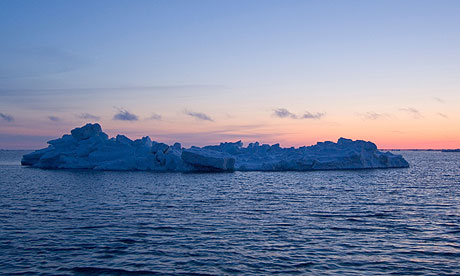
    Scientists say Arctic sea ice has plummeted to its lowest levels ever this year. Photgraph: Steven J Kazlowski/Alamy

    Sea ice in the Arctic has melted faster this year than ever recorded before, according to the US government’s National Snow and Ice Data Centre (NSIDC).

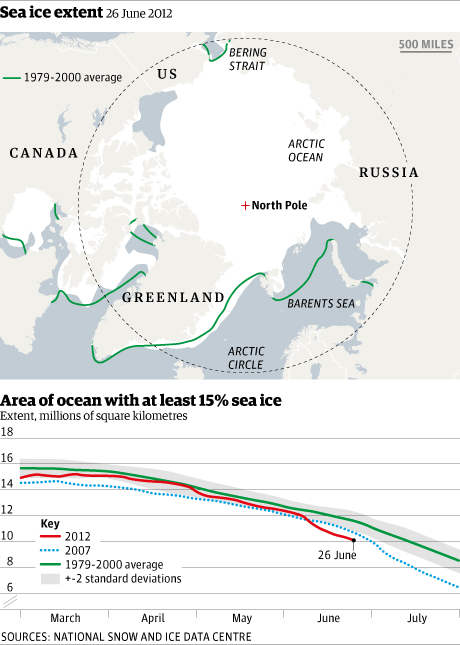
    Satellite observations show the extent of the floating ice that melts and refreezes every year was 318,000 square miles less last week than the same day period in 2007, the year of record low extent, and the lowest observed at this time of year since records began in 1979. Separate observations by University of Washington researchers suggest that the volume of Arctic sea ice is also the smallest ever calculated for this time of year.

    Scientists cautioned that it is still early in the “melt season”, but said that the latest observations suggest that the Arctic sea ice cover is continuing to shrink and thin and the pattern of record annual melts seen since 2000 is now well established. Last year saw the second greatest sea ice melt on record, 36% below the average minimum from 1979-2000.

    “Recent ice loss rates have been 100,000 to 150,000 square kilometres (38,600 to 57,900 square miles) per day, which is more than double the climatological rate. While the extent is at a record low for the date, it is still early in the melt season. Changing weather patterns throughout the summer will affect the exact trajectory of the sea ice extent through the rest of the melt season,” said a spokesman for the NSIDC.

    The increased melting is believed to be a result of climate change. Arctic temperatures have risen more than twice as fast as the global average over the past half century.
    arctic sea ice Map and chart showing extent of Arctic sea ice. Photograph: Graphic

    Shipping companies said they would be able to send more ships to China and Japan through the previously impassable waters north of Russia if the ice continued to melt so fast. The “northern sea route”, which normally requires ice breakers, cuts about 4,000 nautical miles off a journey from Europe to China and can save tens of thousands of pounds in fuel bills.

    “This year we expect to send six to eight vessels through the north-east passage, compared to none just a few years ago. There are advantages but there are extra costs and it needs special ships,” said a spokesman for Copenhagen-based Nordic Bulk Carriers, the first company to use the northern sea route in 2010.

    More open water during the summer is expected to help Russian, US and European oil companies to move into the Arctic. This week Norway announced plans to issue oil and gas exploration permits for up to 86 offshore tracts, most of them in Arctic waters, by the end of 2013. Russian companies have already drilled exploratory wells and Shell is preparing to sink two exploration wells in US Arctic Ocean waters – one between Alaska and Siberia and north of the Bering Strait, the other in the Beaufort Sea north of Alaska.

    The record speed of ice melt in the Arctic this year coincides, but is not necessarily linked to heatwaves in Siberia, record temperatures in eastern US and some of the most extreme weather ever recorded in the UK and northern Europe. The link between melting Arctic ice and extreme weather in the northern hemisphere is not established, but the UK Met Office and recent scientific reports have suggested that declining sea ice is linked to colder winters.

    Marine biologists this month said that the warming Arctic could be having major ecological effects. Scientists funded by Nasa working 100km from the nearest unfrozen waters reported in the journal Science that they had last year unexpectedly found vast concentrations of microscopic phytoplankton – the foundation of the marine food chain – under the ice, which they described as like finding a rainforest in the desert. Until now, they had believed phytoplankton grew only in open water.

    The massive sub-glacial “algal bloom”, they said, could be a sign that as the that the ice may now be thin enough to allow sunlight to catalyse algal blooms without it melting completely. “We were astonished. It was completely unexpected. It was literally the most intense phytoplankton bloom I have ever seen in my 25 years of doing this type of research,” said Prof Kevin Arrigo, a scientist at Stanford University in California.

    The findings, if confirmed, could affect the global carbon cycle because phytoplankton absorb carbon dioxide, the main greenhouse gas.

    Scientists say that the latest observations suggest that Arctic sea ice cover is continuing to shrink and thin

    Actic sea ice

    Scientists say Arctic sea ice has plummeted to its lowest levels ever this year. Photgraph: Steven J Kazlowski/Alamy

    Sea ice in the Arctic has melted faster this year than ever recorded before, according to the US government’s National Snow and Ice Data Centre (NSIDC).

    Satellite observations show the extent of the floating ice that melts and refreezes every year was 318,000 square miles less last week than the same day period in 2007, the year of record low extent, and the lowest observed at this time of year since records began in 1979. Separate observations by University of Washington researchers suggest that the volume of Arctic sea ice is also the smallest ever calculated for this time of year.

    Scientists cautioned that it is still early in the “melt season”, but said that the latest observations suggest that the Arctic sea ice cover is continuing to shrink and thin and the pattern of record annual melts seen since 2000 is now well established. Last year saw the second greatest sea ice melt on record, 36% below the average minimum from 1979-2000.

    “Recent ice loss rates have been 100,000 to 150,000 square kilometres (38,600 to 57,900 square miles) per day, which is more than double the climatological rate. While the extent is at a record low for the date, it is still early in the melt season. Changing weather patterns throughout the summer will affect the exact trajectory of the sea ice extent through the rest of the melt season,” said a spokesman for the NSIDC.

    The increased melting is believed to be a result of climate change. Arctic temperatures have risen more than twice as fast as the global average over the past half century.

    arctic sea ice Map and chart showing extent of Arctic sea ice. Photograph: Graphic

    Shipping companies said they would be able to send more ships to China and Japan through the previously impassable waters north of Russia if the ice continued to melt so fast. The “northern sea route”, which normally requires ice breakers, cuts about 4,000 nautical miles off a journey from Europe to China and can save tens of thousands of pounds in fuel bills.

    “This year we expect to send six to eight vessels through the north-east passage, compared to none just a few years ago. There are advantages but there are extra costs and it needs special ships,” said a spokesman for Copenhagen-based Nordic Bulk Carriers, the first company to use the northern sea route in 2010.

    More open water during the summer is expected to help Russian, US and European oil companies to move into the Arctic. This week Norway announced plans to issue oil and gas exploration permits for up to 86 offshore tracts, most of them in Arctic waters, by the end of 2013. Russian companies have already drilled exploratory wells and Shell is preparing to sink two exploration wells in US Arctic Ocean waters – one between Alaska and Siberia and north of the Bering Strait, the other in the Beaufort Sea north of Alaska.

    The record speed of ice melt in the Arctic this year coincides, but is not necessarily linked to heatwaves in Siberia, record temperatures in eastern US and some of the most extreme weather ever recorded in the UK and northern Europe. The link between melting Arctic ice and extreme weather in the northern hemisphere is not established, but the UK Met Office and recent scientific reports have suggested that declining sea ice is linked to colder winters.

    Marine biologists this month said that the warming Arctic could be having major ecological effects. Scientists funded by Nasa working 100km from the nearest unfrozen waters reported in the journal Science that they had last year unexpectedly found vast concentrations of microscopic phytoplankton – the foundation of the marine food chain – under the ice, which they described as like finding a rainforest in the desert. Until now, they had believed phytoplankton grew only in open water.

    The massive sub-glacial “algal bloom”, they said, could be a sign that as the that the ice may now be thin enough to allow sunlight to catalyse algal blooms without it melting completely. “We were astonished. It was completely unexpected. It was literally the most intense phytoplankton bloom I have ever seen in my 25 years of doing this type of research,” said Prof Kevin Arrigo, a scientist at Stanford University in California.

    The findings, if confirmed, could affect the global carbon cycle because phytoplankton absorb carbon dioxide, the main greenhouse gas.