Category: News

Add your news
You can add news from your networks or groups through the website by becoming an author. Simply register as a member of the Generator, and then email Giovanni asking to become an author. He will then work with you to integrate your content into the site as effectively as possible.
Listen to the Generator News online

 
The Generator news service publishes articles on sustainable development, agriculture and energy as well as observations on current affairs. The news service is used on the weekly radio show, The Generator, as well as by a number of monthly and quarterly magazines. A podcast of the Generator news is also available.
As well as Giovanni’s articles it picks up the most pertinent articles from a range of other news services. You can publish the news feed on your website using RSS, free of charge.
 

  • Mariana trench fuels volcanoes and quakes

    Mariana trench fuels volcanoes and quakes
    Futurity: Research News
    “We think that much of the water that goes down at the Mariana trench actually comes back out of the earth into the atmosphere as water vapor when the volcanos erupt hundreds of miles away,” says Doug Wiens, professor of earth and planetary science.
    See all stories on this topic »
    Guatemalan Volcanoes Increase Activity
    Prensa Latina
    26 de marzo de 2012, 14:28Guatemala, Mar 26 (Prensa Latina) Guatemalan volcanoes Santiaguito and Fuego increased their activity in the last hours and the authorities recommended on Monday took all the necessary precautions with the surrounding air
    See all stories on this topic »
    Batu Tara volcano (Indonesia): larger ash eruption
    VolcanoDiscovery
    As our colleague Marc from vulkane.net reports, the volcano Batu Tara in the Sunda Sea off the island of Flores in Indonesia had a larger than usual ash eruption today, which triggered an alert of the VAAC Darwin, who raised the aviation color code to
    See all stories on this topic »
    NASA’s ISS Views A Steamy Pagan In A Ring Of Fire (Imagery)
    SatNews Publishers
    A steam plume flows blows south from the peak of Pagan Island’s northernmost volcano in this photograph by an astronaut on the International Space Station (ISS). Pagan is part of the Commonwealth of the Northern Marianas, an island chain of volcanoes
    See all stories on this topic »
  • Inquiry to look at rail corridors building

    Inquiry to look at rail corridors building

    Josephine Tovey

    March 27, 2012

    alt

    “Development has taken place above and around only a small number of stations in Sydney – such as Chatswood, Kogarah and Edgecliff.” Photo: James Brickwood

    THE state government should consider creating a special authority to facilitate redevelopment around Sydney’s train stations and railway lines for things such as new apartments and shopping centres, says the state’s top transport official.

    A parliamentary inquiry is under way into the benefits and barriers to building Hong Kong-style developments above and around Sydney’s rail corridors, a concept given general support by a broad range of groups, including the City of Sydney, Infrastructure Partnerships Australia and the government’s own Department of Planning. Benefits cited include providing housing where public transport infrastructure already exists and reducing reliance on cars and road congestion.

    Development has taken place above and around only a small number of stations in Sydney – such as Chatswood, Kogarah and Edgecliff.

    Part of the difficulty in allowing such developments to proceed is the complexity of dealing with a number of different agencies, said the director-general of Transport NSW, Les Wielinga.

    He told the inquiry yesterday a separate authority, a ”one-stop shop” bringing together various necessary expertise and powers including planning, construction and finance, would ideally be established to allow such development to go ahead.

    ”You’ve got to bring together a group of people that have got the capabilities, the skills, to make these developments happen,” he said.

    Mr Wielinga said the authority could function in a similar way to the Sydney Harbour Foreshore Authority. ”This sort of a model is the right sort of model, provided you give it the appropriate powers that the community needs,” he said.

    A number of submissions supporting the proposal cite Hong Kong as an example of successful ”transit-oriented development”. But Mr Wielinga pointed out developments usually took place at the same time as stations were constructed – avoiding the challenges developers would face building over or around already established Sydney stations.

    David Spiteri from RailCorp told the inquiry the difficulty of shutting down stations or whole train lines, and organising alternative transport during construction, was a major impediment to such development.

    ”The biggest constraint to a developer is shutting a railway down to the work,” he said.

    The City of Sydney said in its submission it had long recommended that opportunities for building above Central Station and its rail yards be explored.

    Infrastructure Partnerships Australia identified five city stations in its submission that it considered ideal for redevelopment by public private partnerships – Redfern, Central, Town Hall, Martin Place and Circular Quay.

    Read more: http://www.smh.com.au/nsw/inquiry-to-look-at-rail-corridors-building-20120326-1vung.html#ixzz1qIVcZo5I

  • New Limit Pending on Greenhouse Gas Emissions NY TImes

    Alert Name: CLIMATE CHANGE NEWS
    March 27, 2012 Compiled: 1:25 AM

    By FELICITY BARRINGER and JUSTIN GILLIS (NYT)

    Under the rule, expected to be announced this week, new power plants will have to emit no more than 1,000 tons of carbon dioxide per megawatt-hour of energy produced.

    About This E-mail

    You received this e-mail because you signed up for NYTimes.com’s My Alerts tool. As a member of the TRUSTe privacy program, we are committed to protecting your privacy.

  • Mining not to blame for latest SA quake

    Mining not to blame for latest SA quake

    Updated March 27, 2012 13:33:32

    Geoscience Australia said a magnitude 3.9 earthquake near Olympic Dam in outback South Australia was not caused by any explosion at the mine.

    The quake’s epicentre was about 10 kilometres from the Roxby Downs mine in the far north of SA on Monday morning.

    A magnitude 6.1 earthquake shook the remote region near Ernabella last week.

    Seismologist Hugh Glanville said the two jolts were not related.

    “We’ve had a few aftershocks and foreshocks for that big one north near Ernabella, but for these two earthquakes they’re too far apart to be linked in that kind of way,” he said.

    The quake near Ernabella left no major damage but locals said cracks opened up in the ground and there were some rockfalls.

    The jolt was felt hundreds of kilometres from the epicentre.

    Topics:earthquake, disasters-and-accidents, olympic-dam-5725, roxby-downs-5725, port-pirie-5540, port-lincoln-5606, port-augusta-5700, ernabella-872, sa, australia

    First posted March 27, 2012 13:29:56

  • Mariana Trench: James Cameron completes record-breaking mission

    Mariana Trench: James Cameron completes record-breaking mission

    Titanic director becomes first person to perform solo voyage to floor of seven-mile-deep canyon – the oceans’ deepest point

    • guardian.co.uk, Monday 26 March 2012 12.16 BST
    • Article history
    • James Cameron, director of such Hollywood smashes as Titanic and Avatar, descends to the Mariana Trench in the Pacific Link to this video

      The film director James Cameron was today described as a real-life Avatar after he returned safely from a one-man mission to the Mariana Trench, the deepest point of Earth’s oceans.

      Cameron emerged from his 12-tonne, lime green submarine, Deepsea Challenger, early this morning after travelling nearly seven miles down to the desert-like bottom of the trench. His ship was equipped with 3D cameras to shoot footage for a planned documentary, using lighting from a spectacular eight-foot tower of LEDs. The director of Titanic and Avatar, who has maintained a long-term interest in the secrets of the oceans’ depths, was able to direct and film the action from within the sub.

      “There is scientific value in getting stereo images because … you can determine the scale and distance of objects from stereo pairs that you can’t from 2D images,” Cameron told National Geographic News ahead of the dive. As he reached the bottom of the trench, which is about 200 miles south-west of the Pacific island of Guam, Cameron sent out a tweet reading: “Just arrived at the ocean’s deepest pt. Hitting bottom never felt so good. Can’t wait to share what I’m seeing w/ you”.
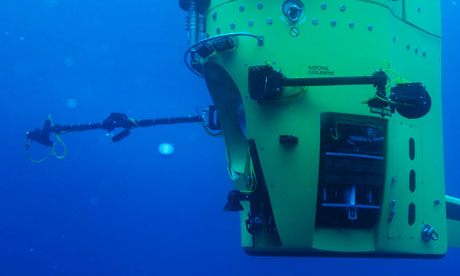
      James Cameron Deepsea challenger test James Cameron’s Deepsea Challenger submersible. Photograph: Reuters

      The Mariana is 120 times larger than the Grand Canyon and more than a mile deeper than Mount Everest is tall. The dive was the first into the depths of the trench since Swiss engineer Jacques Piccard and US navy captain Don Walsh spent 20 minutes there in 1960. Unlike Cameron, they were unable to see – let alone film – very much as their submarine kicked up too much mud from the ocean floor.

      Expedition doctor Joe MacInnis said Cameron’s journey had been “the ultimate test of a man and his machine”, describing his friend as a real-life “avatar”. He said: “He’s down there on behalf of everybody else on this planet. There are seven billion people who can’t go, and he can. And he’s aware of that.”

      The expedition was organised and funded by Cameron himself, an oceanography enthusiast since childhood, along with the National Geographic Society, Rolex and Microsoft co-founder Paul Allen. The director, 57, has undertaken 72 deep-sea submersible dives, 33 of which were to the wreckage of the Titanic, the subject of his 1997 hit film. He expects the trip to the Mariana Trench to be the first of many.

      Expedition member Patricia Fryer told National Geographic News the Deepsea Challenger’s journey to the depths was far more useful scientifically than cheaper unmanned missions. “The critical thing is to be able to take the human mind down into that environment,” said the marine geologist. “To be able to turn your head and look around to see what the relationships are between organisms in a community and to see how they’re behaving – to turn off all the lights and just sit there and watch and not frighten the animals, so that they behave normally. That is almost impossible to do with an ROV [remotely operated vehicle].”

  • Nation’s most needy ‘ missing out on essentials’

    Nation’s most needy missing out on essentials

    March 27, 2012

    Marginalised ... the unemployed.

    Marginalised … the unemployed. Photo: Virginia Star

    SOLE parents and the unemployed on social security payments are missing out on the essentials of life such as dental care and decent housing, and their children lack up-to-date school books and uniforms, a new study shows.

    The study has been released by the Australian Council of Social Service in advance of its national conference on Thursday.

    It shows 61 per cent of the unemployed on the Newstart allowance and 58 per cent of those on the parenting payment are missing out on at least three essentials of life, compared with 12 per cent of age pensioners and 15 per cent of all households.

    Advertisement: Story continues below

    “The worst poverty is found in the last places that governments have looked,” the report says. “Pension payments are frugal but unemployed people and sole parents have to get by on much less.”

    The study found almost one-quarter of those on Newstart and the parenting payment could not afford a decent, secure home; and more than 40 per cent could not afford dental treatment or home contents insurance. Between 37 per cent and 50 per cent could not access $500 in savings and high proportions could not pay utility bills on time.

    More than one-quarter of the children in these families were unable to afford a hobby or leisure activity compared with 5 per cent in the wider community.

    The poverty levels were three to five times greater than found among age pensioners who, on some measures, were doing better than working households.

    The groups in greatest need missed out on $32 a week payment increases that went to age pensioners in 2009 and, due to lack of adequate indexation, people on Newstart have been falling further behind each year.

    The study will be used to bolster calls for the government to increase payments to those on the lowest benefits which are now up to $133 a week less than the age pension. It is the largest gap between pensions and other payments in three decades.

    The Newstart allowance for a single person is $243 a week, the parenting payment is $321 and the age pension is $374.

    The gap is growing wider because pension indexation is linked to wages growth, and Newstart to inflation.

    The report says the argument for keeping Newstart much lower than the age pension – that people only need it for a short period till they find work – is undermined by the nature of the unemployed still stranded on the rolls.

    Almost two-thirds have been on the payment for more than a year and one-fifth have a disability. “Their profile increasingly resembles that of the pension payment recipients of yesteryear,” the study says.

    Disability pensioners were found to also suffer high rates of material deprivation at 43 per cent despite their pension rate being identical to that of age pensioners. This is because they face significant extra costs due to their disability and are more likely to be renting.

    The findings showed welfare recipients who are renting, including age pensioners, to be much worse off, highlighting the need for substantial increases in rent assistance, ACOSS says.

    The study is based on data developed by the social policy research centre at the University of NSW that measures people’s actual living standards – their access to the essentials of life.

    The essentials have been chosen by a random sample of Australian adults who whittled down a proposed list to 24 items, each of which garnered more than 50 per cent support. Researchers consider people who lack three or more of the 24 essentials because of low income to suffer multiple deprivations.

    Read more: http://www.smh.com.au/national/nations-most-needy-missing-out-on-essentials-20120326-1vup2.html#ixzz1qGk8fdNP