SYDNEY CBD AREA COPPING HEAVY STORM AND HAIL

Add your news
You can add news from your networks or groups through the website by becoming an author. Simply register as a member of the Generator, and then email Giovanni asking to become an author. He will then work with you to integrate your content into the site as effectively as possible.
Listen to the Generator News online
The Generator news service publishes articles on sustainable development, agriculture and energy as well as observations on current affairs. The news service is used on the weekly radio show, The Generator, as well as by a number of monthly and quarterly magazines. A podcast of the Generator news is also available.
As well as Giovanni’s articles it picks up the most pertinent articles from a range of other news services. You can publish the news feed on your website using RSS, free of charge.
SYDNEY CBD AREA COPPING HEAVY STORM AND HAIL
|
Inbox
|
x |

|
6:06 PM (5 minutes ago)
 |
|
|||
climate code red |
| As 2015 smashes temperature records, it’s hotter than you think
Posted: 23 Aug 2015 07:07 PM PDT by David Spratt
There is an El Nino in full swing which helps push average global temperatures higher, and records are being broken, but just how hot is it? For several years, we have heard that global warming has pushed temperatures higher by around 0.8 to 0.85 degrees Celsius (°C). But in 2015, that number is not even close. Even before this year’s strong El Nino developed, 2015 was a hot year. The first few months of the year broken records for the hottest corresponding period in previous years all the way back to the start of the instrumental record in 1880. Each month, new records fell.  With the July data in, the US Government’s National Oceanic and Atmospheric Administration reported that July was the hottest month among the 1627 months on record since 1880, and the first seven months of the year was the hottest January-July on record:
In addition the year-to-date globally-averaged land surface temperature beat the previous record in 2007 by a whopping 0.15°C, and the year-to-date globally-averaged sea surface temperature surpassed the previous record of 2010 by 0.06°C. Every major ocean basin observed record warmth in some areas. And, as Joe Romm has reported, “It was especially hot for the 6 billion of us up here in the northern hemisphere, where the first seven months of 2015 were a remarkable 0.3°F (0.17°C) warmer than the first seven months of any year on record — and nearly a half degree Fahrenheit warmer than any year before 2007”. El Nino may be strongest on record 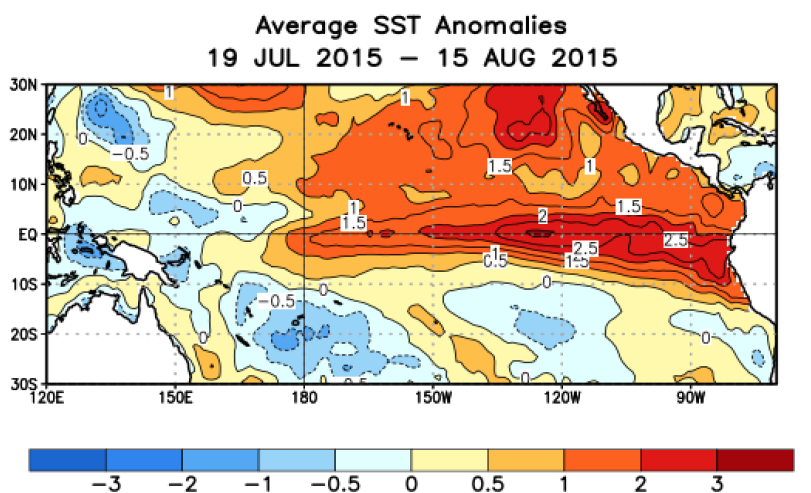 So this year, records are not being broken. They are being smashed, as a strong El Nino (and perhaps the strongest on record) is set to persist through to 2016. El Nino conditions are characterised by a warm band of water across the eastern tropical Pacific Ocean and facilitate the transfer of heat from the ocean surface layer to the atmosphere and are associated with a hotter climate. The NOAA’s most recent El Nino update (Climate Prediction Center / NCEP 17 August 2015) reports that:
(El Nino 3.4 is the zone of longitudes 120 to 150W along the equatorial Pacific Ocean). 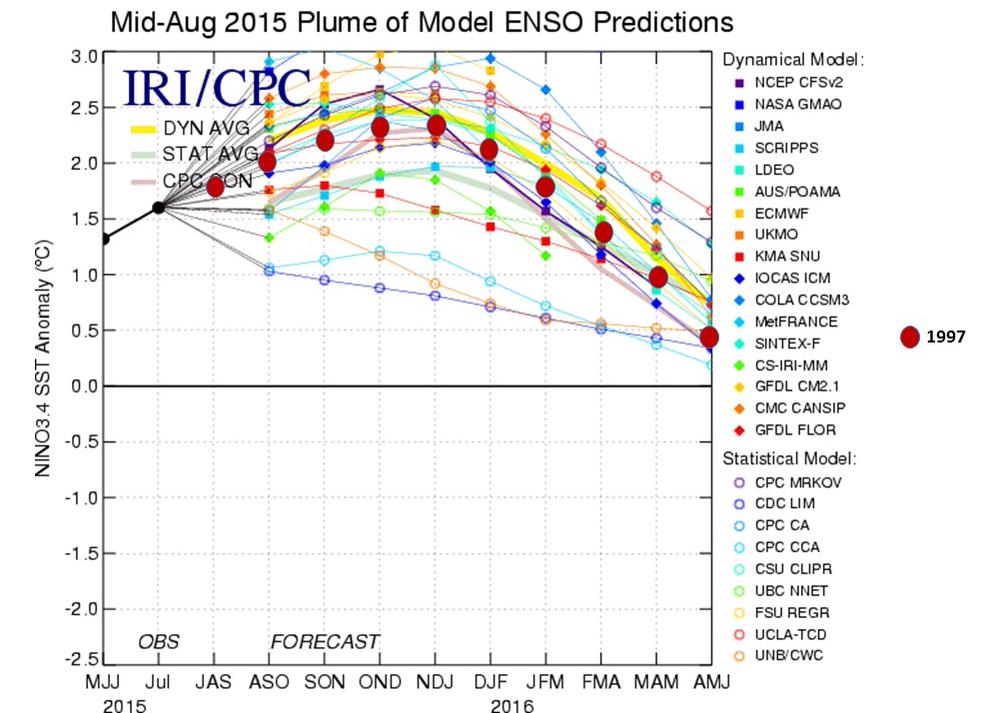 As the chart above illustrates, the projected strength of the El Nino (yellow line) is slightly above the previous strongest such event in 1997 (red dots). So hot will 2015 be? The NOAA has already reported that the first seven months of the year was almost 0.1°C above the previous record. This is a huge amount in a field where changes are often measured in one-hundredths of a degree. With a 90% chance of the El Nino persisting into 2016, it is as close as a certain bet can be that 2015 will be the hottest year on the instrumental record. And there is probably an even-money chance that the margin will exceed 0.1°C. This would be an incredible result with scientists shocked at the margin by which records are being broken. And there is a good chance that 2016 will beat 2015 to become the hottest year on record. It’s hotter than you think But much hotter has it got already? The convention is to talk about the amount of warming “above pre-industrial”, that is, before the steam-and-coal industrial revolution, around 1750. But the instrumental record used by the major agencies in the US, the UK and Japan does not start till 1880, and it is this period that is often used to provide a “pre-industrial” baseline. So when we hear that warming so far up to (the average of) the last decade as being 0.8°C or 0.85°C, it is the warming from a 1880 baseline (see light green column in figure below of 0.87°C, based on the NOAA dataset since 1880). But the climate around 1750 and 1880 were not the same. Research using proxy data and modelling shows that between 1750 and 1880 the global average temperature increased by ~0.2°C.
When that is added (dark green column), we find that the real warming from pre-industrial 1750 to the average of the last decade is 1.07°C. It is a shock to see that we are more than half way to the unsafe 2°C “guardrail” favoured by international policy-makers. The warming over 1750 pre-industrial to 2014 was 1.17°C. And for the first seven months of 2015, the margin is a staggering 1.26°C higher than the pre-industrial level. Yes, it is a strong El Nino period, and it may drop back for a short while, but 2016 could be just as hot and we may be entering a new phase of accelerated warming. Greenhouse emissions continue to soar to record levels, and attempts to clean up and retire some of the world’s dirtiest coal power plants may result in a lowering of the production of aerosols (including black-carbon soot, organic carbon, sulphates, nitrates, as well as dust from smoke, manufacturing and windstorms) which at the moment provide a temporary (~1 week) cooling of 0.8-1°C. The leading climate researcher Michael E. Mann says that as fossil fuel use is curtailed, the aerosol cooling impact will lessen. Mann says that “if the world burns significantly less coal…we would have to limit CO2 to below roughly 405 ppm”, a level we will reach in two years. A climate emergency requiring levels of action far beyond anything that is currently perceived by policy makers? As temperatures soar to record levels and it is hotter than most people understand, you can bet on that. |
|
Inbox
|
x |
|
5:08 PM (40 minutes ago)
|
|
|||
|
 |
|
||||
|
Inbox
|
x |
|
10:09 AM (53 minutes ago)
|
|
|||
|
|
Inbox
|
x |

|
7:55 AM (1 hour ago)
|
|
|||
When everyone is thinking the same, no one is thinkingJohn Wooden
“The US and it’s allies want to keep this monster (ISIS) in check, but they don’t want to destroy it. What the West has done so far has strengthened terrorism not ended it. The proof is that terrorism has spread everywhere, its material resources have increased, and its ranks have swollen.”Bashar al Assad
In September 2015, Agenda 21 Will Be Transformed Into The 2030 Agendathe 2030 Agenda is a template for governing the entire planet.
Warring Migrant Tribes, Grenade Attacks…What Is Going On In Sweden?if you bring intolerant people into your country this is what can happenImmigrants in Germany swell to record high 11 million
Yemen after 5 months ‘already looks like Syria after five years of war’Entrenched poverty, months of intensified warfare and limits on imports because of an international embargo have contributed to “catastrophic” conditions
China’s Dramatic Rise, and What It MeansOver the past 30 years, real per capita income has grown by more than 1,300%. Over the last decade alone, China quadrupled its industrial output. It now produces more automobiles than the US and Japan combined.
Germany made €100bn profit on Greek crisisGreece’s biggest creditor Germany has made a huge profit on the country’s debt crisis over the last 5 years as it saved through lower interest payments on funds borrowed amid investor “flights to safety.”
1 of 17
|
Inbox
|
x |

|
5:41 PM (1 hour ago)
|
|
|||
|
|
|
||||