Category: News

Add your news
You can add news from your networks or groups through the website by becoming an author. Simply register as a member of the Generator, and then email Giovanni asking to become an author. He will then work with you to integrate your content into the site as effectively as possible.
Listen to the Generator News online

 
The Generator news service publishes articles on sustainable development, agriculture and energy as well as observations on current affairs. The news service is used on the weekly radio show, The Generator, as well as by a number of monthly and quarterly magazines. A podcast of the Generator news is also available.
As well as Giovanni’s articles it picks up the most pertinent articles from a range of other news services. You can publish the news feed on your website using RSS, free of charge.
 

  • Break-in targets climate scientist


    Fears of further attacks by climate-change deniers have also put Copenhagen delegates under increased pressure to reach a comprehensive deal to limit carbon emissions, with Britain’s chief negotiator, energy and climate change secretary Ed Miliband, warning last week that there was no certainty that a deal would be reached. “We need to have our foot on the gas all the time,” he said on Thursday. “We should not be complacent about getting a deal.” It was crucial that Britain, and Europe, showed ambition in setting an agenda for a tough, binding agreement and not let the efforts of climate sceptics derail negotiations, he added. “Our children will hold us in contempt if we fail now.”

    Analysts say the key to success at Copenhagen would be the establishment of a treaty in which developed countries agree to make major carbon emission cuts while developing nations make lesser, but nevertheless significant reductions of their own. Ultimately, the aim is to ensure that the world’s output of CO2 begins to decline by 2020. If this is not achieved, temperatures will rise by more than 2C and take the world into uncontrollable global warming.

    In addition, the Copenhagen summit will also have to establish a mechanism by which the west will pledge to pay billions of pounds in aid to the developing world to introduce renewable technologies and other climate-control measures. So far, there is little sign of rapprochement, particularly over the issue of cash aid from developed countries.

    “Rich nations tell us they are going to Copenhagen to seal a deal, but we say not an unfair deal. We will never give way,” said Abdalmahmood Abdalhaleem Mohamed, Sudan’s ambassador to the UN. Bangladesh’s senior delegate was equally robust, describing the $10bn so far offered by the west as “peanuts”.

    However, there was more encouraging news last week when India’s prime minister, Manmohan Singh, announced he would attend the summit, joining Gordon Brown and President Barack Obama on the final day of the meeting. India is the world’s fourth biggest emitter of greenhouse gases and has just pledged to cut its carbon emissions by 20-25% by 2020. India had previously been reluctant to commit itself to carbon cuts. Singh’s new stance suggests his country is now prepared to be more co-operative.

  • Copenhagen: the african dimension


    Any concerted effort to tackle climate change in Africa must focus primarily on poverty reduction and the UN’s millennium development goals (MDGs), the internationally agreed effort to halve extreme poverty and hunger and reduce major diseases by 2015. Any attempt to “seal the deal” – as the secretary-general puts it – must therefore also involve a development deal for African nations and other developing regions.

    However, finalising such a deal isn’t just about responding to Africa’s vulnerabilities. It also means that we must assess how African countries can contribute to the solution.

    First, we must remember that climate change is not a problem of Africa’s making: according to estimates, the continent has contributed only 3.8% of the world’s greenhouse gas emissions. Further, Africa’s potential to help tackle climate change is both largely unrecognised and unrealised. For instance, thanks to the forest cover and rich topsoil found in many countries in Africa, the region represents a major carbon storehouse. African forests take in 20% of the carbon absorbed by trees across the world.

    It is now widely recognised that global temperatures should not increase more than two degrees Celsius as compared with pre-industrial levels. The world will not be able to achieve that goal without reducing emissions from land use and leveraging the untapped capacity of ecosystems to store carbon. Africa has a central role to play in that process.

    The climate deal that replaces the Kyoto protocol in 2012 could result in important additional funds for developing countries. These funds could represent a primary source of development financing for the continent. Climate change management thus offers a number of “win-win” opportunities for African countries to both reduce the adverse effects of climate change and address some of their deep-rooted development concerns such as access to energy, food security and the prevention of crises and conflicts.

    While these key issues should serve as the core pillars of Africa’s engagement in the negotiations, the next question is how to transform these opportunities into concrete actions and results.

    Africa will require urgent support for the formulation of climate change strategies as well as upfront financing to take highly effective measures for adaptation and mitigation.

    Because of the sheer impact and magnitude of climate change on the continent, African leaders at national and sub-national levels (regions, provinces and municipalities) must not only co-ordinate their responses to its effects but also ensure that they are in line with existing development plans.

    With over 70% of greenhouse gas emissions influenced by local behaviours and investment choices, sub-national authorities, which are often responsible for making key decisions on the ground, will be essential actors in this process.

    African policymakers are aware of the need to co-ordinate climate strategies, as exemplified by a recent declaration, signed by 30 African ministers, which speaks of “a consolidated framework to ensure coordination and coherence …of climate change initiatives and sustainable development plans in Africa at all levels.” As such, one of the immediate priorities will be the creation of a fund that would build the capacities of developing countries in preparing such low-carbon and climate-resilient strategies.

    In addition, a range of resources – from grants and loans to fiscal measures and market-based instruments – will be needed for successful mitigation and adaptation on the ground. Additional aid is also urgently required to complement the new adaptation fund of the UN framework convention on climate change (UNFCCC), which is helping vulnerable countries to meet the costs of adaptation.

    Market-based instruments are essential. If properly reformed, the clean development mechanism (CDM) and other carbon market schemes could play a significant role in funding a broad portfolio of renewable energy and energy-efficient options in Africa. These could represent more than 180 gigawatts of additional power generation. That is more than twice the region’s total existing capacity.

    Biocarbon, the carbon sequestered and stored in the world’s trees, plants, soil and oceans, offers similarly attractive investment options that could significantly contribute to reducing emissions from deforestation and forest degradation.

    The stakes and options are clear. If world leaders seal the deal – and ensure that it is a deal for development – the result could be a huge new boost in the fight for human development and environmental sustainability in Africa.
  • Land grab in Mali forces local farmers off their land

    Land grab in Mali forces local farmers off their land

    Ecologist

    4th December, 2009

    Local population evicted as Mali sells long-term leases on large tracts of agricultural land to Libyan company

    A Libyan agribusiness has bought the farming rights for 100,000 hectares of land in northern Mali.
     
    The deal is part of the Malian government’s strategy to promote private investment in rice production and includes the construction of a 40km irrigation canal.  
     
    But the region’s farmers are concerned that the deal will have negative consequences for their livelihoods.

    Under the agreement, Malibya, a subsidiary of a Libyan sovereign wealth fund, has been granted a 50-year lease to the land in the Office du Niger region.
     
    Lamine Coulibaly, of Coordination Nationale des Organisations Paysannes (CNOP), an umbrella organisation representing the interests of farmers, said the agreement was driven by Libya’s concerns over food security.
     
    ‘Libya is dependent on multinationals for agricultural products. Following the example of other Arab countries, projects like this in Office du Niger are an attempt to end this dependency,’ he said.
     
    Land grab or opportunity?
     
    Mali’s Agricultural Minister Agatham Ag Alassane said that Mali had no choice if is going to feed its own population.
     
    ‘Our concern today is to modernise agriculture, especially rice cultivation. To do this, we need a lot of resources and a lot of land. We cannot give a tractor to a small producer who would use it on two or three hectares; that would be a waste,’ he is reported as saying.
     
    CNOP said the local population were already being evicted from their land.
     
    ‘The Chinese company contracted to build the canal has started work on the demolition of 150 houses.  Other families have had their gardens destroyed along with all the food that they grow. So far there has been no compensation,’ said Coulibaly.
     
    Competition for water
     
    Local farmers are expected to receive compensation in the form of irrigated land but there are fears that large-scale rice production by Malibya will mean they lose out on water.
     
    ‘The project will increase competition for the waters of the river Niger, the most important irrigation resource in the country,’ said Coulibaly.
     
    He added that Malibya had entered into negotiations to have priority over water resources in the low season, when water supplies are weak.
     
    Roger Wilson, of the World Land Trust, expressed concern at the apparent lack of transparency in the agreement being made.
     
    ‘This is a strategic decision with a 50 year lock-in. There needs to be more information about the social and environmental ramifications of this project.’

    Useful links
    CNOP
    World Land Trust

  • Climate guru to boycott Copenhagen


    Dr Hansen, 68, was one of the first voices to raise the alarm about rising global temperatures in the early 1980s, forecasting correctly that the planet would warm in the coming decades.

    Next week he publishes his first book, Storms of my Grandchildren, warning that “our planet, with its remarkable array of life, is in imminent danger of crashing” and declaring, “It is our last chance.” He decries the cap-and-trade system envisaged by governments as ineffective in stemming carbon emissions. Under such systems, governments set limits on overall emissions and polluters trade quotas among themselves.

    “The fundamental problem is that fossil fuels are the cheapest form of energy. As long as they are, they are going to be used,” he said. “It’s remarkable. They refuse to recognise and address the fundamental problem and the obvious solution.”

    He dismisses government announcements of national targets for greenhouse gas emissions as promises that will not be kept.

    It would be better for the Copenhagen summit to fail rather than reach the type of cap-and-trade-based system envisaged, he said. “If they sign on to anything like they are talking about then it’s definitely counter-productive. Any time you start down that path, it’s time wasted. We would do better taking a year time-out and figuring out a better path.”

    Dr Hansen, adjunct professor at Columbia University’s Earth Institute in New York, says the only way to control global warming is through a carbon tax. “We are going to have to move beyond fossil fuels at some point. Why continue to stretch it out?” he said.

    “The only way we can do that is by putting a price on carbon emissions. The business community and the public need to understand that there will be a gradually increasing price on carbon emissions.” He proposes that carbon tax revenues be returned directly to the public in the form of a dividend.

    He also believes that the world must be prepared to abandon coal unless its emissions are captured.

  • Copenhagen climate change talks must fail, says top scientist


    “The whole approach is so fundamentally wrong that it is better to reassess the situation. If it is going to be the Kyoto-type thing then [people] will spend years trying to determine exactly what that means.” He was speaking as progress towards a deal in Copenhagen received a boost today, with India revealing a target to curb its carbon emissions. All four of the major emitters – the US, China, EU and India – have now tabled offers on emissions, although the equally vexed issue of funding for developing nations to deal with global warming remains deadlocked.

    Hansen, in repeated appearances before Congress beginning in 1989, has done more than any other scientist to educate politicians about the causes of global warming and to prod them into action to avoid its most catastrophic consequences. But he is vehemently opposed to the carbon market schemes – in which permits to pollute are bought and sold – which are seen by the EU and other governments as the most efficient way to cut emissions and move to a new clean energy economy.

    Hansen is also fiercely critical of Barack Obama – and even Al Gore, who won a Nobel peace prize for his efforts to get the world to act on climate change – saying politicians have failed to meet what he regards as the moral challenge of our age.

    In Hansen’s view, dealing with climate change allows no room for the compromises that rule the world of elected politics. “This is analagous to the issue of slavery faced by Abraham Lincoln or the issue of Nazism faced by Winston Churchill,” he said. “On those kind of issues you cannot compromise. You can’t say let’s reduce slavery, let’s find a compromise and reduce it 50% or reduce it 40%.”

    He added: “We don’t have a leader who is able to grasp it and say what is really needed. Instead we are trying to continue business as usual.”

    The understated Iowan’s journey from climate scientist to activist accelerated in the last years of the Bush administration. Hansen, a reluctant public speaker, says he was forced into the public realm by the increasingly clear looming spectre of droughts, floods, famines and drowned cities indicated by the science.

    That enormous body of scientific evidence has been put under a microscope by climate sceptics after last month’s release online of hacked emails sent by respected researchers at the climate research unit of the University of East Anglia. Hansen admitted the controversy could shake public’s trust, and called for an investigation. “All that stuff they are arguing about the data doesn’t really change the analysis at all, but it does leave a very bad impression,” he said.

    The row reached Congress today, with Republicans accusing the researchers of engaging in “scientific fascism” and pressing the Obama administration’s top science adviser, John Holdren, to condemn the email. Holdren, a climate scientist who wrote one of the emails in the UEA trove, said he was prepared to denounce any misuse of data by the scientists – if one is proved.

    Hansen has emerged as a leading campaigner against the coal industry, which produces more greenhouse gas emissions than any other fuel source.

    He has become a fixture at campus demonstrations and last summer was arrested at a protest against mountaintop mining in West Virginia, where he called the Obama government’s policies “half-assed”.

    He has irked some environmentalists by espousing a direct carbon tax on fuel use. Some see that as a distraction from rallying support in Congress for cap-and-trade legislation that is on the table.

    He is scathing of that approach. “This is analagous to the indulgences that the Catholic church sold in the middle ages. The bishops collected lots of money and the sinners got redemption. Both parties liked that arrangement despite its absurdity. That is exactly what’s happening,” he said. “We’ve got the developed countries who want to continue more or less business as usual and then these developing countries who want money and that is what they can get through offsets [sold through the carbon markets].”

    For all Hansen’s pessimism, he insists there is still hope. “It may be that we have already committed to a future sea level rise of a metre or even more but that doesn’t mean that you give up.

    “Because if you give up you could be talking about tens of metres. So I find it screwy that people say you passed a tipping point so it’s too late. In that case what are you thinking: that we are going to abandon the planet? You want to minimise the damage.”

    • James Hansen’s book Storms of My Grandchildren is published by Bloomsbury, £18.99

  • Copenhagen climate change talks must fail, says top scientist

    Copenhagen climate change talks must fail, says top scientist

    Exclusive: World’s leading climate change expert says summit talks so flawed that deal would be a disaster

    James Hansen

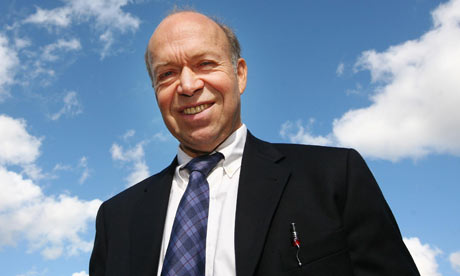
    ‘We don’t have a leader who is able to grasp [the issue] and say what is really needed. Instead we are trying to continue business as usual,’ say James Hansen. Photograph: Gareth Fuller/PA

    The scientist who convinced the world to take notice of the looming danger of global warming says it would be better for the planet and for future generations if next week’s Copenhagen climate change summit ended in collapse.

    ” + __flash__argumentsToXML(arguments,0) + ““)); }” s_getversion=”function () { return eval(instance.CallFunction(“” + __flash__argumentsToXML(arguments,0) + ““)); }” s_getmovieid=”function () { return eval(instance.CallFunction(“” + __flash__argumentsToXML(arguments,0) + ““)); }” s_getpageurl=”function () { return eval(instance.CallFunction(“” + __flash__argumentsToXML(arguments,0) + ““)); }” s_getpagename=”function () { return eval(instance.CallFunction(“” + __flash__argumentsToXML(arguments,0) + ““)); }” s_getaccount=”function () { return eval(instance.CallFunction(“” + __flash__argumentsToXML(arguments,0) + ““)); }” s_gettrackclickmap=”function () { return eval(instance.CallFunction(“” + __flash__argumentsToXML(arguments,0) + ““)); }” s_getdomindex=”function () { return eval(instance.CallFunction(“” + __flash__argumentsToXML(arguments,0) + ““)); }” s_getswfurl=”function () { return eval(instance.CallFunction(“” + __flash__argumentsToXML(arguments,0) + ““)); }” returntype=”javascript” name=”name”>