Category: News

Add your news
You can add news from your networks or groups through the website by becoming an author. Simply register as a member of the Generator, and then email Giovanni asking to become an author. He will then work with you to integrate your content into the site as effectively as possible.
Listen to the Generator News online

 
The Generator news service publishes articles on sustainable development, agriculture and energy as well as observations on current affairs. The news service is used on the weekly radio show, The Generator, as well as by a number of monthly and quarterly magazines. A podcast of the Generator news is also available.
As well as Giovanni’s articles it picks up the most pertinent articles from a range of other news services. You can publish the news feed on your website using RSS, free of charge.
 

  • Wind Power: the silent majority must speak out, says Miliband

    Wind power: the silent majority must speak out, says Miliband


    To tackle climate change we must end public apathy – and widen our leaders’ focus beyond their pet policies.
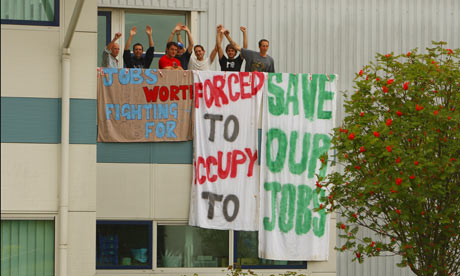


    Vestas Wind Systems turbine workers stage jobs fight sit-in, Newport, Isle of Wight

    Staff members stage a sit-in the Vestas Wind Systems factory in Newport, Isle of Wight. Photograph: Chris Ison/PA


    Last night I went to hear Ed Miliband, the secretary of state for energy and climate change, speak in Oxford Town Hall. About 800 people turned up, a lot of them determined to challenge him.


    It started badly. His spin doctor tried to get the organisers to take down the polite banners people were holding in support of the workers at the Vestas wind turbine factory on the Isle of Wight. I asked her why she wanted them removed. She replied that it was a public meeting, not a protest. Why couldn’t it be both?


    “It’s just my opinion; I don’t like them.”


    The banners stayed up.


    Though I didn’t agree with everything he said, and though he’s no orator, Miliband was good. He never tried to duck a question. He listened, answered directly, never insulted the intelligence of the audience: he appeared, in other words, to be the opposite of a New Labour politician. If the government were composed of people like him and Hilary Benn, I would vote Labour again. But what poor company they keep!


    He began by responding to one of the Vestas workers (there were several in the hall). He said that he had asked Vestas whether its decision to move its plant to the US “was about money. They said no. Would [government] money make a difference? No.” It was about the credit crunch and the planning system. He was trying to address both problems: by putting £1bn into wind developments and by changing the planning laws.


    “But the biggest thing we can do for people like David [the Vestas worker] and his colleagues is to change people’s minds about onshore wind. … There’s a big, big persuasion job we’ll have to do on people: that the biggest threat to the countryside is not the wind turbines; it’s climate change. … The truth is that a vocal minority has stopped them going ahead and the silent majority has not done enough to ensure they go ahead. We’re doing all the government can do, I hope people will also do their bit.” (Well we tried, but his spin doctor wanted us to take down the banners.)


    This was his major theme. He ended his talk by saying “We don’t have enough of a global campaign around Copenhagen [climate talks this December] at the moment. I hope you will take part in it.” It’s not the first time that Miliband has pressed people to give the government a harder time, and he’s right: we can’t sit on our butts and expect polticians to do more than the public is demanding.


    His responses to the questions were interesting, though they betrayed the strangely narrow view that cabinet ministers – so focused on the complexities of immediate policy – now seem obliged to possess. He was asked, for example, about how the UK will implement the findings of IAASTD‘s report that relate to global warming. This is the vast global assessment of agricultural science which was overseen by a British civil servant and published last year. It was roughly the equivalent of the Intergovernmental Panel on Climate Change’s assessment reports: it is one of the most important environmental documents ever published. But Miliband had no idea what she was talking about. Agriculture belongs to another department, so even though it’s responsible for a substantial portion of our greenhouse gases, he doesn’t have to know anything about it.


    There was a similar gap when I asked him about the stonking contradiction at the heart of his new, low-carbon transition paper. There’s plenty of good in it, and for the first time it provides a clear road map for achieving the government’s inadequate targets for cutting emissions. But while it spells out the means by which we might minimise our consumption of fossil fuels, it also demands that we maximise their production. This is what it says:


    “The government’s approach is to maximise the economic exploitation of the UK’s own oil reserves, to work with other countries to ensure a well-functioning global oil market, and to improve UK fuel infrastructure.”


    and


    “[We will] maximise the economic production of oil and gas from the North Sea”.


    The government has the same policy for coal. The 2007 Energy White paper says that it intends to “maximise economic recovery of the oil and gas from the UK Continental Shelf (UKCS) and from remaining coal reserves.” (page 107).


    He appeared to be unaware of the coal policy, denying it while I was asking the question. Has the policy changed? If so, when was this announced? And why are opencast coal mines still being given planning permission? Or could his civil servants have shielded him so effectively from the government’s dodgier energy policies that he has never been exposed to this contradiction before?


    In any case, he decided to concentrate on gas.


    “The less we produce from the North Sea, the more we will import. Gas is a transition technology and it’s a long transition. I agree that we have to wean ourselves off fossil fuels, but it is a transition and gas is part of the transition.”


    Maximising production doesn’t look like weaning ourselves off it; nor does his explanation make sense of the government’s policy on coal and oil. This is one I won’t drop.


    I agreed with what he said about population, however.


    “There’s no question that population growth is part of the reason why we have growth in carbon emissions… but I’m not sure that there’s an easy or necessarily desirable solution once you’ve stated that fact.”


    Here’s what he said in response to a question about flying:


    “Domestic flights have got to become more expensive. There are perverse incentives. We have argued strongly for aviation to be included in the European Emissions Trading Scheme. Personally I think aviation is undertaxed. We are the only country in the world to have said we will keep carbon levels from aviation to current levels by 2050. But here’s a difficult thing about aviation: we have an 80% reduction target. If we cut aviation emissions by that by 2050, we’d go back to 1974 levels of flying. But the world is getting closer together, not further apartt… we will have to do a lot more in other areas if we’re going to carry on flying.”


    What this means of course is that we’ll have to make cuts of greater than 80% in emissions from heating, electricity, other forms of transport and farming in order to accommodate current levels of flying. Where’s the vision here? Why can’t the government announce a study, for example, on how it might best phase out business flights, replacing them with enhanced video conferencing and all the other brilliant virtual technologies we now enjoy?


    The other thing that struck me about the meeting was the great enthusiasm for wind farms. The Vestas people were cheered to the rafters, and even the government’s draconian new planning laws were popular. On this issue Miliband is right: the surveys show that there really is a silent majority in favour of onshore wind, but we’ve failed to mobilise in its defence.



    www.monbiot.com

  • A force of nature: our influential Anthropocene period.


    A force of nature: our influential Anthropocene period


    What humanity does has important consequences, so we must manage our global life-support system


    We live in epoch-making times. I mean this literally, rather than as a tool to dramatise the global economic crisis or latest political scandal. An epoch describes a geological time period. The end of the last glaciation, some 11,000 years ago, saw the transition from the cool Pleistocene to the warmer Holocene. This relatively stable epoch saw humans turn to agriculture and our population rise considerably. Now geologists, ecologists and climate scientists, myself included, are reporting we have entered a new and much less stable geological epoch: the Anthropocene.


    Just as changes to the Earth’s orbit, volcanic eruptions and asteroid impacts in the distant past have set the world on radically new courses, humanity itself has now become a collective force of nature, with far-reaching consequences. But what does this startling discovery – that humanity has become a globally significant geophysical force – mean for society, solving environmental problems, and perhaps more profoundly, how we see ourselves?


    People have always had an impact on the environment. The difference now is that rather than influencing only local environments in limited ways, humanity is having planet-wide impacts on the Earth’s workings. The best known global change is the rise in atmospheric carbon dioxide and resulting climatic changes. Some of the CO2 in the atmosphere dissolves into the oceans, making them more acid, which is degrading marine ecosystems. To put this in context, the oceans are more acidic today that they have been for at least 800 millenia. The atmospheric CO2 increase has also boosted plant growth in some places, changing the world’s forests and grasslands. In short, the global cycling of carbon has been significantly altered.


    The impacts of human activity on the other great global chemical cycles are similarly profound. To increase crop yields, more nitrogen is added to ecosystems through fertiliser use, than is added by all natural processes combined. But fertiliser run-off leads to ‘dead-zones’ of low-oxygen water that currently affect 245,000 sq km of the world’s ocean.


    Furthermore, scientists estimate that each year humans move more rock, sediment and soil than all natural processes , that at least three times as much fresh water is held in reservoirs than in rivers, and at least a third of all land has been appropriated for human use.


    The heavy hand of humanity reaches into the living world too. Each year, we extract 7m tonnes of bushmeat from tropical forests, 95m tonnes of fish from the oceans, and raze 80,000 sq km of forest. The result: we are at the leading edge of the sixth mass extinction in Earth’s history. Extinction rates today are at least 100 times higher than ‘background’ rates. Previous extinctions, such as that which wiped out the dinosaurs 65m years ago, are joined by a human-induced loss of life.


    Many of these trends look set to continue or accelerate, with potentially dire consequences. Recent events may provide a taste of what’s to come: in 2007 and 2008 food protests erupted across three continents, in part because of the switch of some land from food to biofuel production. In the same period, about 1% of humanity had their homes damaged or destroyed by extreme weather events. Interlinked feedback loops amongst political, economic and environmental spheres could lead to grave problems without foresight and planning.


    The big question in the Anthropocene is: can we learn to manage our own global life-support system and avoid crossing dangerous thresholds? The answer so far, if progress in 14 years of UN climate change talks is a measure, is probably no.


    But perhaps there are grounds for cautious optimism. The word “Anthropocene”, coined by Nobel prize winner Paul Crutzen, has greatly assisted researchers in understanding how the Earth and human society function together. Perhaps pushing the concept into wider usage would enable politicians, business leaders, social movements and NGO’s to similarly benefit from thinking along integrated, quantitative and evidence-based lines.


    Of course, scientific knowledge itself cannot set goals for society. Choosing how to manage our life support system is within the realm of politics. Scientists can identify the likely (and unlikely) outcomes of choices we face. For instance, humanity’s impact on the environment has been greatest over the last 50 years. In this time human numbers have doubled and the global economy increased more than fifteen-fold. Our socio-economic system and the fossil fuels that power it lie at the heart of understanding how humans have become a force of nature, and therefore how to alter our future impacts.


    Big ideas from science are often discomfiting. The Anthropocene is no exception. There is a temptation to see humanity as “bad” for despoiling the environment, or to deny the evidence through fear of acknowledging the need for profound changes. I see it as an update on how we view our place in the universe. First, Copernicus discovered that the Earth revolves around the sun, and humanity is not at the centre of the universe. Then, Darwin established that we are not even at the heart of life on Earth. Now Crutzen has reversed this trend by naming a new human-dominated geological epoch. . The future direction of the only place in the universe where we know life exists is in our hands. Suddenly, after almost 500 years, humanity is centre stage again. Let’s not blow it.


  • China’s three biggest power firms emit more carbon than Britain, says report

    China’s three biggest power firms emit more carbon than Britain, says report


    Greenpeace report names top three polluters and calls for tax on coal to improve efficiency and encourage switch to renewables 


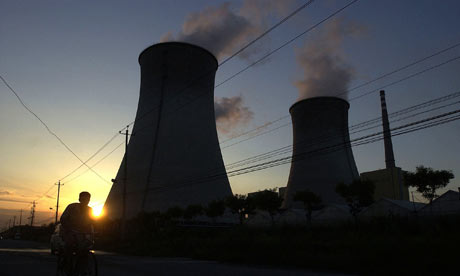
    A cyclist rides past a China Huaneng Group power plant in Beijing

    A cyclist rides past a China Huaneng Group power plant in Beijing Photograph: China Newsphoto/Reuters


    China‘s three biggest power firms produced more greenhouse gas emissions last year than the whole of Britain, according to a Greenpeace report published today.


    The group warned that inefficient plants and the country’s heavy reliance on coal are hindering efforts to tackle climate change. While China’s emissions per capita remain far below those of developed countries, the country as a whole has surpassed the United States to become the world’s largest emitter.


    Greenpeace said the top 10 companies, which provided almost 60% of China’s total electricity last year, burned 20% of China’s coal — 590m tonnes — and emitted the equivalent of 1.44 billion tonnes of carbon dioxide.


    The efficiency of Chinese power generation compares unfavourably with other countries. In Japan, 418 grams of carbon dioxide are emitted per kilowatt hour and in the US, the equivalent figure is 625 grams. But most of the top 10 firms in China produce 752 grams of CO2.


    “China is suffering the pains of extreme weather events such as droughts, heat waves, typhoons and floods, worsened by climate change. These power companies can and must help China to prevent climate disaster by rapidly increasing efficiency and the share of renewable energy such as wind and solar,” said Yang Ailun, Greenpeace’s climate campaign manager, at the launch in Beijing of the Greenpeace report, Polluting Power: Ranking China’s Biggest Power Companies.


    The report says that in 2008, Huaneng, Datang and Guodian — the top three firms — emitted more greenhouse gases than the whole of the United Kingdom.


    But Yang added: “China is ideally placed to…[become] the world’s superpower in terms of smart energy and renewable energy.”


    The group said China closed down 54.07 gigawatt of the least efficient coal-fired plants over the last three and a half years — more than the total electricity installed capacity of Australia.


    It urged power firms to phase out all inefficient coal-fired plants under 100 megawatt by 2012, saving 90m tonnes of coal consumption and 220m tonnes of carbon dioxide annually.


    Firms are already turning to renewable energy and by the end of last year Guodian had installed 2.88 gigawatt of wind power; almost 24% of China’s total and enough to make it the biggest wind energy firm in Asia.


    But Greenpeace said only three of the top 10 produced 10% or more of their energy from renewable sources. The vast majority relied heavily on hydropower — with eight of the firms not even halfway to their legal obligation to produce 3% of energy from other renewable sources by 2010.


    Greenpeace urged the Chinese government to impose energy and environment taxes on coal, encouraging increased efficiency and a move to renewable sources.


    It also called for a doubling of the national renewable energy target to 30% by 2020 and for stricter efficiency standards for coal-fired power stations.


    The State Council, China’s cabinet, is currently drawing up plans for a massive “new energy” programme to cut emissions and ensure energy security. Reports in the domestic media and from foreign diplomats suggest the next decade could see between 1.4 trillion (US$200 bn) and 4.5 trillion yuan (US$600bn) investment in projects ranging from nuclear power, low carbon transport and clean coal technology to super-efficient electric grids.


    This huge expansion is already causing problems. Manufacturing capacity is outstripping supply and the country’s under-invested power grid networks were not ready for large-scale wind power input. Some wind farms have been unable to start operating because of a lack of grid connection or were operating at levels lower than planned.


    But experts warn that de-carbonising the energy supply must happen fast, given the massive toll on China’s environment. State news agency Xinhua reported yesterday that the country’s largest desert lake could vanish in decades due to climate change and human activities.


    “Just 10 years ago, one couldn’t see the other bank of the Hongjiannao even through a telescope. Today, it’s visible with the naked eye,” said He Fenqi, a researcher with the Chinese Academy of Sciences.


    The Hongjiannao, sandwiched between the Muus Desert in Shaanxi Province and the Erdos Plateau in Inner Mongolia, has shrunk by at least 30% in the past two decades, Xinhua reported. It now covers 4,600 hectares and its water level is declining by 20 centimetres annually

  • Greenpeace study finds oil companies may be doomed

    Greenpeace study finds oil companies may be doomed


    Environmental activist network argues that the oil industry might be approaching a tipping point from fall in the price, advances in technology and policies on climate change


    A long-term decline in the demand for oil could undermine the huge investments in Canadian tar sands, which have been heavily opposed by environmentalists, according to a report published today.


    The report, by Greenpeace, will make uncomfortable reading for the companies that are investing tens of billions of pounds to exploit the hard-to-extract oil in the belief that demand and the price would climb inexorably as countries such as China and India industrialise.


    Citing projections from the oil producers’ cartel Opec and the International Energy Agency, as well as various oil experts, the report casts doubt on the conventional assumption that consumption and prices will begin gathering pace once the world pulls itself out of recession.


    It argues that alongside the cyclical fall in the oil price there are more fundamental structural changes taking place. These are driven by advances in energy efficiency and alternative energy, cleaner vehicles, government policies on climate change and concerns over energy security. Greenpeace has posted the report to 200 shareholders in Shell and BP, including pension funds, in an effort to put pressure on the companies to think again. BP reports quarterly results tomorrow and Shell on Thursday.


    Lorne Stockman, the author of the report, said: “A peak in oil demand was barely discussed even a year ago, but now it is a viable idea. When it happens, I wouldn’t want to guess, but it will happen sooner than we thought. There has been lots of talk about a supply peak, but it is good to start talking about a demand peak, and that has huge implications for these companies.


    “All of the international oil companies as you look beyond 2020 need a high oil price to be profitable, because they are increasingly being pushed to develop expensive resources in not just the tar sands, but in deep water and offshore Arctic sites.


    “But there is something more structural going on,” he added. “Governments are beginning to act, and not just the Obama administration. In the EU, the policy driver is climate change, and in China and the US, it is about energy security and the vulnerability of the economy to volatility in the oil price.”


    The rush to exploit the tar sands in Canada has been described as a modern day gold rush that has led to a huge boom in once sleepy towns in the province of Alberta. The oil was once considered too difficult and expensive to extract as it is a mixture of clay, water and bitumen.


    Many of the projects have been mothballed until the oil price recovers. It has fallen from a peak of $147 a barrel and is currently at about $68. Merrill Lynch estimates that the price would need to settle at about $80 to make further investment viable. Critics argue that tar sands extraction is disastrous to the environment, causing deforestation, requiring huge amounts of water and greenhouse emissions three to five times greater than conventional crude.


    The report notes that Opec and the IEA have been revising projections for oil demand downwards since 2006, with by far the sharpest revision this year. Opec has revised its 2025 oil forecast down by 12% within the past four years.


    Peter Hughes, who spent much of his career at BP and BG, and is now director for global energy at consultancy firm Arthur D Little, recently wrote a report titled ‘The Beginning of the End for Oil?’ He supports the Greenpeace view and said the correlation between oil demand and GDP growth has been weakened. “It is widely accepted that demand in OECD countries has plateaued and is going into decline but it has also been thought that would be massively outweighed by growth in China. But the Chinese think long-term and identified some time ago that the biggest threat to their economic growth was an increasing dependency on imported energy, which is anathema to them. The conclusion is clear – to reduce the reliance on hydrocarbons through energy efficiency and fundamental technology change. I think we will reach peak oil demand in the middle of the next decade.”


    About 50% of oil demand in the US fuels cars and the report takes hope from the Obama administration having tied recent bailouts for the industry to the development of cleaner vehicles. But it notes the US is far behind China, where government mandates mean new Chinese cars are 56% more fuel-efficient than those built in Detroit. Fuel-efficient cars in China attract 1% sales tax and sports utility vehicles, 40%.


    Greenpeace also contends that a high oil price is simply unsustainable. It cites research from Cambridge Energy Research Associates, which suggests that economies become constrained when the price moves into a band between $100 and $120 a barrel, causing the price to fall back. Another report from energy business analysts Douglas Westwood puts the “recession threshold” even lower, at $80 a barrel.


    Shell, which has delayed a number of tar sands projects, argues that energy supply will struggle to keep up with the demands of a growing global population and that in the long term there will be upward pressures on energy prices that justify investing in the Canadian tar sands. “Our first oil sands operation, the Athabasca Oil Sands Project (60% Shell share) was built between 1999 and 2003, when the oil price was considerably lower,” a spokeswoman said. Shell has the highest exposure of the majors to the tar sands and is most at risk from a decline in demand.


    There are contrary views. The Saudi oil minister warned in May that the world could be facing another oil shock, with prices above $150 within two to three years through a lack of investment in new capacity. The International Monetary Fund has expressed similar concerns. Even Greenpeace does not suggest that there will not be temporary squeezes on demand and price spikes. But it believes that the world might fast be approaching a tipping pointthat could have profound implications.


  • Kenya to build Africa’s biggest windfarm

    Kenya to build Africa’s biggest windfarm


    With surging demand for power and blackouts common across the continent, Africa is looking to solar, wind and geothermal technologies to meet its energy needs


    ngong wind farm

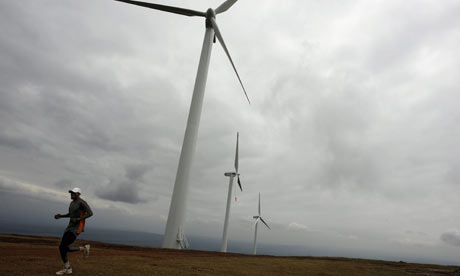
    A wind farm in the Ngong hills on the outskirts of Nairobi, Kenya Photograph: Stephen Morrison/EPA


    One of the hottest places in the world is set to become the site of Africa’s most ambitious venture in the battle against global warming. 


    Some 365 giant wind turbines are to be installed in desert around Lake Turkana in northern Kenya – used as a backdrop for the film The Constant Gardener – creating the biggest windfarm on the continent. When complete in 2012, the £533m project will have a capacity of 300MW, a quarter of Kenya’s current installed power and one of the highest proportions of wind energy to be fed in a national grid anywhere in the world. 


    Until now, only north African countries such as Morocco and Egypt have harnessed wind power for commercial purposes on any real scale on the continent. But projects are now beginning to bloom south of the Sahara as governments realise that harnessing the vast wind potential can efficiently meet a surging demand for electricity and ending blackouts. 


    Already Ethiopia has commissioned a £190m, 120MW farm in Tigray region, representing 15% of the current electricity capacity, and intends to build several more. Tanzania has announced plans to generate at least 100MW of power from two projects in the central Singida region, more than 10% of the country’s current supply. In March, South Africa, whose heavy reliance on coal makes its electricity the second most greenhouse-gas intensive in the world, became the first African country to announce a feed-in tariff for wind power, whereby customers generating electricity receive a cash payment for selling that power to the grid.


    Kenya is trying to lead the way. Besides the Turkana project, which is being backed by the African Development Bank, private investors have proposed establishing a second windfarm near Naivasha, the well-known tourist town. And in the Ngong hills near Nairobi, the Maasai herders and elite long-distance athletes used to braving the frigid winds along the escarpment already have towering company: six 50m turbines from the Danish company Vestas that were erected last month and will add 5.1MW to the national grid from August. Another dozen turbines will be added at the site in the next few years. 


    Christopher Maende, an engineer from the state power company KenGen, which is running the Ngong farm and testing 14 other wind sites across the country, said local residents and herders were initially worried that noise from the turbines would scare the animals. 


    “Now they are coming to admire the beauty of these machines,” he said. 


    Kenya’s electricity is already very green by global standards. Nearly three-quarters of KenGen’s installed capacity comes from hydropower, and a further 11% from geothermal plants, which tap into the hot rocks a mile beneath the Rift Valley to release steam to power turbines. 


    Currently fewer than one-in-five Kenyans has access to electricity but demand is rising quickly, particularly in rural areas and from businesses. At the same time, increasingly erratic rainfall patterns and the destruction of key water catchment areas have affected hydroelectricity output. Low water levels caused the country’s largest hydropower dam to be shut down last month. 


    As a short-term measure KenGen is relying on imported fossil fuels, such as coal and diesel. But within five years the government wants to drastically reduce the reliance on hydro by adding 500MW of geothermal power and 800MW of wind energy to the grid. 


    Not only are they far greener options than coal or diesel, but the country’s favourable geology and meteorology make them cheaper alternatives over time. The possibility of selling carbon credits to companies in the industrialised world is an added financial advantage. 


    “Kenya’s natural fuel should come from the wind, hot underground rock and the sun, whose potential has barely even been considered,” said Nick Nuttall, spokesman for the United Nations Environment Programme. “After the initial capital costs this energy is free.” 


    The Dutch consortium behind the Lake Turkana Wind Power (LTWP) project has leased 66,000 hectares of land on the eastern edge of the world’s largest permanent desert lake. The volcanic soil is scoured by hot winds that blow consistently year round through the channel between the Kenyan and Ethiopian highlands.


    According to LTWP, which has an agreement to sell its electricity to the Kenya Power & Lighting Company, the average wind speed is 11metres per second, akin to “proven reserves” in the oil sector, said Carlo Van Wageningen, chairman of the company. 


    “We believe that this site is one of the best in the world for wind,” he said. If the project succeeds, the company estimates that there is the potential for the farm to generate a further 2,700MW of power, some of which could be exported.


    First, however, there are huge logistical obstacles to overcome. The remote site of Loiyangalani is nearly 300 miles north of Nairobi. Transporting the turbines will require several thousand truck journeys, as well as the improvement of bridges and roads along the way. Security is also an issue as the region is known bandit country, and many locals are armed with AK-47 assault rifles. 


    LTWP also has to construct a 266-mile transmission line and several substations to connect the windfarm to the national grid. It has promised to provide electricity to the closest local towns, currently powered by generators. 


    The greening of Africa


    At the end of 2008, Africa’s installed wind power capacity was only 593MW. But that is set to change fast. Egypt has declared plans to have 7,200MW of wind electricity by 2020, meeting 12% of the country’s energy needs. Morocco has a 15% target over the same period. South Africa and Kenya have not announced such long-term goals, but with power shortages and wind potential of up to 60,000MW and 30,000MW respectively, local projects are expected to boom. With the carbon credit market proving strong incentives for investment other types of renewable energy are also set to take off. Kenya is planning to quickly expanding its geothermal capacity, and neighbouring Rift Valley countries up to Djibouti are examining their own potential. As technology improves and costs fall, solar will also enter the mix. Germany has already publicised plans to develop a €400bn solar park in the Sahara.


    “Ultimately for Africa solar is the answer, although [costs mean] we may still be decades away,” said Herman Oelsner, president of the African Wind Energy Association.


  • World will warm faster than predicted in next five years, study warns


    World will warm faster than predicted in next five years, study warns


    New estimate based on the forthcoming upturn in solar activity and El Niño southern oscillation cycles is expected to silence global warming sceptics


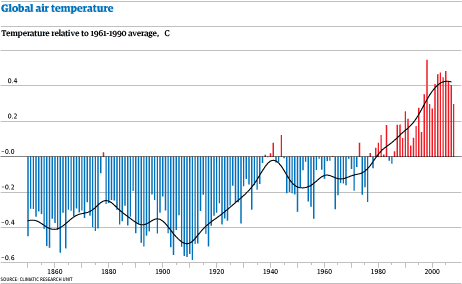
    Air temp

    The world faces record-breaking temperatures as the sun’s activity increases, leading the planet to heat up significantly faster than scientists had predicted for the next five years, according to a study.


    The hottest year on record was 1998, and the relatively cool years since have led to some global warming sceptics claiming that temperatures have levelled off or started to decline. But new research firmly rejects that argument.


    The research, to be published in Geophysical Research Letters, was carried out by Judith Lean, of the US Naval Research Laboratory, and David Rind, of Nasa’s Goddard Institute for Space Studies.


    The work is the first to assess the combined impact on global temperature of four factors: human influences such as CO2 and aerosol emissions; heating from the sun; volcanic activity and the El Niño southern oscillation, the phenomenon by which the Pacific Ocean flips between warmer and cooler states every few years.


    The analysis shows the relative stability in global temperatures in the last seven years is explained primarily by the decline in incoming sunlight associated with the downward phase of the 11-year solar cycle, together with a lack of strong El Niño events. These trends have masked the warming caused by CO2 and other greenhouse gases.


    As solar activity picks up again in the coming years, the research suggests, temperatures will shoot up at 150% of the rate predicted by the UN’s Intergovernmental Panel on Climate Change. Lean and Rind’s research also sheds light on the extreme average temperature in 1998. The paper confirms that the temperature spike that year was caused primarily by a very strong El Niño episode. A future episode could be expected to create a spike of equivalent magnitude on top of an even higher baseline, thus shattering the 1998 record.


    The study comes within days of announcements from climatologists that the world is entering a new El Niño warm spell. This suggests that temperature rises in the next year could be even more marked than Lean and Rind’s paper suggests. A particularly hot autumn and winter could add to the pressure on policy makers to reach a meaningful deal at December’s climate-change negotiations in Copenhagen.


    Bob Henson, of the National Centre for Atmospheric Research in Colorado, said: “To claim that global temperatures have cooled since 1998 and therefore that man-made climate change isn’t happening is a bit like saying spring has gone away when you have a mild week after a scorching Easter.” Temperature highs and lows


    1998

    Hottest year of the millennium


    Caused by a major El Niño event. The climate phenomenon results from warming of the tropical Pacific and causes heatwaves, droughts and flooding around the world. The 1998 event caused 16% of the world’s coral reefs to die.


    1957

    Most sunspots in a year since 1778


    The sun’s activity waxes and wanes on an 11-year cycle. The late 1950s saw a peak in activity and were relatively warm years for the period.


    1601

    Coldest year of the millennium


    Ash from the huge eruption the previous year of a Peruvian volcano called Huaynaputina blocked out the sun. The volcanic winter caused Russia’s worst famine, with a third of the population dying, and disrupted agriculture from China to France.