Category: News

Add your news
You can add news from your networks or groups through the website by becoming an author. Simply register as a member of the Generator, and then email Giovanni asking to become an author. He will then work with you to integrate your content into the site as effectively as possible.
Listen to the Generator News online

 
The Generator news service publishes articles on sustainable development, agriculture and energy as well as observations on current affairs. The news service is used on the weekly radio show, The Generator, as well as by a number of monthly and quarterly magazines. A podcast of the Generator news is also available.
As well as Giovanni’s articles it picks up the most pertinent articles from a range of other news services. You can publish the news feed on your website using RSS, free of charge.
 

  • Is the clean energy cashback tariff high enough to stimulate investment ?


    1. Is the clean energy cashback tariff high enough to stimulate investment?


    After months of deliberation, the UK government has announced a range of illustrative figures for feed-in tariffs. From Carbon Commentary, part of the Guardian Environment Network


    After months of deliberation, the UK government has announced a range of illustrative figures for feed-in tariffs (FITs), which it’s calling a Clean Energy Cashback scheme. FITs are fixed payments made to the owners of small generating stations for the electricity that they export to the grid. Micro-generators need high payments to justify their expensive investment in buying and installing green generation.


    The proposed levels of FIT vary by the type of technology. The principal ones covered are biomass combustion (burning wood to generate electric power), hydro, solar photovoltaics, and wind turbines. Of these, the most appealing are likely to be wind and PV. If my estimates in the following paragraphs are correct, the government’s proposal for payments to rooftop PV are too low to generate much new investment. On the other hand, the payments for rural wind are good enough to make decent returns. If the figures survive unchanged through (yet another) consultation process, we should see thousands of small wind turbines in windy British fields.


    Solar
    The proposal is for a FIT of 36.5 pence per kilowatt hour for a domestic rooftop system for installations in financial year 2010/2011. A typical UK installation is about ‘2 kilowatts peak’, a figure for the maximum output in the middle of the day in mid-summer. Such an installation will generate about 1,800 kilowatt hours (kWh) a year in a sunny location in Devon or Cornwall on a south-facing roof. No more than half this electricity would be fed into the grid, the rest would be used in the home. In this case, the revenues are approximately as follows:


    2 kilowatt peak installation in the English south-west:


    Output

    1800 kWh
    Export 900 kWh
    FIT 36.5p per kWh
    Total value 328.5
    Used in the home 900 kWh
    Saving in electricity bill 13p per kWh
    Total value 117
    Total value of installation 445.5

    The cost of such an installation today would be about £10,000, meaning a running return of about 4.5%. A PV installation is likely to last 25 years or more, so the installation pays back its cost, but with only a little to spare. In the north of England, the figures would be even less good. PV is nice, but it isn’t a money-spinner. To attract large-scale investment, the FIT might have had to be 50p or more.


    Wind is better
    A 15 kW turbine at the end of a large rural garden or on a village green would cost about £50,000 (source: Proven Turbines: £41,000 for the turbine and my estimate of £9,000 for installation and grid connection). This machine would generate perhaps 25,000 kilowatt hours on a windy and exposed site with minimal turbulence created by trees. All this would get pumped into the grid. (This is good – you get more cash from exporting the electricity than you would save by using it yourself.)


    15 kilowatt wind turbine in a good location:


    Output

    25,000 kWh
    Export 25,000 kWh
    FIT 23p per kWh
    Total value 5750
    Less: yearly maintenance cost (estimate) 750
    Total value of installation 5000

    If these estimates are correct, the return on a 15 kilowatt turbine would be 10% p.a. A machine should last twenty years or more. It isn’t a return that would excite Goldman Sachs, but it isn’t bad. Go for a wind turbine, not for the more glamorous solar panels.

     

  • The rich can relax. We just need the poor world to cut emissions. By 125%

    The rich can relax. We just need the poor world to cut emissions. By 125%


    British and G8 climate strategy just doesn’t add up. As soon as serious curbs are needed it turns into impossible nonsense.


    Well, at least that clears up the mystery. Over the past year I’ve been fretting over an intractable contradiction. The government has promised spectacular cuts in greenhouse gas emissions. It is also pushing through new roads and runways, approving coal-burning power stations, bailing out car manufacturers and ditching regulations for low-carbon homes. How can these policies be reconciled?


    We will find out tomorrow, when it publishes a series of papers on carbon reduction. According to one person who has read the drafts, the new policies will include buying up to 50% of the reduction from abroad. If this is true, it means that the UK will not cut its greenhouse gases by 80% by 2050, as the government promised. It means it will cut them by 40%. Offsetting half our emissions (which means paying other countries to cut them on our behalf) makes a mockery of the government’s climate change programme.


    The figure might have changed between the draft and final documents, but let’s take it at face value for the moment, to see what happens when rich nations offload their obligations. What I am about to explain is the simple mathematical reason why any large-scale programme of offsets is unjust, contradictory and ultimately impossible.


    Last week the G8 summit adopted the UK’s two key targets : it proposed that developed countries should reduce their greenhouse gases by 80% by 2050 to prevent more than two degrees of global warming. This meant that it also adopted the UK’s key contradiction, as there is no connection between these two aims. An 80% cut is very unlikely to prevent two degrees of warming; in fact it’s not even the right measure, as I’ll explain later on. But let’s work out what happens if the other rich nations adopt both the UK’s targets and its draft approach to carbon offsets.


    Please bear with me on this: the point is an important one. There are some figures involved, but I’ll use only the most basic arithmetic, which anyone with a calculator can reproduce.


    The G8 didn’t explain what it meant by “developed countries”, but I’ll assume it was referring to the nations listed in Annex 1 of the Kyoto protocol: those that have promised to limit their greenhouse gases by 2012. (If it meant the OECD nations, the results are very similar.) To keep this simple and consistent, I’ll consider just the carbon emissions from burning fossil fuels, as listed by US Energy Information Administration. It doesn’t publish figures for Monaco and Lichtenstein, but we can forgive that. The 38 remaining Annex 1 countries produce 15bn tonnes of CO2, or 51% of global emissions. Were they to do as the UK proposes, cutting this total by 80% and offsetting half of it, they would have to buy reductions equal to 20% of the world’s total carbon production. This means that other countries would need to cut 42% of their emissions just to absorb our carbon offsets.


    But the G8 has also adopted another of the UK’s targets: a global cut of 50% by 2050. Fifty per cent of world production is 14.6bn tonnes. If the Annex 1 countries reduce their emissions by 80% (including offsets), they will trim global output by 12bn tonnes. The other countries must therefore find further cuts of 2.6bn tonnes. Added to the offsets they’ve sold, this means that their total obligation is 8.6bn tonnes, or 60% of their current emissions.


    So here’s the outcome. The rich nations, if they follow the UK’s presumed lead, will cut their carbon pollution by 40%. The poorer nations will cut their carbon pollution by 60%.


    If global justice means anything, the rich countries must make deeper cuts than the poor. We have the most to cut and can best afford to forgo opportunities for development. If nations like the UK cannot make deep reductions, no one can. We could, as I showed in my book Heat, reduce emissions by 90% without seriously damaging our quality of life. But this carries a political price. Business must be asked to write off sunk costs, people must be asked to make minor changes in the way they live. This country appears to be doing what it has done throughout colonial and postcolonial history: dumping its political problems overseas, rather than confronting them at home.


    Befuddled yet? I haven’t explained the half of it. As the G8 leaders know, a global cut of 50% offers only a faint to nonexistent chance of meeting their ultimate objective: preventing more than two degrees of warming. In its latest summary of climate science, published in 2007, the Intergovernmental Panel on Climate Change suggested that a high chance of preventing more than two degrees of warming requires a global cut of 85% by 2050. In drafting the climate change act, the UK government promised to keep matching the target to the science. It has already raised its cut from 60% to 80% by 2050. If it sticks to its promise it will have to raise it again.


    Global average CO2 emissions are 4.48 tonnes per person per year. Cutting the world total by 85% means reducing this to 0.67 tonnes. Average per capita output in the 38 Annex 1 countries is 10 tonnes; to hit this target they must cut their emissions by 93.3% by 2050. If the rich persist in offsetting 50% of this cut, the poorer countries would have to reduce their emissions by 7bn tonnes to absorb our offsets. To meet a global average of 0.67 tonnes, they would also need to chop their own output by a further 10.8bn tonnes. This means a total cut of 17.8bn tonnes, or 125% of their current emissions. I hope you have spotted the flaw.


    In fact, even the IPCC’s proposal has been superseded. Two recent papers in Nature show that the measure that counts is not the proportion of current emissions produced on a certain date, but the total amount of greenhouse gases we release. An 85% cut by 2050 could produce completely different outcomes. If most of the cut took place at the beginning of the period, our cumulative emissions would be quite low. If, as the US Waxman- Markey bill proposes, it takes place towards the end, they would be much higher. To deliver a high chance of preventing two degrees of warming, we would need to cut global emissions by something like 10% by the end of next year and 25% by 2012. This is a challenge no government is yet prepared to accept.


    Carbon offsetting makes sense if you are seeking a global cut of 5% between now and for ever. It is the cheapest and quickest way of achieving an insignificant reduction. But as soon as you seek substantial cuts, it becomes an unfair, impossible nonsense, the equivalent of pulling yourself off the ground by your whiskers. Yes, let us help poorer nations to reduce deforestation and clean up pollution. But let us not pretend that it lets us off the hook.


  • Most Americans don’t believe humans responsible for climate change, study finds

    Most Americans don’t believe humans responsible for climate change, study finds


    In contrast, scientists overwhelmingly believe global warming is caused by human activity


    Earth

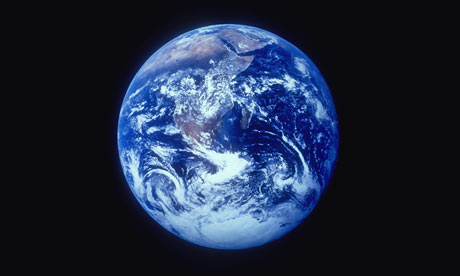
    Planet Earth. Photograph: Blue Line Pictures/Getty Images


    Barack Obama’s sense of urgency in getting Congress and the international community to act on climate change does not appear to have rubbed off on the average American, a new study published today reveals.


    Even as the president pressed the G8 and the world’s major polluters to resist cynicism and the pressure of the economic recession to act against global warming, a majority of Americans remain unconvinced that humans are responsible for climate change, or that there is an urgent need to act.


    About 49% of Americans believe the Earth is getting warmer because of the burning of fossil fuels and other human activity, the survey by the Pew Research Centre and the American Association for the Advancement of Science said. Some 36% attributed global warming to natural changes in the atmosphere and another 10% said there was no clear evidence that the earth was indeed undergoing climate change.


    Scientists in contrast are overwhelmingly persuaded that global warming is caused by humans – some 84% blame human activity. A strong majority – some 70% – also believe it is a very serious problem. Despite that degree of consensus, some 35% of Americans continues to believe – wrongly it turns out – that climate change remains a matter of scientific controversy. Only about 47% of the public views climate change as a very serious problem, a finding that has remained stable over the years, the survey said. In other public opinion polls over the years, climate change has ranked near the bottom of the list of pressing problems.


    The Pew poll, like others in the past, also found attitudes towards climate change breaking down according to political allegiance. Some 67% of Republicans either deny the existence of climate change or attribute the phenomenon to natural causes. In contrast, 64% of Democrats believe that the earth is getting warmer because of human activity.

  • India prays for rain as water wars break out

    India prays for rain as water wars break out


    The monsoon is late, the wells are running dry and in the teeming city of Bhopal, water supply is now a deadly issue. Gethin Chamberlain reports


    A young Indian man walks across Upper Lake

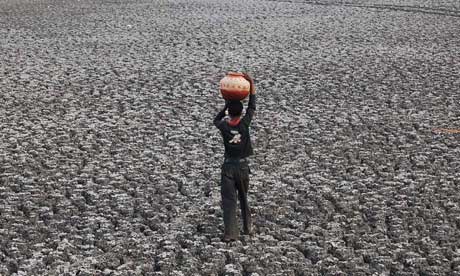
    A young man walks across Bhopal’s Upper Lake, which has shrunk to an eighth of its original area. Photograph: STR/AFP/Getty Images


    It was a little after 8pm when the water started flowing through the pipe running beneath the dirt streets of Bhopal’s Sanjay Nagar slum. After days without a drop of water, the Malviya family were the first to reach the hole they had drilled in the pipe, filling what containers they had as quickly as they could. Within minutes, three of them were dead, hacked to death by angry neighbours who accused them of stealing water.


    In Bhopal, and across much of northern India, a late monsoon and the driest June for 83 years are exacerbating the effects of a widespread drought and setting neighbour against neighbour in a desperate fight for survival.


    India’s vast farming economy is on the verge of crisis. The lack of rain has hit northern areas most, but even in Mumbai, which has experienced heavy rainfall and flooding, authorities were forced to cut the water supply by 30% last week as levels in the lakes serving the city ran perilously low.


    Across the country, from Gujarat to Hyderabad, in Andhra Pradesh, the state that claims to be “the rice bowl of India”, special prayers have been held for more rain after cumulative monsoon season figures fell 43% below average.


    On Friday, India’s agriculture minister, Sharad Pawar, said the country was facing a drought-like situation that was a “matter for concern”, with serious problems developing in states such as Punjab, Uttar Pradesh and Bihar.


    In Bhopal, which bills itself as the City of Lakes, patience is already at breaking point. The largest lake, the 1,000-year-old, man-made Upper Lake, had reduced in size from 38 sq km to 5 sq km by the start of last week.


    The population of 1.8 million has been rationed to 30 minutes of water supply every other day since October. That became one day in three as the monsoon failed to materialise. In nearby Indore the ration is half an hour’s supply every seven days.


    The UN has warned for many years that water shortages will become one of the most pressing problems on the planet over the coming decades, with one report estimating that four billion people will be affected by 2050. What is happening in India, which has too many people in places where there is not enough water, is a foretaste of what is to come.


    In Bhopal, where 100,000 people rely solely on the water tankers that shuttle across the city, fights break out regularly. In the Pushpa Nagar slum, the arrival of the first tanker for two days prompted a frantic scramble, with men jostling women and children in their determination to get to the precious liquid first.


    Young men scrambled on to the back of the tanker, jamming green plastic pipes through the hole on the top, passing them down to their wives or mothers waiting on the ground to siphon the water off into whatever they had managed to find: old cooking oil containers were popular, but even paint pots were pressed into service. A few children crawled beneath the tanker in the hope of catching the spillage.


    In the Durga Dham slum, where the tanker stops about 100 metres away from a giant water tower built to provide a supply for a more upmarket area nearby, Chand Miya, the local committee chairman, watched a similar scene. There was not enough water to go around, he said. “In the last six years it has been raining much less. The population has increased, but the water supply is the same.”


    Every family needed 100 litres a day for drinking, cooking and washing, he said, and people had no idea when the tanker would come again.


    Not everyone gets a tanker delivery. The city has 380 registered slums, but there are numerous other shanties where people have to find their own methods. Some, like the Malviyas, tap into the main supply. Others cluster around the ventilation valves for the main pipelines that stick up out of the ground from place to place, trying to catch the small amounts of water leaking out. In the Balveer Nagar slum, 250 families have no supply at all. The women get up in the middle of the night to walk 2km to the nearest pumping station, where someone has removed a couple of bricks from the base to allow a steady flow of water to pour out.


    A few communities have received help from non-governmental organisations. In the Arjun Nagar slum, a borewell has been drilled down 115 metres by Water Aid to provide water for 100 families, each paying 40 rupees (50p) a month.


    Until the well was drilled, Shaheen Anjum, a mother of four, got up at 2.30am each day to fetch water, wheeling a bike with five or six containers strapped to it to the nearest public pipe in the hope of beating the queues. “Often we would get there and the water would not be running,” she said. “It was so tiring: the children were suffering and getting ill because they had to come too. The tankers used to come, but there were so many fights that the driver used to run away.”


    Water Aid is working in 17 of the city’s 380 registered slums, providing water and sanitation. “It’s not just Bhopal. This has been a drought year for many districts,” said Suresh Chandra Jaiswal, the technical officer. “Now it has reached a critical stage. We just don’t know any more how long the water will last.”


    Fifty years ago, Bhopal had a population of 100,000; today it is 1.8 million and rising. In a good year the city might get more than a metre of rain between July and September, but last year the figure was only 700mm.


    Neighbours of the Malviyas cluster around the hole in the street outside the house where Jeevan Malviya lived with his wife, Gyarasi, their son, Raju, 18, and their four other children. It was the evening of 13 May, said Sunita Bai, a female relative: a local man, Dinu, thought that the family had blocked the pipe to stop the water flowing further down the hill.


    He and a group of friends slapped Gyarasi, 35; Raju tried to stop him. Someone produced a sword and, a few minutes later, the Malviyas lay dying. “We were too afraid to do anything,” said a woman who gave her name as Shanno. “Dinu didn’t want them to take any water. He wanted it for himself.”


    Everyone stood around, looking down at the hole in the ground. The pipe is dry. “It is a terrible thing, that people should be fighting over water,” said Shanno.

  • Wild weather in the year ahead, scientists predict

    Wild weather in the year ahead, scientists predict


    Climate scientists have warned of wild weather in the year ahead as the start of the global “El Niño” phenomenon exacerbates the impact of global warming. As well as droughts, floods and other extreme events, the next few years are also likely to be the hottest on record, scientists say.


    In the UK, a Met Office spokesman said yesterday that the El Niño event was likely to cause a hot, dry summer following a warm June, but said it could have other unpredictable effects on weather in Britain and north-west Europe. “Much depends on how much the El Niño deepens in the next few months.”


    El Niño – “the child” in Spanish – was named by fishermen in Peru and Ecuador because the phenomenon arrives there at Christmas. It is part of a natural meteorological cycle that happens every 3-7 years and affects weather worldwide for a year or more. It is caused by changes in ocean temperatures, with the first sign being abnormal warming in the Pacific.


    Sea surface temperatures across an area of the Pacific almost the size of Europe have been increasing for six months and will trigger worldwide weather turbulence for the next year, said a spokesman for the US National Oceanic and Atmospheric Administration (Noaa).


    At this stage, both US and Australian climate scientists say this may be a medium-strength El Niño, but they have warned it could develop further.


    “Temperatures in the Pacific are around 1C above average, and sub-surface temperatures up to 4C warmer than normal, ” said a spokesman for Australia’s Bureau of Meteorology.


    The last major El Niño in 1998 killed more than 2,000 people and caused billions of dollars worth of damage to crops and infrastructure in Australia and Asia. It led to forest fires in south-east Asia, a collapse of fish stocks in South America and a drought threatening 700,000 people in Papua New Guinea.


    Strong El Niños often have long-lasting effects. The 1991-92 event led to droughts in Africa and food shortages that left 30 million people at risk of malnutrition and set back development for a decade.


    Oxfam has alerted teams globally. “This could be the hottest year in known history. Poverty and climate change is enough of a challenge: an El Niño will only make things harder,” said Steve Jennings, Oxfam’s disaster risk reduction manager.

  • Gilbert school ‘green’ in more ways than 1

    Gilbert school ‘green’ in more ways than 1


    Hayley Ringle, Tribune


    July 10, 2009 – 7:06P 


    Having it's own water chilling system on campus allows  Gilbert's Campo Verde High School to keep their air conditioning system cooler and cheaper.

    Having it’s own water chilling system on campus allows Gilbert’s Campo Verde High School to keep their air conditioning system cooler and cheaper.


    Darryl Webb, Tribune


    Although the Campo Verde High School name was not chosen for the “green” elements found throughout the Gilbert campus, it’s even more fitting that the school has green in its name because of all the energy-saving details.


    Former Gilbert Unified School District governing board member Elaine Morrison said she chose Campo Verde, which means “green field” in Spanish, because of the area’s farming and cultural history.


    When freshmen and sophomores start at their new school on Aug. 10, they’ll walk under green, patina-coated metal walkways throughout the campus, which provides shade for them and keeps the buildings cooler, said Dave Tucker, the project manager with CORE Construction, the company building the school. CORE is a member of the United States Green Building Council.


    The exterior windows have 1-inch-thick, insulated glass, and those not shaded by the walkways have green, patina-coated aluminum shades, which reduces cooling and heating costs. The windows also have interior window blinds, and students will notice more windows in their classroom to let in more natural light.


    As students walk into their new classrooms, the motion-detector lights will turn on; when they leave, the lights will turn off.


    A campuswide lighting control system will give school staff an opportunity to easily turn off various lights around campus to reduce energy costs, Tucker said.


    Gilbert governing board member Helen Hollands said she is “thrilled” the board chose to put “green” elements into the district’s fifth and final high school on the northwest corner of Germann Road and Quartz Street, just west of Val Vista Drive off the Santan Freeway stretch of Loop 202.


    Hollands was board president in February 2008 when the board approved the $1.4 million in “green” elements.


    The school cost about $52.8 million to build, with an additional $4.7 million for nearby road improvements.


    “I think it’s important that we are conscious protectors of our environment,” Hollands said. “Personally, I wish we could have gone further, but we have to balance it with the money we have available.”


    The green grass on the football field is made of synthetic turf, which requires little maintenance. There’s no need for fertilizer, mowing, and repainting the lines on the field since the yard markers are actually sewn into the turf, Tucker said.


    Water is only used to cool and clean off the $500,000 field, which is another savings. Eight water cannons on the perimeter of the field can spray water onto the field to cool it off for the Campo Verde Coyotes, the school’s mascot.


    The turf will last 15 years, Tucker said, and sits next to the six baseball and softball fields, six tennis courts and three basketball courts.


    “It certainly is an absolutely beautiful facility, and I understand from a maintenance standpoint we will realize quite a bit of savings,” Hollands said. “Yes, from a capital standpoint it’s more expensive, but long term we don’t have those maintenance and operations expenses.”


    Besides the “green” aspects of the turf, since the field is not real grass, it can be used year-round for practice, band and soccer, and even after rain, without tearing up the field. This also eliminated the need for two practice fields, Tucker said.


    Students eating outside under the dining canopy will be cooled by solar-powered fans.


    “I like that the students will be able to see it in action,” Hollands said.


    Desert landscaping replaced several lawn areas throughout the campus, although there is still lots of green grass for the students.


    A “state of the art” central air conditioning plant is in a large room in back of the cafeteria and is the “most energy efficient” to cool the campus, Tucker said.


    The fields and landscape are irrigated with nonpotable water, and faculty bathrooms have two-stage flushing.


    Students will also have a “very cutting-edge technology” educational tool with the opportunity to see the electrical consumption the school is using by accessing a Web site, Tucker said.


    A 400-kilowatt solar panel array could also be placed on top of the cafeteria and an adjacent classroom building to tie into the power grid and save even more money for the school. The school board is still considering the extra costs for the solar panels.


    “This is the first high school we’re (CORE Construction) building with synthetic turf and sonar panels,” Tucker said. “As the technology improves and items become more affordable, ‘green’ elements will become more common.”


    The 60-acre, 250,000-square-foot school also has an amphitheater with seating capacity for 725 people, a main gym with three basketball and three volleyball courts, and a practice gym with an additional basketball and volleyball court.


    The school also has a dance room with mirrors covering three walls of the room, a weight room next door, and several rooms for orchestra, band and choir.


    To continue the greenness of the school, students chose copper and dark green as the school colors.