Category: News

Add your news
You can add news from your networks or groups through the website by becoming an author. Simply register as a member of the Generator, and then email Giovanni asking to become an author. He will then work with you to integrate your content into the site as effectively as possible.
Listen to the Generator News online

 
The Generator news service publishes articles on sustainable development, agriculture and energy as well as observations on current affairs. The news service is used on the weekly radio show, The Generator, as well as by a number of monthly and quarterly magazines. A podcast of the Generator news is also available.
As well as Giovanni’s articles it picks up the most pertinent articles from a range of other news services. You can publish the news feed on your website using RSS, free of charge.
 

  • El Nino Variant Is Linked to Hurricanes in Atlantic

    El Niño Variant Is Linked to Hurricanes in Atlantic


    Published: July 2, 2009


    Scientists have known for some time that El Niño, the warm spell that turns up every four or five years in the waters of the eastern Pacific Ocean, reduces hurricane activity in the Atlantic. But in a new study, researchers at the Georgia Institute of Technology have linked a variant of that pattern — periodic warming in the central Pacific — to more frequent hurricanes in the Atlantic, particularly on the Gulf Coast and in the Caribbean.


    Related


    Times Topics: Hurricanes and Tropical Storms


    The researchers and scientists who have reviewed their work said it was too soon to say whether the warming pattern resulted from global climate change or simply had been undetected.


    Scientists can detect warming in the central Pacific earlier than they can discern the development of El Niño, the researchers said, so the new finding may help improve forecasts for hurricane seasons over all.


    In an El Niño year, warming of the eastern Pacific changes air flow patterns in the troposphere, the lowest portion of Earth’s atmosphere, so that one layer moves eastward and the other westward. Wind shear then develops over the Atlantic, inhibiting the ability of storms to turn into tight, powerful gyres.


    But the warming patterns that occur in the central Pacific cause the wind shear phenomenon to shift well to the west, the researchers say, allowing Atlantic hurricanes to form relatively unimpeded.


    Peter J. Webster, a professor of earth sciences at Georgia Tech and an author of the report, said the variant pattern was discovered in the 1980s by Japanese and Korean researchers, who dubbed it “modiki” El Niño. (Modiki is Japanese for “similar but different.”)


    Dr. Webster said it might be difficult for researchers to determine whether the warming pattern was new because their observational record was relatively short and their climate models were imperfect.


    Kerry Emanuel, a climate expert at the Massachusetts Institute of Technology, said the new work was impressive. But he added that he believed that the pattern “has been there all along, but we just didn’t see it.”

  • Costa Rica is world’s greenest, happiest country

    Costa Rica is world’s greenest, happiest country


    Latin American nation tops index ranking countries by ecological footprint and happiness of their citizens


    A rainbow over San Jose in Costa Rica

    A rainbow over San Jose in Costa Rica. Photograph: Juan Carlos Ulate/Reuters


    Costa Rica is the greenest and happiest country in the world, according to a new list that ranks nations by combining measures of their ecological footprint with the happiness of their citizens.


    Britain is only halfway up the Happy Planet Index (HPI), calculated by the New Economics Foundation (NEF), in 74th place of 143 nations surveyed. The United States features in the 114th slot in the table. The top 10 is dominated by countries from Latin America, while African countries bulk out the bottom of the table.


    The HPI measures how much of the Earth’s resources nations use and how long and happy a life their citizens enjoy as a result. First calculated in 2006, the second edition adds data on almost all the world’s countries and now covers 99% of the world’s population.


    NEF says the HPI is a much better way of looking the success of countries than through standard measures of economic growth. The HPI shows, for example, that fast-growing economies such as the US, China and India were all greener and happier 20 years ago than they are today.


    “The HPI suggests that the path we have been following is, without exception, unable to deliver all three goals: high life satisfaction, high life expectancy and ‘one-planet living’,” says Saamah Abdallah, NEF researcher and the report’s lead author. “Instead we need a new development model that delivers good lives that don’t cost the Earth for all.”


    Costa Ricans top the list because they report the highest life satisfaction in the world, they live slightly longer than Americans, yet have an ecological footprint that is less than a quarter the size. The country only narrowly fails to achieve the goal of what NEF calls “one-planet living”: consuming its fair share of the Earth’s natural resources.


    The report says the differences between nations show that it is possible to live long, happy lives with much smaller ecological footprints than the highest-consuming nations.


    The new HPI also provides the first ever analysis of trends over time for what are supposedly the world’s most developed nations, the Organisation for Economic Cooperation and Development (OECD).


    OECD nations’ HPI scores plummeted between 1960 and the late 1970s. Although there have been some gains since then, HPI scores were still higher in 1961 than in 2005.


    Life satisfaction and life expectancy combined have increased 15% over the 45-year period for those living in the rich nations, but it has come at the cost of a 72% rise in their ecological footprint. And the three largest countries in the world – China, India and the US, which are aggressively pursuing growth-based development models – have all seen their HPI scores drop in that time.


    The highest placed western nation is the Netherlands. People there live on average over a year longer than people in the US, and have similar levels of life satisfaction – yet their per capita ecological footprint is less than half the size. The Netherlands is therefore over twice as environmentally efficient at achieving good lives as the US, Nef says.


    The report sets out a “Happy Planet Charter” calling for an unprecedented collective global effort to develop a “new narrative” of human progress, encourage good lives that don’t cost the earth, and to reduce consumption in the highest-consuming nations – which it says is the biggest barrier to sustainable wellbeing.

  • Why did the government dump its green building regulations plan ?

    Why did the government dump its green building regulations plan?


    Bang goes its promise of efficient homes; bang goes the green new deal. How will the government meet its obligations under the Climate Change Act?


    I’ve asked this question before, but the mystery seems only to thicken: how in God’s name does the government intend to meet its obligations under the Climate Change Act?


    Its programme for cutting carbon through renewable energy is way behind schedule. It is expanding airports and motorways, while bailing out the car industry, ensuring that motor emissions stay high. The EU emissions trading scheme hardly touches the industries it is meant to regulate. Full carbon capture and storage will come too late to stop new coal-burning power stations from adding greatly to the problem.


    I cannot understand how these policies can be reconciled with a legally binding 80% cut by 2050, let alone a 34% cut by 2020. When compared to real policies, the cuts predicted by its Committee on Climate Change look like pure wishful thinking.


    But at least the government seemed to be getting something right. It was making what looked like bold moves to improve our housing stock, insisting that all new homes be zero carbon by 2016 and launching a scheme to improve the energy efficiency of existing stock. Even if nothing else was working, one sector would be making carbon cuts commensurate with the government’s legal obligations. Or so we thought.


    Much of the improvement in existing housing stock was meant to have been delivered through tightening the building regulations. From next year, the government had promised us, the energy efficiency of existing homes would have to be improved whenever they were substantially refurbished or extended or their lofts were converted. This was the most important of the government’s energy efficiency reforms, which was meant to have delivered the biggest carbon saving. It also had the potential to employ a carbon army of insulators and draft stoppers: tens of thousands of people who could be taken from the dole queue and quickly trained.


    But a fortnight ago, the government suddenly dumped this plan, when it published its new consultation document on Part L of the building regs. It’s the second time this has happened: the government broke the same promise in 2006. Bang goes its promise of efficient homes; bang goes the green new deal. Why?


    The only explanation I can think of is that it fears a populist backlash. It’s not hard to imagine the tabloid fulminations about snooping inspectors invading the sanctity of our homes, the big brother state telling us how to live. But the stupid thing is that building inspectors are meant to sign off all substantial works anyway: to implement the energy regulations they would only have had to add one or two more lines to their check list. Like the other building regs – which protect us from fire, collapse, electrocution, explosions and the rest – the proposed new intrusion would have done us a favour, ensuring that we don’t spend hundreds of pounds a year heating the air outside our homes, rather than the air inside. It would have helped to protect homeowners from cowboy builders. But the government is so paralysed by the fear of middle class reaction that it won’t implement even the simplest measures to help us improve our own lives.


    So where will its carbon cuts come from? I was mystified before; now I am utterly baffled. Can anyone help me out?


    monbiot.com

  • Porritt blasts Treasury ‘arrogance’

    Porritt blasts Treasury ‘arrogance’


    Jonathon Porritt, one of Britain’s leading environmentalists, has attacked the Treasury for being “startlingly arrogant” and for dragging its feet over sustainability.


    This month Porritt steps down as chairman of the Sustainable Development Commission, an independent government watchdog, after occupying the role since it was founded nine years ago.


    He said: “Looking back now, as I am in my last few days, I see a terrain of wasted opportunity. I am not saying the only reason is the intransigence of the Treasury, but I do think the Treasury has killed a lot of the energy around sustainable development.”


    Porritt, who is being replaced by William Day, gave the Treasury credit for hiking the landfill tax and for commissioning Sir Nicholas Stern’s review on the economics of climate change. However, he added: “Too often they have been foot-dragging and obstructive.”


    He said: “It is a startlingly arrogant part of government. There is almost no curiosity about sustainable wealth creation. There is no readiness to interrogate the macro-economic model. SDC produced a report, Prosperity without Growth, in an attempt to start a debate on redefining prosperity, but we were met with a weird mixture of hostility and indifference.”


    According to Porritt, the Treasury was slow to set an example on sustainability through programmes such as the private finance initiative (PFI) or Building Schools for the Future (BSF). He said he tried to engage with the Treasury over PFI, which he saw as one of the main mechanisms by which the government could send out signals to the private sector about promoting sustainability. But, he said: “The whole PFI process from 1999 onwards has been a sustainability-free zone.


    “With the Building Schools for the Future programme it took four or five years for the Treasury to understand it had to have sustainability at its heart. It was straight Treasury obstinacy.”


    Since it was founded in 2000, the SDC lobbied the government consistently to use its multibillion-pound budget to promote sustainable development through its procurement of buildings, goods and services. But Porritt said his efforts fell on stony ground for years. “At meetings relatively senior civil servants from the Treasury were sitting there glowering and wondering what they could do to scupper things when they got back to base,” he said.


    “Last year, the Treasury realised government had to play a role but it was blindingly obvious all along.”

  • Fears for the world’s poor countries as the rich grab land to grow food

    Fears for the world’s poor countries as the rich grab land to grow food


    • UN sounds warning after 30m hectares bought up
    • G8 leaders to discuss ‘neo-colonialism 


    The acquisition of farmland from the world’s poor by rich countries and international corporations is accelerating at an alarming rate, with an area half the size of Europe’s farmland targeted in the last six months, reports from UN officials and agriculture experts say.


    New reports from the UN and analysts in India, Washington and London estimate that at least 30m hectares is being acquired to grow food for countries such as China and the Gulf states who cannot produce enough for their populations. According to the UN, the trend is accelerating and could severely impair the ability of poor countries to feed themselves.


    Today it emerged that world leaders are to discuss what is being described as “land grabbing” or “neo-colonialism” at the G8 meeting next week. A spokesman for Japan’s ministry of foreign affairs confirmed that it would raise the issue: “We feel there should be a code of conduct for investment in farmland that will be a win-win situation for both producing and consuming countries,” he said.


    Olivier De Schutter, special envoy for food at the UN Office of the High Commissioner for Human Rights, said: “[The trend] is accelerating quickly. All countries observe each other and when one sees others buying land it does the same.”


    The UN’s food and agricultural organisation and other analysts estimate that nearly 20m hectares (50m acres) of farmland – an area roughly half the size of all arable land in Europe – has been sold or has been negotiated for sale or lease in the last six months. Around 10m hectares was bought last year. The land grab is being blamed on wealthy countries with concerns about food security.


    Some of the largest deals include South Korea’s acquisition of 700,000ha in Sudan, and Saudi Arabia’s purchase of 500,000ha in Tanzania. The Democratic Republic of the Congo expects to shortly conclude an 8m-hectare deal with a group of South African businesses to grow maize and soya beans as well as poultry and dairy farming.


    India has lent money to 80 companies to buy 350,000ha in Africa. At least six countries are known to have bought large landholdings in Sudan, one of the least food-secure countries in the world.


    Other countries that have acquired land in the last year include the Gulf states, Sweden, China and Libya. Those targeted include not only fertile countries such as Brazil, Russia and Ukraine, but also poor countries like Cameroon, Ethiopia, Madagascar, and Zambia.


    De Schutter said that after the food crisis of 2008, many countries found food imports hit their balance of payments, “so now they want to insure themselves”.


    “This is speculation, betting on future prices. What we see now is that countries have lost trust in the international market. We know volatility will increase in the next few years. Land prices will continue to rise. Many deals are even now being negotiated. Not all are complete yet.”


    He said that about one-fifth of the land deals were expected to grow biofuel crops. “But it is impossible to know with certainty because declarations are not made as to what crops will be grown,” he said.


    Some of the world’s largest food, financial and car companies have invested in land.


    Alpcot Agro of Sweden bought 120,000ha in Russia, South Korea’s Hyundai has paid $6.5m (£4m) for a majority stake in Khorol Zerno, which owns 10,000ha in Eastern Siberia, while Morgan Stanley has bought 40,000ha in Ukraine. Last year South Korea’s Daewoo signed a 99-year lease for 1.3m hectares of agricultural land in Madagascar.


    Devinder Sharma, analyst with the Forum for Biotechnology and Food Security in India, predicted civil unrest.


    “Outsourcing food production will ensure food security for investing countries but would leave behind a trail of hunger, starvation and food scarcities for local populations,” he said. “The environmental tab of highly intensive farming – devastated soils, dry aquifer, and ruined ecology from chemical infestation – will be left for the host country to pick up.”


    In Madagascar, the Daewoo agreement was seen as a factor in the subsequent uprising that led to the ousting of the president, Marc Ravalomanana. His replacement, Andry Rajoelina, immediately moved to repeal the deal.


    Concern is mounting because much of the land has been targeted for its good water supplies and proximity to ports. According to a report last month by the London-based International Institute for Environment and Development, the land deals “create risks and opportunities”.


    “Increased investment may bring benefits such as GDP growth and improved government revenues, and may create opportunities for economic development and livelihood improvement. But they may result in local people losing access to the resources on which they depend for their food security – particularly as some key recipient countries are themselves faced with food security challenges”, said the authors.


    According to a US-based thinktank, the International Food Policy Research Institute, nearly $20bn to $30bn a year is being spent by rich countries on land in developing countries.

  • Obama to seek climate deal in Moscow

    Obama to seek climate deal in Moscow


    After success with China, US targets Russia in strategy to reach separate agreements with world’s biggest polluters


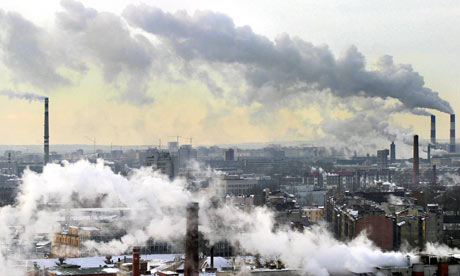
    Pollution in Russia :  smoke from the chimneys billow over St. Petersburg

    Chimney smoke billows over St Petersburg in Russia, the third largest source of emissions after the US and China. Photograph: Sergey Kulikov/AFP/Getty Images


    Barack Obama will move to seal a deal with Russia for joint action on climate change during his summit in Moscow next week, the Guardian has learned. 


    Obama arrives in Moscow on Monday at the start of a trip to Russia, Italy and Ghana that will focus heavily on energy and climate change. From Moscow, Obama travels on to Italy for a meeting of the G8 and a gathering of the major polluting countries.


    Administration officials are still working out the broad outlines of an agreement that would see the US offer its expertise and technical support to Russian efforts to make its industries more energy efficient. In return Moscow would sign on to international efforts to scale back the emissions that cause global warming at a crucial UN summit in Copenhagen in December.


    The overture to Russia — the third largest source of greenhouse gas emissions after America and China — furthers the strategy adopted by the Obama administration to enter into separate deals for action on climate change with each of the world’s biggest polluters. 


    The administration sees such deals as crucial groundwork ahead of the Copenhagen meeting. They dismiss suggestions that the US is trying to undermine the UN process.


    The separate negotiations policy began taking shape in May, as the US climate change envoy, Todd Stern, pursued a deal with China, the world’s biggest polluter.


    Next on the list is Russa. After that, it could well be Japan or Brazil. “You can definitely say we are looking for other partners,” an administration official said.


    In the case of China, as well as Russia, US officials have steered clear of trying to press for binding targets for emissions reductions.


    Major environmental organisations support the Obama administration approach. David Doniger, the director of climate policy at the Natural Resources Defence Council, argues that Obama and other high-level members of his team have far greater flexibility to try to reach a deal in such bilateral talks than officials working through routine diplomatic channels.


    “If you are trying to put together a baseball team you have to sign contracts with 30 players. You don’t work them out in one big meeting,” he said. “It’s very difficult in the multilateral setting. It is just not the place where it is very easy to get countries to make new moves.”


    It is uncertain whether Obama will make a formal announcement of a new energy pact between the US and Russia. Instead, the president is expected to set out his ideas for a partnership with Russia on climate change and energy in a speech at the end of the summit. “They won’t have the full road map for what they are going to do but want to launch a stepped up partnership,” said Jake Schmidt, the international climate change director of the NRDC.


    Another scenario envisaged is the establishment of a separate US-Russian working group on global warming to be overseen by Todd Stern, the State Department envoy on climate change.


    The US and Russia have long-standing co-operation on energy, but the Obama administration would like to ratchet up that involvement.


    There have also been recent signs of movement from Russia, which is beginning to engage with climate change far more seriously than before, said Andrew Kuchins of the Russia programme at the Centre for Strategic and International Studies. In April, Moscow unveiled a new doctrine on climate change. “I think there is a much more realistic appraisal about the potential pros and cons of climate change. It is hard for them to ignore what is happening in the Arctic [which is warming rapidly],” said Kuchins.


    In recent weeks, the White House, State Department and National Security Council have also been studying a report from the Centre for American Progress, an influential think tank, that called for looking at climate change as an economic issue, and for demonstrating clear benefits to Russia of action. “What is most crucial is engaging them on energy efficiency. We think that it is important to frame climate change as an economic issue and one where Russia stands to benefit by first undergoing significant energy efficiency [improvements].”


    Russian industry is very inefficient, using three times more energy per unit of gross domestic product as the European Union and twice as much as the US, Light notes in the paper. He argues there would be great interest in Russia in collaborating with US experts on technologies to improve its use of energy.


    The economic potential is huge. A World Bank report last year found that Russia, with reasonable investment, would be able to cut its energy consumption by about 50%or the equivalent of 60 biliion barrels a day of oil over the next three years.