At a meeting this week in the capital Maputo, government ministers agreed to put conservation measures in place before any commercial logging occurs there after meeting representatives from the Royal Botanic Gardens Kew, the Mulanje Mountain Conservation Trust (MMCT), and numerous other groups involved in the project.
“The three messages we conveyed were that there is rich biodiversity in Mozambique, that butterflies and botany can be as important as mammals, and that conservation policy should take into consideration areas such as these mountains or the coastal forests, that do not easily fit into the usual category of national park,” said Kew’s Jonathan Timberlake. The media coverage had clinched the participation of the government, added Paul Smith, head of the Millennium Seed Bank project at Kew.
Julian Bayliss of MMCT, who first identified Mount Mabu as an area of possible exploration using satellite imagery on Google Earth said: “As scientists it is incredibly exciting to go into a previously unexplored area and discover new species of butterfly, snake and chameleon, but our aim was always to secure pledges of conservation towards the protection of these sites.”
The first full-scale expedition to Mabu last October uncovered three new species of butterfly, a new species of bush viper, a number of rare birds and potentially unrecorded plants. “These expeditions into the area are absolutely essential to securing conservation measures,” said Smith. “Unless you know what’s there, then no protective decision can be taken about management of those areas.”
Outside the forest, the land has been devastated by civil war, but inside the landscape was almost untouched. Ignorance of its existence, poor access and the forest’s value as a refuge for villagers during the fighting had combined to protect it. The scientists fear that with local people returning to the area, and Mozambique’s economy booming, pressure to cut the forest for wood or burn it to make space for crops will threaten the ecology.
Just weeks before presenting their findings in Maputo, Bayliss was convinced that further new species could be discovered and so gathered a team of experts – and the Observer – for a final expedition into the area.
After trekking into the thick forest, the team spent its time setting up butterfly traps in sunspots, overturning stones and fallen branches searching for frogs, and tapping at the huge mahogany buttresses to awaken sleeping snakes. Nights saw the bat nets go up and torch-lit searches for chameleons.
“Hunting chameleons at night is much easier,” explained herpetologist Bill Branch. “Because at night they sit out in the open and they bleach to a white colour, which means they stand out in torch light.”
The pygmy chameleons, no bigger than a thumb, were in abundance, but it took three nights to uncover a different beautiful creature with perfectly coiled tail. “It appears similar to the one that is considered endemic to Mount Mulanje, but frankly from the colouration I suspect we have a new species here. This is what I came to Mabu to find,” said Branch.
The expedition discovered eight new species of amphibians, four of butterfly and a new pseudo scorpion.
The findings were reported at the meeting in Maputo, where representatives from the Mozambican department of agricultural research, Birdlife International, WWF, the International Union for Conservation of Nature, and the British High Commission joined the others to convince the government to commit to protection. “It was an extremely positive outcome,” said Smith.
The expedition team
Bill Branch Herpetologist at Bayworld, Port Elizabeth, South Africa: “These mountains are some of the last explored areas in southern Africa; I came here specifically to hunt for a new species of chameleon.”
Colin Congdon Lepidopterist based in Tanzania: “We leapt at the opportunity to join this expedition because nobody from the butterfly world has ever been into these places before.”
Martin Hassan Lepidopterist based in Tanzania: “The Baliochila were flying high up in the canopy and I had to climb high up a vine and use extension poles on my net to catch them.”
Steve Collins Director of African Butterfly Research Institute, Nairobi, Kenya: “It has been really exciting to see the place – seeing is believing – to get to the top of the mountain and look at the forest spread out is incredible.”
Julian Bayliss Project field coordinator of this Darwin Initiative project and ecological adviser to the Mulanje Mountain Conservation Trust: “We don’t just want to finish this project with a series of technical reports put on the tables of various Mozambican departments, we want pledges of conservation towards the protection of these sites.”
Hassam Patel Botanist: “Mabu is very important because it is such a big area of mountain forest. In the other sites it was mainly woodland, but this is very special and we are uncovering lots of new plants.”
 Irrigators in the Murray Darling river basin have begun hitting back against their widespread depiction in the media as the cause of the destruction of the Murray River. Olympian Stephanie Rice, sponsored by SunRice, has joined a group called Water4Food to promote the value of irrigation in securing our food supply. Ex-president of the National Farmers Federation, Peter Corish told the lobby group’s national conference that irrigators are being treated like common criminals. He said he is not opposed to the government’s buy back scheme or moves to increase water efficiency, but he thinks that farmers need to rebuild their image.
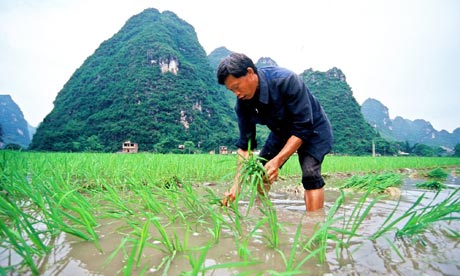 Chinese Minister for Land and Resources, Lu Xinshe, has announced that the regime is struggling to maintain the 120million hectares of arable land required to feed China’s population because of urban and industrial sprawl. “We will not plan any new large scale projects to return farmland to its natural state, beyond those that have already been planned,” he said. China has bought vast tracts of arable land in poor nations. There are now estimated to be one million Chinese farmers in Africa, alone.