Category: News

Add your news
You can add news from your networks or groups through the website by becoming an author. Simply register as a member of the Generator, and then email Giovanni asking to become an author. He will then work with you to integrate your content into the site as effectively as possible.
Listen to the Generator News online

 
The Generator news service publishes articles on sustainable development, agriculture and energy as well as observations on current affairs. The news service is used on the weekly radio show, The Generator, as well as by a number of monthly and quarterly magazines. A podcast of the Generator news is also available.
As well as Giovanni’s articles it picks up the most pertinent articles from a range of other news services. You can publish the news feed on your website using RSS, free of charge.
 

  • Snowy River revival ‘ a complete failure ”

    Alliance vice-chairwoman Louise Crisp says parts of the river are running out of time.

    “Basically the river has possibly only 18 months before some of the upper section will die,” she said.

    “It’s been a complete failure as far as what the community expected.

    “None of the legislated target flows are binding and neither are the environmental objectives.”

    Ms Crisp says the Snowy’s annual natural flow sits at 4 per cent below the Jindabyne Dam, but the agreed target for June 2009 was 15 per cent.

    The Alliance has been advised it has little chance of suing the three governments for failing to live up to their promises.

    ‘NSW responsible’


    Craig Ingram is the independent member for the Victorian seat of Gippsland East and a former member of the Snowy River Alliance.

    On his election to parliament in 1999, the Victorian Labor Party gave him an undertaking that it would work to have an environmental flow of 28 per cent returned to the Snowy, and Mr Ingram’s resulting support helped them take office.

    He blames the New South Wales Government for the Snowy River stalemate.

    “New South Wales under the agreements and under the legislation is the responsible government, if I can use that term very loosely,” he said.

    “They have systematically failed to deliver on the intent, the spirit and what the community thought they were getting when they signed up to the agreement.

    “One of the disappointing things is that we really haven’t had the level of support from the New South Wales Opposition that we should have had to hold the New South Wales Government to account.

    “And basically they’ve been missing in action on this.”

    He said the other governments should probably have taken action against New South Wales.

    “I think it’s probably time they actually investigate their legal avenues to ensure that the money that’s been contributed by the other stake-holding governments delivers the environmental outcomes that the community expects,” he said.

    “If New South Wales isn’t prepared to do it, then the other governments should force them to do it.”

  • Science Museum has a vital role in the climate change debate


    No wonder then that decarbonising the world’s energy system to avoid dangerous climate change is proving to be intractable, for it embodies all these features. Despite the rhetoric and a host of initiatives by individuals, corporations and governments, human carbon emissions continue to increase, with no sign of the essential peak and decline. The latest research indicates that if the maximum does not occur by 2015, we will almost certainly have committed ourselves to changes in weather patterns that will adversely affect our food and water supplies, as well as triggering an ineluctable, long-term rise in world sea level.

    One hundred years ago the future looked brighter. Our forebears saw science and engineering as the means to improve the human condition. They celebrated the fruits of industrialisation in cathedrals of innovation, such as the Science Museum. The practitioners were the celebrities of the day, and people flocked to see the wonders that were shaping the future. Many were inspired to become the scientists, engineers and entrepreneurs who designed and built the modern world.

    So as the Science Museum enters its second century today, what is its role? I believe little has changed from a century ago, except for the degree of urgency. Our unique collection provides us with a powerful means to make sense of the science that shapes our lives. We seek to raise curiosity and release creativity, and to do so in a way that engages and inspires our visitors to participate in shaping the future.

    In particular, our climate change gallery, currently being designed, aims to change the way people think, talk and act about climate change. A glimpse into the museum’s enormous reserve collection of objects (only 6% of the collection is on public display), or along the 20km of historical books and technical documentation in our library, can quickly convince of the ability of the scientists and engineers of the world to develop the array of technical solutions that can make a sustainable future possible.

    What is not clear, is whether humanity has the capacity to marshal this technical capability and to exploit it in time. This is where the role of the museum as a trustworthy source of information, and its track record of presenting a balanced view of the evidence will be especially valuable in stimulating public debate. With many experts viewing the upcoming UN’s Copenhagen Conference in December this year as “the last chance saloon” to put in place the international negotiating mechanism without which a globally coordinated effort cannot take place, the importance of such debate is paramount.

    The Science Museum may be 100 years old, but it has never been more relevant.

    • Professor Chris Rapley CBE is director of the Science Museum

  • House Passes Bill to Address Threat of Climate Change

    “This legislation will break our dependence on foreign oil, make our nation a leader in clean energy jobs and cut global warming pollution,” said Representative Henry A. Waxman, Democrat of California, a co-sponsor of the bill, adding that Friday’s vote was a “decisive and historic action” that would position the United States as a leader in energy efficiency and technology.

    The bill’s provisions forcing reductions in the use of fossil fuel while increasing production of alternative energy sources would produce millions of new jobs, Mr. Waxman said.

    But the legislation, a patchwork of compromises, falls far short of what many European governments and environmentalists have said is needed to avert the worst impacts of global warming. And it has pitted liberal Democrats from both coasts against more conservative Democrats from areas dependent on coal for electricity and heavy manufacturing for jobs.

    Friday’s vote illustrated that rift: The bill passed by a seven-vote margin, with 44 Democrats voting against it.

    As difficult as passage in the House proved, it is just the beginning of the energy and climate debate in Congress, since the issue now moves to the Senate, where political divisions and regional differences are even starker.

    At the heart of the legislation is a cap-and-trade system that sets an overall limit on emissions of heat-trapping gases like carbon dioxide while allowing utilities, manufacturers and other emitters to trade pollution permits, or allowances, among themselves. The cap grows increasingly tighter over the years, pushing up the price of emissions and presumably driving industry to find cleaner ways of producing energy.

    While some environmental groups supported the legislation, others — Greenpeace, for example — vigorously opposed it. Business groups were also split. Republican leaders called the bill a national energy tax and predicted that those who voted for the measure would pay a heavy price at the polls next year.

    “No matter how you doctor it or tailor it,” said Representative Joe Pitts, Republican of Pennsylvania, “it is a tax.”

    Only eight Republicans voted for the bill, which runs to more than 1,300 pages.

    Apart from its domestic implications, the bill is a show of resolve that American officials can point to when negotiating the new global climate change treaty, after years of American objections to binding limits on carbon dioxide emissions.

    The German chancellor, Angela Merkel, who was in Washington Friday to meet President Obama, strongly endorsed the bill even though it fell short of European goals for reducing the emissions of heat-trapping gases.

    Ms. Merkel, a longtime advocate of strong action to cut carbon dioxide emissions, has been pushing the United States to take a leading role in advance of the global climate negotiations set for December in Copenhagen.

    After meeting with Mr. Obama, she said she had seen a “sea change” in the United States on climate policy that she could not have imagined a year ago when President George W. Bush was in office.

    “This really points to the fact that the United States is very serious on climate,” Ms. Merkel said.

    The compromises in the bill were necessary to attract the support of Democrats from different regions and ideologies. In the months of horse-trading leading to Friday’s vote, the bill’s targets for emissions were weakened, its mandate for renewable electricity was scaled back, and incentives for various industries from automobiles to natural gas were sweetened.

    The final bill intends to reduce overall heat-trapping gases in the United States by 17 percent of 2005 levels by 2020, and 83 percent by midcentury.

    When the program is scheduled to begin in 2012, the estimated price of a permit to emit a ton of carbon dioxide will be about $13. That is projected to rise steadily as emission limits come down, but the bill contains a measure to prevent costs from rising too quickly in any one year.

    The bill grants a majority of the permits free in the early years of the program, to keep costs low. The Congressional Budget Office estimated that the average American household would pay an additional $175 a year in energy costs by 2020 as a result of the provision, while the poorest households would end up with $40 in rebates.

    Several House members expressed concern about the new market to be created in carbon allowances, saying it posed the same risks as markets in other kinds of derivatives. Regulation of such markets would be divided among the Commodity Futures Trading Commission, the Treasury Department and the Federal Energy Regulatory Commission. The bill also sets a national standard of 20 percent for the production of renewable electricity by 2020, although a third of that could be met with efficiency measures rather than renewable energy sources like solar, wind and geothermal.

    It also devotes billions of dollars to new energy projects and subsidies for low-carbon agricultural practices, clean-coal research and electric vehicle development. 
  • California fires up laser fusion machine


    The building, which has taken almost 15 years to build and commission, is due to be opened in a ceremony attended by the US energy secretary, Steven Chu, and the California governor, Arnold Schwarzenegger, who has said the facility could “revolutionise our energy future”.

    “If they’re successful, it will be a very big deal. No one has achieved a net gain in energy before,” said Derek Stork, assistant technical director at the UK United Kingdom Atomic Energy Authority (UKAEA)’s centre for fusion research in Culham, Oxfordshire.

    Inside the building, scientists will use the world’s most powerful laser to create 192 separate beams of light that will be directed at a bead of frozen hydrogen in a violent burst lasting five billionths of a second. Each fuel pellet measures just two millimetres across but costs around $40,000, because they must be perfectly spherical to ensure they collapse properly when the laser light strikes.

    The intense beams produce a powerful shockwave that crunches the fuel pellet at a million miles an hour, generating temperatures of around 100,000,000C. Under such extreme conditions, which are found only in the core of stars, the hydrogen atoms will fuse, producing helium and vast amounts of energy.

    The facility will gradually work up to full power over the next 12 months or so, but experiments are scheduled to run until around 2040.

    If the NIF succeeds, politicians will be under pressure to invest in the technology to develop a first generation of demonstration plants to feed fusion energy into electricity grids.

    Plans for a laser fusion plant have been drawn up at UKAEA in Culham. The Hiper project would use two lasers to produce power from seawater and lithium, an abundant element.

    “When this works, it will immediately change the future energy map for the world. One cubic kilometre of sea water has the fusion energy equivalent of whole world’s oil reserves,” said John Parris at the Hiper project. That would overturn concerns over energy security caused by vast amounts of the globe’s oil been locked up beneath a small number of nations.

    The NIF facility must overcome major technical hurdles before scientists can start celebrating. The laser at the heart of the facility can only fire a handful of times a day. In between each shot, the hydrogen fuel pellet needs to be replaced. Over the coming years, scientists want to see improvements that allow the facility to run continuously. That could mean firing the laser 10 times a second, at fuel pellets that are shot mid air as they are dropped into the fusion chamber.

  • India seeks more talks on contentious climate draft

    A top negotiator said the problems mainly related to mitigation measures such as determining the long-term global emissions goals and setting a peak year for global emissions.

    “There are differences on some of these issues, so it’s not a consensus text that is ready to be adopted in one more meeting,” the official told Reuters on Friday on condition of anonymity because he was not authorised to speak to reporters.

    Another Indian official with knowledge of the negotiations said: “There is difference of opinion and approach among the participating countries.”

    The 17 MEF members account for 80 percent of global emissions so any agreement among them would go a long way to defining a new U.N. climate treaty due to be agreed in Copenhagen in December.

    The two-page draft declaration does not set clear goals but says that developed countries, including the United States, the European Union and Japan, would “undertake robust aggregate and individual mid-term reductions in the 2020 timeframe.”

    Developing nations such as China and India say rich nations should cut emissions by “at least 40 percent” below 1990 levels by 2020 — a target developed nations say is out of reach when they are trying to stimulate recession-hit economies.

    The Indian negotiators said there was broad consensus on the need for more funding for climate change adaptation and the transfer of clean-energy technology, but there were differences of opinion on the amount and how to disburse the money.

    “More than the volume of funds it’s the delivery mechanism, the commitment that is important,” one of the negotiators said.

    (Editing by David Fogarty)

  • Growth of global carbon emissions halved in 2008, say Dutch researchers


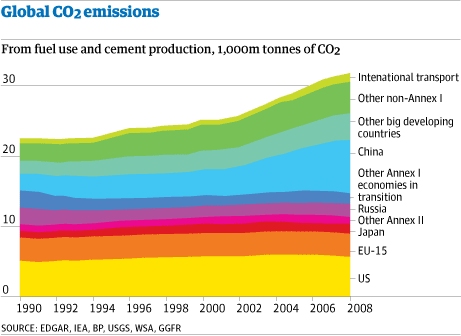
    The slowdown in emissions growth was caused primarily by a 0.6% fall in the consumption of oil – the first decline in global oil use since 1992. This trend was unevenly distributed around the world. In China oil use continued to rise, but at only 3%, down from an average of 8% since 2001. In the US, oil consumption fell by a massive 7%.

    co2

    The falling global demand reflects high prices for oil in the first half of 2008 and the economic slowdown in the second half of the year. Increasing biofuel production also helped displace a substantial volume of fossil-fuel petrol and diesel.

    Jos Olivier, the NEAA researcher responsible for the new data, acknowledged that the environmental benefits of biofuels would look “less favourable” in a broader analysis considering the impact of all greenhouses gases, rather than CO2 alone. Furthermore, the data does not take into account the CO2 released by deforestation, which accounts for almost 20% of all greenhouse gas emissions and takes place overwhelmingly in the developing world.

    Increasing renewable energy capacity and improving energy efficiency in many countries will also have contributed to the reduced rise in CO2 emissions. Olivier said: “The impact of energy and climate policy is hard to distinguish from those of fuel prices and the recession, but policies encouraging renewable electricity generation will have helped avoid around 500 million tonnes of CO2 from fossil-fuel power stations.”

    Coal consumption continued to creep up at a slower rate than in previous years, but the rise in the consumption of natural gas remained unchanged.

    It is too early to determine whether the recession will lead to global emissions flattening off entirely this year. But policymakers are likely to be particularly struck by the second revelation in the NEAA analysis.

    In 2008, the developing-world accounted for 50.3% of CO2 emissions, exceeding developed nations and international travel combined for the first time. With crucial UN climate negotiations over a successor to the Kyoto protocol now less than six months away, this new data will provide useful ammunition for those arguing for binding emissions targets for all nations.