Category: News

Add your news
You can add news from your networks or groups through the website by becoming an author. Simply register as a member of the Generator, and then email Giovanni asking to become an author. He will then work with you to integrate your content into the site as effectively as possible.
Listen to the Generator News online

 
The Generator news service publishes articles on sustainable development, agriculture and energy as well as observations on current affairs. The news service is used on the weekly radio show, The Generator, as well as by a number of monthly and quarterly magazines. A podcast of the Generator news is also available.
As well as Giovanni’s articles it picks up the most pertinent articles from a range of other news services. You can publish the news feed on your website using RSS, free of charge.
 

  • Kevin Rudd set to soften stance on energy

    Kevin Rudd set to soften stance on energy

    Lenore Taylor, National correspondent | April 29, 2009

    Article from:  The Australian

    ENERGY-HUNGRY industries could be offered exemptions from the federal Government’s new 20 per cent renewable energy target, as Kevin Rudd struggles to win support for his climate change policies in the face of the global economic crisis.

    The Prime Minister will ask premiers to sign off on the further concessions for the industries at tomorrow’s Council of Australian Governments meeting in Hobart.

    The Government had foreshadowed an exemption for aluminium, which consumes about 15per cent of the nation’s electricity, but sources said it was now considering a broader partial exemption or compensation scheme that would cover other big electricity users such as pulp and paper, steel, cement and silicon.

    Major industries had complained about the “double whammy” from both the planned carbon pollution reduction scheme and the renewable energy target, which requires that electricity retailers and large users source 20 per cent of electricity supply from renewable sources by 2020.

    Some sources suggested the broader RET exemptions could soften industry resistance to the emissions trading law when its fate is decided in the Senate next month.

    Bluescope Steel chairman Graham Kraehe yesterday launched a bitter attack against the emissions trading scheme plan, saying it was “dangerous”, “flawed” and could lead to thousands of job losses.

    “It is very disappointing that the Government still appears stubbornly committed to its 2010 carbon pollution reduction scheme deadline, despite its obvious and serious flaws,” Mr Kraehe told a meeting of the Australian Institute of Company Directors in Brisbane.

    He said the Government was on the one hand injecting more than $50 billion into the economy to soften the downturn and on the other hand potentially destroying employment for thousands of workers with a carbon tax that would have a serious destabilising effect on industry and regional Australia.

    Climate Change Minister Penny Wong said clear domestic laws were crucial to the success of the UN climate change talks in Copenhagen in December to determine a successor agreement to the Kyoto Protocol, which expires in 2012.

    Speaking from Washington, where she is attending a meeting of ministers from major emitting nations as part of a process organised by US President Barack Obama to inject momentum into the Copenhagen negotiations, Senator Wong said: “The consistent message has been that international negotiations have to be underpinned by domestic actions.”

    A decision to exempt more electricity-hungry industries from the renewable energy target would anger environmentalists.

    The Australian Conservation Foundation, the ACTU, the Australian Council of Social Service and the Climate Institute think tank wrote to Kevin Rudd last week arguing against any exemptions from the target.

    The groups said they could see “no public policy justification for assistance to Australia’s most polluting industries under RET, particularly in the context of the generous, poorly targeted assistance to industry proposed in the CPRS.”
  • Conservation coalition debunks Coral Sea Hertitage Park Myths

    Marine

    Conservation coalition debunks Coral Sea Heritage Park myths

    Date: 29-Apr-2009

     CAIRNS: A coalition of conservation groups today debunked several myths about the proposed Coral Sea Heritage Park.

    “The proposed park is in a remote area that is visited by only the few anglers with the means to head out far into the open ocean,” said Mr Steve Ryan, Marine Campaigner, Cairns and Far North Environment Centre. “A small number of recreational fishers have been misleading in their claims about the proposal leading to the end of fishing along the coastline.  This is totally incorrect.”

    The proposal for a Coral Sea Heritage Park was publicly released last September. If declared, the Park would extend from the eastern boundary of the Great Barrier Reef Marine Park (GBRMP) out to Australia’s maritime borders with Papua New Guinea, the Solomon Islands and New Caledonia.  The proposal calls on the Federal Government to protect this deep ocean area. 
     
    “Some misinformation about the Coral Sea Heritage Park proposal has unnecessarily caused concern in Cairns.  We believe that once people are better informed, they will see the potential locally for being the gateway to the world’s largest marine park,” said Ms Imogen Zethoven, Coral Sea Campaign Director, Pew Environment Group. 

    “The Great Barrier Reef Marine Park Authority has confirmed that fishing in the GBR Marine Park will continue as usual, regardless of what happens with the Coral Sea Heritage Park,” said Ms Amy Hankinson, National Liaison Officer, Australian Conservation Foundation.

    “This proposal is about honouring the natural, military and civic heritage values of Australia’s remote Coral Sea, where Australians fought heroically in a Battle that turned the tide of WWII in the Pacific and where precious marine wildlife now abounds,” said Ms Nicola Temple, Coral Sea Campaigner, Australian Marine Conservation Society.

    The groups – the Australian Conservation Foundation, Australian Marine Conservation Society, Queensland Conservation Council, the Pew Environment Group and Cairns and Far North Environment Centre – made the following clarifications about inaccuracies that have been aired in recent discussions about the park proposal:

    • Recreational fishing along the coastline and in the Great Barrier Reef Marine Park (GBRMP) will not be affected at all by the proposed Coral Sea Heritage Park. It’s business as usual in the GBR Marine Park.
    • There is no link between the Coral Sea Heritage Park and the GBRMP zoning plan review which will occur sometime after 2011 (the Federal Environment Minister must decide the date).
    • Most charter fishing occurs inside the GBRMP, between Cairns and Lizard Island, along the Ribbon Reefs. Charter fishing inside the GBRMP will not be affected by the Coral Sea proposal.
    • The Coral Sea Heritage Park is totally compatible with, and will help secure, a vibrant tropical coast charter fishing industry operating in the GBRMP.
    • The Cairns economy will benefit from the Coral Sea Heritage Park as it will create new tourism opportunities and new jobs in Cairns. The proposal is good for Cairns.
    • Commercial fishing in the Coral Sea would cease under the proposal, which can only be good for game fishing in the GBRMP.

    “99.9 percent of the world’s oceans are open to fishing,” said Ms. Zethoven. “With our oceans under increasing pressure, governments need to set aside a few large areas that can be kept as safe havens for marine life so our children and their children can appreciate unspoilt places in the future.”

    The Australian Coral Sea Heritage Park initiative has the support of a broad range of agencies, non-governmental groups, and civic leaders including:

    • Vice Admiral (Rtd) David Shackleton AO (Chief of Navy 1999-2002)
    • Vice Admiral (Rtd) Chris Ritchie AO (Chief of Navy 2002-2005)
    • A group of six professors of marine science led by Professor Terry Hughes, Director of the ARC Centre of Excellence for Coral Reef Studies, recent winner of the international Darwin Medal
    • Battle for Australia Commemoration National Council

    See below for resources.

  • Ministers split over Antarctic ice shelf claims

    Ministers split over Antarctic ice shelf claims

     Greg Roberts | April 29, 2009

    Article from:  The Australian

    A SPLIT over global warming has emerged in Kevin Rudd’s cabinet after it was revealed that a 13-month-old photograph was published this month to support the view that a catastrophic melting of Antarctic ice was imminent.

    Federal government sources said Climate Change Minister Penny Wong was disappointed with the way her ministerial colleague, Peter Garrett, weighed into the debate about global warming, claiming sea levels could rise by 6m as a result of melting in Antarctica. Senator Wong yesterday pointedly refused to indicate whether she supported Mr Garrett’s view.

    “The impacts of climate change are being seen in many ways, from sea level rise through to extreme weather events,” Senator Wong said yesterday.

    “Climate change is a clear and present danger to our world that demands immediate attention.”

    Senator Wong declined to nominate potential levels to which seas could rise.

    At a time when the Rudd Government is battling to salvage its emissions trading scheme, some of Mr Garrett’s Labor colleagues were annoyed the Environment Minister used his responsibility for Australia’s Antarctic territory to weigh into the climate change debate with exaggerated claims.

    Mr Garrett claimed the break-up of the Wilkins ice shelf in West Antarctica indicated sea level rises of 6m were possible by the end of the century, and that ice was melting across the continent.

    The Environment Minister later sought to distance himself from his comments.

    A study released last week by the British Antarctic Survey concluded that sea ice around Antarctica had been increasing at a rate of 100,000sqkm a decade since the 1970s.

    While the Antarctic Peninsula, which includes the Wilkins ice shelf and other parts of West Antarctica were experiencing warmer temperatures, ice had expanded in East Antarctica, which is four times the size of West Antarctica.

    British newspaper The Observer this month published prominently a story with a photograph of breaks in the Wilkins shelf.

    “A huge ice shelf in the Antarctic is in the last stages of collapse and could break up within days in the latest sign of how global warming is thought to be changing the face of the planet,” the story began.

    In March last year, US news agency msn published the same photograph with a similar story that began: “A vast ice shelf hanging on by a thin strip looks to be the next chunk to break off from the Antarctic Peninsula, the latest sign of global warming’s impact on Earth’s southernmost continent.” The photograph was published by numerous other outlets, including The Australian.

    A spokeswoman for the British Antarctic Survey said the photograph in both stories was taken in March last year.

    Nationals Senate leader Barnaby Joyce said the misuse of the photograph and the similar story lines 13 months apart reflected how the Wilkins ice shelf break-up was being recycled annually to fuel global warming concerns.

    Senator Joyce said Mr Garrett’s entry into the debate demonstrated how it was being hijacked by misinformation.

    “We are on the edge of a possible pandemic that could cause untold misery and people are running around tilting at windmills,” he said.

    Opposition environment spokesman Greg Hunt said Senator Wong should distance herself from Mr Garrett’s comments.

    Mr Garrett was defended by Australian Conservation Foundation director Don Henry.

    “The minister is right to raise concerns that melting of our ice caps could lead to that kind of sea level rise,” he said.

  • Reveal carbon risks, oil firms told


    Reveal carbon risks, oil firms told

    Oil giants involved in the exploitation of tar sand fields face calls this week to disclose future carbon liabilities. Co-operative Financial Services (CFS) and environmental charity WWF-UK are launching a campaign for a legal requirement for companies including Shell and BP to include this information in financial reporting.

    The Co-op says tar sands activities threaten to create a new class of toxic investment that could push the financial system into deeper crisis, while WWF wants the UK to take the lead and make London the centre of green finance. Nearly £40bn of UK pension assets is invested in British-based oil and gas companies. Co-op and WWF say investors need disclosure so they can factor financial and environmental risks into their decision-making. Disclosure of the financial risks associated with tar sands should be a key part of a new transparent system.

    The Co-operative Bank is already funding a legal challenge against oil companies by the Beaver Lake Cree nation in Canada’s Alberta province. Chief Al Lameman claims caribou, elk, moose and other animals are being harmed and plants used in traditional medicine are threatened.

    Paul Monaghan of CFS said: “The Co-op focused on the issue of unconventional oil in last year’s Observer Good Companies Guide and highlighted the risks and need for improved transparency on environmental performance. Legislation encouraging better disclosure on carbon would be a good start.”

  • US admits responsibility for emissions to bring big polluters together

    US admits responsibility for emissions to bring big polluters together

    Hillary Clinton offers admission to ease obstacles towards reaching agreement at climate change summit in Copenhagen


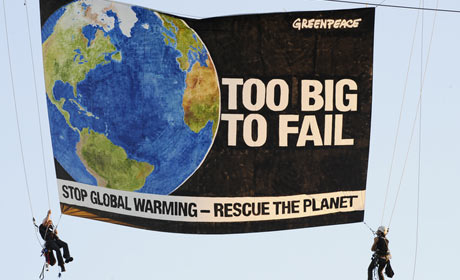
    Greenpeace activists display a banner from a crane near the State Department in Washington

    Greenpeace activists display a banner from a construction crane near the State Department in Washington Photograph: Tazz/Tazz/Greenpeace

    The Obama administration issued a mea culpa today on America’s role in causing climate change, in a move to get the major economies working together on a global warming treaty.

    The admission by Hillary Clinton at a two-day meeting of the world’s biggest polluters was intended to ease some of the obstacles towards a deal at UN talks in Copenhagen in December. She placed the gathering of officials from 17 countries, the European Union and the United Nations on a par with the G20 meeting on the economic crisis earlier this month.

    As the secretary of state opened the meeting, the Greenpeace US executive director, Phil Radford, was arrested in his first day in the job. He and six other climbers unfurled a banner from a construction crane near the state department with a message for the environment ministers: “Stop Global Warming. Rescue the Planet.” Radford called for the industrialised world to commit to deeper cuts in emissions and provide assistance to developing countries.

    Clinton addressed the complaints of developing countries such as India and China that America and the EU, by demanding binding emissions cuts, want to saddle them with the burden of climate change; they argue they did not cause the problem and must prioritise growth. She said the US recognised industrialised countries bore a responsibility: “Some countries like mine are responsible for past emissions.” She wanted China and India to grow their economies: “We want people to have a higher standard of living.”

    Obama had broken with eight years of denial under George Bush, Clinton said. “The United States is fully engaged and ready to lead and determined to make up for lost time both at home and abroad … the US is no longer absent without leave.”

    She saw climate change as the gravest problem facing the international community: “The facts on the ground are outstripping the worst case scenario models.”

    Diplomats see the gathering of Australia, Brazil, Canada, China, the European commission, France, Germany, India, Indonesia, Italy, Japan, Korea, Mexico, Russia, South Africa, Britain, the United States, Denmark and the UN as an important ­station on the road to Copenhagen.

    The two-day meeting – one of three such before December – is not expected to produce definitive agreements. But diplomats hope to get a clearer idea of how countries are prepared to act. There is also hope of establishing negotiations on financial aid and technological assistance to developing countries which will bear the brunt of global warming.

    In almost 100 days in office, Obama has worked to persuade the world he wants to play a leadership role on climate change. Clinton emphasised that progress, noting directives by Obama, and US rulings designating CO2 as a pollutant.

  • The truth about climate change

    The truth about climate change

    Vested interests have tried to spread misinformation about global warming, but scientific evidence shows urgent action is needed 

    Many people ask how sure we are about the science of climate change. The most definitive examination of the scientific evidence is to be found in the work of the Intergovernmental Panel on Climate Change (IPCC) and its last major report published in 2007. I had the privilege of being chairman or co-chairman of the panel’s scientific assessments from 1988 to 2002.

    Many hundreds of scientists from different countries were involved as contributors and reviewers for these reports, which are probably the most comprehensive and thorough international assessments on any scientific subject ever carried out. In June 1995, just before the G8 summit in Scotland, the academies of science of the world’s 11 largest economies (the G8 plus India, China, and Brazil) issued a statement endorsing the IPCC’s conclusions and urging world governments to take urgent action to address climate change. The world’s top scientists could not have spoken more strongly.

    Unfortunately, strong vested interests have spent millions of dollars on spreading misinformation about climate change. First, they tried to deny the existence of any scientific evidence for global warming. More recently, they have largely accepted the fact of anthropogenic (man-made) climate change but argue that its impacts will not be great, that we can “wait and see,” and that in any case we can always fix the problem if it turns out to be substantial.

    The scientific evidence does not support such arguments. Urgent action is needed both to adapt to the climate change that is inevitable and to reduce emissions of greenhouse gases, especially CO2, to prevent further damage as far as possible.

    At the Earth summit in Rio de Janeiro in 1992, the world’s nations signed up to the Framework Convention on Climate Change (FCCC), the objective of which is “to stabilise the concentration of greenhouse gases in the atmosphere at a level that does not cause dangerous interference with the climate system … that allows ecosystems to adapt naturally to climate change, that ensures food production is not threatened, and that enables economic development to proceed in a sustainable manner.” Such stabilisation would also eventually stop further climate change.

    It is now recognised that widespread damage due, for instance, to sea level rise and more frequent and intense heat waves, floods and droughts, will occur even for small increases of global average temperature. Therefore it is necessary that very strong efforts be made to hold the average global temperature rise below 2C relative to its preindustrial level.

    If we are to have a good chance of achieving that target, the concentration of CO2 must not be allowed to exceed 450 parts per million (it is now nearly 390 ppm). This implies that before 2050 global emissions of CO2 must be reduced to below 50% of the 1990 level (they are currently 15% above that level), and that average emissions in developed countries must be reduced by at least 80% of the 1990 level. The UK has already committed itself to a binding target to reduce emissions by that amount, and President Barack Obama has expressed intention that the United States should also set that target.

    One clear requirement is that tropical deforestation, which is responsible for 20% of greenhouse gas emissions, be halted within the next decade or two. Regarding emissions from the burning of fossil fuels, the International Energy Agency (IEA) in its Energy Technology Perspectives has set out in detail the technologies and actions that are needed in different countries and sectors to meet these targets.

    For the short term, the IEA points out that very strong and determined action will be necessary to ensure that global CO2 emissions stop rising (the current increase is more than 3% per year), reach a peak by about 2015, and then decline steadily toward the 2050 target. The IEA also points out that the targets can be achieved without unacceptable economic damage. In fact, the IEA lists many benefits that will be realised if its recommendations are followed.

    What is required now is recognition that anthropogenic climate change will severely affect our children, grandchildren, the world’s ecosystems, and the world’s poorer communities, and that the severity of the impact can be substantially alleviated by taking action now.

    John Theodore Houghton, a former professor of atmospheric physics at Oxford University, and founder of the Hadley Centre for Climate Prediction and Research, was the co-chair of the IPCC’s scientific assessment working group and lead editor of its first three reports

    Copyright: Project Syndicate, 2009.