Category: News

Add your news
You can add news from your networks or groups through the website by becoming an author. Simply register as a member of the Generator, and then email Giovanni asking to become an author. He will then work with you to integrate your content into the site as effectively as possible.
Listen to the Generator News online

 
The Generator news service publishes articles on sustainable development, agriculture and energy as well as observations on current affairs. The news service is used on the weekly radio show, The Generator, as well as by a number of monthly and quarterly magazines. A podcast of the Generator news is also available.
As well as Giovanni’s articles it picks up the most pertinent articles from a range of other news services. You can publish the news feed on your website using RSS, free of charge.
 

  • World will not meet 2C warming target, experts agree


    World will not meet 2C warming target, climate change experts agree

    Guardian poll reveals almost nine out of 10 climate experts do not believe current political efforts will keep warming below 2 C

    Animal skull lies on dried-up reservoir

    Water shortage will cause greater ruin than peak oil. Photograph: Pedro Armestre/AFP/Getty Images

    Almost nine out of 10 climate scientists do not believe political efforts to restrict global warming to 2C will succeed, a Guardian poll reveals today. An average rise of 4-5C by the end of this century is more likely, they say, given soaring carbon emissions and political constraints.

    Such a change would disrupt food and water supplies, exterminate thousands of species of plants and animals and trigger massive sea level rises that would swamp the homes of hundreds of millions of people.

    The poll of those who follow global warming most closely exposes a widening gulf between political rhetoric and scientific opinions on climate change. While policymakers and campaigners focus on the 2C target, 86% of the experts told the survey they did not think it would be achieved. A continued focus on an unrealistic 2C rise, which the EU defines as dangerous, could even undermine essential efforts to adapt to inevitable higher temperature rises in the coming decades, they warned.

    The survey follows a scientific conference last month in Copenhagen, where a series of studies were presented that suggested global warming could strike harder and faster than realised.

    The Guardian contacted all 1,756 people who registered to attend the conference and asked for their opinions on the likely course of global warming. Of 261 experts who responded, 200 were researchers in climate science and related fields. The rest were drawn from industry or worked in areas such as economics and social and political science.

    The 261 respondents represented 26 countries and included dozens of senior figures, including laboratory directors, heads of university departments and authors of the 2007 report from the Intergovernmental Panel on Climate Change (IPCC).

    The poll asked the experts whether the 2C target could still be achieved, and whether they thought that it would be met: 60% of respondents argued that, in theory, it was still technically and economically possible to meet the target, which represents an average global warming of 2C since the industrial revolution. The world has already warmed by about 0.8C since then, and another 0.5C or so is inevitable over coming decades given past greenhouse gas emissions. But 39% said the 2C target was impossible.

    The poll comes as UN negotiations to agree a new global treaty to regulate carbon pollution gather pace in advance of a key meeting in Copenhagen in December. Officials will try to agree a successor to the Kyoto protocol, the first phase of which expires in 2012. The 2C target is unlikely to feature in a new treaty, but most of the carbon cuts proposed for rich countries are based on it. Bob Watson, chief scientist to Defra, told the Guardian last year that the world needed to focus on the 2C target, but should also prepare for a possible 4C rise.

    Asked what temperature rise was most likely, 84 of the 182 specialists (46%) who answered the question said it would reach 3-4C by the end of the century; 47 (26%) suggested a rise of 2-3C, while a handful said 6C or more. While 24 experts predicted a catastrophic rise of 4-5C, just 18 thought it would stay at 2C or under.

    Some of those surveyed who said the 2C target would be met confessed they did so more out of hope rather than belief. “As a mother of young children I choose to believe this, and work hard toward it,” one said.

    “This optimism is not primarily due to scientific facts, but to hope,” said another. Some said they thought geoengineering measures, such as seeding the ocean with iron to encourage plankton growth, would help meet the target.

    Many of the experts stressed that an inability to hit the 2C target did not mean that efforts to tackle global warming should be abandoned, but that the emphasis is now on damage limitation.

  • Sea ice spread linked to ozone layer


    Sea ice spread linked to ozone layer

    Article from:  The Australian

    SEA ice around Antarctica has been increasing at a rate of 100,000sq km a decade since the 1970s, according to a landmark study to be published today.

    The study by the British Antarctic Survey, published in the journal Geophysical Research Letters, says rather than melting as a result of global warming, Antarctica continues to expand.

    The fact that Antarctic ice is still growing does not in itself prove that global warming is not happening. But the BAS says increased ice formation can be explained by another environmental concern, the hole in the ozone layer, which is affecting local weather conditions.

    But the absence of an ice melt overall does put a further question mark over extreme claims that the world faces precipitous rises in sea levels because of the melting polar ice caps.

    Federal Environment Minister Peter Garrett has been under fire for suggesting sea levels could rise by 6m as a result of the melting of the Antarctic ice. Antarctica has 90 per cent of the Earth’s ice and extensive melting of its ice sheet would be required to raise sea levels substantially.

    The Weekend Australian reported on Saturday that the results of ice-core drilling and sea ice monitoring indicated there was no large-scale melting of ice over most of Antarctica. Drilling in the fast ice, a type of sea ice, off Australia’s Davis Station last year showed the ice was 1.9m thick, its densest in 10 years.

    The BAS, which discovered the ozone hole in the mid-1980s, has drawn on data from international agencies, including Australia’s three Antarctic bases.

    BAS project leader John Turner told The Australian yesterday that cooling had been recorded at the Australian bases and elsewhere in east Antarctica. He said satellite images indicated the ozone layer had strengthened surface winds around Antarctica, deepening storms in the South Pacific area of the Southern Ocean. This had resulted in a greater flow of cold air over the Ross Sea, leading to more ice production.

    While sea ice had been lost to the west of the Antarctic Peninsula, sea ice cover over the Ross Sea had increased.

    Dr Turner said the research results indicated why the extensive melting of ice in the Arctic was not occurring in Antarctica.

    “While there is increasing evidence that the loss of sea ice in the Arctic has occurred due to human activity, in the Antarctic, human influence through the ozone hole has had the reverse effect and resulted in more ice,” he said. As the ozone hole repaired itself as a result of measures in place to reduce chlorofluorocarbons in the stratosphere, the cooling in Antactica was expected to be reversed.

    “We expect ozone levels to recover by the end of the century, and by then there is likely to be around one-third less Antarctic sea ice,” Dr Turner said.

    He said that while the expansion of sea ice, the relatively thin ice in Antarctic coastal waters, had been established, debate continued about whether the main mass of the Antarctic ice sheet was growing or shrinking.

  • Miliband’s coal decision is cvnical and meaningless


    Miliband’s coal decision is cynical and meaningless

    If coal plants go ahead on the condition that their emissions will one day be abated through carbon capture and storage technology, then emissions are a certainty

    It’s simple: there should be no new coal burning without 100% carbon capture and storage (CCS) to bury carbon dioxide emissions underground where they cannot influence the climate.

    This is a very different matter from Ed Miliband’s proposal in the House of Commons today that energy companies must “demonstrate CCS on a substantial proportion of any new coal-fired power station.” The figures he has just proposed (400MW of gross capacity) suggest that only around one-quarter to one-fifth of total emissions from a new plant will be captured.

    These partly abated coal plants, in other words, would still be much worse than unabated gas plants.

    Miliband went on to insist that “when the technology is proven [we will make a] commitment that CCS will be fitted on the entire plant.”

    So the big “if” about CCS has magically been turned into a “when”.

    If Miliband is sure that full-scale CCS is viable, two questions arise:

    1. Why has he just announced four demonstration projects to test whether it is viable or not?

    2. Why not go ahead with full CCS right now?

    Of course, there is no “when”. As Alastair Darling told the House of Commons in May 2007:

    “It is true to say that the technology to capture, transport and store the carbon exists, but it has not actually been joined up on a commercial basis yet … these things might never become available.”

    It might work. It might not. As anyone seeking to develop and commercialise a new technology knows, it is likely to be beset by a host of unforeseeable difficulties, which will almost certainly delay it and possibly derail it.

    As Miliband says:

    “I have had representations that from day one there should be 100% CCS on new coal, but I believe that this does not appreciate the need that still exists to demonstrate the technology before full-scale commercial deployment is possible.”

    So here’s the difficulty for the government. It will approve a new generation of coal-burning power stations, starting with Kingsnorth in Kent, on the basis that they will one day reduce their emissions by means of a technology that has not yet been demonstrated. What happens if the CCS demonstrations show that it doesn’t work on the scale Miliband envisages, or not, at least, when he predicts? The only means the government will then have of cutting emissions from the coal-burning plants it approves today is to shut them down, wholly or partially. Two factors mean that this is likely to be politically impossible:

    1. The government has to decide now what our future energy mix will be. All large-scale electricity generation – whether from fossil fuel, nuclear or renewables – takes years to plan, develop and bring onstream. If, say, the government decides that in 2020 one-fifth of our power will come from coal, and then discovers in 2020 that coal emissions cannot be abated by CCS, it will not be able to shut those power stations down without massive consequences for electricity supply. The choice will be a stark one: either it will have to abandon its carbon targets or it will have to subject the country to electricity rationing and rolling black-outs. It’s not hard to guess which way it would jump.

    2. Both Labour and the Conservatives have long colluded with the power generation industry. The Guardian’s new revelations about this relationship are just the latest in a long line. The power sector is a formidable industrial lobby group, which no government appears prepared to confront.

    Miliband can make extravagant promises today about retrofitting 100% CCS to all new coal-burning power stations by 2020 and preventing them from operating without it. But he probably won’t be in office then, and almost certainly won’t be in his current role. Perhaps, as a private citizen, he intends to march into the Kingsnorth power plant and demand that it shuts down, but he can expect to be bludgeoned by the police if he does, just like the rest of us.

    The government’s announcement, in other words, is cynical and meaningless. It cannot enforce the decision it has just made, and it knows that no one else will. If coal plants go ahead on the condition that their emissions will one day be abated through CCS, the emissions will be a certainty. The abatement will not.

    monbiot.com

  • Mangroves ‘protect coastal villages during cyclones’


    Mangroves ‘protect coastal villages during cyclones’

    Mangroves cut coastal deaths during cyclones — but their effectiveness during tsunamis is inconclusive, says a new study. From SciDev, part of the Guardian Environment Networ

    Mangrove swamp

    Debate is growing on using mangrove forests as a protective shield against cyclones

    Mangrove forests, common along tropical coasts, can provide a protective shield against destructive cyclones and reduce deaths, a study has found.

    The finding follows a report published earlier this year (January) which said that mangroves were not effective against tsunamis (see Mangroves do not protect against tsunamis). It adds to a growing debate on using mangroves as bioshields in coastal areas.

    The new study, conducted by scientists at the University of Delhi, India, and Duke University in the United States, analysed the 1999 ‘super cyclone’ that ravaged Orissa state in eastern India, killing an estimated 10,000 people.

    The scientists found that coastal villages in Orissa with the widest mangrove belts suffered fewer deaths, compared to those with narrower or no mangroves.

    Their statistical models suggest that without mangroves, villages within ten kilometres of the coast would have suffered an average of 1.72 additional deaths.

    “Statistical evidence of this life-saving effect is robust” and remains “highly significant” even after taking into account other environmental and socioeconomic factors, the report says.

    The January study, however, found that ‘bioshields’ have negligible effects against tsunamis. Others have argued that promoting green coastal belts as a buffer against tsunamis is diverting valuable funds from effective protection measures such as developing early warning systems.

    Saudamini Das, an associate professor at the University of Delhi and a co-author of the new study points out that while the new study does not address whether mangroves protect tsunami-hit areas it does clear all doubts about their effects against cyclones.

    Das told SciDev.Net that there are key differences in the height and energy of the waves in tsunami and cyclone situations. Cyclones cause sea waters to rise and form a wall of water called a ‘storm surge’ up to eight metres high. The waves are driven by cyclone winds and their energy is concentrated near the water surface. “Mangroves can reduce the wind energy and [wave] velocity in this case,” she says.

    By contrast, tsunami wave heights can reach up to 20 metres and their effects on mangroves are not clear as there is no similar study covering a large sample size and taking into account other environmental and socioeconomic factors, she says.

    Das also says the maximum speed of tsunami waves mangroves can withstand is yet to be studied.

    • This article was shared by our content partner SciDev, part of the Guardian Environment Network

  • Budget 2009: Darling promises 34% emissions cuts with world’s first binding carbon budgets


    Budget 2009: Darling promises 34% emissions cuts with world’s first binding carbon budgets

    Environmentalists warn that emissions targets are out of date


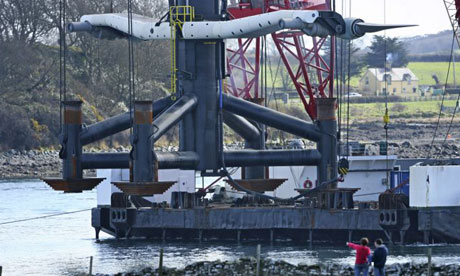
    SeaGen - the world's first and largest commercial scale tidal stream energy generator - was laid down in Strangford Lough, Northern Ireland

    There was widespread criticism that the rest of the budget did not include enough money for renewable energy such as tidal power. Photograph: Peter Muhy/Getty/AFP

    If they can actually do it, the government’s pledge to cut global warming emissions by one third in just over a decade should transform the way the UK economy works.

    However, critics warned that the cuts would still not be enough to avoid dangerous climate change, and warned that other spending pledges were not nearly enough to meet the target.

    Darling has now promised to cut greenhouse gases by 34% by 2020 through so-called carbon budgets, which fix binding limits on greenhouse gas emissions over five-year periods. The 34% target is in line with the advice of the government’s independent watchdog, the Committee on Climate Change. “This represents a step change in the UK ambition on climate change,” said the budget report.

    The budget report said the government “aims” to do this without purchasing controversial carbon credits from cuts made in other countries, but said these “offsets” could be a “fallback option”. It also said the target cut would be higher if there was “satisfactory” global agreement on cutting emissions, but stopped short of committing to the higher 42% cut recommended by the CCC in those circumstances.

    “These budgets give industry the certainty needed to develop and use low carbon technology – cutting emissions, creating new businesses and jobs,” said the chancellor.

    Nobody expected the government to reject the emissions targets put forward by its watchdog, which are designed to help reach a promised reduction of 80% by the middle of this century.

    However, the formal announcement makes the UK the first country in the world to set legally binding targets.

    Environmental campaigners and business groups commended the government on committing itself to firm targets. However, there were immediate warnings that not enough was being done.

    Friends of the Earth, the charity which led a mass public campaign for the Climate Change Act which created the targets, said the 34% cut was no longer enough.

    “Setting the first ever carbon budgets is a ground-breaking step – but the government has ignored the latest advice from leading climate scientists and set targets that are completely inadequate,” said Andy Atkins, the organisation’s executive director. “A 42% cut by 2020 is the minimum required if we are to play our part in avoiding dangerous climate change.”

    There was also widespread criticism that the rest of the budget did not include enough money for renewable energy like wind and tidal power, and energy efficiency for homes and other buildings. The budget also promised up to four “demonstration” projects for carbon capture and storage for coal and gas power plants, and £60m of new spending on research and development of the unproven technology, but critics said these partial capture schemes were not enough if the government goes ahead with plans for up to eight new coal plants.

    James Cameron, vice-chairman of Climate Change Capital, a low-carbon investment fund with more than US$1.5bn (£1bn) under management, said: “The idea of a carbon budget is to be applauded and must become a permanent feature of how we direct our economy. But the reality is that creating a low carbon economy requires more than high-level commitment. The scale of investment required is huge, and thus far the commitments to stimulate the economy and reduce emissions have been small gestures, albeit in the right direction. They have identified the correct areas to be targeting with strategic intervention but the orders of magnitude are much too small.”

    The budget report said a full strategy on how the targets will be met is due this summer, but that the “latest government modelling” showed it was on course to meet the 2020 and two interim targets.

    “The strategy will strengthen the long-term policy framework, taking into account recent consultations on heat and energy saving, renewable energy and zero carbon homes,” added the report.

  • Biogas reaches critical mass in Europe

    From Renewable Energy News

    The yard is piled high with stacks of wood. A local company collects it from the surrounding forests and brings it to the 2-MW gassification biomass power plant at Gussing in Burgenland in Austria.

    Biomass supplies Gussing with not only all of its own energy needs, but also allows it to feed surplus energy into the national grid – using only about a quarter of the amount of wood that regrows each year in the local forests.

    “We wouldn’t be able to use all the new wood there is out there,” said Christian Keglovits from the European Center for Renewable Energy in Gussing.

    About 47 percent of the land in Austria is covered in forest, and it is by tapping its rich timber resources that the country now plans to ramp up the proportion of renewables in its energy mix to meet an ambitious European Union goal, which was set in 2008.

    All the European Union countries are required to increase their use of renewable energies by an average of about 11 percent to boost the EU’s share of renewables in the energy mix from about 8.5% today to 20% by 2020.

    They’ve also been asked to increase energy efficiency by 20 percent compared to a business-as-usual scenario.

    In line with this, Austria has been given a national target of generating 34 percent of its energy from renewable sources by 2020, up from the 23.3 percent today.

    To meet the EU targets by 2020, Austria’s final energy consumption should be 1,406 PJ. Of that, about one-fifth, or around 280 PJ, is expected to come from biomass by 2020. In fact, biomass will be supplying more than half of the 519 PJ set to be generated by renewables in Austria, jumping ahead of the traditional hydropower resource.

    “If you look at all the countries in the top of the EU table when it comes to producing renewable energy, they all make use of bioenergy. Austria, Sweden, Latvia and Finland all have abundant forests. Bioenergy around the globe has a huge potential,” Kasimir Nemestothy, Austrian Chamber of Agriculture, told RenewableEnergyWorld.com.

    Nemestothy recently helped author a policy paper for the magazine Science (March 13th) arguing that America could apply some of the lessons from Austria’s biomass industry to tap its own gigantic bioenergy resources.

    Austria’s biomass sector has indeed been growing fast and furious out of the spotlight. In 2005, biomass contributed 176 PJ to Austria’s final energy consumption compared to 131 PJ in 2000.

    “Biomass could contribute much more than 280 PJ to Austria’s final energy consumption,” said Gregor Grill from Austria’s Biomass Association, a biomass industry umbrella organization.

    Sweden recently floated a plan to increase the country’s share of renewables to 50 percent by 2020, largely by using its biomass resources.

    The key to using bioenergy successfully is efficiency, says Grill. First, there has to be logistical and organizational efficiency when it comes to collecting wood, waste and straw and getting it to the biomass plant.

    Second, there has to be technological efficiency in converting the wood or straw or waste to energy. To improve the logistics of collecting wood economically, Austria is promoting a decentralized network of small-scale biomass plants rather than large-scale ones.

    “The key to bioenergy efficiency is integration and multipurpose use so we can get heat and electricity at the same time,” said Grill.

    Austria already has 120 combined heat and power (CHP) plants producing 320 MW of electricity. Grill said some of these CHP plants have a conversion rate of 60 to 70 percent.

    More than just a reliable resource, biomass is also flexible.