Category: News

Add your news
You can add news from your networks or groups through the website by becoming an author. Simply register as a member of the Generator, and then email Giovanni asking to become an author. He will then work with you to integrate your content into the site as effectively as possible.
Listen to the Generator News online

 
The Generator news service publishes articles on sustainable development, agriculture and energy as well as observations on current affairs. The news service is used on the weekly radio show, The Generator, as well as by a number of monthly and quarterly magazines. A podcast of the Generator news is also available.
As well as Giovanni’s articles it picks up the most pertinent articles from a range of other news services. You can publish the news feed on your website using RSS, free of charge.
 

  • Maldives tries to avert disaster

    From the UK Guardian

    Nasheed approached British climate change experts Chris Goodall and Mark Lynas to help develop the radical carbon-neutrality plan. The pair worked on a package of measures that could virtually eliminate fossil fuel use on the Maldive archipelago by 2020.

    The plan includes a new renewable electricity generation and transmission infrastructure with 155 large wind turbines, half a square kilometre of rooftop solar panels, and a biomass plant burning coconut husks. Battery banks would provide back-up storage for when neither wind nor solar energy is available.

    The clean electricity would power not only homes and businesses, but also vehicles. Cars and boats with petrol and diesel engines would be gradually replaced by electric versions.

    Goodall, author of Ten Technologies to Save the Planet, led the development of the clean-energy package. He said: “The Maldives could just give up. Its people could declare themselves climate change refugees and ask for sanctuary elsewhere. But the new government is taking a stand and asked us to give them a plan for a near zero-carbon economy.

    “We don’t want to pretend that this plan is going to be easy to implement. There will be hiccups, and electricity supply will occasionally be disrupted. But we think that building a near-zero-carbon Maldives is a realistic challenge. Get it right and we will show the apathetic developed world that action is possible, and at reasonable cost.”

    The Maldives is one of the world’s lowest-lying countries, with 385,000 people living mainly on land less than two metres above sea level. The country would be rendered almost entirely uninhabitable by a rise in sea levels of one metre.

    Lynas said: “The Maldives is in the front line of climate change. It is perhaps the most vulnerable country in the world. If nothing is done to cut global carbon emissions, the country will sink beneath rising seas this century. It is a poor country, but here we have a government that is throwing down the gauntlet to the rich, highly polluting countries.”

    The Maldives plan is not the first national carbon-neutrality target. Norway is aiming to be zero-carbon by 2030. However, the Maldives scheme is more ambitious – not just in terms of its 10-year timetable, but also because it aims to totally decarbonise the local economy. By contrast, the Norwegian scheme allows a large slice of domestic emissions to be offset by investments in forestry schemes overseas.

    The cost for the package of low-carbon measures is estimated to be about $110m a year for 10 years. The scheme should pay for itself quite quickly, because the Maldives will no longer need to import oil products for electricity generation, transport and other functions. If the oil price were to rise to $100 per barrel, the payback period would be as short as 11 years. At current prices, it would take roughly twice as long to break even.

    Nasheed said: “Climate change is a global emergency. The world is in danger of going into cardiac arrest, yet we behave as if we’ve caught a common cold. Today, the Maldives has announced plans to become the world’s most eco-friendly country. I can only hope other nations follow suit.”

  • Marine dead zones expanding rapidly

    Dead zones are caused by agricultural runoff, especially nitrogen-rich fertilizers, and the burning of fossil fuels. The pollutants cause marine eutrophication, whereby the ecosystem receives too many nutrients, triggering massive algae blooms, which eventually die and are broken down bacteria. By breaking down the algae the bacteria consume excessive amounts of oxygen, essentially starving the marine system.

     
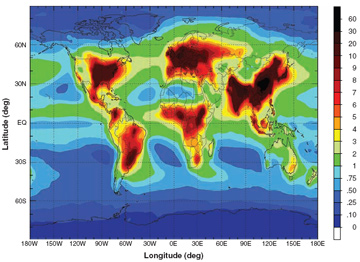
    Estimated N deposition from global total N (NOy and NHx) emissions, totaling 105 Tg N per year. Image appeared in J.N. Galloway et al (2008). “Transformation of the Nitrogen Cycle: Recent Trends, Questions, and Potential Solutions,” Science 16 May 2008.

    The majority of dead zones are near large populations in wealthy nations. For example, the United States’ east coast is covered with hypoxia sites, as is much of western and northern Europe. Such areas—heavy in industry, fishing, and runoffs from intensive agriculture—spew massive amounts of nutrient-rich pollutants into the sea.

    The authors note that “most of these systems were not hypoxic when first studied, but it appears that from the middle of the past century, the dissolved oxygen concentrations of many coastal ecosystems have been adversely affected by eutrophication.” A number of human-related factors likely caused the sudden explosion of dead zones, but certainly the development in the 1940s of mass-produced fertilizer containing nitrogen is a major culprit.

    Dead zones live up to their name in terms of biomass, the loss of which adds greater strains on already overfished and overexploited oceans. As an example, the researchers note that the Kattegat sea—between Denmark and Sweden—has experienced high levels of fish mortality and a collapse of their lobster industry due to eutrophication. In addition, they estimate that if the entire Baltic Sea recovered from eutrophication it would be one-third to one-half more productive—a boon for Scandinavian fishermen and a reprieve from other fishing areas.


    Global distribution of the 400+ marine systems with dead zones caused by increased eutrophication. Their distribution matches the current human “footprint” in the northern hemisphere. In the southern hemisphere, dead zones have only been reported recently. [Image courtesy of Science/AAAS]
  • Worlds seafood to disappear in 40 years

    From NaturalNews

    The number of “dead zones” in coastal regions around the world continues to rapidly increase, according to a study conducted by researchers from the Virginia Institute of Marine Science and the University of Gothenberg, and published in the journal Science.

    “It’s not sort of a local or regional problem, which is how it was thought of in the past,” researcher Robert Diaz said. “It is actually a global problem.”

    Dead zones are areas where oxygen has become so depleted that little or no marine life is able to survive. They form when excessive plant nutrients, particularly nitrogen and phosphorus, run off from the coast and lead to an explosion of algae blooms. When this vastly increased biomass dies and sinks to the bottom, its decomposition leads to the proliferation of oxygen-consuming bacteria.

    In some cases, this may lead to increased crowding pressure in other parts of the ocean.

    “Fish are the best at avoiding dead zones,” Diaz says. “When the oxygen starts to decline, they’re smart – they leave, they don’t hang around. Crabs and shrimp are pretty good at getting away, too, as are lobsters.”

    Many slower moving animals such as clams, worms and small crustaceans, however, simply die.

    In the current study, researchers found that the number of dead zones has steadily increased from 39 at the end of the 1960s through 63 at the end of the 1970s, 132 at the end of the 1980s and 301 at the end of the 1990s to the current number of 405. The total area consumed by dead zones now measures no less than 95,000 square miles.

    The major sources of the pollutants that produce dead zones are fertilizer runoff from industrial agriculture and nitrogen-based byproducts of fossil fuel use.

    “Most of it is agricultural-based, but there is a lot of industrial nitrogen in there, too, if you consider electric generation,” Diaz said.

    Dead zones now function as one of the primary stresses on marine biodiversity, along with overfishing and habitat loss.

  • Pharma ships bird flu to Europe


    The Australian Vaccination Network press release

    Could this be the start of the Bird Flu epidemic?

    It could be the plot line for a Hollywood thriller – shades of I Am Legend. But recently-released information showing that the influenza vaccine produced by Baxter International Inc was ‘unintentionally’ contaminated with live H5N1 avian influenza virus has shocked the medical world and caused panic in the European nations where the vaccine was distributed and administered.

    Interestingly, Baxter has been awarded contracts by several nations around the world to develop an Avian influenza vaccine. This ‘error’ on their part could be the means by which an epidemic of this fatal form of influenza begins in the community.

    This is just one more piece of evidence to show that vaccine manufacturers do not maintain strict controls over their production processes or facilities.

    On May 1, 2008, the FDA (Food and Drug Administration) cited Merck & Co.  for contamination at their plant which produces the Gardasil vaccine – a vaccine which is credited with causing 17 serious reactions a week in Australian girls who receive it.

    The letter which the FDA wrote to Merck in regards to their plant inspection, describes “significant deviations from current good manufacturing practice (CGMP)” and described a failure to “…assure that drug products conform to appropriate standards of identity, strength, quality, and purity.”

    In addition to the Gardasil vaccine, this plant produces Liquid PedvaxHIB®, RECOMBIVAX HB®, ProQuad®, Gardasil®, VAQTA®, and COMVAX®. Merck is also the manufacturer of the MMR (Measles, Mumps and Rubella) vaccination which we currently use in Australia.

    “The government, medical community, and the pharmaceutical companies all have a duty of care to ensure that the vaccines we are administering to our children are as safe and pure as they possibly can be. It is obvious that this duty of care is not being taken seriously. The AVN demands more transparency regarding the vaccine production process and inclusion of representatives of our organisation on the government committees that oversee these processes.” says Meryl Dorey, President of the Australian Vaccination Network.


  • Analysis of US food safety act

    Is this Change we can believe in? Maybe it is for Obama’s Secretary of Agriculture, Tom “I Fly with Monsanto” Vilsack.

    For the rest of us, this is a nightmare.

    For the original of this article visit Cryptogon

    Let’s take it piece by piece:

    What is the legislation called? H.R. 875: Food Safety Modernization Act of 2009:

    111th CONGRESS
    1st Session
    H. R. 875

    To establish the Food Safety Administration within the Department of Health and Human Services to protect the public health by preventing food-borne illness, ensuring the safety of food, improving research on contaminants leading to food-borne illness, and improving security of food from intentional contamination, and for other purposes.

    How does this affect farmers who just sell fruit and vegetables at farmers markets?

    SEC. 3. DEFINITIONS.

    (9) CATEGORY 5 FOOD ESTABLISHMENT- The term ‘category 5 food establishment’ means a food establishment that stores, holds, or transports food products prior to delivery for retail sale.

    13) FOOD ESTABLISHMENT-

    (A) IN GENERAL- The term ‘food establishment’ means a slaughterhouse (except those regulated under the Federal Meat Inspection Act or the Poultry Products Inspection Act), factory, warehouse, or facility owned or operated by a person located in any State that processes food or a facility that holds, stores, or transports food or food ingredients.

    Does this really apply to fruit and vegetables? Yes.

    SEC. 3. DEFINITIONS.

    (12) FOOD- The term ‘food’ means a product intended to be used for food or drink for a human or an animal and components thereof.

    Registration:

    SEC. 202. REGISTRATION OF FOOD ESTABLISHMENTS AND FOREIGN FOOD ESTABLISHMENTS.

    (a) In General- Any food establishment or foreign food establishment engaged in manufacturing, processing, packing, or holding food for consumption in the United States shall register annually with the Administrator.

    (b) Registration Requirements-

    (1) IN GENERAL- To be registered under subsection (a), a food establishment shall submit a registration or reregistration to the Administrator.

    (2) REGISTRATION- Registration under this section shall begin within 90 days of the enactment of this Act. Each such registration shall be submitted to the Secretary through an electronic portal and shall contain such information as the Secretary, by guidance, determines to be appropriate. Such registration shall contain the following information:

    (A) The name, address, and emergency contact information of each domestic food establishment or foreign food establishment that the registrant owns or operates under this Act and all trade names under which the registrant conducts business in the United States relating to food.

    (B) The primary purpose and business activity of each domestic food establishment or foreign food establishment, including the dates of operation if the domestic food establishment or foreign food establishment is seasonal.

    (C) The types of food processed or sold at each domestic food establishment or, for foreign food establishments selling food for consumption in the United States, the specific food categories of that food as listed under section 170.3(n) of title 21, Code of Federal Regulations, or such other categories as the Administrator may designate in guidance, action level, or regulations for evaluating potential threats to food protection.

    (D) The name, address, and 24-hour emergency contact information of the United States distribution agent for each domestic food establishment or foreign food establishment, who shall maintain information on the distribution of food, including lot information, and wholesaler and retailer distribution.

    (E) An assurance that the registrant will notify the Administrator of any change in the products, function, or legal status of the domestic food establishment or foreign food establishment (including cessation of business activities) not later than 30 days after such change.

    (3) PROCEDURE- Upon receipt of a completed registration described in paragraph (1), the Administrator shall notify the registrant of the receipt of the registration, designate each establishment as a category 1, 2, 3, 4, or 5 food establishment, and assign a registration number to each domestic food establishment and foreign food establishment.

    Inspection, Category 5 Food Establishments

    SEC. 205. INSPECTIONS OF FOOD ESTABLISHMENTS.

    (a) In General- The Administrator shall establish an inspection program, which shall include statistically valid sampling of food and facilities to enforce performance standards. The inspection program shall be designed to determine if each food establishment–

    (1) is operated in a sanitary manner;

    (2) has continuous preventive control systems, interventions, and processes in place to minimize or eliminate contaminants in food;

    (3) is in compliance with applicable performance standards established under section 204, and other regulatory requirements;

    (4) is processing food that is not adulterated or misbranded;

    (5) maintains records of process control plans under section 203, and other records related to the processing, sampling, and handling of food; and

    (6) is otherwise in compliance with the requirements of the food safety law.

    (5) CATEGORY 5 FOOD ESTABLISHMENTS- A category 5 food establishment shall–

    (A) have ongoing verification that its processes are controlled; and

    (B) be randomly inspected at least annually.

    (c) Establishment of Inspection Procedures- The Administrator shall establish procedures under which inspectors shall take random samples, photographs, and copies of records in food establishments.

    What happens if you own a farm, ranch, orchard, vineyard, aquaculture facility, or confined animal-feeding operation that does not prepare or serve food directly to the consumer?

    I hope you like having Feds crawling all over your property and telling you what to do.

    SEC. 206. FOOD PRODUCTION FACILITIES.

    (a) Authorities- In carrying out the duties of the Administrator and the purposes of this Act, the Administrator shall have the authority, with respect to food production facilities, to–

    (1) visit and inspect food production facilities in the United States and in foreign countries to determine if they are operating in compliance with the requirements of the food safety law;

    (2) review food safety records as required to be kept by the Administrator under section 210 and for other food safety purposes;

    (3) set good practice standards to protect the public and animal health and promote food safety;

    (4) conduct monitoring and surveillance of animals, plants, products, or the environment, as appropriate; and

    (5) collect and maintain information relevant to public health and farm practices.

    (b) Inspection of Records- A food production facility shall permit the Administrator upon presentation of appropriate credentials and at reasonable times and in a reasonable manner, to have access to and ability to copy all records maintained by or on behalf of such food production establishment in any format (including paper or electronic) and at any location, that are necessary to assist the Administrator–

    (1) to determine whether the food is contaminated, adulterated, or otherwise not in compliance with the food safety law; or

    (2) to track the food in commerce.

    (c) Regulations- Not later than 1 year after the date of the enactment of this Act, the Administrator, in consultation with the Secretary of Agriculture and representatives of State departments of agriculture, shall promulgate regulations to establish science-based minimum standards for the safe production of food by food production facilities. Such regulations shall–

    (1) consider all relevant hazards, including those occurring naturally, and those that may be unintentionally or intentionally introduced;

    (2) require each food production facility to have a written food safety plan that describes the likely hazards and preventive controls implemented to address those hazards;

    (3) include, with respect to growing, harvesting, sorting, and storage operations, minimum standards related to fertilizer use, nutrients, hygiene, packaging, temperature controls, animal encroachment, and water;

    (4) include, with respect to animals raised for food, minimum standards related to the animal’s health, feed, and environment which bear on the safety of food for human consumption;

    (5) provide a reasonable period of time for compliance, taking into account the needs of small businesses for additional time to comply;

    (6) provide for coordination of education and enforcement activities by State and local officials, as designated by the Governors of the respective States; and

    (7) include a description of the variance process under subsection (d) and the types of permissible variances which the Administrator may grant under such process.

    Is registration required? Yes. Is compliance with inspections required? Yes

    TITLE IV–ENFORCEMENT
    SEC. 401. PROHIBITED ACTS.

    It is prohibited–

    (3) for a food establishment or foreign food establishment to fail to register under section 202, or to operate without a valid registration;

    (4) to refuse to permit access to a food establishment or food production facility for the inspection and copying of a record as required under sections 205(f) and 206(a);

    (5) to fail to establish or maintain any record or to make any report as required under sections 205(f) and 206(b);

    (6) to refuse to permit entry to or inspection of a food establishment as required under section 205;

    So what might happen if I refuse?

    SEC. 405. CIVIL AND CRIMINAL PENALTIES.

    (a) Civil Sanctions-

    (1) CIVIL PENALTY-

    (A) IN GENERAL- Any person that commits an act that violates the food safety law (including a regulation promulgated or order issued under the food safety law) may be assessed a civil penalty by the Administrator of not more than $1,000,000 for each such act.
  • US legislates against farmer’s markets

    The “food safety” bills in Congress were written by Monsanto, Cargill, Tysons, ADM, etc.  All are associated with the opposite of food safety.  What is this all about then?


    In the simplest terms, organic food and a rebirth of farming were winning.  Not in absolute numbers but in a deep and growing shift by the public toward understanding the connection between their food and their health, between good food and true social pleasures, between their own involvement in food and the improvement in their lives in general, between local food and a burgeoning local economy.

    Slow Food was right – limit your food to what comes from your region and from real farmers, and slow down to cook it and linger over it with friends and family, and the world begins to change for the better.
     
    And as we face an unprecedented economic crisis, and it is hard to be sure what has value, one thing that always does is food.  Which is why the corporations are after absolute control over it.  But what obstacles to a complete lock on food do they face?  All the people in this country who are “banking” on organic farming and urban gardens and most of all, everyone’s deepening pleasure in and increasing involvement with everything about food.

    Farmers markets.  Local farmers.  Real milk.  Fresh eggs.  Vegetable stands.  

    Those are things we not only all want, but things we are actively getting involved in, and things we very much need.  And where they are truly good, they are growing.

    The international financial corporations which have wreaked havoc around the world with astounding nonsensical “solutions” that are destructive of everyone but them, are brothers to the international agribusiness giants (Monsanto, Cargill, Tysons, ADM, etc.) which are just as aggressively after their own form of “taking.”  Just seeds, animals, water, land.  

    And freedom. 

    Because human beings are by in large good and by in large incredibly resilient and clever, and left to their own devices – that is, free – they would handle this gargantuan financial stupidity the corporations brought us with NAFTA, CAFTA, GATT and all other globalized schemes (which they hope to eventually top off with CODEX).  How?  By being productive in real ways and locally.  And farming is the solid ground under that.  Farmers produce something of real value (something we used to take for granted), and from that base, businesses grow up.  Local markets, local food processors, local seed companies, local tool and supply companies, local stores … and an economy based on reality and something truly good for us, too, begins to grow.  

    So, look again at what has been exciting us – Farmers markets.  Local farmers.  Real milk.  Fresh eggs.  Vegetable stands. – and realize that they are not only wonderfully healthy but fun and naturally community building.  And more, they are a real economy and deeply democratic – and just at a time we need something that works economically, that supports our democratic rebirth, and that protects food itself and our easy access to it.

    And it is all those things that threaten the corporations … which is why we now have these massive “fake food safety” bills in Congress.  Everything is going under thanks to these fools, and they wish to be there like vultures to make sure that every drop of blood that can be sucked out of our resources and us, is theirs.  To wit, they must get rid of such good and innocent things and yet truly powerful things as:

    Farmers markets.  Local farmers.  Real milk.  Fresh eggs.  Vegetable stands.  

    And how will those who contaminate our country’s food with pesticides, hormones, antibiotics and more, do that?  Why, by setting standards for “food safety” that are so grotesquely and inappropriately and even cruelly applied to a local, independent farmers and ranchers that there is no way they can manage.  Imagine your being faced with a 100 page IRS form and facing a million dollar a day penalty for screwing up.  That would be in the ball park of the impossible complexity mixed with threat facing our farmers.  Imagine having the government and corporations deciding every single thing you can do and must do in your kitchen and backing that up with the threat of 10 years in prison for screwing up – though you have never made anyone sick, and those corporations have.  Imagine being surveilled 24 hours a day by GPS tracking devices that feed into … a corporate data bank, one they have now moved out of the country so no one here can have legal access to see what is in it.  

    Imagine the devil himself – or a whole boardrooms of them, dressed in suits – defining the only safe and healthy food in this country as dangerous and burdening hard working farmers with more work then anyone could bear, while his own, their own, food is so dangerous at this point that in the last 10 years alone, diabetes has gone up 90%.

    And how did they get this far with such a scheme to apply insane industrial standards to every farm in the country?  Through fear of diseases and of outbreaks of food borne illnesses, both of which they cause themselves. 

    How it works:  Tyson helps Bill Clinton get into office.  Bill Clinton immediately and significantly lowers contamination standards for poultry as a thank you.  And it is such contaminated waste from transnational poultry factories which is now implicated as the source of bird flu. Then fortunes on made on that fear.  And then poultry industry uses the crisis they created to push out small farmers and take greater control than ever.  Their mantra?  Biodiversity not only be damned but be eliminated.  And get rid of those damn farmers who protect it while we’re at it.

    The bills would require such a burdensome complexity of rules, inspections, licensing, fees, and penalties for each farmer who wishes to sell locally – a fruit stand, at a farmers market –  no one could manage it.  And THAT is the point.  The whole dirty tricks point.  The whole “be in tight control of everything needed for survival because it’ll be worth a fortune” point.