Energy Secretary of the United Kingdom, Ed Milibrand, told the Financial Times on December 21st that the government would not ban new coal fired power stations if such a ban threatened the energy security of the island nation. The UK Climate Change Act 2008 commits the nation to a 20 percent cut in greenhouse gas emissions by 2020, a minimum of 15 percent of energy to be renewable and feed-in tariffs to reward householders and business who install grid interactive power generation. The coal industry has been lobbying for recognition of its investment in carbon capture and storage technologies. It claims that clean coal can be part of a low carbon future. Lobbyists for clean coal in the United States are spending millions of dollars on a campaign to redefine the term
Category: News
Add your news
You can add news from your networks or groups through the website by becoming an author. Simply register as a member of the Generator, and then email Giovanni asking to become an author. He will then work with you to integrate your content into the site as effectively as possible.
Listen to the Generator News online
The Generator news service publishes articles on sustainable development, agriculture and energy as well as observations on current affairs. The news service is used on the weekly radio show, The Generator, as well as by a number of monthly and quarterly magazines. A podcast of the Generator news is also available.
As well as Giovanni’s articles it picks up the most pertinent articles from a range of other news services. You can publish the news feed on your website using RSS, free of charge.
-
Germany passes US as biggest renewable market
From Ernst and Young
Press Release
The US has seen its position as the most attractive destination for investment in renewable energy nose dive, helping Germany move to joint first place according to Ernst & Young’s latest Renewable energy country attractiveness indices.
The indices – which track and score global investment in renewable energy – also reveal that there has been a record reduction in the attractiveness of all 20 countries included for the first time since its creation five years ago.
Jonathan Johns, head of renewable energy at Ernst & Young says, “Although the financial crisis has negatively impacted the attractiveness of all countries in the indices, the US has borne the brunt of the economic slowdown.”
The economic situation in the US has restricted access to finance and slowed the recycling of Production Tax Credits (PTC) and Investment Tax Credits (ITC), which allow corporates to gain tax breaks by purchasing credits from renewables developers.
“This has allowed Germany, almost by default, to take the position of most attractive destination for renewable investment alongside the US, largely as a result of its feed-in tariff making the German market more resilient,” Johns adds.
The UK moved one place to joint fifth in the All renewables index, sharing the position with Spain. The attractiveness of the UK was boosted by the UK Government’s announcement in its Pre Budget Report to extend the renewables obligation to 2037, as well as the enactment of the Energy and Planning Act 2008, which includes the establishment of a new feed-in tariff for small wind farm projects with up to 5 megawatt capacity.
US’ fall from grace
Johns says that although the US attractiveness has been enhanced by the signing of the Energy Improvement and Extension Act – which includes the extension of production and investment tax credits for renewable technologies – the economic crisis has hit the industry hard.
The financial services industry was by far the biggest consumer of PTC and ITC, which have been the cornerstone of the industry’s success in the US. However, the volatility in the global financial markets has meant many of these institutions have been unable to purchase these credits, and this is preventing many investors in renewables projects from realizing the value of their investments. A radical improvement in the effectiveness of the PTC will therefore be needed to restore the fortunes of the US industry.
“The path followed by the US is critical to the industry and measures announced by the impending Obama presidency will be keenly monitored. Worldwide growth of renewables is likely to continue, albeit at reduced levels, but if the US were to stall its plans there would be significant reverberations for the global industry,” adds Johns.
Germany could fall as quickly as it has risen
As well as the attractive feed-in tariffs, Germany’s position at the top of the Indices has been boosted by the news that its Government has set out plans to build 33 offshore wind farms as part of its efforts to achieve 25 gigawatts from wind by 2030, but in practice investments maybe delayed.
“While the German Government has set out bold plans for energy generation from wind farms, the reality may turn out to be different as the financial crisis stems the flow of capital and funding,” says Johns.
Falling pound takes wind out of UK’s sails
While the UK’s position has been bolstered by the extension of the renewables obligation and the enactment of the Energy and Planning Act 2008, the UK industry is facing increasing cost pressures due to the decline of the pound versus the euro.
Johns says, “The falling value of the pound is making UK renewable projects increasingly expensive as imported technologies from Europe continue to rise as a result of the exchange rate. The declining price of oil is compounding the problem by reducing project revenues as wholesale energy prices fall, resulting in many projects becoming uneconomical. It is unlikely that falling commodity prices such as steel and copper will compensate enough.”
Across the globe, there is likely to be a raft of project cancellations and delays as industry players adopt a wait and see approach in relation to regulation and supply chain costs. In the meantime, Johns says that capital rich investors will take advantage.
“An interesting dynamic developing in the industry, and one to watch over the coming months, is the increase in partnerships and joint ventures between industry players and cash rich investors in these capital constrained times,” he concluded.
Stanford sicentist ranks renewables
Read the full report
The best ways to improve energy security, mitigate global warming and reduce the number of deaths caused by air pollution are blowing in the wind and rippling in the water, not growing on prairies or glowing inside nuclear power plants, says Mark Z. Jacobson, a professor of civil and environmental engineering at Stanford.
And “clean coal,” which involves capturing carbon emissions and sequestering them in the earth, is not clean at all, he asserts.
Jacobson has conducted the first quantitative, scientific evaluation of the proposed, major, energy-related solutions by assessing not only their potential for delivering energy for electricity and vehicles, but also their impacts on global warming, human health, energy security, water supply, space requirements, wildlife, water pollution, reliability and sustainability. His findings indicate that the options that are getting the most attention are between 25 to 1,000 times more polluting than the best available options. The paper with his findings will be published in the next issue of Energy and Environmental Science and is available online here. Jacobson is also director of the Atmosphere/Energy Program at Stanford.
“The energy alternatives that are good are not the ones that people have been talking about the most. And some options that have been proposed are just downright awful,” Jacobson said. “Ethanol-based biofuels will actually cause more harm to human health, wildlife, water supply and land use than current fossil fuels.” He added that ethanol may also emit more global-warming pollutants than fossil fuels, according to the latest scientific studies.
The raw energy sources that Jacobson found to be the most promising are, in order, wind, concentrated solar (the use of mirrors to heat a fluid), geothermal, tidal, solar photovoltaics (rooftop solar panels), wave and hydroelectric. He recommends against nuclear, coal with carbon capture and sequestration, corn ethanol and cellulosic ethanol, which is made of prairie grass. In fact, he found cellulosic ethanol was worse than corn ethanol because it results in more air pollution, requires more land to produce and causes more damage to wildlife.
To place the various alternatives on an equal footing, Jacobson first made his comparisons among the energy sources by calculating the impacts as if each alternative alone were used to power all the vehicles in the United States, assuming only “new-technology” vehicles were being used. Such vehicles include battery electric vehicles (BEVs), hydrogen fuel cell vehicles (HFCVs), and “flex-fuel” vehicles that could run on a high blend of ethanol called E85.
Wind was by far the most promising, Jacobson said, owing to a better-than 99 percent reduction in carbon and air pollution emissions; the consumption of less than 3 square kilometers of land for the turbine footprints to run the entire U.S. vehicle fleet (given the fleet is composed of battery-electric vehicles); the saving of about 15,000 lives per year from premature air-pollution-related deaths from vehicle exhaust in the United States; and virtually no water consumption. By contrast, corn and cellulosic ethanol will continue to cause more than 15,000 air pollution-related deaths in the country per year, Jacobson asserted.
Because the wind turbines would require a modest amount of spacing between them to allow room for the blades to spin, wind farms would occupy about 0.5 percent of all U.S. land, but this amount is more than 30 times less than that required for growing corn or grasses for ethanol. Land between turbines on wind farms would be simultaneously available as farmland or pasture or could be left as open space.
Indeed, a battery-powered U.S. vehicle fleet could be charged by 73,000 to 144,000 5-megawatt wind turbines, fewer than the 300,000 airplanes the U.S. produced during World War II and far easier to build. Additional turbines could provide electricity for other energy needs.
“There is a lot of talk among politicians that we need a massive jobs program to pull the economy out of the current recession,” Jacobson said. “Well, putting people to work building wind turbines, solar plants, geothermal plants, electric vehicles and transmission lines would not only create jobs but would also reduce costs due to health care, crop damage and climate damage from current vehicle and electric power pollution, as well as provide the world with a truly unlimited supply of clean power.”
Jacobson said that while some people are under the impression that wind and wave power are too variable to provide steady amounts of electricity, his research group has already shown in previous research that by properly coordinating the energy output from wind farms in different locations, the potential problem with variability can be overcome and a steady supply of baseline power delivered to users.
Jacobson’s research is particularly timely in light of the growing push to develop biofuels, which he calculated to be the worst of the available alternatives. In their effort to obtain a federal bailout, the Big Three Detroit automakers are increasingly touting their efforts and programs in the biofuels realm, and federal research dollars have been supporting a growing number of biofuel-research efforts.
“That is exactly the wrong place to be spending our money. Biofuels are the most damaging choice we could make in our efforts to move away from using fossil fuels,” Jacobson said. “We should be spending to promote energy technologies that cause significant reductions in carbon emissions and air-pollution mortality, not technologies that have either marginal benefits or no benefits at all.”
“Obviously, wind alone isn’t the solution,” Jacobson said. “It’s got to be a package deal, with energy also being produced by other sources such as solar, tidal, wave and geothermal power.”
During the recent presidential campaign, nuclear power and clean coal were often touted as energy solutions that should be pursued, but nuclear power and coal with carbon capture and sequestration were Jacobson’s lowest-ranked choices after biofuels. “Coal with carbon sequestration emits 60- to 110-times more carbon and air pollution than wind energy, and nuclear emits about 25-times more carbon and air pollution than wind energy,” Jacobson said. Although carbon-capture equipment reduces 85-90 percent of the carbon exhaust from a coal-fired power plant, it has no impact on the carbon resulting from the mining or transport of the coal or on the exhaust of other air pollutants. In fact, because carbon capture requires a roughly 25-percent increase in energy from the coal plant, about 25 percent more coal is needed, increasing mountaintop removal and increasing non-carbon air pollution from power plants, he said.
Nuclear power poses other risks. Jacobson said it is likely that if the United States were to move more heavily into nuclear power, then other nations would demand to be able to use that option.
“Once you have a nuclear energy facility, it’s straightforward to start refining uranium in that facility, which is what Iran is doing and Venezuela is planning to do,” Jacobson said. “The potential for terrorists to obtain a nuclear weapon or for states to develop nuclear weapons that could be used in limited regional wars will certainly increase with an increase in the number of nuclear energy facilities worldwide.” Jacobson calculated that if one small nuclear bomb exploded, the carbon emissions from the burning of a large city would be modest, but the death rate for one such event would be twice as large as the current vehicle air pollution death rate summed over 30 years.
Finally, both coal and nuclear energy plants take much longer to plan, permit and construct than do most of the other new energy sources that Jacobson’s study recommends. The result would be even more emissions from existing nuclear and coal power sources as people continue to use comparatively “dirty” electricity while waiting for the new energy sources to come online, Jacobson said.
Jacobson received no funding from any interest group, company or government agency.
Energy and vehicle options, from best to worst, according to Jacobson’s calculations:
Best to worst electric power sources:
1. Wind power 2. concentrated solar power (CSP) 3. geothermal power 4. tidal power 5. solar photovoltaics (PV) 6. wave power 7. hydroelectric power 8. a tie between nuclear power and coal with carbon capture and sequestration (CCS).
Best to worst vehicle options:
1. Wind-BEVs (battery electric vehicles) 2. wind-HFCVs (hydrogen fuel cell vehicles) 3.CSP-BEVs 4. geothermal-BEVs 5. tidal-BEVs 6. solar PV-BEVs 7. Wave-BEVs 8.hydroelectric-BEVs 9. a tie between nuclear-BEVs and coal-CCS-BEVs 11. corn-E85 12.cellulosic-E85.
Hydrogen fuel cell vehicles were examined only when powered by wind energy, but they could be combined with other electric power sources. Although HFCVs require about three times more energy than do BEVs (BEVs are very efficient), HFCVs are still very clean and more efficient than pure gasoline, and wind-HFCVs still resulted in the second-highest overall ranking. HFCVs have an advantage in that they can be refueled faster than can BEVs (although BEV charging is getting faster). Thus, HFCVs may be useful for long trips (more than 250 miles) while BEVs more useful for trips less than 250 miles. An ideal combination may be a BEV-HFCV hybrid.
Algae top of the biofuel pops
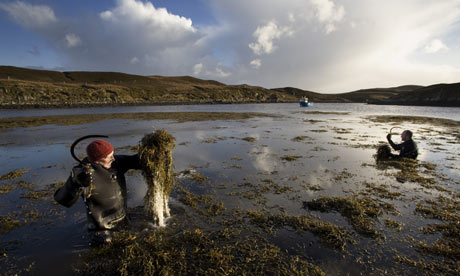 A grant last week from the European Union to Scottish scientists in Oban near Glasgow has alerted the mainstream media to the potential of marine algae, such as seaweed to supply large quantities of fuel oil. Algae can potentially return hundreds of times the volume of complex hydrocarbons as the same area of land growing crops such as corn or soyabeans. Because the marine algae does not compete with food crops for land and water it does not have the impact on the world’s food supplies that has led to tensions over land-use in developing countries during 2008. The scottish scientists will be working with natural seaweeds, harvested by traditional methods at low tide. Most of the companies formed to commercialise the potential of marine algae are farming microscopic forms. Spanish company Biofuel Systems believes it can meet the world’s existing demand for oil from an area of open ocean 250 kilometres squared.
Read The Generator from 2006
Read the facts on biofuel from algae
Read The Guardian article
Barrier Reef to suffer this summer
See the full NOOA report or read this summary
Indo-Pacific Bleaching Outlook:
The area most likely to suffer thermal stress with the potential for severe bleaching during the next 15 weeks is a region spanning Papua New Guinea, the Solomon Islands, and the Far Northern section of the GBR. Less severe thermal stress is expected in a broader region including all of the Cairns section of the GBR. To the west, the model currently predicts a threat of moderate levels of thermal stress from southern Borneo across through Timor-Leste to southern Papua New Guinea and Torres Strait. This level of potential stress then picks up in the central GBR and east extending across Vanuatu and New Caledonia to the east-southeast of Fiji. Some mild stress may be seen around Madagascar. The greatest warming is expected to begin from late January through February.
St Kevin breaks the faith
Last Christmas, Rudd visited Australian troops in Iraq and Afghanistan; back in Canberra for his first Christmas Day at the Lodge, he visited a homeless shelter as part of his deep commitment to doing something about homelessness.
This week he saw the Australian troops in southern Afghanistan and, as he wings his way back to Canberra, is planning to meet his promise, just, of releasing a report on homelessness before Christmas.
As Labor’s first Prime Minister in 12years and only the third elected from Opposition since World War II, Rudd was hell-bent on keeping his promises. It was part of a determination to deliver what he said he would, to ensure the electorate did not lose faith in his word, and to compare favourably with other incoming administrations that junked election promises once in office.
Overall, the Rudd Government has delivered on its specific promises, particularly in the budget, and Rudd and Wayne Swan have declared, rightly, that they have kept faith with the electorate. The early emotional high points were the ratification in Bali of the Kyoto Protocol on greenhouse gas emissions only days after the election, the delivery of a parliamentary apology to the Stolen Generations, the withdrawal of troops from Iraq and this week’s unveiling of an emissions trading scheme.
The parliamentary apology remains the apogee of Rudd’s first year, a symbolic act that not only satisfied and pleased his supporters but also gained credit from those who were originally opposed to it. Thanks to the support of Brendan Nelson, the apology became bipartisan, common political ground, bringing strong and enduring credit to Rudd well beyond party lines.
But while keeping the first two promises, on Kyoto and the apology, met with unashamed acclaim, the last has been greeted with a good deal of shaming condemnation from those who most vigorously supported Labor’s promises on climate change in Opposition. The disappointment from environmental groups on the detail of the emissions trading scheme is the first real dissension to appear over Labor’s promises and the public’s expectations, yet it is only one of several areas where Labor has failed to deliver, has provided only sham commitments, has not filled the gap between rhetoric and reality or has falsely claimed a mandate for changes that go beyond its election promises.
There is also an underlying danger – notwithstanding the genuine threat of the global financial crisis – that Rudd’s natural bias towards a big-spending, nation-building government is coming to the fore as he moves away from his crucial characterisation as a fiscal conservative.
Apart from the bringing forward of billions in infrastructure spending and assisting the states to borrow billions more, the compensation element of Rudd’s emissions trading scheme looks more like a wealth-shifting exercise than a scheme designed to cut greenhouse gas emissions.
Of course, the biggest problem for Rudd with his climate change policy is the gap between expectations and the reality of delivery. John Howard was accused of being in the pocket of big business, only interested in old king coal, not caring for the Great Barrier Reef and not accepting the science of man-made climate change. After his low-impact, high-compensation – and as industry-friendly as possible – emissions trading scheme, Rudd is being accused of exactly the same environmental crimes. However, when compared with some of the pea and thimble acts on other promises and expectations, the emissions trading scheme is notable not for being a failed promise but for being the first to engender real disappointment.
The most spectacular failure to deliver on a straight election promise has been Labor’s inability to meet its undertaking to provide high-speed broadband services for more than 98per cent of Australians beginning this year. This was a core Labor promise, put up with Telstra’s backing as an alternative to the Coalition’s scheme, and its largest single infrastructure commitment.
Even in March Communications Minister Stephen Conroy was repeating the election promise of having tenders let for a new system and for construction to begin before the end of the year.
“I expect to be able to give final government approval by the end of August or early September, and hope construction will commence before the end of the year,” Conroy said.
That promise is now officially a dud. The tender process is a mess and the prospects of legal wrangling and commercial brawling threaten to derail and delay the entire process.
This slippage has been occurring for a while but it is clear that the broadband failure – not the low-start, Howard-lite emissions trading scheme – is Labor’s biggest, clearest failure to deliver on a promise.
The other key area of broken faith with the electorate is within the area of industrial relations and this will become more apparent as Julia Gillard’s Fair Work Bill is examined in the Senate next year as a rise in unemployment takes hold. This is a broken promise because Labor said it would not go beyond the return of union power set out in its policy document.
We know from polling before and during the election campaign that the public intensely disliked the Howard government’s Work Choices legislations, especially the unfair dismissal laws, but we also know there were realconcerns about empowering union officials.
The provisions on right of entry for union officials are a breach of Labor’s faith on industrial relations changes.
Rudd has slipped past responsibility for other failures by suggesting they never were official promises, that he can’t be held responsible for the electorate’s expectations, or by carrying out pointless exercises that enable him to tick a box on promises kept. The $2million in wasted taxpayers’ funds over the pointless pursuit of the Japanese whaling fleet, the ignominious retreat on international court action over Iran’s rogue leader Mahmoud Ahmadinejad and the agitprop solutions to rising petrol and food prices of FuelWatch and Grocerychoice all failed to match the rhetorical promise.
Rudd previously has failed to meet his election undertakings, but it has taken the disappointment of those supporters expecting him to be less like Howard on emissions trading to make it an issue.