Category: Uncategorized

  • I was shaking and giggling like a kid AVAAZ

    1 of 44
    Why this ad?
    Solar Systems From $2,399energyaustralia.com.au/Solar – If You Find A Better Price, We’ll Match It. We Are The Solar Experts

    I was shaking and giggling like a kid

    Inbox
    x

    Christoph Schott – Avaaz.org

    3:34 PM (21 minutes ago)

    to me
    Dear friends,

    Renata created a petition that helped save a rape victim facing prison in Dubai for ‘extramarital sex.’ “When I found out she was free, I just ran around the house yelling, ‘she’s out! she’s out!” I was shaking and giggling like a little kid.” Now we can all bring huge change to our communities with a few minutes and the Avaaz community petition site. Click below to get started:

    I just got off the phone with Renata and I have to share this with you!

    She told me, “When I found out she was free, I just ran around the house yelling, ‘she’s out! she’s out!’ I was shaking and giggling like a little kid. I yelled for my husband, grabbed him and started dancing around. I had no idea how much change just one person can bring!”

    Renata was talking about Hannah*, an Austrian woman who was facing prison in Dubai for extramarital sex, after reporting her brutal rape to the police!! When Renata read about her in the newspaper, she was “horrified and angry. Then I thought of Avaaz. I thought I can ignite a fire, get others to join.”

    Her petition to Austria’s foreign minister got over 150,000 signatures in one day and was quickly at the center of a media firestorm in Austria and around the world. Suddenly, after six weeks of inaction, the Minister scrambled a crisis team with high level negotiators who flew to Dubai, and three days after the petition was launched Hannah’s horrible ordeal was over and she was free!

    Any of us can use Avaaz’s petition site to do the same thing, and now Avaaz is going to provide $10,000 for each of the top 10 petitions to help them win. Click below to get started, and let’s get more shaking and giggling happening in the world 🙂

    http://www.avaaz.org/en/petition/start_a_petition/?cl=3915723073&v=37613&source=recruit

    The difference between reading about the worst news stories and actually being able to do something to change them can feel like a huge chasm — but it’s not. The internet is bringing people together in powerful ways faster than ever before, and by simply starting a petition, countless members of our community are literally saving lives.

    Renata’s petition is just one story — petitions started by people just like her have protected a vital park space in Italy, helped bring us inches away from ending a corrupt secret voting practice in Brazil and helped get the national government to move to protect habitat for orangutans in Indonesia. The potential of this tool to change the world is why Avaaz is now offering up to $10,000 in support of the best petitions started by our members to make the biggest impact possible. Imagine not only getting thousands of people behind a cause, but also having $10,000 to fund the best way to win – anything from dozens of radio ads to funding a rally to building a giant billboard or float.

    It only takes a couple of minutes to get started, and there are tonnes of tips and advice to help you along the way. Click below to start a petition now:

    http://www.avaaz.org/en/petition/start_a_petition/?cl=3915723073&v=37613&source=recruit

    We’re winning every day, but the world is full of opportunities for impact. With almost 35 million of us, we can spread our power like wildfire and bring justice across the globe. Let’s get started changing the future for all of us.

    With hope for all we will achieve together,

    Christoph, Jeremy, Patri, Ari, Alice, Ricken and the whole Avaaz team

    *Hannah is a pseudonym used to respect this woman’s request for anonymity

    SOURCES:

    Austria brings home rape case woman from Dubai (Reuters)
    http://uk.reuters.com/article/2014/01/31/us-austria-dubai-idUKBREA0U0PR20140131

    Sebastian Kurz under pressure to secure release of Austrian woman in Dubai (Austrian Times)
    http://austriantimes.at/news/General_News/2014-01-30/50406/Sebastian_Kurz_under_pressure_to_secure_release_of_Austrian_woman_in_Dubai_

    Nude protest against Brazil secret vote (IOL)
    http://www.iol.co.za/news/world/nude-protest-against-brazil-secret-vote-1.1579620#.UyoOSeddVpw

    Brazil’s lower house approves end to secret voting in congress; reform now goes to senate (Fox News)
    http://www.foxnews.com/world/2013/09/04/brazil-lower-house-approves-end-to-secret-voting-in-congress-reform-now-goes-to/

    176.000 signatures save Abruzzo’s Regional Park, in italian only, (Gaia News)
    http://gaianews.it/ambiente/il-popolo-del-web-salva-il-parco-regionale-in-abruzzo-49587.html#.UyrFFK1dW80

    Global calls to save Aceh Forest, (The Jakarta Post)
    http://www.thejakartapost.com/news/2013/05/19/global-calls-save-aceh-forest.html


    Support the Avaaz Community!
    We’re entirely funded by donations and receive no money from governments or corporations. Our dedicated team ensures even the smallest contributions go a long way.
  • Devil Ark Easter 2014

    1 of 46
    Why this ad?
    Solar Systems From $2,399energyaustralia.com.au/Solar – If You Find A Better Price, We’ll Match It. We Are The Solar Experts

    Devil Ark Easter 2014

    Inbox
    x

    Devil Ark info@devilark.com.au via mail21.atl71.mcdlv.net

    12:41 PM (49 minutes ago)

    to me
    You are receiving this as you have previously given us permission to keep you updated and informed about the Australian Reptile Park. Email not displaying correctly?
    View it in your browser.

    Devil Ark
    Giving hope to the iconic Tasmanian devil

    Devil Ark leads the way in
    Australian animal conservation

    Hi Inga & Neville

    Devil Ark is now recognised as the leading breeding facility for Tasmanian devils and home to almost 200 of these iconic marsupials.

    There are now twelve free range enclosures at Devil Ark and the fourth breeding season has just started. It’s funny – when we first placed the founder devils into Devil Ark in January 2011, we were unsure whether they’d settle enough to breed at all that year. We lived on tender hooks for three months; just monitoring the devils from afar to see if they showed any signs of breeding. These signs include the female devil developing a roll of fat around her neck (which the keepers think looks like a Mohawk!) to protect her when the male drags her into the den and it’s also where the joeys hang onto when they first venture out of the den. The female can look really red in the ears and eyes – it almost looks like she’s in a trance and she’s constantly dragging nesting material into her den.

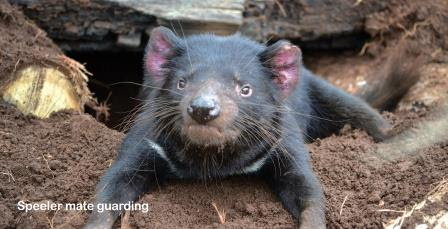
    Girls go through three breeding cycles from February to June (called oestrous) so joeys born in a breeding season can be older by four months. Once the devils have mated (yes, he does drag her into the den!), the male will guard her den for around seven days. This is called mate guarding. However, it’s a long time without eating, so if he sneaks off to find some food, another male may enter the den and mate with her. The Tasmanian devil is one of the few animals that can have multiple sires in the same litter of joeys.

    Around 25 joeys are born just 19-21 days later, but only the first four that attach to mum’s teat will live, so it’s survival of the fittest right from the start. The amazing thing is that they remain loyal to one teat for the duration so it’s easy for keepers to tell if mum had one, two, three or four joeys by how many teats are active.

    Anyway, back to my original story! We waited that first year and saw some promising signs, however it wasn’t until June that we could actually trap a female and check her pouch for young. So on a bitter winter’s day in the alpine conditions that are Devil Ark, we nervously opened the trap with anticipation. To our delight, the female devil had a “pouch full” – four joeys the size of jelly beans (and pink too) were spotted before the keepers quickly let mum go back to her den. So it was high-fives all ‘round and the sense of relief that our little conservation project was working! After all the hard work of building Devil Ark from nothing, in the middle of the bush, in torrential rain – we had joeys! It was a fantastic feeling for sure; one of the greatest days of my life. That season, we didn’t think we’d have any joeys, but the final count came in at 26!

    In Tasmania, the latest statistics on Devil Facial Tumour Disease are grim. More than 85% of the State is affected and in some parts, less than 10% of the wild population remains.

    That’s why Devil Ark is so important. Insurance breeding facilities like Devil Ark mean that we can repopulate Tasmania once Devil Facial Tumour Disease has finally run its course. Because the disease is only transmitted via biting, once the last devil has gone, the disease has gone. At this time, our devils will return to their home state and our ambitious job of saving the species from extinction will be done. My favourite animal is the Thylacine (Tasmanian tiger) and this magnificent creature became extinct in 1936. Please don’t let the devil go the same way. Our motto at Devil Ark is extinction is not an option!

    I wish you and your family a safe and Happy Easter. Autumn at Devil Ark is just beautiful, with the heat of summer behind us and the cool winds of winter approaching. Please help us continue our quest, every donation counts – and please – help us spread the word about Devil Ark by liking us on Facebook (facebook.com/tassiedevilark).
    Yours sincerely,

    Tim Faulkner

    General Manager- Devil Ark

    Mak
  • No cuts to the ABC

    1 of 1
    Why this ad?
    Solar Systems From $2,399energyaustralia.com.au/Solar – If You Find A Better Price, We’ll Match It. We Are The Solar Experts

    No cuts to the ABC

    Inbox
    x

    Jason Clare labor@australianlaborparty.emailnb.com via email.nationbuilder.com

    3:55 PM (13 minutes ago)

    to me

    Hi Neville,
    Last night I caught up with B1 and B2. The bad news is that they are on Tony Abbott’s chopping block.

    The budget is now only 8 weeks away. That means we have got 8 weeks to put the pressure on Tony Abbott to keep the promise he made the night before the election when he said there would be “no cuts to the ABC or SBS.”

    More than 25,000 people have already signed our petition, but we need to spread the word even further.

    We need your help to share our graphic on Facebook to get your friends and family to sign the petition.

    1959636_223880487819808_1042849816_n.jpg

    Click here to share our graphic on Facebook and spread the word.

    Thank you so much for all your help. We have got 8 weeks to go before the Budget. Now is the time to increase the pressure. It’s only with your support that we can protect the ABC from Tony Abbott’s razor gang.

    Jason Clare
    Shadow Minister for Communications

    P.S I spoke in the Parliament this week about cuts to the ABC and its impacts on regional Australia – you can watch it by clicking here.
    Donate

  • The CarbonClix Daily

    The CarbonClix Daily

    • Wednesday, Mar. 19, 2014
    • Next update in about 14 hours
    • Archives

    Researchers: Northeast Greenland Ice Loss Accelerating

    Shared by
    Pandeplata

    newswise.com – Newswise — COLUMBUS, Ohio—An international team of scientists has discovered that the last remaining stable portion of the Greenland ice sheet is stable no more. The finding, which will likely boos…

    Scientists Sound Alarm on Climate – NYTimes.com

    Shared by
    Marilyn Bush

    nytimes.com – Early in his career, a scientist named Mario J. Molina was pulled into seemingly obscure research about strange chemicals being spewed into the atmosphere. Within a year, he had helped discover a g…

    Climate Change Reduces Crop Yields, Says Study – TIME

    Shared by
    Greenpeace

    time.com – It’s St. Patrick’s Day, which means the 100 million or so people of Irish descent around the world get the opportunity to celebrate their heritage with song, food and increasingly controversial par…

    Climate Change: News – Amazon inhales more carbon than it emits, NASA finds

    Shared by
    Dindo Asuncion

    climate.nasa.gov – A new NASA-led study seven years in the making has confirmed that natural forests in the Amazon remove more carbon dioxide from the atmosphere than they emit, therefore reducing global warming. Thi…

    Abrupt Climate Change: No Bioperturbation

    Shared by
    Perry Bulwer

    truth-out.org – Today, we are burning fossil carbon one million times faster than it was naturally put in the ground, and carbon dioxide is increasing 14,000 times faster than anytime in the last 610,000 years (1,…

    From the Editor

    Editor’s note

    The objective of this Daily update is to provide a resource for individuals interested in understanding our impact on the planet. We at CarbonClix think everybody should care about the environment and do something about it on a daily basis. The more informed we are the easier it becomes to act. Hopefully you will find this a useful source of information.
  • Climate risks as conclusive as smoking and lung cancer link – scientists

    The Daily Climate

    Climate risks as conclusive as smoking and lung cancer link – scientists


    UK flood

    Floodwaters hit Tadley, England, in 2007. Heavy flooding has hit the United Kingdom every year since. One of the world’s premier science organizations is trying, once again, to make clear to the public that rising greenhouse emissions are linked to changes we’re seeing in the world today. Photo courtesy Denni Schnapp/flickr

    March 18, 2014

    Doorstep logo

    In an unusual policy intervention, U.S. scientists say evidence that the world is warming is as conclusive as the link between smoking and lung cancer.

    A “Climate at Your Doorstep” story.

    Daily Climate staff and wire report

    Editor’s Note: “Climate at Your Doorstep” is an effort by The Daily Climate to highlight stories about climate change impacts happening now. Find more stories like this here.

    One of the world’s largest and most knowledgeable scientific bodies wants to make one point very clear: Just as smoking causes cancer, so too are humanity’s greenhouse gas emissions causing the planet to change, with potentially unknown and unalterable impacts.

    What we are trying to do is to move the debate from whether human-induced climate change is reality.

     – Alan Leshner,
    AAAS

    The American Association for the Advancement of Science, or AAAS, made a rare foray into the climate debate Tuesday, releasing a report reiterating what many scientific bodies have already said:

    The evidence is overwhelming. Temperatures are going up. Springs are arriving earlier. Ice sheets are melting. Seas are rising. Rainfall and drought patterns are changing. Heat waves are getting worse, as is extreme precipitation. The oceans are acidifying.

    WhatWeKnow-115“The science linking human activities to climate change is analogous to the science linking smoking to lung and cardiovascular diseases. Physicians, cardiovascular scientists, public health experts and others all agree smoking causes cancer,” the AAAS wrote in its report, “What We Know.

    “And this consensus among the health community has convinced most Americans that the health risks from smoking are real. A similar consensus now exists among climate scientists, a consensus that maintains climate change is happening, and human activity is the cause.”

    Move the debate

    Speaking to reporters at a teleconference, AAAS chief executive officer Alan Leshner said: “What we are trying to do is to move the debate from whether human-induced climate change is reality. We want to move the debate to: Exactly what should you do about it?”

    “We are trying to provide a voice for the scientific community on this issue so that we can help this country, help the world, move this issue forward,” he added.

    The report also warns of a “small but real” chance that a warming climate will cause sudden and possibly unalterable changes to the planet.

    This echoes the words used in the AAAS’ 2007 report by the Intergovernmental Panel on Climate Change (IPCC), which said climate change might bring “abrupt and irreversible” impacts.

    The significance of Tuesday’s report lies not in its findings, which cover familiar ground, but in who is saying it: the world’s largest general scientific body, and one of its most respected.

    Headline message

    The report’s headline messages are unambiguous. It says climate change is occurring here and now: “Based on well-established evidence, about 97 percent of climate scientists have concluded that human-caused climate change is happening.”

    This agreement, the report continued, is documented not just by a single study, but by a converging stream of evidence over the past two decades from surveys of scientists, content analyses of peer-reviewed studies, and public statements issued by virtually every membership organization of experts in this field.

    “We are at risk of pushing our climate system toward abrupt, unpredictable, and potentially irreversible changes with highly damaging impacts,” the association concluded. “Disturbingly, scientists do not know how much warming is required to trigger such changes to the climate system.”

    “As emissions continue and warming increases, the risk increases”.

    Unprecedented speed

    The AAAS says there is scarcely any precedent for the speed at which this is happening: “The rate of climate change now may be as fast as any extended warming period over the past 65 million years, and it is projected to accelerate in the coming decades.”

    Historically rare extreme weather like once-in-a-century floods, droughts and heat waves could become almost annual occurrences, it says. Antarctic and Greenland ice sheets could see large-scale collapse, the Gulf Stream could alter its course, the Amazon rain forest and coral reefs could die off, and mass extinctions could threaten ecosystems.

    The authors acknowledge that what the AAAS is doing is unusual: “As scientists, it is not our role to tell people what they should do or must believe about the rising threat of climate change,” the authors said.

    “But we consider it to be our responsibility as professionals to ensure, to the best of our ability, that people understand what we know: human-caused climate change is happening.”

    Climate News Network, a journalism news service delivering news and commentary about climate change for free to media outlets worldwide, contributed to this report.

    The Daily Climate is an independent, foundation-funded news service covering energy, the environment and climate change. Find us on Twitter @TheDailyClimate or email editor Douglas Fischer at dfischer [at] DailyClimate.org

    Find more Daily Climate stories in the TDC Newsroom

    Creative Commons License

     This work by The Daily Climate is licensed under a Creative Commons Attribution-No Derivative Works 3.0 United States License.

  • Climatologists offer explanation for widening of Earth’s tropical belt

    Featured Research

    from universities, journals, and other organizations

    Climatologists offer explanation for widening of Earth’s tropical belt

    Date:
    March 18, 2014
    Source:
    University of California – Riverside
    Summary:
    Climatologists posit that the recent widening of the tropical belt is primarily caused by multi-decadal sea surface temperature variability in the Pacific Ocean. This variability includes the Pacific Decadal Oscillation (a long-lived El Niño-like pattern of Pacific climate variability) and anthropogenic pollutants, which act to modify the Pacific Decadal Oscillation. Until now there was no clear explanation for what is driving the widening.

    A cool-water anomaly known as La Niña occupied the tropical Pacific Ocean throughout 2007 and early 2008. In April 2008, scientists at NASA’s …

    Credit: NASA image by Jesse Allen, AMSR-E data processed and provided by Chelle Gentemann and Frank Wentz, Remote Sensing Systems

    Recent studies have shown that Earth’s tropical belt — demarcated, roughly, by the Tropics of Cancer and Capricorn — has progressively expanded since at least the late 1970s. Several explanations for this widening have been proposed, such as radiative forcing due to greenhouse gas increase and stratospheric ozone depletion.

    Now, a team of climatologists, led by researchers at the University of California, Riverside, posits that the recent widening of the tropical belt is primarily caused by multi-decadal sea surface temperature variability in the Pacific Ocean. This variability includes the Pacific Decadal Oscillation (PDO), a long-lived El Niño-like pattern of Pacific climate variability that works like a switch every 30 years or so between two different circulation patterns in the North Pacific Ocean. It also includes, the researchers say, anthropogenic pollutants, which act to modify the PDO.

    Study results appear March 16 in Nature Geoscience.

    “Prior analyses have found that climate models underestimate the observed rate of tropical widening, leading to questions on possible model deficiencies, possible errors in the observations, and lack of confidence in future projections,” said Robert J. Allen, an assistant professor of climatology in UC Riverside’s Department of Earth Sciences, who led the study. “Furthermore, there has been no clear explanation for what is driving the widening.”

    Now Allen’s team has found that the recent tropical widening is largely driven by the PDO.

    “Although this widening is considered a ‘natural’ mode of climate variability, implying tropical widening is primarily driven by internal dynamics of the climate system, we also show that anthropogenic pollutants have driven trends in the PDO,” Allen said. “Thus, tropical widening is related to both the PDO and anthropogenic pollutants.”

    Widening concerns

    Tropical widening is associated with several significant changes in our climate, including shifts in large-scale atmospheric circulation, like storm tracks, and major climate zones. For example, in Southern California, tropical widening may be associated with less precipitation.

    Of particular concern are the semi-arid regions poleward of the subtropical dry belts, including the Mediterranean, the southwestern United States and northern Mexico, southern Australia, southern Africa, and parts of South America. A poleward expansion of the tropics is likely to bring even drier conditions to these heavily populated regions, but may bring increased moisture to other areas.

    Widening of the tropics would also probably be associated with poleward movement of major extratropical climate zones due to changes in the position of jet streams, storm tracks, mean position of high and low pressure systems, and associated precipitation regimes. An increase in the width of the tropics could increase the area affected by tropical storms (hurricanes), or could change climatological tropical cyclone development regions and tracks.

    Belt contraction

    Allen’s research team also showed that prior to the recent (since ~1980 onwards) tropical widening, the tropical belt actually contracted for several decades, consistent with the reversal of the PDO during this earlier time period.

    “The reversal of the PDO, in turn, may be related to the global increase in anthropogenic pollutant emissions prior to the ~ early 1980s,” Allen said.

    Analysis

    Allen’s team analyzed IPCC AR5 (5th Assessment Report) climate models, several observational and reanalysis data sets, and conducted their own climate model experiments to quantify tropical widening, and to isolate the main cause.

    “When we analyzed IPCC climate model experiments driven with the time-evolution of observed sea surface temperatures, we found much larger rates of tropical widening, in better agreement to the observed rate–particularly in the Northern Hemisphere,” Allen said. “This immediately pointed to the importance of sea surface temperatures, and also suggested that models are capable of reproducing the observed rate of tropical widening, that is, they were not ‘deficient’ in some way.”

    Encouraged by their findings, the researchers then asked the question, “What aspect of the SSTs is driving the expansion?” They found the answer in the leading pattern of sea surface temperature variability in the North Pacific: the PDO.

    They supported their argument by re-analyzing the models with PDO-variability statistically removed.

    “In this case, we found tropical widening — particularly in the Northern Hemisphere — is completely eliminated,” Allen said. “This is true for both types of models–those driven with observed sea surface temperatures, and the coupled climate models that simulate evolution of both the atmosphere and ocean and are thus not expected to yield the real-world evolution of the PDO.

    “If we stratify the rate of tropical widening in the coupled models by their respective PDO evolution,” Allen added, “we find a statistically significant relationship: coupled models that simulate a larger PDO trend have larger tropical widening, and vice versa. Thus, even coupled models can simulate the observed rate of tropical widening, but only if they simulate the real-world evolution of the PDO.”

    Future work

    Next, the researchers will be looking at how anthropogenic pollutants, by modifying the PDO and large scale weather systems, have affected precipitation in the Southwest United States, including Southern California.

    “Future emissions pathways show decreased pollutant emissions through the 21st century, implying pollutants may continue to drive a positive PDO and tropical widening,” Allen said.


    Story Source:

    The above story is based on materials provided by University of California – Riverside. The original article was written by Iqbal Pittalwala. Note: Materials may be edited for content and length.


    Journal Reference:

    1. Robert J. Allen, Joel R. Norris, Mahesh Kovilakam. Influence of anthropogenic aerosols and the Pacific Decadal Oscillation on tropical belt width. Nature Geoscience, 2014; DOI: 10.1038/ngeo2091

    Cite This Page:

    University of California – Riverside. “Climatologists offer explanation for widening of Earth’s tropical belt.” ScienceDaily. ScienceDaily, 18 March 2014. <www.sciencedaily.com/releases/2014/03/140318113829.htm>.