Category: Uncategorized

  • Global warming melts last stable edge of Greenland’s Zachariae ice stream, scientist say

    Global warming melts last stable edge of Greenland’s Zachariae ice stream, scientist say

    Posted 23 minutes ago

    The last edge of the Greenland ice sheet that resisted global warming has now become unstable, adding billions of tonnes of meltwater to rising seas, scientists have said.

    In a study published in the journal Nature Climate Change, researchers said a surge in temperature from 2003 had eased the brakes on a long “river” of ice that flows to the coast in north-eastern Greenland.

    Known as an ice stream, the “river” takes ice from a vast basin and slowly shifts it to the sea – in the same way that the Amazon River drains water.

    In the past, the flow from this ice stream had been constrained by massive build-ups of ice debris choking its mouth.

    But a three-year spell of exceptionally high temperatures removed this blockage and, like a cork removed from a bottle, helped accelerate the flow, the study said.

    The ice stream, called Zachariae, is the largest drain from an ice basin that covers a whopping 16 per cent of the Greenland ice sheet.

    From 2003 to 2012, north-eastern Greenland disgorged 10 billion tonnes of ice annually into the ocean, the study found.

    “North-east Greenland is very cold. It used to be considered the last stable part of the Greenland ice sheet,” said Michael Bevis, an Earth sciences professor at Ohio State University, who led the study.

    “This study shows that ice loss in the north-east is now accelerating. So, now it seems that all the margins of the Greenland ice sheet are unstable.”

    Greenland is estimated to contribute 0.5mm to the 3.2mm annual rise in global sea levels.

    The main tool in the study was data from a network of 50 Global Positioning System (GPS) sensors along the Greenland coast.

    The monitors use Earth’s natural elasticity as a stethoscope of the ice sheet.

    Ice is heavy, so when it melts in massive quantities the land rebounds and the position of the sensors changes slightly.

    To get a wider picture, the GPS data was then overlaid with data from three US satellites and a European one that measured ice thickness from space.

    “The Greenland ice sheet has contributed more than any other ice mass to sea level rise over the last two decades and has the potential, if it were completely melted, to raise global sea level by more than seven metres,” said Jonathan Bamber, a professor at Britain’s University of Bristol.

    “About half of the increased contribution of the ice sheet is due to the speed-up of glaciers in the south and north-west. Until recently, north-east Greenland has been relatively stable. This new study shows that it is no longer the case.”

    AFP

  • A Star in a Bottle An audacious plan to create a new energy source could save the planet from catastrophe. But time is running out.

    A Reporter at Large

    A Star in a Bottle

    An audacious plan to create a new energy source could save the planet from catastrophe. But time is running out.

    by March 3, 2014

    Commercial reactors modelled on <small>ITER</small> could generate power with no carbon, virtually no pollution, and scant radioactive waste.

    Commercial reactors modelled on ITER could generate power with no carbon, virtually no pollution, and scant radioactive waste. Illustration by Jacob Escobedo.

    Years from now—maybe in a decade, maybe sooner—if all goes according to plan, the most complex machine ever built will be switched on in an Alpine forest in the South of France. The machine, called the International Thermonuclear Experimental Reactor, or ITER, will stand a hundred feet tall, and it will weigh twenty-three thousand tons—more than twice the weight of the Eiffel Tower. At its core, densely packed high-precision equipment will encase a cavernous vacuum chamber, in which a super-hot cloud of heavy hydrogen will rotate faster than the speed of sound, twisting like a strand of DNA as it circulates. The cloud will be scorched by electric current (a surge so forceful that it will make lightning seem like a tiny arc of static electricity), and bombarded by concentrated waves of radiation. Beams of uncharged particles—the energy in them so great it could vaporize a car in seconds—will pour into the chamber, adding tremendous heat. In this way, the circulating hydrogen will become ionized, and achieve temperatures exceeding two hundred million degrees Celsius—more than ten times as hot as the sun at its blazing core.

    No natural phenomenon on Earth will be hotter. Like the sun, the cloud will go nuclear. The zooming hydrogen atoms, in a state of extreme kinetic excitement, will slam into one another, fusing to form a new element—helium—and with each atomic coupling explosive energy will be released: intense heat, gamma rays, X rays, a torrential flux of fast-moving neutrons propelled in every direction. There isn’t a physical substance that could contain such a thing. Metals, plastics, ceramics, concrete, even pure diamond—all would be obliterated on contact, and so the machine will hold the superheated cloud in a “magnetic bottle,” using the largest system of superconducting magnets in the world. Just feet from the reactor’s core, the magnets will be cooled to two hundred and sixty-nine degrees below zero, nearly the temperature of deep space. Caught in the grip of their titanic forces, the artificial earthbound sun will be suspended, under tremendous pressure, in the pristine nothingness of ITER’s vacuum interior.

    For the machine’s creators, this process—sparking and controlling a self-sustaining synthetic star—will be the culmination of decades of preparation, billions of dollars’ worth of investment, and immeasurable ingenuity, misdirection, recalibration, infighting, heartache, and ridicule. Few engineering feats can compare, in scale, in technical complexity, in ambition or hubris. Even the ITER organization, a makeshift scientific United Nations, assembled eight years ago to construct the machine, is unprecedented. Thirty-five countries, representing more than half the world’s population, are invested in the project, which is so complex to finance that it requires its own currency: the ITER Unit of Account.

    No one knows ITER’s true cost, which may be incalculable, but estimates have been rising steadily, and a conservative figure rests at twenty billion dollars—a sum that makes ITER the most expensive scientific instrument on Earth. But if it is truly possible to bottle up a star, and to do so economically, the technology could solve the world’s energy problems for the next thirty million years, and help save the planet from environmental catastrophe. Hydrogen, a primordial element, is the most abundant atom in the universe, a potential fuel that poses little risk of scarcity. Eventually, physicists hope, commercial reactors modelled on ITER will be built, too—generating terawatts of power with no carbon, virtually no pollution, and scant radioactive waste. The reactor would run on no more than seawater and lithium. It would never melt down. It would realize a yearning, as old as the story of Prometheus, to bring the light of the heavens to Earth, and bend it to humanity’s will. ITER, in Latin, means “the way.”

    The main road to the ITER construction site from Aix-en-Provence, where I had booked a room, is the A51 highway. The drive is about half an hour, winding north past farmland and the sun-glittered Durance River. Just about every form of energy is in evidence nearby, from hydroelectric dams to floating solar panels. Seams of lignite, a soft brownish coal, run beneath the soil in Provence, but the deposits have become too expensive to mine. Several miles from Aix, a large coal plant, with a chimney that climbs hundreds of feet into the sky, is being converted to burn biomass—leaves, branches, and agricultural debris. ITER is being built a mile or two from the wooded campus of the Commissariat à l’Énergie Atomique et aux Énergies Alternatives, a state-funded research organization, created in 1945 to advance nuclear power, and now also renewable energy. Evergreen oak and Aleppo pine cover the foothills; beneath them, the French government maintains its largest strategic oil reserve.

    ITER’s headquarters, a five-floor edifice, was erected two years ago. An undulating wave of gray concrete slats shade its floor-to-ceiling windows. Its interior is simple: whitewashed walls, polished-concrete floors. The building’s southern façade overlooks a work site, more than a hundred acres of construction on the opposite side of a berm. By the time the reactor is turned on—the formal target date for its first experiment is 2020—the site will be home to a small city. Nearly forty buildings will surround the machine, from cooling towers to a cryogenics plant, which will produce liquid helium to cool the superconducting magnets. A skywalk extends from the second floor of the headquarters to the berm, where a capacious NASA-style control room will one day be built. For now, the bridge ends in a pile of ochre dirt, and the only way to the vast expanse of construction is via a circuitous drive.

    “A Star in a Bottle” continues
  • Germany’s aggressive push for a clean-energy future (+video)

    %

    Subscribe 

    Germany’s aggressive push for a clean-energy future (+video)

    Germany has a bold plan for a clean-energy future. A majority of the public is on board even though they’re paying a steep price – but industry is balking.

    By , Staff writer / March 9, 2014

    Employees at Freiberg’s Fraunhofer Institute for Solar Energy Systems are bathed in sunlight, filtered through solar panels. Germany’s green energy push is the subject of the cover story in the March 11, 2014 issue of The Christian Science MonitorWeekly magazine.

    Ann Hermes/The Christian Science Monitor

    Enlarge

    Freiburg im Breisgau, Germany

    On the Black Forest’s western slopes – in the land of cuckoo clocks and Brothers Grimm – there is a city that calls itself “green.”

    Rich silver deposits first lured settlers to Germany‘s Freiburg im Breisgau back in the 12th century, but today this quaint city is anything but medieval. Freiburg is a prototype for a clean-energy future that Germany is aggressively pursuing.

    Nations across the globe are looking increasingly to wind, water, and the sun to power their economies in the decades to come. But Germany stands apart as a global leader in the industrialized world’s push to limit fossil-fuel consumption. Forging a stable path to a post-carbon economy would be a watershed moment in human history – not to mention a tremendous economic boon for whoever finds the way. But it will not be easy to shift off the coal, oil, and natural gas that have powered global economic development for centuries.

    In Freiburg – where silicon has overtaken silver as the city’s focus – the energy transition is getting a trial run.

    Solar panels line the train station’s glassy facade, from which visitors alight into a bustling shopping district. Photovoltaic panels top the pitched roofs of churches, schools, and houses in sleepy residential quarters and help power the local soccer stadium and city hall. Students from all over the world study renewable-energy engineering at the University of Freiburg, established under the Habsburgs more than 500 years ago. After they graduate, they might get a job up the street at the Fraunhofer Institute for Solar Energy Systems, Europe‘s largest solar research facility.

    Along the historical center’s cobblestones, where Marie Antoinette traveled en route to live not-so-happily-ever-after in France, slick modern trams run on electricity generated exclusively from water, wind, and the sun. When this corner of old Europe was flattened in an air raid six months before the fall of the Third Reich, Freiburg’s 13th-century cathedral was among a handful of buildings that survived – the Gothic Münster‘s spire still soars over the sleepy square below but shares the skyline with wind turbines spinning on nearby peaks.

    Freiburg’s passion for alternative energy dates back to protests that blocked the construction of a nearby nuclear plant in the 1970s. But Ukraine’s 1986 Chernobyl nuclear disaster further galvanized locals, and the green momentum grew as the threat of climate change came into focus.

    Over the decades, Freiburg expanded its own clean-energy and efficiency infrastructure and worked with regional utilities that trade largely in wind, solar, and hydro power.

    By 2011, when Japan’s Fukushima Daiichi nuclear plant rekindled anti-nuclear sentiments and prompted the immediate shutdown of Germany’s oldest nuclear plants, Freiburg had already cut its carbon dioxide emissions by nearly 20 percent from 1992 levels. And it aims to cut 20 percent more by 2030. But even as it has built an economy and identity around efficiency and renewable energy, Freiburg gets only about 5.5 percent of its electricity from locally generated, renewable sources. The rest is a mix of renewable and nonrenewable energy from regional utilities. Plans are under way to install additional wind energy capacity locally and enact more efficiency measures, with the goal of using 100 percent renewable energy by 2050.

    It is difficult enough to transform how a quiet city’s 230,000 residents heat their homes, cook their food, and light their streets. Doing the same for an industrialized superpower of 82 million is an entirely different affair. If Germany can demonstrate how to run a major economy on primarily sunlight, wind, and water, it would tip the global scales in favor of renewable energy and accelerate a worldwide shift away from fuels that contribute to global warming.

    1 | 2 | 3 | 4 | 5 | 6
  • Your vision for this movement GET-UP

    1 of 42
    Why this ad?
    3 Best Solar Power Quotessolarquotes.com.au/_Get_Free_Quotes – 1 Form – 2 Minutes – 3 Free Quotes. We Use 12,000 Reviews & Hand-Pick 3

    Your vision for this movement

    Inbox
    x

    GetUp!

    12:16 PM (9 minutes ago)

    to me
    There’s so much at stake, NEVILLE.2014 is shaping up to be a year that challenges our movement – with threats to the Reef, the climate and our ABC already looming large. But these challenges will only make us stronger. We’re ready for the fight ahead – and we know you are too – so it’s time to get planning.

    Help shape our priorities for the year ahead in our annual Member Vision Survey.

    As a thank you, you’ll be the first to see a new video project introducing some of the wonderful members who made 2013 our most impactful year yet. We’ve heard their stories, and now we want to hear yours. Today there are more than 670,000 of us that make up the GetUp movement. We all have a story to tell, a reason why we’re here and a vision for an Australia we can be proud of.

    Make sure that vision is part of our plan for the year ahead.

    Thanks for being part of the GetUp movement,
    Sam for the GetUp team

    Take our annual member Vision Survey and tell us what your vision is for our movement this year


    GetUp is an independent, not-for-profit community campaigning group. We use new technology to empower Australians to have their say on important national issues. We receive no political party or government funding, and every campaign we run is entirely supported by voluntary donations. If you’d like to contribute to help fund GetUp’s work, please donate now! If you have trouble with any links in this email, please go directly to www.getup.org.au. GetUp has recently updated our Privacy Policy, to read the policy go to: www.getup.org.au/about/privacy-policy. To unsubscribe from GetUp, please click here. Authorised by Sam Mclean, Level 2, 104 Commonwealth Street, Surry Hills NSW

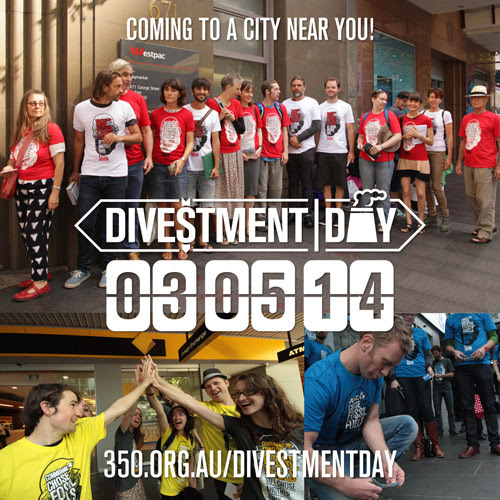
  • 14 locations to divest in May! 350 org

    4 of 38
    Why this ad?
    Guaranteed SEO Serviceswww.seoquote.com.au/SEO – Page 1 in 90 Days or pay nothing. Australia’s Most Trusted SEO Firm!

    14 locations to divest in May!

    Inbox
    x

    Charlie Wood – 350.org Australia charlie@350.org

    11:12 AM (3 hours ago)

    to me

    Dear friend,

    We now have over 600 people registered to switch to fossil free banks on Divestment Day on May 3rd, with events in more than 14 locations across Australia! 

    This email contains essential details about how you can participate in this first ever day of divestment action! But first, some pretty excellent divestment developments are currently underway that we thought you’d be excited to hear about:

    But as major investors at home and abroad wake up to the risks of fossil fuels, new research reveals that, since 2008, the Big 4 Banks have loaned almost $19 billion to new coal and gas projects in Australia, many on the Great Barrier Reef.

    It’s time show the big banks that we need to move beyond fossil fuels. Already 600 of you have registered to close your Big 4 account on the 2nd and 3rd of May and switch to a fossil free bank – but we need more people! We we want you to be part of this historic moment. Click here to find your nearest event and register today, then LIKE and SHARE our image to invite others to join you.

    Once you register, our friends at FossilFree.com.au can give you a call to talk you through the divestment process. Then, on the 2nd and 3rd of May, we’ll all join forces to send the strongest divestment message Australia’s big banks have ever heard.

    Locate your nearest divestment event here.

    If you’re not ready to close your account on the 2nd or 3rd OR you’ve already divested, please still join us! You can print out a copy of this letter to tell your bank that you’ll be leaving them or if you have already moved to fossil free bank use this letter to tell them why you’ve joined them, then join your nearest event for the fun, photos and celebrations.

    And don’t forget, you don’t have to be with the Big 4 to participate. Checkout Market Forces’ great comparison table to see whether your bank lends to coal and gas. If they do, we hope you’ll join us for d-day!

    Good luck with your preparations and thanks so much for using your dollars and cents to build a fossil free future! Can’t wait to see you in May!

    Yours sincerely,

    Charlie, Blair, Aaron, Josh and co.


  • Why the potential for grid defection matters

    Why the potential for grid defection matters

    By on 14 March 2014
    Print Friendly

    RMI

    Two weeks ago, Rocky Mountain Institute, HOMER Energy, and CohnReznick Think Energy released The Economics of Grid Defection, which assesses when and where distributed solar-plus-battery systems could reach economic parity with the electric grid, creating the possibility for defection of utility customers.
    rsz_blog_2014_03_11-1The results of our analysis have been startling to many: continued rapid declines in the cost of solar and the start of the same trend for storage mean that grid parity may come much sooner than previously thought—and well within the 30-year planned economic life of typical utility investments.

    This blog post explores why cost parity doesn’t necessarily equate to widespread customer defection, why defection would create a suboptimal electricity system, and why even the specter of customer defection is relevant.

    We selected the pairing of solar PV and batteries—and, for commercial scenarios, the addition of diesel gensets—to explore one set of economics around the trend. There are other disruptive challenges to the grid, including grid-tied solar PV, distributed gas microturbines, and integrated resource microgrids. If anything, these multiple potential disruptors increase the urgency to plan and execute a purposeful electricity system transformation. That transformation is already under way, and the approaching date of grid parity for solar-plus-battery systems is an important consideration.

    ECONOMIC PARITY DOESN’T NECESSARILY MEAN CUSTOMERS WILL DEFECT

    Our report does not predict if, when, or how many customers will choose to defect. Rather it projects the economics of several current (and possibly, accelerating) trends that are reshaping the electricity landscape: dramatically declining costs for solar and batteries; increasing customer demand for clean electricity, resilience, and other value-added services; and recent upward pressure on retail electricity prices. Ultimately, the impact of these trends depends on a number of factors, including how customers, utilities, regulators, technology providers, and society choose to respond.

    The economics that were the subject of our analysis are one of many factors that influence any customer decision to defect (or not) from the grid, or even to adopt grid-tied distributed resources. Other factors customers consider include transaction costs, the relative convenience or hassle associated with the decision, upfront capital and time requirements, confidence a given solution will reliably meet their needs (including the risk that a distributed generation and storage system’s capacity would be sized either too small or too large to closely match a customer’s demand), uncertainty about their long-term electricity needs, and more. Very few customers, especially in the commercial sector, know with certainty their electricity demand for the next twenty years.

    Service providers—utilities or third parties intent on winning customers over from grid-supplied electricity—will need to create integrated service packages to overcome adoption barriers that have plagued efficiency and distributed generation providers. Regardless, in addition to the rapidly growing grid-connected distributed solar market, we’ve already seen early adopters working with service and technology providers either to go entirely off-grid or install grid-tied solar-plus-battery combinations that similarly impact (and reduce) their demand from the grid.

    DEFECTION WOULDN’T BE THE BEST OUTCOME

    Customers will make decisions that serve their best interest based on the many factors referenced above, and while for a very few defection might ultimately be the best outcome, mass defection from the grid is almost certainly suboptimal. Distributed resources such as solar and storage can generate more value and have better economics for customers and society both if they are connected to the grid. The challenge is that today’s utility business models and regulatory environment don’t incentivize the rapid evolution of those solutions, something that needs to change if society is to capture that value.

    There is tremendous potential system value in identifying where grid-tied distributed energy resources can create new sources of value and how to access that value. But does most or all of the new value accrue to customers? Or can these resources also create important new sources of value for the grid and ultimately for society? The answer to the latter question can be a resounding yes, so any sustainable solution will need to find a way to equitably share value created through distributed investments.

    So how would widespread grid defection create undesirable outcomes?

    For one, large numbers of customers going it alone for their electricity generation introduces all manners of economic inefficiency. Each customer faces the risk of over- or under-investing in capacity. Over-investing especially—via necessarily larger systems sized to individual peak demand—would result in significant overbuild and sunk capital. Instead, markets (via a connected grid) provide for greater economic efficiency by allowing customers and suppliers to readily make transactions to balance their own supply and demand, including optimizing distributed generation and storage investments across larger pools of customers rather than one by one, each for their own. Grid-based solutions reduce this economic risk and allow assets to be utilized more efficiently.

    For another, grid defection raises social equity concerns. With widespread defection, utilities operating under legacy business models would be forced to significantly raise retail electricity prices to recover costs of grid infrastructure. Those higher prices would unfairly burden remaining grid-connected customers who cannot or choose not to invest in distributed generation and storage, including low-income families who can’t afford system upfront costs and apartment residents who logistically can’t install systems.

    An entirely off-grid system would only become a reality if customers are not given an opportunity to participate, through new business models, in the business of generating, storing, and balancing electricity needs. Or if customers’ requirements, including for resilience and clean energy, are not being met by their central provider. That’s a future that would be suboptimal for all.

    WHY POTENTIAL DEFECTION MATTERS—CUSTOMER CHOICE AND EMPOWERMENT

    But if a grid-defected future is so suboptimal, why then is it so important to understand the economics of grid defection?

    First, there is strikingly little quantitative analysis to inform the discussion. It’s critical to know the facts and underlying analytics to support productive conversations about how to move forward in the face of powerful trends and a dramatically shifting electricity landscape.

    Second, the option to defect—whether or not it is ultimately exercised in part or in full—adds urgency for utility business models and regulations to change and identifies when scaled solutions that properly value distributed investments need to be in place. Empowered customers, ones with the ability to choose how they purchase, generate, store, and/or use electricity, have a more important seat at the electricity table. That empowered customer is a force of change.

    Customers, utilities, grid operators, regulators, and technology providers must work together to develop business models that stave off the need or even desire for customer grid defection. The electricity system needs to give customers an opportunity to transact with the grid in a way that meets their desires (for clean, reliable, affordable electricity) and be compensated for any value they are able to bring to the system at large (through contributions to peak shaving, investing in local reserve supply through distributed storage, through distributed generation that can supply feeder-level power needs, and others).

    GOING BEYOND THE EITHER/OR OF GRID-CONNECTED OR GRID-DEFECTED

    We need not face an electricity future with an either/or dichotomy of two extremes: total utility/centralized dependence and total defection/independence. There exists another path, one in which central and distributed resources are complementary, connected and supported by a nimble grid. That’s why RMI’s high-renewables (80 percent) Transform scenario in Reinventing Fire envisions a future and a grid powered by equal parts distributed and centrally generated renewables.

    In such a future, the utility evolves to play a critical coordination and stewardship role, one that helps balance various distributed resources and supports them with low-cost central generation. Customers, utilities, regulators, and technology providers have an urgent need to shape this future, or we could in fact run the risk of the defected extreme.

    A COMMITMENT TO COLLABORATIVELY FORGING SOLUTIONS

    Disruptive challenges-cum-opportunities won’t go away. Distributed solar PV is scaling rapidly. Battery costs are declining, with breakthrough innovation accelerating. And third-party service providers are making these systems financially and logistically accessible to bigger pools of customers. RMI’s historic and current activities on energy efficiency, balance of system solar cost reduction, system financing innovations, and storage integration have helped propel the economics of distributed resources forward. An electricity future that includes significantly higher percentages of distributed renewables offers many benefits. But to access those benefits, the entire electricity system must evolve … with utilities and the grid, not in spite of them or without them.

    That’s why RMI is committed to collaboratively forging solutions. To achieve the optimal energy future, our Electricity Innovation Lab (e-Lab), for example, brings together utilities, regulators, NGOs, technology providers, and other stakeholders to collaborate on practical solutions to the challenges today’s electricity system faces. In addition, we work hand-in-hand with these and other stakeholders on key components of an integrated solution through direct engagement. Our work on these solutions will be the focus of a forthcoming blog.


    Source: RMI. Reproduced with permission.

    Sign up for our FREE daily