Category: Uncategorized

  • Ambitious plans for 2014 350 0rg

    Why this ad?
    Solar Systems From $2,399energyaustralia.com.au/Solar – If You Find A Better Price, We’ll Match It. We Are The Solar Experts

    Ambitious plans for 2014

    Spam
    x

    Bhavik Lathia – 350.org 350@350.org

    9:54 AM (1 hour ago)

    Images are not displayed. Display images below

    Friends,

    We have ambitious plans for 2014, and we want your help in making them stronger. Take this survey and let us know what you think.

    Already this year is off to a strong start. Here’s what we’ve accomplished so far:

    • “Power Shift” convergences from Japan to Congo to Kyrgyzstan, training climate leaders around the world
    • A divestment movement that is spreading quickly across Europe, to strip the fossil-fuel industry of its social license
    • “Summer Heat” actions against dirty energy expansions in full swing in Australia

    And so much more.

    Over the past few months, we have been thinking hard about what to do next. At the same time, we want to learn from what we did last year and hear from you on our priorities for 2014. We know that people in the 350.org network — that’s all of you — have untapped reserves of passion, creativity, and ideas.

    As we chart the path forward in 2014, we want to make sure we’re harnessing the collective insights of this incredible movement.

    Click here to add your voice: 350.org/global-priorities

    Thanks in advance for your time and thoughts,

    Bhavik, Will, and the 350.org Global Team


    350.org is building a global climate movement. Connect with us on Facebook and Twitter, and sign up for email alerts. You can help power our work by making a donation. To change your email address or update your contact info,

  • Sleepless in Ningbo HANSEN

    1 of 40
    Why this ad?
    1.5kW System From $2,399energyaustralia.com.au/Solar – Now W/ Free Upgrade To SMA Inverter Covered By Our Price Match Promise

    Sleepless in Ningbo

    Inbox
    x

    James Hansen via mail320.us3.mcdlv.net

    4:35 AM (6 hours ago)

    to me
    Email not displaying correctly? View it in your browser.
    Sleepless in Ningbo
    Here is a note concerning a draft op-ed written during my recent trip to China. Both are also on my web site.

    ~Jim
    10 March 2014

    Like my Facebook page
    Like https://www.facebook.com/jimehansen on Facebook
    Share
    Facebook Twitter

  • Mysterious new man-made gases pose threat to ozone layer

    9 March 2014 Last updated

    Mysterious new man-made gases pose threat to ozone layer

    Matt McGrath By Matt McGrath Environment correspondent, BBC News

    ozone hole Dealing with the hole in the ozone layer has been one of the most successful international science projects

    Scientists have identified four new man-made gases that are contributing to the depletion of the ozone layer.

    Two of the gases are accumulating at a rate that is causing concern among researchers.

    Worries over the growing ozone hole have seen the production of chlorofluorocarbon (CFC) gases restricted since the mid 1980s.

    But the precise origin of these new, similar substances remains a mystery, say scientists.

    Lying in the atmosphere, between 15 and 30km above the surface of the Earth, the ozone layer plays a critical role in blocking harmful UV rays, which cause cancers in humans and reproductive problems in animals.

    Continue reading the main story

    “Start Quote

    We don’t know where the new gases are being emitted from and this should be investigated”

    Dr Johannes Laube University of East Anglia

    Scientists from the British Antarctic Survey were the first to discover a huge “hole” in the ozone over Antarctica in 1985.

    The evidence quickly pointed to CFC gases, which were invented in the 1920s, and were widely used in refrigeration and as aerosol propellants in products like hairsprays and deodorants.

    Remarkably, global action was rapidly agreed to tackle CFCs and the Montreal Protocol to limit these substances came into being in 1987.

    A total global ban on production came into force in 2010.

    Now, researchers from the University of East Anglia have discovered evidence of four new gases that can destroy ozone and are getting into the atmosphere from as yet unidentified sources.

    Halley The Halley Research Station in Antarctica, where the hole in the ozone layer was first discovered
    Three of the gases are CFCs and one is a hydrochlorofluorocarbon (HCFC), which can also damage ozone.

    “Our research has shown four gases that were not around in the atmosphere at all until the 1960s which suggests they are man-made,” said lead researcher Dr Johannes Laube.

    The scientists discovered the gases by analysing polar firm, perennial snow pack. Air extracted from this snow is a natural archive of what was in the atmosphere up to 100 years ago.

    Grim discoveryThe researchers also looked at modern air samples, collected at remote Cape Grim in Tasmania.

    They estimate that about 74,000 tonnes of these gases have been released into the atmosphere. Two of the gases are accumulating at significant rates.

    “The identification of these four new gases is very worrying as they will contribute to the destruction of the ozone layer,” said Dr Laube.

    “We don’t know where the new gases are being emitted from and this should be investigated. Possible sources include feedstock chemicals for insecticide production and solvents for cleaning electronic components.”

    “What’s more, the three CFCs are being destroyed very slowly in the atmosphere – so even if emissions were to stop immediately, they will still be around for many decades to come,” he added.

    Continue reading the main story

    Mysterious gases

    • The four new gases have been identified as CFC-112, CFC112a, CFC-113a, HCFC-133a
    • CFC-113a has been listed as an “agrochemical intermediate for the manufacture of pyrethroids”, a type of insecticide once widely used in agriculture
    • CFC-113a and HCFC-133a are intermediaries in the production of widely used refrigerants
    • CFC-112 and 112a may have been used in the production of solvents used to clean electrical components

    Other scientists acknowledged that while the current concentrations of these gases are small and they don’t present an immediate concern, work would have to be done to identify their origin.

    “This paper highlights that ozone depletion is not yet yesterday’s story,” said Prof Piers Forster, from the University of Leeds.

    “The concentrations found in this study are tiny. Nevertheless, this paper reminds us we need to be vigilant and continually monitor the atmosphere for even small amounts of these gases creeping up, either through accidental or unplanned emissions.

    “Of the four species identified, CFC-113a seems the most worrying as there is a very small but growing emission source somewhere, maybe from agricultural insecticides. We should find it and take it out of production.”

    The research has been published in the journal, Nature Geoscience.

    Follow Matt on Twitter @mattmcgrathbbc.


  • What on Earth is an Angry Summer? FLANNERY

    4 of 9
    Why this ad?
    Dodo Electricitywww.dodo.com – Electricity rates too high? Get 15% OFF your usage rates.

    What on Earth is an Angry Summer?

    Trash
    x

    Tim Flannery – Climate Council via sendgrid.info

    1:39 PM (3 hours ago)

    to me
    Hi Inga 

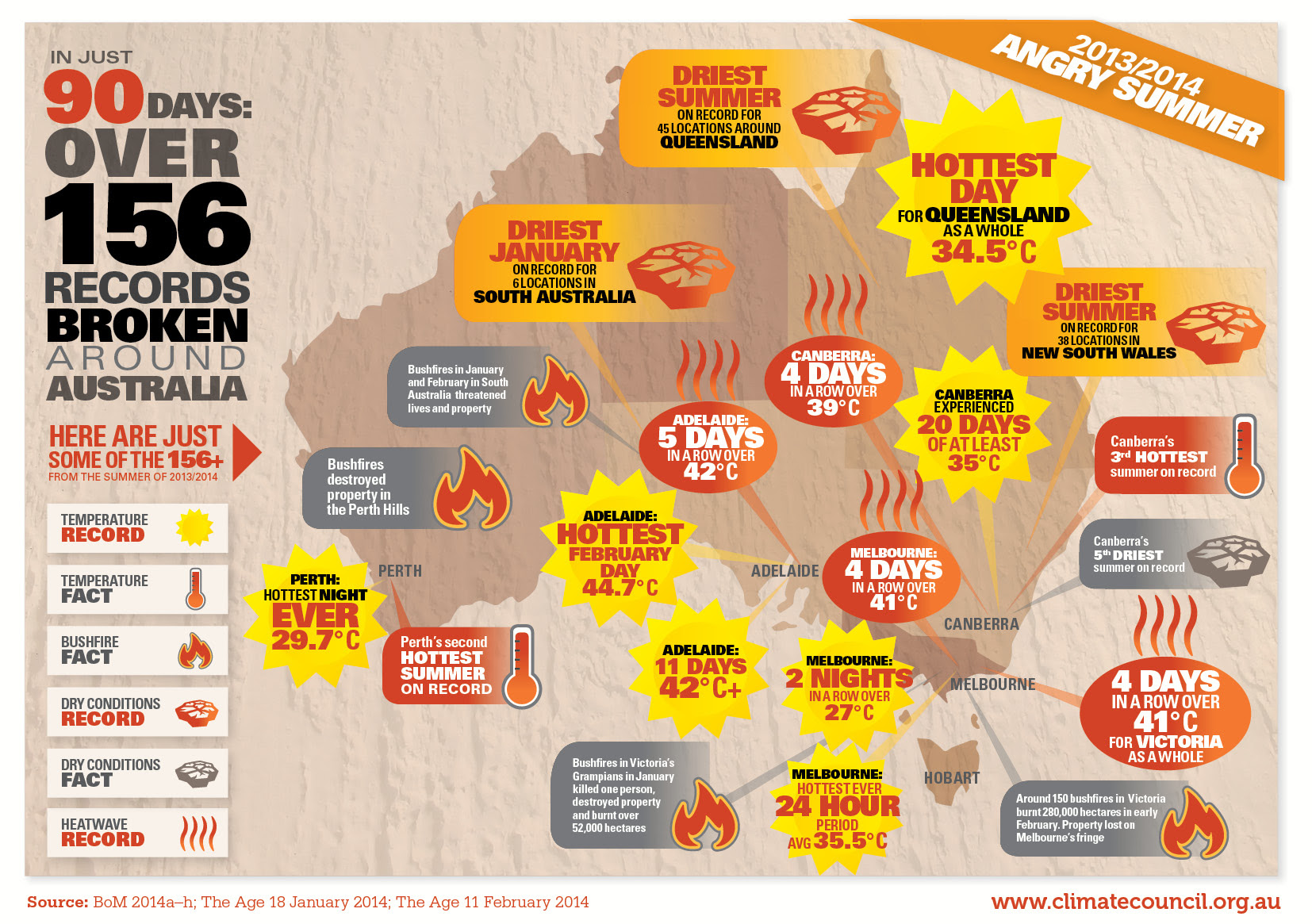
    More than 156 extreme weather records have been broken across Australia this summer. Extraordinary heatwaves and hot days, drought and rainfall deficiency, and bushfires have dominated.

    This comes on the heels of last summer which broke 123 extreme weather records.

    While we’ve always experienced some extreme weather in Australia, climate change is increasing the intensity and frequency of extreme weather events. 

    Today I’m in Adelaide – a city that has really suffered these extremes – to launch the Climate Council’s latest report The Angry Summer.

    This info-graphic gives you a snapshot of just how intense the summer has been.

    Angry Summer Infographic

    Click to share this with your networks to help us communicate this warning.
    Avoiding more frequent Angry Summers requires urgent and deep reductions in the emissions of greenhouse gases. The decisions we make this decade will largely determine the severity of climate change and its influence on extreme events for our grandchildren.

    This is the critical decade.

    Our community-funded reports give people the accurate & independent climate information they need to make decisions and take action.

    Today I will be talking to the media – getting this information out as far and wide as I can. Please take a moment to help me do this by sharing this information with your networks.

    Click to see the full report and images to share. 

    Thank you for your support.

    Tim Flannery,
    Chief Councillor

    P.S If you have further questions I encourage you to watch this Q&A where I answer a range of really interesting questions from the public about the summer and other topics: www.climatecouncil.org.au/ask-tim-flannery.

     
  • Demand changes and solar impact continue to shock experts

    Demand changes and solar impact continue to shock experts

    By on 10 March 2014
    Print Friendly

    The rapid transformation of the electricity market – and the crucial role of household and commercial consumers – continue to confound the experts, including the energy market operator, which has announced yet another downgrade of its forecasts.

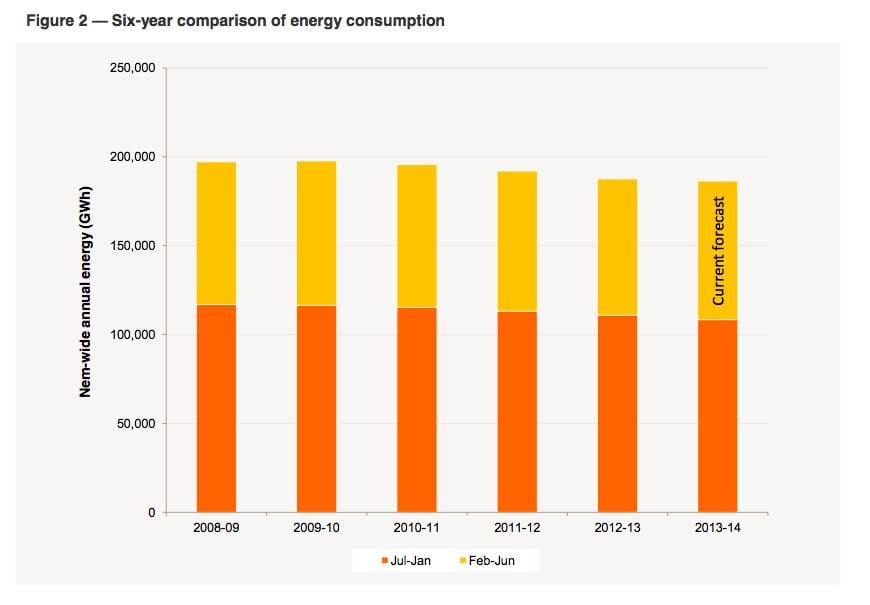
    AEMO (Australian Energy Market Operator) last week quietly released its latest “Supply Demand” snapshot for February, with the biggest takeout being that demand continues to fall way below forecast, despite big revisions in the last few years.

    In June, AEMO slashed its forecasts for the current fiscal year by 2.4 per cent. That came after a 10 per cent downgrade for 2012/13, which still overshot the result by 1.1 per cent.

    In November, it noted that consumption in the first quarter of 2013/14 was 3.5 per cent lower than it had forecast in June – leading it to cut its overall forecast for the financial year by a further 1.3 per cent.

    Now, it says, consumption in the October to January period was 1.5 per cent lower than even the November revision. It blamed this mostly on “variances in commercial and residential consumption” in November 2013, likely to have been caused by the increase in rooftop solar in the past year.

    aemo feb update

    AEMO noted that 500MW of rooftop solar had been installed in the first 9 months of 2013 – although this was 30 per cent lower than a year earlier. But is seems – from this and other reports – that the combination of solar, energy efficient devices and bill awareness is causing a fundamental change in the consumption profile of residential and commercial users.

    The South Australian network distributor recently reported, for instance, that household consumption had fallen 5.7 per cent in the latest year, despite an increase in population. EnergyAustralia reported an “unprecedented” fall in demand as it reported massive losses and the write downs in the valuations of several key generation assets.

    “There has been a downward trend in consumption from the grid over the last five years, and current forecasts indicate that this decline will continue for the remainder of 2013–14,” AEMO writes.

    “On a year-to-date basis, 2013–14 consumption to January 2014 is 2.3% lower than the same period in 2012–13. The recent announcement that Alcoa Australia’s Point Henry aluminium smelter will close in August 2014 will further reduce industrial consumption in Victoria by approximately 360 MW.”

    The AEMO data shows that 2,400MW of baseload power – nearly 10 per cent of Australia’s baseload capacity (coal and gas) has been withdrawn from service – either temporarily or permanently.

    The latest was the Swanbank baseload gas generator in Queensland, although as RenewEconomy reported last week, the Darling Downs baseload generator is now likely to be used only as a peaking plant in future, EnergyAustralia has written down the value of its Tallawarra baseload gas generator, and black coal generators – particularly in NSW – are operating at vastly reduced capacity factors.

    The AEMO report is likely to be used as further grist to the mill from the appeal by generators to bring the renewable energy target to a stop, or at least to reduce it dramatically. But the focus on costs to consumers highlights the point that these appeals are entirely framed as an appeal to generators to protect their own investment.

    The RET was designed to hasten the transition to clean energy, but no-one anticipated it would be quite so successful. That’s because no-one anticipated the rapid uptake of rooftop solar and the impact it would have on demand.

    Here is the latest AEMO graph chronicling the decline in demand since 2008 – when assumptions of high demand growth were used as the launch-pad for much of the $45 billion investment in networks across the National Electricity Market. (This graph does not include the WA grid or other isolated grids in WA, NT, and Queensland).

    aemo 6 year forecast

    Even Queensland, which is anticipating a 1GW rebound in demand when the massive LNG plants start to come online later this year, will not need any new capacity as early as thought.

    AEMO said previously the state might need new capacity by 2019/20, but that is likely to be pushed out beyond at least another year. No other state has any new demand requirements within the 10-year modelling horizon.

  • Clean energy investors abandon Australia, head overseas By Giles Parkinson on 10 March 2014

    Clean energy investors abandon Australia, head overseas

    By on 10 March 2014
    Print Friendly

    Clean energy and low-carbon investors are abandoning Australia as the new Federal government, and its conservative colleagues at state level, turn their interests and policies away from renewables and long-term abatement incentives.

    Several key players in the clean energy finance industry have told the Senate hearings into the proposed Direct Action policy that investors are looking to Europe, the US and some South American countries to find low-carbon opportunities.

    “My members are looking at the United Kingdom, Ireland, the United States, France and some South American countries as having more stable investment environments for low-carbon opportunities,” said Nathan Fabian, the head of the Investor Group on Climate Change.

    “Direct action is not an investment grade policy,” he said, noting that investors viewed it more like a short-term grants scheme. Banks were likely to take a similar view.

    He also proposed review of the RET “appears to be another very clear signal that Australia will not be a market for low-carbon investing for the next few years.”

    Tim Buckley, a former Citigroup analyst, funds manager, and now with the US-based Institute for Energy Economics and Financial Analysis, said the Australian clean energy industry is regressing because of the lack of clarity on policy.

    “We are worse than stalling; we are actually investing in assets that I think will become stranded as a result. Internationally, companies and economies are building industry capacity to transition for the long term. We should be building capacity as well and we are not doing so.”

    He said Australia was currently missing out on hundreds of billions of dollars that being invested every year in renewables, in energy efficiency and in development of these new technologies, and the hundreds of thousands of jobs being created in China, in Germany and in America.

    Numerous other parties have dismissed the proposed emissions reduction fund as “unfinancable” – mostly because it offers a maximum 5-year investment horizon. That reflects the view of most people, and possibly even the government, that Direct Action is not a long-term policy position, just part of a short-term political manoeuvre that has helped deliver power to the Conservatives.

    Still, it is the situation that is facing investors – be they developers, financiers, bankers or infrastructure investors – in Australia in the coming year.

    Tim Buckley, a former Citigroup analyst, funds manager, and now with the US-based Institute for Energy Economics and Financial Analysis, said the Australian clean energy industry is regressing because of the lack of clarity on policy.

    “We are worse than stalling; we are actually investing in assets that I think will become stranded as a result. Internationally, companies and economies are building industry capacity to transition for the long term. We should be building capacity as well and we are not doing so.”

    He said Australia was currently missing out on hundreds of billions of dollars that being invested every year in renewables, in energy efficiency and in development of these new technologies, and the hundreds of thousands of jobs being created in China, in Germany and in America.

    Players in the renewables industry say the sector is facing its biggest crisis in a decade, when the last Coalition government brought a close to the then mandatory renewable energy target , causing new manufacturing facilities to close, international groups to withdraw, and local developers such as Pacific Hydro and Roaring Forties to move the bulk of the operations overseas.

    The assessment by Fabian and Buckley is consistent with frustrations expressed privately by international investors, who have seen policies on hold, the price of renewable energy certificates fall by nearly half, the carbon price subject to repeal, and a proposed replacement that holds no interest for financiers.

    One investor said recently there is a complete lack of liquidity in the market, because everyone is in “wait and watch” mode. Banks are not able to price the forward market, and the outlook looks poor.

    Its ironic, one noted, because the market for conventional generation is dead, but there is currently little to interest investors in clean technology, particularly new emerging technologies. The ACT auction program, part of its plan to seek 90 per cent renewables by 2020, is the one exception. But while welcome and of interest, it is relatively small-scale in a global or national context.

    Buckley said Australia appears to be working on the premise that the world is going to do nothing on climate change.

    “That is a flawed premise, he said. “We are investing tens of billions of dollars building new assets to promote fossil fuels, be it in LNG, coal, the Galilee in particular, Abbot Point port infrastructure. The investment is huge and I think it is going to end up leaving us with stranded assets because we are missing the point that China, India, America and Germany are moving full steam towards a low-carbon economy.

    “They are not going to need our fossil fuels in 20 or 30 years time, and we are building assets with 50-year lives. To build a coal port in the middle of the Great Barrier Reef with a 50-year life means we are effectively becoming a price taker for fossil fuels. Those assets will be stranded and we will see very, very significant write-downs on the back of them. “

    Fabian said the scenario that Buckley cited could begin to “bite quite hard” within the next decade. “That compromises our investors, compromises the beneficiaries and workers and compromises the pensions that we guard. That is the essential policy risk that we are trying to address with a long-term framework.

    Fabian said that the carbon price, the renewable energy target, and institutions such as ARENA and the CEFC play critical roles in assisting and building the capacity of the Australian financial community in low-carbon investing.

    “This is a strategic question for Australia in terms of what competency we are going to have in our financial markets,” he said. “We need to move markets to places where they are not quite sure they should be yet because the policy signals are not clear enough. We know that cannot last.

    “Without a central, long-term policy framework, there is significant uncertainty for investors in all assets – emissions-intensive, emissions- reducing technologies and low-carbon activities alike. The consequence of this is that the cost of private capital for achieving emissions reductions would increase and the cost of achieving those reductions would also increase.”