Category: Uncategorized

  • Antarctic ice sheet is result of carbon dioxide decrease, not continental breakup

    Featured Research

    from universities, journals, and other organizations

    Antarctic ice sheet is result of carbon dioxide decrease, not continental breakup

    Date:
    July 30, 2014
    Source:
    University of New Hampshire
    Summary:
    Climate modelers have shown that the most likely explanation for the initiation of Antarctic glaciation during a major climate shift 34 million years ago was decreased carbon dioxide levels. The finding counters a 40-year-old theory suggesting massive rearrangements of Earth’s continents caused global cooling and the abrupt formation of the Antarctic ice sheet. It will provide scientists insight into the climate change implications of current rising global carbon dioxide levels.

    Antarctic Peninsula.
    Credit: © adfoto / Fotolia

    Climate modelers from the University of New Hampshire have shown that the most likely explanation for the initiation of Antarctic glaciation during a major climate shift 34 million years ago was decreased carbon dioxide (CO2) levels. The finding counters a 40-year-old theory suggesting massive rearrangements of Earth’s continents caused global cooling and the abrupt formation of the Antarctic ice sheet. It will provide scientists insight into the climate change implications of current rising global CO2 levels.

    In a paper published today in Nature, Matthew Huber of the UNH Institute for the Study of Earth, Oceans, and Space and department of Earth sciences provides evidence that the long-held, prevailing theory known as “Southern Ocean gateway opening” is not the best explanation for the climate shift that occurred during the Eocene-Oligocene transition when Earth’s polar regions were ice-free.

    “The Eocene-Oligocene transition was a major event in the history of the planet and our results really flip the whole story on its head,” says Huber. “The textbook version has been that gateway opening, in which Australia pulled away from Antarctica, isolated the polar continent from warm tropical currents, and changed temperature gradients and circulation patterns in the ocean around Antarctica, which in turn began to generate the ice sheet. We’ve shown that, instead, CO2-driven cooling initiated the ice sheet and that this altered ocean circulation.”

    Huber adds that the gateway theory has been supported by a specific, unique piece of evidence — a “fingerprint” gleaned from oxygen isotope records derived from deep-sea sediments. These sedimentary records have been used to map out gradient changes associated with ocean circulation shifts that were thought to bear the imprint of changes in ocean gateways.

    Although declining atmospheric levels of CO2 has been the other main hypothesis used to explain the Eocene-Oligocene transition, previous modeling efforts were unsuccessful at bearing this out because the CO2 drawdown does not by itself match the isotopic fingerprint. It occurred to Huber’s team that the fingerprint might not be so unique and that it might also have been caused indirectly from CO2 drawdown through feedbacks between the growing Antarctic ice sheet and the ocean.

    Says Huber, “One of the things we were always missing with our CO2 studies, and it had been missing in everybody’s work, is if conditions are such to make an ice sheet form, perhaps the ice sheet itself is affecting ocean currents and the climate system — that once you start getting an ice sheet to form, maybe it becomes a really active part of the climate system and not just a passive player.”

    For their study, Huber and colleagues used brute force to generate results: they simply modeled the Eocene-Oligocene world as if it contained an Antarctic ice sheet of near-modern size and shape and explored the results within the same kind of coupled ocean-atmosphere model used to project future climate change and across a range of CO2 values that are likely to occur in the next 100 years (560 to 1200 parts per million).

    “It should be clear that resolving these two very different conceptual models for what caused this huge transformation of the Earth’s surface is really important because today as a global society we are, as I refer to it, dialing up the big red knob of carbon dioxide but we’re not moving continents around.”

    Just what caused the sharp drawdown of CO2 is unknown, but Huber points out that having now resolved whether gateway opening or CO2 decline initiated glaciation, more pointed scientific inquiry can be focused on answering that question.

    Huber notes that despite his team’s finding, the gateway opening theory won’t now be shelved, for that massive continental reorganization may have contributed to the CO2 drawdown by changing ocean circulation patterns that created huge upwellings of nutrient-rich waters containing plankton that, upon dying and sinking, took vast loads of carbon with them to the bottom of the sea.

  • Delaying climate action will carry heavy economic cost, White House warned

    Delaying climate action will carry heavy economic cost, White House warned

    President’s council of economic advisers sounds warning over delaying EPA power plant rules in face of industry lobbying

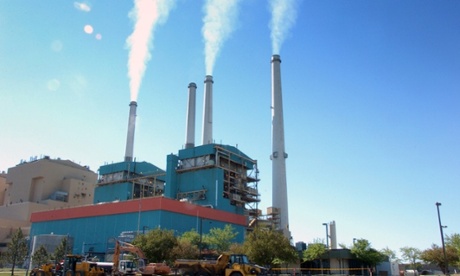
    Coal pollution climate change
    Industry groups claim that new Environmental Protection Agency rules for power plants will cripple the economy. Photograph: Matt Brown/AP

    The White House has warned that delaying action on climate change would carry a heavy price, racking up an additional 40% in economic losses from climate impacts and other costs over the course of 10 years.

    White House officials said the stark finding from the president’s council of economic advisers underlined the urgency of Barack Obama’s efforts to cut carbon pollution.

    In addition to a new report on the economic cost of delay, the White House is poised to launch two new initiatives on Tuesday dealing with fast-rising methane emissions from the natural gas industry, and buffering food security against future climate change.

    “We are pushing across the board on the elements of the climate action plan,” John Podesta, Obama’s counsellor, told a conference call with reporters.

    Several former treasury secretaries and a couple of billionaires have come forward in recent weeks to warn Americans about the economic risks of climate change. By producing its own report on the costs of climate change, the White House appeared to be moving to bolster Obama’s climate agenda from industry attacks.

    Industry groups claim that new Environmental Protection Agency rules for power plants will cripple the economy.

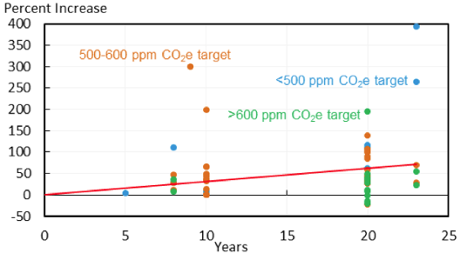
    In their rebuttal, Obama’s economic team said the costs of delaying action to cut carbon pollution would be far higher in the long term – 40% over the course of a decade, in terms of the increased costs of cutting greenhouse gas emissions and dealing with climate impacts.

    The costs were projected to rise even more steeply with each additional degree of warming above the 2C threshold for dangerous climate change, the report said.

    “Each decade we delay acting results in an added cost of dealing with the problem of an extra 40%,” Jason Furman, chairman of the council of economic advisers, told a conference call with reporters. “The total amount we would have to pay today would be 40% larger if we waited a decade instead of acting now.”

    Additional costs of adapting to climate change caused by delaying action to cut emissions

    Costs from delaying action on climate change
    This graph shows the council of economic advisers’ calculations on the additional costs that would come from delaying rules to cut emissions on power plants – over a 10-year period, it is an extra 40%. Photograph: /CEA

    Delaying action would deepen the risks to property and livelihoods. It would also make it more costly to reduce greenhouse gas emissions.

    A 3C rise above pre-industrial levels would shave about 0.9% a year off global GDP, or about $150 billion a year, the report said. A 4C rise would cost the global economy 3.1% of global GDP a year, it said.

    “The cost …..ramps up potentially astronomically to the point that even if you want to you couldn’t actually stabilise the temperature,” Furman said.

    Furman said the finding was based on an analysis of 16 different economic models, and took into consideration economic damage due to climate change, and lost investment and other opportunities.

    The report – and the other interventions – appeared timed to build support around the main pillar of Obama’s climate action plan, regulations limiting carbon pollution from power plants.

    The EPA is holding public hearings in Atlanta, Denver, Pittsburgh and Washington DC this week on regulations to cut carbon pollution from power plants by 30% over the next 16 years.

    The EPA regulations, which target the country’s largest single source of carbon dioxide emissions, are the main pillar of Obama’s climate plan – one of the signature issues of his second term – and by default contentious.

    More than 1,600 people have signed up to speak at the hearings, and 300,000 have sent in written comments. Some 680 groups have signed up to lobby the EPA, according to the Center for Responsive Politics – more than any other government department.

    The regulations are critical to Obama’s commitment to the international community to cut greenhouse gas emissions 17% on 2005 levels by 2020.

    The EPA Administrator, Gina McCarthy, told reporters on Monday that she expected opponents to focus on the economy. “We are bound to hear this week and beyond that EPA actions are bad for the economy,” she said.

    Industry groups, such as the American Petroleum Institute and the American Coalition for Clean Coal Electricity, accuse the EPA of waging a “war on coal” and say the regulations will damage the economy.

    A Republican congressman, Mike Kelly, likened the regulations to terrorism, in an event at the conservative Heritage Foundation on Monday. “You talk about terrorism, you can do it in a lot of different ways,” he said. “But you terrorise the people who supply everything this country needs to be great – and you keep them on the sidelines – my goodness what have we become?”

    Opponents of the EPA regulations also argue that they will be ineffective unless China and other big emitters also take action on climate change.

    But McCarthy told the call America had to take actions at home to cut carbon pollution “or a global solution on climate change won’t make it to the table”.

    She said there were already signs that the EPA regulations had encouraged China and other countries to do more to cut their own emissions.

    The White House, the EPA Senate Democrats, economists, and environmental groups argue the regulations represent an opportunity – and that it would be far more costly to delay action.

    The former treasury secretary, Robert Rubin, wrote in the Washington Post last week that framing the regulations as a trade-off between the environment and the economy was as false choice.

    “The real question should be: What is the cost of inaction? In my view — and in the view of a growing group of business people, economists, and other financial and market experts — the cost of inaction over the long term is far greater than the cost of action,” Rubin wrote.

    Senate Democrats are expected to expand on that argument at a budget committee hearing on Tuesday called “The costs of inaction: the economic and budgetary consequences of climate change”.

    European and British economists have warned for years about the costs of inaction on climate change, with Nicholas Stern coming out with his landmark report in 2006.

    But those findings did not get wide airing in the American media until earlier this year when a group of billionaires and former treasury secretaries came out with their report, Risky Business, on the costs of ignoring the climate problem.

    Meanwhile, the Obama administration will on Tuesday announce a number of new initiatives on containing fast-rising emissions of methane from the natural gas industry.

    The White House is also due to announce a new effort by companies such as Microsoft and Coca Cola on plans to help protect food production.

    Green light

    Sign up for the Green light email

    The most important environment stories each week including data, opinion pieces and guides.

    Sign up for the Green light email

  • Ocean Currents Making Waves: Episode 123

    Home Ocean Media Podcasts Making Waves: Ocean Currents

    Ocean Currents

    Making Waves: Episode 123

    In this episode: You know about ocean tides, but how much do you know about ocean currents? Watch our three-minute video podcast to learn what puts the motion in the ocean.

    Transcript

    This is Making Waves from NOAA’s National Ocean Service.

    The ocean never stands still. Even here in this quiet marina, you can see the water is slowly moving.

    If you stood at this spot for many hours, you’d witness one of the most reliable and predictable features of the ocean: the rise and fall of the tide, caused by the gravitational pull of the moon and the sun on our planet.

    But what’s causing the motion you see here with this gently swaying anemone on the sea floor off the Atlantic Coast? This is ocean current. The reason we have currents in the ocean is a bit more complicated.

    Let’s go back to the shoreline to witness one cause of ocean currents. Tides.

    1. Tidal Currents

    Tidal currents are strongest near the shore, in bays, and in estuaries along our coasts. This illustration will give you an idea of how this works. As the tide rises, water moves inland. This is called a flood current. As the tide recedes, the water moves seaward. This is called an ebb current. You can see the movement of water by watching the green seaweed.

    Now let’s zoom out and look at what’s happening near the surface of the ocean on a global scale over time. At this scale, currents are driven primarily by two different forces.  The first force is something we all know: wind.

    2. Wind

    This animation is from NASA’s Goddard Space Flight Center. It shows surface ocean currents around the world during the period from June 2005 to December 2007. Check our show notes for a link to the full animation.

    Let’s take a few moments to look at a few prominent surface ocean currents.  See that? You’ve probably heard of this current. It’s called the Gulf Stream.

    The Gulf Stream is an intense, warm ocean current in the western North Atlantic. It transports nearly four billion cubic feet of water per second.

    Now let’s speed up a bit and to go look at another special current.

    Coming into view now is the Kuroshio Current, located off the east coast of Japan. This is the ocean’s largest current. It can travel between 25-75 miles a day and is equal in volume to 6,000 large rivers.

    Surface ocean currents on the open ocean are fantastically complicated and beautiful, driven by a complex global wind system.

    But there’s one more ocean current force that you may have never heard of. It’s called thermohaline circulation.

    3. Thermohaline Circulation

    Thermo means ‘heat,’ and ‘haline’ refers to salinity. This term describes how changes in heat and salt content constantly change the density of ocean water. Cold, salty water is dense and sinks to the bottom of the ocean and eventually returns to the surface through mixing and wind driven upwelling.

    On a global scale, this sinking and rising of ocean water creates what scientists call the ‘great ocean conveyor belt.’

    This conveyor belt affects the Earth’s climate by driving warm water from the Equator and cold water from the poles around the Earth. It takes water almost 1000 years to move through the whole conveyor belt.

    So there you have it. Tides, wind, heat, and salinity are all factors that put the motion in the ocean.

    CREDITS:

    Making Waves podcast iconFrom corals to coastal science, catch the current of the ocean with our audio and video podcast, Making Waves.

    Subscribe to Feed | Subscribe in iTunes

    Search Our Podcasts
    Get Social


    More Information
  • Daily update: US solar giant quits Australia due to policy uncertainty

    Click here to enable desktop notifications for Gmail.   Learn more  Hide
    1 of 3
    Why this ad?
    Get 3 Local Solar Quotessolarquotes.com.au/_3_Best_Quotes – Compare 3 Solar Installers, Free. Save Time & Money Now!

    Daily update: US solar giant quits Australia due to policy uncertainty

    Inbox
    x

    Renew Economy editor@reneweconomy.com.au via mail68.atl51.rsgsv.net

    2:34 PM (50 minutes ago)

    to me
    US solar giant quits Australia due to policy uncertainty; Shoalhaven seeks $200k for community owned solar project; Infigen revenues down 18%; Ceramic fuel cells sales jump 43%; Death spiral? Energy utilities should check out the food industry; Next frontier for solar markets beyond the grid – big data; Rio Tinto puts thermal coal in ‘too hard’ basket; Can decentralised energy make US power grid blackout-proof?; Bleak future for nuclear power; and Wind power in Denmark half price of coal and gas.
    Is this email not displaying correctly?
    View it in your browser.
    RenewEconomy Daily News
    The Parkinson Report
    US solar giant Recurrent Energy is closing its Australian office because of policy uncertainty over renewables. It could be the start of a mass exodus of international players frustrated by the lack of action, Direct or otherwise, from the Abbott government.
    Shoalhaven community energy group offers 6.5% return for investors in 99kW solar system at NSW bowling club to begin installation next week.
    Infigen Energy suffers sharp fall in 4th quarter revenue, due to slump in wholesale prices and RET certificate prices.
    Ceramic Fuel Cells reveals 43% increase in sales for year ended June 30, warns it will need even higher unit sales to sustain the business.
    How does a supermarket deal with the grow-your-own revolution? Not like Australia’s power utilities, or we would see another industry death spiral.
    Big data is paving way for mobile money, PAYG finance, and distributed solar being made accessible to rural poor of developing countries.
    Rio Tinto is grabbing headlines after crystallising massive losses from its Mozambique coal disaster. But the real significance is the difference between what big miners say about coal, and what they do about it.
    Decentralizing the grid through distributed energy resources could be the best way to improving the grid’s reliability and resilience.
    World Nuclear Industry Status Report concludes nuclear industry is aging, plagued with high costs and construction delays, and generally on the decline.
    Onshore wind power will be cheapest form of new electricity when new turbines become operational in 2016 in Denmark.
  • Scientists discover vast methane plumes escaping from Arctic seafloor

    EarthSky // Earth, Human World, Science Wire Release Date: Jul 30, 2014

    Scientists discover vast methane plumes escaping from Arctic seafloor

    “We are sniffing methane. We see the bubbles on video from the camera … All analysis tells the signs. We are in a [methane] mega flare.”

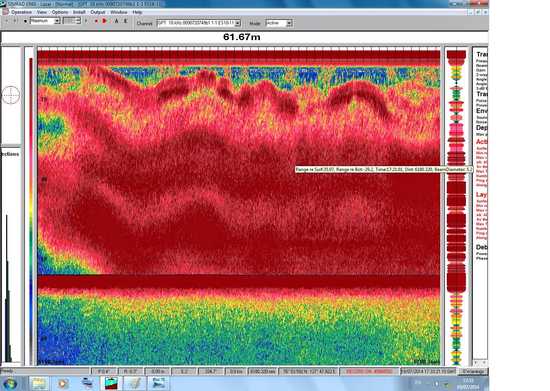
    Mega methane event.  Image via University of Stockholm via Daily Kos.

    Methane mega flare event on the Laptev Sea slope of the Arctic Ocean, at a depth of about 62 meters. Image via Daily Kos via University of Stockholm.

    An international team of scientists aboard the icebreaker Oden – currently north of eastern Siberia, in the Arctic Ocean – is working primarily to measure methane emissions from the Arctic seafloor. On July 22, 2014, only a week into their voyage, the team reported “elevated methane levels, about 10 times higher than background seawater.” They say the culprit in this release of methane, a potent greenhouse gas, may be a tongue of relatively warm water from the Atlantic Ocean, the last remnants of the Gulf Stream, mixing into the Arctic Ocean. A press release from University of Stockholm described the discovery as:

    … vast methane plumes escaping from the seafloor of the Laptev continental slope. These early glimpses of what may be in store for a warming Arctic Ocean could help scientists project the future releases of the strong greenhouse gas methane from the Arctic Ocean.

    The scientists refer to the plumes as methane mega flares.

    Click here to see where the icebreaker Oden is right now.

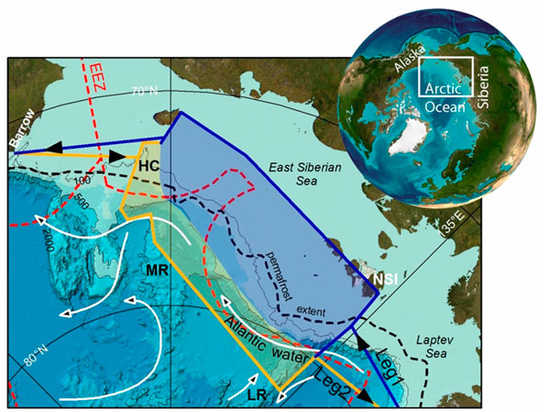
    SWERUS expedition preliminary cruise plan and study areas of Leg 1 and 2. EEZ=Exclusive Economic Zone; LR=Lomonosov Ridge; MR=Mendeleev Ridge; HC=Herald Canyon; NSI=New Siberian Islands. Image via Daily Kos via University of Stockholm.

    Expedition of the icebreaker Oden – called the SWERUS expedition – preliminary cruise plan and study areas of Leg 1 and 2. EEZ=Exclusive Economic Zone; LR=Lomonosov Ridge; MR=Mendeleev Ridge; HC=Herald Canyon; NSI=New Siberian Islands. Image via Daily Kos via University of Stockholm.

    On July 22, 2014, chief scientist Örjan Gustafsson of the University of Stockholm wrote about the methane mega flare event in his blog. He wrote:

    So, what have we found in the first couple of days of methane-focused studies?

    1) Our first observations of elevated methane levels, about ten times higher than in background seawater, were documented already as we climbed up the steep continental slope at stations in 500 and 250 meter depth. This was somewhat of a surprise. While there has been much speculation of the vulnerability of regular marine hydrates [frozen methane formed due to high pressure and low temperature] along the Arctic rim, very few actual observations of methane releases due to collapsing Arctic upper slope marine hydrates have been made. ¨

    It has recently been documented that a tongue of relatively warm Atlantic water, with a core at depths of 200–600 meters may have warmed up some in recent years. As this Atlantic water, the last remnants of the Gulf Stream, propagates eastward along the upper slope of the East Siberian margin, our SWERUS-C3 program is hypothesizing that this heating may lead to destabilization of upper portion of the slope methane hydrates. This may be what we now for the first time are observing.

    2) Using the mid-water sonar, we mapped out an area of several kilometers where bubbles were filling the water column from depths of 200 to 500 meters. During the preceding 48 hours we have performed station work in two areas on the shallow shelf with depths of 60-70m where we discovered over 100 new methane seep sites. SWERUS-C3 researchers have on earlier expeditions documented extensive venting of methane from the subsea system to the atmosphere over the East Siberian Arctic Shelf. On this Oden expedition we have gathered a strong team to assess these methane releases in greater detail than ever before to substantially improve our collective understanding of the methane sources and the functioning of the system. This is information that is crucial if we are to be able to provide scientific estimations of how these methane releases may develop in the future.

    While not as long-lasting in the atmosphere as carbon dioxide, methane is much more effective than carbon dioxide at trapping heat in Earth’s atmosphere. Climate scientists discuss a potential feedback loop regarding methane’s role in global warming. That is, as Earth’s climate warms, methane that is frozen in reservoirs stored in Arctic tundra soils – or marine sediments – may be released into the atmosphere, where it warm Earth still more, releasing more methane, and so on.

    Methane release from the Arctic Ocean is not a new phenomenon; after all, the Stockholm scientists were there to measure it. U.S. scientists have observed Arctic Ocean methane release, too. For example, NASA reported in April 2012 on a study in which scientists measured surprising levels of methane coming from cracks in Arctic sea ice and areas of partial sea ice cover.

    Bubbles of methane rising up through Arctic seawater.  Image via University of Stockholm.

    Methane bubbles discovered on Laptev continental slope of Arctic Ocean by the science team aboard the icebreaker Oden. Image via University of Stockholm.

    On July 23, Ulf Hedman – who is aboard the Oden and who is Science Coordinator for the Swedish Polar Research Secretariat – gave a vivid description of the discovery in his blog:

    We are ‘sniffing’ methane. We see the bubbles on video from the camera mounted on the CTD or the Multicorer. All analysis tells the signs. We are in a [methane] mega flare. We see it in the water column we read it above the surface an we follow it up high into the sky with radars and lasers. We see it mixed in the air and carried away with the winds. Methane in the air. Where does it come from? Is it from the old moors and mosses that used to be on dry land but now has sunken into the sea. Does it come from the deep interior of the Earth following structures in the bedrock up into the sand filled reservoirs collecting oil and gas then leaking out upwards, as bubbles through the sea bed into the water, into the mid-water sonar, the Niskin bottles the analysis and into our results?

    Where does the methane come from? Is it organic or not? What’s the volume? How much is carried up into the air? Is there an effect on the climate? One mega flare does not tell the truth. It’s not evidence enough.

    We carry on for the next station.

    And the next, and next, next…

    Bottom line: A team of international scientists aboard the icebreaker Oden has documented “elevated methane levels, about ten times higher than in background seawater” in the Arctic Ocean. They are calling it a methane mega flare event and express hopes it will help them project future releases of the strong greenhouse gas methane from the Arctic Ocean, and to understand the role this released methane might play in global warming.

  • Sixteen-foot swells reported in once frozen region of Arctic Ocean

    By Fred Barbash July 30 at 2:24 AM

    Broken Arctic sea ice as seen from a window in from a U.S. Coast Guard flight over the Beaufort Sea in the Arctic Ocean in 2009. (Yereth Rosen/Reuters)

    Big waves like those fit for surfing are not what we think of when contemplating the Arctic Ocean. The water is ice-covered most of the time — and it takes large expanses of open sea plus wind to produce mighty surf.

    So the fact that researchers have now measured swells of more than 16 feet in the Arctic’s Beaufort Sea, just north of Alaska, is a bit of a stunner. Swells of that size, researchers say, have the potential to break up Arctic ice even faster than than the melt underway there for decades thanks to rapid global warming.

    The wave measurements, using sensors beneath the surface communicating via satellite, were recorded by Jim Thomson of the University of Washington and W. Erick Rogers of the Naval Research Laboratory in 2012 and reported in an article in Geophysical Research Letters this year.

    “The observations reported here are the only known wave measurements in the central Beaufort Sea,” they wrote, “because until recently the region remained ice covered throughout the summer and there were no waves to measure.”

    Sixteen feet was the average during a peak period, Thomson said in an email. “The largest single wave was probably” 9 meters, or about 29 feet, he said. The average over the entire 2012 season was 3 to 6 feet.


    Satellite images of polar ice sheets taken in 2001 and 2007 show retreating ice in the Beaufort Sea during summer in the Arctic Ocean. (Photo by USGS via Getty Images)

    The distances of open water change “dramatically throughout the summer season, from essentially zero in April to well over 1000 km in September,” they reported. “In recent years, the seasonal ice retreat has expanded dramatically, leaving much of the Beaufort Sea ice free at the end of the summer.”

    Because swells carry more energy, they reported, they will likely increase the pace of ice breakup in the region, eventually producing an “ice-free summer, a remarkable departure from from historical conditions in the Arctic, with potentially wide-ranging implications for the air-water-ice system and the humans attempting to operate there.”

    “Waves could accelerate the ice retreat,” Thomson said in his email from a village on the Arctic, where he was getting read to deploy some wave buoys.  “We don’t have much direct evidence of this, or knowledge of the relative importance compared with melting, but the process is real.  We are conducting a large project this summer to answer just that question”