Category: Uncategorized

  • The Arctic Vs. Antarctica

    The Arctic Vs. Antarctica

    The Arctic Vs. Antarctica

    RiAus Director Paul Willis is heading down to Antarctica to take photos for you! Submit a photo option in the sidebar (under Samantha’s bio) and see the list of submissions already made at The Great Antarctic Photo Quest

    One of them has penguins and Santa Claus is listed at the other, but which is which? The easiest way to remember is the Arctic has fewer letters, so floats to the top (the north pole) whilst the Antarctic has more letters, therefore is heavier and sinks to the bottom (the south pole). But beyond the spelling and the locals what is the difference between the two?

    Geography and Oceanography

    The arctic is roughly divided into two regions – the Arctic Circle (subarctic) and the poetically named land of the midnight sun and polar nights to the north. The Arctic Circle includes parts of several countries (USA, Canada, Greenland, Iceland, Lapland, Norway and Russia) surrounding the Arctic Ocean and is viewed as an ocean with eight states. The North Pole lies directly in the middle of this ocean. The land of the midnight sun is so called due to its unique position that results in it spending half of the year in direct sunlight and the other half facing away from the sun. The temperatures of the Arctic range from a nippy -30°C in winter to 0°C in the summer.

    Arctic Vs Antarctica-01

    The Antarctic on the other hand, is a single continent covered completely in ice. This land mass is surrounded by the Antarctic Circumpolar Current, the largest current in the world, allowing little circulation from other waters and keeping the temperatures low enough to maintain its icy beauty. The Antarctic is the coldest place on earth, much colder than its counterpart in the north, ranging from -68°C (inland) in winter to a balmy 10°C in summer.

    So they are both icy, what are the differences for science and research?

    Although they seem similar the Arctic and Antarctic provide vastly different environments for research. The Arctic Circle has one of the most amazing and delicate environments on earth. Humans have impacted parts of the Arctic region for centuries, from the indigenous locals to explorers from the south. Due to its delicate nature the Arctic is one of the most important places for studying climate change and the environmental impact of human activity on our planet. Collaborative research between the Arctic nations and others is governed by such groups as the International Arctic Science Committee (IASC) and the Arctic Council (overseeing issues related to the Arctic Governments and Indigenous peoples). Current research areas highlighted by the IASC include; coastal biodiversity and dynamics, hydrology, environmental data gathering, human-caribou grazing systems, glaciology and effects of Arctic environmental contaminants on human health.

    The Antarctic on the other hand does not belong to anyone. It is the last truly wild place on earth and has never been inhabited by humans – inhabited here meaning large cities and farms and destruction of the wild environment. Humanity first discovered Antarctica in the early 20th century and in order to preserve the area the Antarctic Treaty was formed in 1959. This treaty states that it is in “the interests of all mankind that Antarctica shall continue forever to be used exclusively for peaceful purposes and shall not become the scene or object of international discord”. Research in Antarctica covers many fields including biology, environmental science, marine biology, earth science, geophysics, astronomy and astrophysics. In fact it is considered the best place on earth for astronomy, as the stars are most easily visible from the South Pole region!

    Neumayer_Station_Antarctica 300px(h)

    Research stations in the Antarctic are staffed by scientists from around the globe, built on solid rock or ice with some less permanent camps arising in the summer for specific projects. The region has no plants or land animals, meaning all supplies must be brought with the research group, and all trash must be removed as well. Antarctica is not only the coldest but also the windiest place on earth, which, coupled with the complete isolation, can be difficult for the dedicated scientists working there.

    In the Arctic region however research is often conducted from ships or floating stations, or is conducted from universities or research centres located in one of the countries of the region. There is plenty of wildlife (including polar bears!) and even some plant life, making life a researcher in the Arctic slightly more comfortable – but only slightly.

    CCGS_Amundsen 300px(h)

    One more quick fact…OK maybe two…

    The South Pole does not line up directly with the North Pole. The Earth’s magnetic field is not quite symmetrical so tunnelling through the centre of the earth would not be the fastest way to get from one pole to the other.

    The North Pole changes position due to changes in the Earth’s core – explaining why Santa Claus’s workshop has never been found!

    Did you like this blog? Follow us on Facebook or Twitter or sign up for the RiAus Newsletter to get all the latest science.

  • Re: UPDATE: Church deleting our criticism

    2 of 40
    Why this ad?
    Audit of SMSF Workshopscharteredaccountants.com.au/smsf – The Institute offers 3 workshops to help you remain SIS compliant.

    Re: UPDATE: Church deleting our criticism

    Inbox
    x

    Peter Mitchell via Change.org mail@change.org

    12:25 PM (2 hours ago)

    to me
    Change.org
    Help us take our message to the Catholic Church: it’s time to treat child abuse victims better
    Click here to donate

    *** Since I first sent this email, hundreds of people have chipped in almost $10,000 to help get an ad exposing the church’s hypocrisy into the Adelaide Advertiser. We’re now less than $2000 away from our target! But we still need more help to achieve our goal.

    Can you chip in just a few dollars and help me do this? Huge, public, media pressure is the only thing the Church responds to: I need your help to deliver that.***

    (I also had some problems with PayPal earlier – they shut down my account because too many people were giving at once! They’ve fixed it now, so if you tried to donate and couldn’t, please click here to try chipping in again.

    NEVILLE –

    UPDATE: Archbishop Wilson yesterday deleted his Facebook page and all of the critical comments on it – he’s denying any part in 12 years of delays for St Ann’s victims; now he’s trying to shut down any criticism.

    It feels like this is all just a game to the Catholic Church. But this is our lives. We just want some justice and to put this behind us.

    I need your help to get our message through to Archbishop Wilson: that it’s time to treat child abuse victims better. We’re planning to take out a huge newspaper ad in the Adelaide Advertiser next week that does just that – would you chip in a few dollars to help us put it in the paper? Click here to donate now.

    The church allowed a paedophile to drive our children’s school bus. Our children were sexually abused, and now, they’ve made us fight for 12 long years to try and get justice.

    Huge public and media pressure seems to be the only thing the Church responds to. So far the Church’s legal and financial might keeps shutting us down – but we can change that: with a huge newspaper ad that shines a spotlight on what Archbishop Wilson is doing.

    I’ve done the pricing and lined up a designer with experience in making these ads. If just 700 of us chip in $15 each,we’ll be able to take out a huge full-page ad in The Advertiser next week.

    It’s time we draw a line in the sand. To put an end to the Catholic Church saying a big, public “sorry” at the Royal Commission – but behind the scenes using legal tactics to crush abuse victims.

    Can you chip in a few dollars to help our families take out a huge newspaper ad in the Adelaide Advertiser next week to get our message through to the Catholic Church? Click here donate.

    Thank you so much for your support,

    Peter

    P.S. Your support has been incredible so far. We’re hoping with one final big push we can convince the Catholic Church finally let us have some peace. And some justice. If you can spare any change to help us win this fight, we’d really appreciate it. All the funds will be

  • The Cryosphere Discuss., 8, 1453-1477, 2014

    The Cryosphere Discuss., 8, 1453-1477, 2014
    www.the-cryosphere-discuss.net/8/1453/2014/
    doi:10.5194/tcd-8-1453-2014
    © Author(s) 2014. This work is distributed
    under the Creative Commons Attribution 3.0 License.
    Review Status
    This discussion paper is under review for the journal The Cryosphere (TC).

    Small impact of surrounding oceanic conditions on 2007–2012 Greenland Ice Sheet surface mass balance
    B. Noël1,2, X. Fettweis1, W. J. van de Berg2, M. R. van den Broeke2, and M. Erpicum1
    1Department of Geography, University of Liège, Belgium
    2Institute for Marine and Atmospheric research Utrecht, University of Utrecht, the Netherlands

    Abstract. During recent summers (2007–2012), several surface melt records were broken over the Greenland Ice Sheet (GrIS). The extreme summer melt resulted in part from a persistent negative phase of the North-Atlantic Oscillation (NAO), favouring warmer than normal conditions over the GrIS. In addition, it has been suggested that significant anomalies in sea ice cover (SIC) and sea surface temperature (SST) may partially explain recent anomalous GrIS surface melt. To assess the impact of 2007–2012 SIC and SST anomalies on GrIS surface mass balance (SMB), a set of sensitivity experiments was carried out with the regional climate model MAR. These simulations suggest that changes in SST and SIC in the seas surrounding Greenland do not significantly impact GrIS SMB, due to the katabatic winds blocking effect. These winds are strong enough to prevent oceanic near-surface air, influenced by SIC and SST variability, from penetrating far inland. Therefore, the ice sheet SMB response is restricted to coastal regions, where katabatic winds are weaker. However, anomalies in SIC and SST could have indirectly affected the surface melt by changing the general circulation in the North Atlantic region, favouring more frequent warm air advection to the GrIS.

    Citation: Noël, B., Fettweis, X., van de Berg, W. J., van den Broeke, M. R., and Erpicum, M.: Small impact of surrounding oceanic conditions on 2007–2012 Greenland Ice Sheet surface

  • New data confirms Arctic ice trends: sea ice being lost at a rate of five days per decade

    hysical Sciences

    UCL Home
    A A A

    Picture of the Week

    Sulphur crystals. Photo: UCL Museums & Collections - UCL Geology Collections

    Brimstone

    The yellow crystals in this geological sample are nuggets of pure sulphur – or brimstone, as it is known to the more biblically minded.
    More…

    View all pictures of the week

    New data confirms Arctic ice trends: sea ice being lost at a rate of five days per decade

    4 March 2014

    The melt season across the Arctic is getting longer by five days per decade, according to new research from a team including Prof Julienne Stroeve (Professor of Polar Observation and Modelling at UCL Earth Sciences). New analysis of satellite data shows the Arctic Ocean absorbing ever more of the sun’s energy in summer, leading to an ever later appearance of sea ice in the autumn. In some regions, autumn freeze-up is occurring up to 11 days per decade later than it used to.

    Arctic sea ice breaking up. Photo: NASA/GSFC

    Satellite image of Arctic sea ice breaking up
    Credit: NASA/Goddard Space Flight Center

    The research, published in a forthcoming issue of the journal Geophysical Research Letters, has implications for tracking climate change, as well as having practical applications for shipping and the resource industry in the arctic regions.

    “The extent of sea ice in the Arctic has been declining for the last four decades,” says Julienne Stroeve, “and the timing of when melt begins and ends has a large impact on the amount if ice lost each summer. With the Arctic region becoming more accessible for long periods of time, there is a growing need for improved prediction of when the ice retreats and reforms in winter .”

    While temperatures have been increasing during all calendar months, trends in melt onset are considerably smaller than that of autumn freeze-up. Nevertheless, the timing of melt onset strongly influences how much of the Sun’s energy gets absorbed by the ice and sea. This in turn is affected by how reflective the surface is. Highly reflective surfaces, such as ice, are said to have a high albedo, as they reflect most of the incoming heat back into space. Less reflective surfaces like liquid water have a low albedo, and absorb most of the heat that is directed at them.

    This means that even a small change in the extent of sea ice in spring can lead to vastly more heat being absorbed over the summer, leading to substantially later onset of ice in the autumn. There is also a second effect, in that multi-year ice (which survives through the summer without melting) has a higher albedo than single-year ice that only covers the sea in winter. Since the 1980s, the proportion of the Arctic winter ice that is made up of multi-year ice has dropped from around 70% to about 20% today, so the changes are quite substantial

    These feedback effects, in which small changes in atmospheric temperature and sea ice lead to large changes in heat absorption, was what the team set out to study.

    Stroeve’s team analysed satellite imagery of the Arctic region, dating back over 30 years. The data breaks down the whole region into 25x25km squares, and the team analysed the albedo of each of these for each month for which they had data. This allowed them to update trends and add an extra 6 years onto the most recent analysis of its kind. The new data continues the trend towards longer ice-free periods previously observed.

    Melt length trends 1979-2013

    This map charts the change in the melt season over the past quarter century. Red areas see lengthened melt seasons. In a handful of areas (in blue) the melt season has shortened.
    Credit: Julienne Stroeve (UCL Earth Sciences/National Snow and Ice Data Center)

    “The headline figure of five days per decade hides a lot of variability. From year to year, the onset and freeze-up of sea ice can vary by about a week. There are also strong variations in the total length of the melt season from region to region: up to 13 days per decade in the Chukchi Sea, while in one, the Sea of Okhotsk, the melt season is actually getting shorter.”

    The amounts of energy involved in these changes are enormous – hundreds of megajoules of extra energy accumulated in every square metre of sea. This is equivalent to several times the energy released by the atom bomb at Hiroshima for every square kilometre of the Arctic ocean.

    For organisations such as oil drillers operating in the Arctic region, a sophisticated understanding of when the sea will freeze up is essential. For climate scientists, this type of study helps them better understand the feedback mechanisms inherent in the Arctic climate. The results from this study are closely in line with previous work and therefore give added confidence that models of the complex Arctic climate are broadly correct.

    Correction: The first paragraph of this article initially referred to the ‘ice-free season’ rather than the ‘melt season’. This error has now been corrected.

    Notes

    • The research appears in a paper entitled “Changes in Arctic melt season and implications for sea ice loss”, to be published in a forthcoming issue of the journal Geophysical Research Letters. An online pre-print is available now on the journal website.
    • Julienne Stroeve is a recent appointment to UCL Earth Sciences, joining the department from the National Snow and Ice Data Centre in Colorado, USA.

    Related links

    High-resolution images

    Satellite view of sea ice

    This image may be reproduced freely as it is in the public domain

    Map of changing melt seasons in the Arctic

    This image is available under a Creative Commons Attribution Non-commercial No-derivatives licence. It may additionally be reproduced for the purpose of news reporting.

    Researcher profile

    Science contact

    Julienne Stroeve
    UCL Earth Sciences and National Snow & Ice Data Center
    stroeve@nsidc.org

    Media contact

    Oli Usher
    UCL Faculty of Mathematical and Physical Sciences
    020 7679 7964
    o.usher@ucl.ac.uk


  • Queensland axes 8c/kWh solar feed-in tariff

    Queensland axes 8c/kWh solar feed-in tariff

    Print Friendly

    Queensland’s Newman government has continued its “war on solar”, confirming it will axe the state’s 8c/kWh rooftop solar feed-in tariff at the end of June, leaving solar households with the challenge of negotiating a tariff with their electricity retailer.

    The move by the government – which will affect 40,000 households, and any new rooftop solar adopters – was expected, and was justified by claims it would “lift the cost burden” from electricity network businesses and put “downward pressure” on electricity prices for all Queenslanders.

    In a refrain taken straight from the Campbell Newman songbook, Queensland energy minister Mark McArdle said in a media release on Thursday that the carbon tax and renewable energy targets had driven electricity prices “much higher than they should be.” No mention of the soaring cost of the government-owned networks.

    “Left unchecked, the 8 cent feed-in tariff would cost Queensland households and businesses an extra $110 million on their power bills over the next six years,” McArdle said. Presumably, he was expecting the number of Queensland households to increase dramatically, because the current 40,000 households on the 8c/kWh tariff would need to export nearly all their generation to meet that figure.

    Critics say the changes – announced as part of a series of reforms to the state’s Solar Bonus Scheme – mean that the 40,000 solar households in Queensland will be left at the mercy of the state’s electricity retailers, who will assume responsibility for setting and offering solar energy tariffs.

    “This is incredibly unfair,” said Lindsay Soutar, from Solar Citizens. “It is obvious that it will be difficult for individual households to get a good deal from their power company. They simply don’t have the negotiating power. When retailers set the rules, solar owners lose.”

    As one solar industry expert pointed out, the Queensland government was unable to win its fight with retailers over pricing, so what chance would an individual household have? Victoria, WA, and South Australia all have mandated minimum tariffs. NSW is the only state that doesn’t, and even IPART found that customers were not getting a good deal – most well below the recommended rate. Many households are offered nothing.

    Rhys Clay from Local Energy Solar said that while he disagreed with the Newman government’s approach to limiting the solar feed-in tariff, the changes would at least help encourage customers to install energy storage, and save their surplus solar energy for use later in the night.

    “It is our hope that the QLD goverment reforms electricity pricing to accurately reflect the true cost of electricity (higher prices at peak times) as this will help facilitate a shift energy efficiency and storage which in turn will benefit the network,” Clay said.

    The Queensland government said customers of Energex would no longer have a government regulated rate, but will be able to negotiate a tariff with their retailer. Ergon Energy customers, meanwhile, will continue to be paid a tariff set by the Queensland Competition Authority until “there is enough retail competition in regional areas to make solar more self-sufficient.”

    “These reforms will mean electricity retailers will pay any newly negotiated solar tariff direct to users,” McArdle said. “These are common-sense decisions that will produce a positive outcome for existing customers on the 8 cent rate, as well as new solar owners.”

    This latest solar tariff cut follows the slashing of the 44c/kWh net tariff in 2012, when Campbell Newman’s decision to provide a month-long window to take advantage of the 44c rate inadvertently sparked a massive rush for rooftop solar in Queensland.

    Today, McArdle said the 44c/kWh solar feed-in tariff would be kept in place for the around 284,000 Queensland households who signed up to it before it was closed.

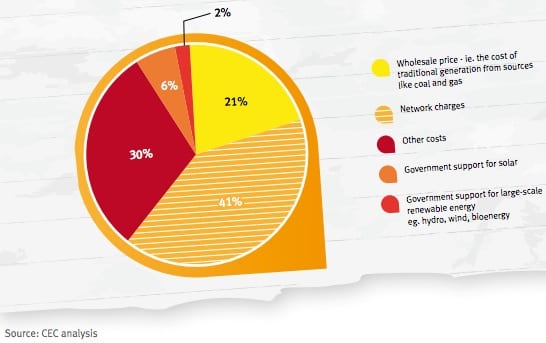
    The solar industry has argued that government support for rooftop solar adds a negligible amount to the average household electricity bill, with more than two-thirds of price rises caused by factors completely unrelated to any green schemes, such as soaring generation costs, network costs, and increased costs from retailers and billing centres.

    Price-breakdown-of-average-home-power-bill

    Price breakdown of average Australian household electricity bill

    Last year, a Queensland Competition Authority report recommended a 13.5 per cent increase in solar tariffs from July 1, 2014, and predicted that the impact of the carbon price, even if not repealed, would actually go down, as would any impact from renewable energy schemes.

    In an interview with the Courier Mail, McArdle said axing the 8c FiT in the state’s southeast would foster competition ahead of the removal of regulated prices in July 2015.

    “I don’t think (retailers) will abandon solar customers, because paying the feed-in tariff is part of their market strategy to attract customers to their contracts,” he said.

    “Customers can then start to play retailers off against each other to get a better deal, and we may well find that the feed-in tariff increases with competition.’’

  • Four Degrees or More? Australia in a hot world, CLIMATE CODE RED

    Why this ad?
    Compare Electricity Ratesyoucompare.com.au/electricity – Save Hundreds On Electricity Bills Cheaper Electricity. Compare & Save

    climate code red

    Inbox
    x

    Climate Code Red noreply@blogger.com via google.com

    8:26 PM (1 minute ago)

    to me

    climate code red


    Too hot to handle: life in a four-degree world

    Posted: 04 Mar 2014 06:24 PM PST

    by Gabrille Kuiper, first published in Overland

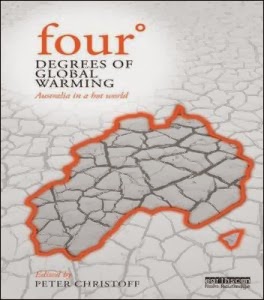
    Four Degrees of Global Warming:
    Australia in a hot world
    Peter Christoff (ed),
    Earthscan/Routledge, 2013

    The book Four Degrees or More? Australia in a hot world, edited by political scientist Peter Christoff, is a timely overview of what we know currently about both global and local predicted impacts of climate change.

    As Christoff notes, ‘this four-degree world is one of almost unimaginable social, economic and ecological consequences and catastrophes’ but, given current international and Australian energy and climate policies, it is “an impending reality”. The book contains contributions by Australia’s leading scientists and economists, including Ross Garnaut, David Karoly and Will Steffen, setting out a four-degree future across the ecological, social and economic impacts, and the adaptation that will be required.

    Previously, climate change dialogue has mainly focused on two degrees Celsius of global temperature rise, which had been identified as a key environmental “tipping point”. Scientific consensus is now that our business-as-usual trajectory will cause the global average temperature to rise by a global average of four degrees Celsius above pre-industrial levels by 2070-2100.

    Nonetheless, regional increases will range from four to sixteen degrees on land, with the Arctic continuing to heat up the most, as it has done to date.

    One of the key insights from Four degrees or More? is that almost nothing about the consequences of climate change will be uniform. To better represent changes across Australia, the book’s initial chapters match Australian cities with places with climates currently analogous with those that these cities will experience in a four-degree world. So Sydney becomes Rockhampton and Brisbane becomes more like Cairns. Broome, which currently has 54 days a year over 35 degrees is projected to have 284 days per year over 35 degrees by 2100. Darwin will be like be like nowhere on earth; the researchers could find no analogue anywhere on earth to a Darwin under a four-degrees scenario.

    The possible consequences of these changes for Australia’s population are not explored in the book. This would be a valuable exercise for geographers and urban planners. One might assume that some northern Australia’s inland settlements will be abandoned. Meanwhile, Tasmania is likely to be a haven from the heat. At the book’s launch, the number of climate scientists who own land in Tasmania was remarked on. Penfolds and Brown Brothers have already purchased land for new vineyards in Tasmania, the wine industry being one that is highly climate dependent and (at least in some companies) very alive to how the climate is already changing.

    The impact of climate change on the marine environment is not as visible but the consequences are worrying indeed. The basic science means that as carbon dioxide levels in the atmosphere increase, some of it dissolves in and acidifies seawater. The world’s oceans have already acidified by almost thirty percent since the Industrial Revolution. Further ocean acidification will disrupt the marine food chain, making it more difficult for organisms to form shells and skeletons, and leading to the decline or collapse of coral reef ecosystems.

    Over 2.6 billion people depend on the seas for their primary source of protein. As Four degrees highlights, overfishing is just one of a multitude of examples of where climate change will exacerbate, accelerate or multiply an existing unsustainable trend. The emission of greenhouse gases is only one way in which humans have fundamentally altered the planet’s biosphere and ecology.

    Other examples of the numerous negative feedback effects caused by climate change include the strengthening of the urban heat island effect (which already exists as a result of the sheer coverage of paved areas and building mass in most cities) and increased riverine salinity due to the extraction of ever-decreasing amounts of water for agriculture from rivers such as the Murray Darling.

    Four degrees discusses how Australian food yields will in decline in quantity and quality as the protein content of grain crops decline. By 2100, Australia – currently a net food exporter – is likely to face food shortages in a world where half of the global population also faces droughts and famine.

    A Four-degree world will also affect human health in other ways. As the January heatwave has underlined, temperature extremes and related events have profound health consequences. Such extremes will become more frequent and ‘normal’ as global warming accelerates.

    Heat is a silent killer. The 2003 European heatwave is estimated to have caused up to 70,000 excess deaths. The Black Saturday bushfires in Victoria in February 2009 killed 173 people, but an additional 374 people died as a consequence of the accompanying heatwave. Children, elderly people and those with underlying health conditions are particularly vulnerable in extreme heat, as are the services and systems that might otherwise support them.

    In addition, a wide variety of health risks will become more common and more extreme in a Four Degree world, ranging from increases in air pollution and aeroallergens (affecting asthma sufferers, in particular) to changes to natural constraints on infectious agents (such as malaria and Ross River fever) to psychological (mental health) effects.

    Crucially, it is the indirect effects of climate change on water and food security, alongside extreme climatic events, which are likely to have the biggest effect on global health – and indeed the movement of people around the globe. As McMichael, Steffen and Griggs highlight in their chapters, there will be complex interactions between climatic impacts. For instance, persistent drought will reduce food production, leading to food shortages, and perhaps emigration, conflict and violence.

    Globally, by the end of this century, up to one billion people will be displaced by climate change as populations try to move towards more survivable climates in the biggest wave of forced migration in human history. Sea level rise is already influencing emigration from Tuvalu, Kiribati, Papua New Guinea and the low-lying Carteret Islands, while water stress is propelling the relocation of people from Mauritania, Sudan, Ghana and Kenya. The Maldives has established a sovereign wealth fund to purchase a new homeland for the 350,000 islanders expected to become the first nation of people fully displaced by climate change.

    Closer to home, Indonesia has a population of 240 million and the fourth largest coastline in the world. Christoff and Eckersley note some 6.4 percent of Indonesia’s population live in the three metre zone prone to coastal flooding and suggest that climate change already locked in to the global system will result in the potential displacement of (at least) 15 million people north of Australia.

    Such detail is what is needed for adaptation planning by Australian governments, business and civil society. The book provides a welcome overview of the big picture; the next step is a more tangible picture of the specific changes to day-to-day business and lives in Australia. But that also requires more research. As Christoff highlights, there hasn’t, for example, been any economic modeling of the consequences for Australian tourism, trade and agriculture since 2008. It’s no wonder that some business finds it frustrating to operate with big picture warnings of massive disruption without the particulars for their industry.

    The indispensable crux of this book – the view of some of the world’s most eminent scientists and social scientists ­– accords with that of Professor Schellnhuber that ‘the difference between (two and four degrees) is human civilisation, if you like’.

    Given a choice, a four-degree world is not one any of us wants to imagine. We don’t want to know about it or talk about it – and some of us actively deny it. This book is essential in that it forces us to stare at the world we are collectively creating, and at its consequences. Its nightmarish projections emphasise that we must put all our efforts into avoiding a four-degree future. We have everything to lose.v

    Dr Gabrielle Kuiper has been working on climate change in various ways for two decades and is currently an independent energy and climate consultant.