Category: Uncategorized

  • Post Traumatic stress Disorder

    Heard on ABC News radio this morning. A distressed call was replayed from a

    policeman re PTSD who later suicided. Very emotional.

    There are instances of PTSD among police and armed service members suffering

    from this condition resulting in family breakdowns and in some cases suicides.

    These people put their lives on the line in carrying out their sworn duties in the

    protection of the public and in combat zones.

    Not enough is being done to assist and rehabilitate these people to live a normal

    Life when this condtion manifests itself.

    These cases must be fully recognised and appropriate treatment and counselling

    provided.


  • Hansen Web Page and Reports.

    Dr. James E. Hansen

    Columbia University
    Earth Institute
    475 Riverside Drive
    New York, NY 10115 USA
    E-mail: jeh1@columbia.edu

    “Storms of My Grandchildren”, by James Hansen

    On the webpage “Updating the Climate Science: What Path is the Real World Following?”, Drs. Makiko Sato and James Hansen update figures in the book Storms of My Grandchildren (see LA Times review) and present updated graphs and discussion of key quantities that help provide understanding of how climate change is developing and how effective or ineffective global actions are in affecting climate forcings and future climate change. A few errata in Storms are also provided.

    Near Future Presentations

    Recent Communications

    Dr. Hansen periodically posts commentary on his recent papers and presentations and on other topics of interest to an e-mail list. To receive announcements of new postings, please click here.

    Go to older postings

    Recent Scholarly Publications

    Hansen, J., P. Kharecha, M. Sato, V. Masson-Delmotte, et al., Assessing “Dangerous Climate Change”: Required Reduction of Carbon Emissions to Protect Young People, Future Generations and Nature. PLOS ONE, 8, e81468.


    Hansen, J., M. Sato, G. Russell, and P. Kharecha, 2013: Climate sensitivity, sea level, and atmospheric carbon dioxide. Phil. Trans. R. Soc. A, 371, 20120294, doi:10.1098/rsta.2012.0294.

    Go to older publications

    Other Recent Publications

    Apr. 4, 2013: Keystone XL: The pipeline to disaster. Op-ed in the Los Angeles Times.

    Go to older publications

    Recent Presentations

    February 2014: Symposium on a New Type of Major Power Relationship: Presentation given at Counsellors Office of the State Council, Beijin, China on Feb. 24.
    + Download PDF (3.5 MB)

    December 2013: Minimizing Irreversible Impacts of Human-Made Climate Change: Presentation given at AGU Fall Meeting on Dec. 12.
    + Download PDF (4.3 MB)

    September 2012: A New Age of Risk: Presentation given at Columbia University on Sep. 22.
    + Download PDF (2.1 MB)
    + Download PPT (2.5 MB)

    Go to older presentations

    Recent TV Appearance

    in Recent News

    Recent Video

    December 2012: Discussion at Climate One about Superstorm Sandy and Carbon Pricing.

    Go to older video

  • Experts Ponder Costs Of Climate Change


    News / Economy

    Experts Ponder Costs Of Climate Change

    TEXT SIZE

    February 28, 2014

    Climate change is making it harder than usual for scientists to figure out what the future will bring and what impact weather changes will have on society and the economy.  An upsurge of severe weather events has already destroyed homes, businesses and lives. Some fairly simple changes may reduce the toll.

    In a laboratory test, a house built with conventional techniques is falling apart in hurricane-force winds.

    The survivor has stronger shingles, thicker roof boards, and metal straps holding floors together.

    Wind tunnel tests were done by the Insurance Institute for Business & Home Safety.  It says stronger construction costs a little more, but holds up much better to extreme weather.

    The growing number of unusually strong storms, like Typhoon Haiyan, has convinced the Chairman of the U. S. Senate Homeland Security Committee, Tom Carper, that extreme weather is the “new norm.”

    “Extreme weather events have increased in frequency over the past 50 years and are expected to become even more common, more intense, and more costly,” said Carper.

    Hurricane Sandy hit beachfront businesses along the U.S. East Coast, including Carper’s home state.   Insurance companies had to pay out huge claims.  To limit such losses, the insurance industry can raise premiums for businesses in vulnerable locations and offer discounts to clients who make their buildings more resilient with upgraded construction techniques.

    Managing risks is the job of insurance brokers like Kevin Connelly of the Graham Company, who spoke to VOA via Skype.

    “We are either going to price your insurance at a huge markup, or we are not going to write (sell it) it at all, which is just as bad obviously,” said Connelly.

    Drought is another suspected consequence of climate change, and dry ground means more wildfires in California.  Current mathematical models of climate change do a poor job of predicting the economic impact of drought and other weather events, says Massachusetts Institute of Technology Professor Robert Pindyck, who spoke via Skype.

    “I think all we can do, taking all of that into account, is come up with some very rough numbers, very rough estimates, “said Pindyck. “Consensus estimates that maybe experts provide, that give us a view of what would the catastrophic outcome look like if we don’t do anything?”

    To help deal with this serious problem, Pindyck says policymakers should take actions such as imposing a tax on carbon dioxide emissions.  A carbon tax would encourage companies and families to use less energy and generate fewer of the gases thought to be driving changes in the climate.  But other analysts say it is unlikely a new tax will get approval in the U.S.

  • The potential impact of large abrupt release of methane in the Arctic

    Sunday, May 20, 2012

    The potential impact of large abrupt release of methane in the Arctic

    1. Methane’s Global Warming Potential (GWP)

    The image displayed on the left shows that methane’s global warming potential (GWP) is more than 130 times that of carbon dioxide over a period of ten years.

    The image featured in a video and poster produced by Sam Carana1 (2012a).

    IPCC2 figures were used to create the blue line. The red line is based on figures in a study by Shindell et al.3, which are higher as they include more effects. This study concludes that methane’s GWP would likely be further increased when including ecosystem responses.

    Ecosystem responses can be particularly strong in the Arctic. As mentioned on the poster, further warming in the Arctic can cause accelerated ice loss and trigger further releases of methane from sediments under the sea.

    Release of methane from sediments is particularly worrying in areas such as the East Siberian Arctic Shelf (ESAS), where the sea is rather shallow (image below), causing much of the methane to enter the atmosphere without being oxidized in the water.

    Furthermore, low water temperatures and long sea currents in the Arctic Ocean are not very friendly toward bacteria that might otherwise break down methane in the water.

    2. Methane’s Local Warming Potential (LWP) 

    As said, release of methane from sediments is particularly worrying in the Arctic, where much of the water is rather shallow, as illustrated on the image below.

    This is the case for areas such as the East Siberian Arctic Shelf (ESAS) that contain huge amounts of methane in the form of free gas in sediments and in hydrates.

    As said, Shindell’s GWP figures do not include all indirect effects. Accelerated loss of sea ice and weakening of methane stores, due to the additional local warming of methane locally, can have a dramatic impact in case of large abrupt methane release in the Arctic.

    Such local warming can cause accelerated loss of the amount of snow and ice and of its capacity to reflect sunlight back into space, causing further warming, in a vicious circle of feedbacks.

    The images below are from Flanner4 (2011) and shows that ice in the Arctic can cool areas by more than 30 Watts per square meter, and in summer by up to 70 Watts per square meter.

    Apart from decline of snow and ice, additional methane releases could also dramatically increase accelerate local warming.

    The potential amount of methane estimated by Shakhova et al. are 1700 Gt5 in the ESAS (image left) alone, in the form of methane in hydrates and as free gas, with further carbon contained in permafrost that may be released as methane as the frozen soil and lakes melt.
    Some 50 Gt6 is ready for abrupt release at any time in the East Siberian Arctic Shelf area (ESAS) alone (image left, from Semiletov7, 2012).

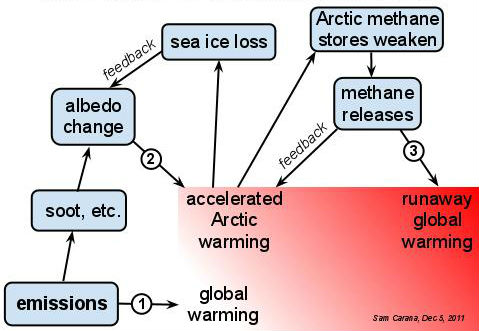
    The image below, from Sam Carana8 (2011), illustrates the danger of the situation in the Arctic, where high levels of greenhouse gases, combined with the impact of aerosols such as soot, can cause high summer temperature peaks.

    High temperatures in the Arctic will speed up loss of sea ice, resulting in even further warming that weakens stores of methane in the form of hydrates and free gas in sediments under the water, in a vicious cycle that threatens to lead to runaway global warming.

    For more details on feedbacks, see extended version of this image and discussion at
    arctic-news.blogspot.com/2012/08/diagram-of-doom.html
    3. Methane’s Lifetime

    The IPCC2 rates methane’s Radiative Efficiency (in W m–2 ppb–1) at 3.7 x 10⁻⁴ and gives methane a perturbation lifetime of 12 years9. The IPCC9 defines perturbation time as the time it takes for a perturbation to be reduced to 37% of its initial amount. At the same time, the IPCC10 gives methane a global mean atmospheric lifetime of 8.4 years, which is the time it takes for half a perturbation to be broken down.

    Methane’s lifetime will be extended as the burden rises, due to hydroxyl depletion. The IPCC11  estimates that this methane feedback effect amplifies the climate forcing of an addition of methane to the current atmosphere by lengthening the perturbation lifetime relative to the global atmospheric lifetime of methane by a factor of 1.4.

    A NASA12 (2009) article discussing Shindell’s work mentions that increases in global methane emissions have caused a 26% decrease in hydroxyl.

    Prather et al.13 (2012) derive a present-day atmospheric lifetime for methane (CH4) of 9.1 years.

    Methane is typically released gradually around the world, allowing much of the methane to be oxidized swiftly by hydroxyl in the tropics.

    In case of large abrupt releases of methane in the Arctic, much of the methane may persist there for decades and thus amplify local warming dramatically.

    This is the case because the methane originated in one location, unlike other types of methane releases that occur gradually around the world.
    There is very little hydroxyl present in the Arctic atmosphere, as illustrated by the image left, from Taraborelli et al.14 (2012).
    The little bit of hydroxyl that is present in the Arctic atmosphere will soon be depleted in case of large abrupt releases.
    While the methane will eventually spread around the world, this will take time. Nesbit15 (2002) mentions that a major methane release in the high Arctic would take 15-40 years to spread to the South Pole.
    Abrupt releases in the Arctic could thus cause dramatic local warming, while lack of hydroxyl in the Arctic  could further make Arctic methane stay there for decades, with a high LWP, threatening to trigger further methane releases.
    4. Abrupt release of 1Gt of methane in the Arctic

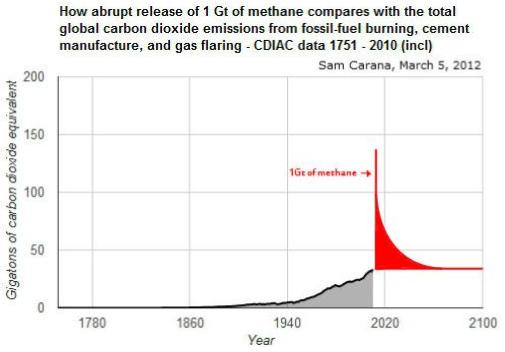
    What would the impact be of abrupt release of 1Gt of methane in the Arctic, compared to the total global carbon dioxide emissions from fossil-fuel burning, cement manufacture, and gas flaring? The image below, from Sam Carana16 (2012b), gives a rather conservative impact, showing a rapid decline toward a small residual impact as carbon dioxide.

    However, above graph does not include the indirect effect of triggering further releases. This is especially a threat in the Arctic, given the large presence of methane, the accelerated warming, the little oxidation that takes place in the Arctic atmosphere, and the time it will take for abruptly released methane to spread away from the Arctic.

    The additional warming that this will cause in the Arctic will make the sea ice decline even more dramatically than is already the case now. The combined impact of sea ice loss and methane is huge, and threatens to trigger further releases of methane in the Arctic, with their joint impact accumulating as illustrated in the image below, also from Sam Carana16 (2012b).

    Dramatic warming will first strike in the Arctic, but will soon spread, threatening to cause heatwaves and firestorms across North America and Siberia, adding additional soot and carbon dioxide in the atmosphere globally, as forests, peat bogs and tundras at higher latitudes burn, threatening to escalate in runaway global warming.

    References

    1. Sam Carana (2012a), Video and poster – methane in the Arctic
    http://arctic-news.blogspot.com/2012/05/video-and-poster-methane-in-arctic.html

    2. IPCC, Climate Change 2007: Working Group I: The Physical Science Basis, Table 2.14
    http://www.ipcc.ch/publications_and_data/ar4/wg1/en/ch2s2-10-2.html

    3. Drew Shindell et al. (2009), Improved Attribution of Climate Forcing to Emissions.
    http://www.sciencemag.org/content/326/5953/716.abstract

    4. M. G. Flanner et al. (2011), Radiative forcing and albedo feedback from the Northern Hemisphere cryosphere between 1979 and 2008.
    5. Natalia Shakhova et al. (2010)
    Presentation at SymposiumNovember 30, 2010

    6. Natalia Shakhova et al. (2008)
    EGU General Assembly 2008

    7.  Semiletov et al. (2012)
    On carbon transport and fate in the East Siberian Arctic land–shelf–atmosphere system
    http://iopscience.iop.org/1748-9326/7/1/015201

    8. Sam Carana (2011), AMEG Poster at AGU 2011.
    9. IPCC, Climate Change 2007: Working Group I: The Physical Science Basis, FAQ 10.3
    http://www.ipcc.ch/publications_and_data/ar4/wg1/en/faq-10-3.html

    10. IPCC, TAR (2001) Working Group I: The Scientific Basis, 4.1.1 Sources of Greenhouse Gases

    11. IPCC, TAR, 04 (2001), Atmospheric Chemistry and Greenhouse Gases, Executive Summary

    http://www.ipcc.ch/ipccreports/tar/wg1/128.htm

    12. NASA (2009), Interactions with Aerosols Boost Warming Potential of Some Gases
    http://www.giss.nasa.gov/research/news/20091029/

    13. Prather et al. (2012), Reactive greenhouse gas scenarios: Systematic exploration of uncertainties and the role of atmospheric chemistry
    http://www.agu.org/pubs/crossref/2012/2012GL051440.shtml

    14. Taraborelli et al (2012),  Hydroxyl radical buffered by isoprene oxidation over tropical forests
    http://www.nature.com/ngeo/journal/vaop/ncurrent/full/ngeo1405.html

    15. Euan G. Nisbet (2002), Have sudden large releases of methane from geological reservoirs occurred since the Last Glacial Maximum, and could such releases occur again?
    http://rsta.royalsocietypublishing.org/content/360/1793/581.abstract

    16. Sam Carana (2012b), How much time is there left to act?
    http://arctic-news.blogspot.com/p/how-much-time-is-there-left-to-act.html

  • Big thaw projected for Antarctic sea ice: Ross Sea will reverse current trend, be largely ice free in summer by 2100

    Featured Research

    from universities, journals, and other organizations

    Big thaw projected for Antarctic sea ice: Ross Sea will reverse current trend, be largely ice free in summer by 2100

    Date:
    February 27, 2014
    Source:
    Virginia Institute of Marine Science
    Summary:
    A new modeling study suggests that a recent observed increase in summer sea-ice cover in Antarctica’s Ross Sea is likely short-lived, with the area projected to lose more than half its summer sea ice by 2050 and more than three quarters by 2100. These changes will significantly impact marine life in what is one of the world’s most productive and unspoiled marine ecosystems.

    Emperor Penguins: Changes in the extent and duration of Ross Sea ice will significantly impact marine life in what is one of the world’s most productive and unspoiled marine ecosystems, where rich blooms of phytoplankton feed krill, fish, and higher predators such as penguins.
    Credit: Photo courtesy of Walker Smith

    Antarctica’s Ross Sea is one of the few polar regions where summer sea-ice coverage has increased during the last few decades, bucking a global trend of drastic declines in summer sea ice across the Arctic Ocean and in two adjacent embayments of the Southern Ocean around Antarctica.

    Now, a modeling study led by Professor Walker Smith of the Virginia Institute of Marine Science suggests that the Ross Sea’s recent observed increase in summer sea-ice cover is likely short-lived, with the area projected to lose more than half its summer sea ice by 2050 and more than three quarters by 2100.

    These changes, says Smith, will significantly impact marine life in what is one of the world’s most productive and unspoiled marine ecosystems, where rich blooms of phytoplankton feed krill, fish, and higher predators such as whales, penguins, and seals.

    Smith, who has been conducting ship-based fieldwork in the Ross Sea since the 1980s, collaborated on the study with colleagues at Old Dominion University. Their paper, “The effects of changing winds and temperatures on the oceanography of the Ross Sea in the 21st century,” appears in the Feb. 26 issue of Geophysical Research Letters. Smith’s co-authors are Mike Dinniman, Eileen Hofmann, and John Klinck.

    Smith says “The Ross Sea is critically important in regulating the production of Antarctica’s sea ice overall and is biologically very productive, which makes changes in its physical environment of global concern. Our study predicts that it will soon reverse its present trend and experience major drops in ice cover in summer, which, along with decreased mixing of the vertical column, will extend the season of phytoplankton growth. These changes will substantially alter the area’s pristine food web.”

    Researchers attribute the observed increase in summertime sea ice in the Ross Sea — where the number of days with ice cover has grown by more two months over the past three decades — to a complex interplay of factors, including changes in wind speed, precipitation, salinity, ocean currents, and air and water temperature.

    But global climate models agree that air temperatures in Antarctica will increase substantially in the coming decades, with corresponding changes in the speed and direction of winds and ocean currents. When Smith and his colleagues fed these global projections into a high-resolution computer model of air-sea-ice dynamics in the Ross Sea, they saw a drastic reduction in the extent and duration of summer sea ice.

    The modeled summer sea ice concentrations decreased by 56% by 2050 and 78% by 2100. The ice-free season also grew much longer, with the mean day of retreat in 2100 occurring 11 days earlier and the advance occurring 16 days later than now.

    Also changed was the duration and depth of the “shallow mixed layer,” the zone where most phytoplankton live. “Our model projects that the shallow mixed layer will persist for about a week longer in 2050, and almost three weeks longer in 2100 than now,” says Smith. “The depth of the shallow mixed layer will also decrease significantly, with its bottom 12% shallower in 2050, and 44% shallower in 2100 than now.”

    For Smith, these changes in ice, atmosphere, and ocean dynamics portend major changes in the Antarctic food web. On the bright side, the decrease in ice cover will bring more light to surface waters, while a more persistent and shallower mixed layer will concentrate phytoplankton and nutrients in this sunlit zone. These changes will combine to encourage phytoplankton growth, particularly for single-celled organisms called diatoms, with ripples of added energy potentially moving up the food web.

    But, Smith warns, the drop in ice cover will negatively affect several other important species that are ice-dependent, including crystal krill and Antarctic silverfish. A decrease in krill would be particularly troublesome, as these are the major food source for the Ross Sea’s top predators — minke whales, Adélie and Emperor penguins, and crabeater seals.

    Overall, says Smith, “our results suggest that phytoplankton production will increase and become more diatomaceous. Other components of the Ross Sea food web will likely be severely disrupted, creating significant but unpredictable impacts on the ocean’s most pristine ecosystem.”


    Story Source:

    The above story is based on materials provided by Virginia Institute of Marine Science. The original article was written by David Malmquist. Note: Materials may be edited for content and length.


    Journal Reference:

    Walker O. Smith, Michael S. Dinniman, Eileen E. Hofmann, John M. Klinck. The effects of changing winds and temperatures on the oceanography of the Ross Sea in the 21stcentury. Geophysical Research Letters, 2014; DOI:

  • Days to kill Keystone — the carbon mega-bomb AVAAZ

    e to enable desktop notifications for Gmail.   Learn more  Hide

    1 of 36
    Why this ad?
    TAFE Courses Onlinewww.opencolleges.edu.au – Study From Home At Your Own Pace Download A Course Guide Today.

    Days to kill Keystone — the carbon mega-bomb

    Inbox
    x

    Pascal V. – Avaaz.org

    2:57 PM (22 minutes ago)

    to me
    Dear friends,

    Right now, the US is deciding whether to approve a monster oil pipeline that would unleash devastating levels of carbon pollution from Canada’s dirty tar sands. The US State Department is holding a public comment process before the big decision, and insiders say they want a mandate to stand up to industry pressure. Let’s help by flooding the comment process with an overwhelming mandate to kill this carbon bomb — we only have days left:

    SIGN THE PETITION

    Right now, the US government is about to make the defining climate decision of Obama’s presidency — whether to approve a monstrous pipeline that will transport up to 830,000 barrels a day of the world’s dirtiest oil from Canada across the US.

    If approved, the Keystone XL pipeline will help pump billions of dollars into the pockets of a few companies… but also millions of tons of carbon into the atmosphere. It’s been called “a fuse to the biggest carbon bomb on the planet”. Bold public action has delayed it once, and a court ruling last week has dealt a serious blow to the project. Now, if we act fast and in massive numbers, we can help kill it for good.

    The US Secretary of State, responsible for the US’s relationship with the world, has opened a final round of comments from the public. He knows this decision is a vital litmus test for US global leadership to avert climate disaster. Let’s turn it into a truly global referendum by flooding the consultation with a million voices from every country calling on them to kill Keystone and take the leadership role they say they want in the fight to save the planet. We only have days until it closes – join here:

    http://www.avaaz.org/en/stop_the_keystone_xl_pipeline_loc/?bhPqncb&v=36676

    The heat from Big Oil is already intense — they’ve bought out the ads in DC subways that politicians pass through to get to work. If we hit a million signers, Avaaz will fight back on the DC battleground, taking out ads right next to theirs so Secretary Kerry and his staff see the people’s voices first and loudest.

    Big Oil ads are just the tip of the iceberg. We know that the US is under fire from industry lobbyists who will make serious money from the pipeline. But it will be at the cost of all of our futures. Tar sands oil is the dirtiest dirty fossil fuel ever cooked up – releasing 3-4 times the global warming pollution of normal petrol!

    Last year, Obama said he’d let Keystone go ahead only if it was found to be in the US’s national interest and if it could be proven that it wouldn’t worsen the climate crisis for future generations. And Secretary of State Kerry, who made climate change one of his signature issues, wants to lead on the world stage, so he’ll be more sensitive to global opinion. Pipeline supporters are answering with claims of more construction jobs and greater independence from petro-states. But Obama knows that the real jobs are in clean energy and that climate change is perhaps the greatest threat to US and global security there is.

    We’re already winning. Three years ago, this pipeline was a foregone conclusion. But then people-power swung into action — thousands were arrested at the largest act of civil disobedience in the US in decades, and Obama refused the initial proposal. Let’s do our part now by collecting the most international comments EVER for a US government decision and give Secretary Kerry and President Obama the public cover they need to reject the Keystone carbon bomb:

    http://www.avaaz.org/en/stop_the_keystone_xl_pipeline_loc/?bhPqncb&v=36676

    Wherever we are in the world — Alberta, Canada, where the pipeline would begin; the UK, still recovering from historic floods; Australia, just emerging from a summer ravaged by record fires, or any other country where extreme weather is taking its toll — we’re all downstream from climate change. If we stand together today, we can all be a part of a victory to stop this crazy pipeline and help build a strong climate movement.

    With hope,

    Pascal, David, Luis, Antonia, Emma, Patri, Wen, Ricken, and the Avaaz team

    SOURCES:

    Pressure is on Kerry as Keystone pipeline decision nears (Washington Post):
    http://www.washingtonpost.com/national/health-science/pressure-is-on-kerry-as-keystone-pipeline-deci…

    Pipeline Fight Lifts Environmental Movement (New York Times):
    http://www.nytimes.com/2014/01/25/us/keystone-xl-pipeline-fight-lifts-environmental-movement.html

    10 Reasons to Oppose the Keystone XL Pipeline (The Huffington Post):
    http://www.huffingtonpost.com/rose-ann-demoro/10-reasons-to-oppose-the-_1_b_4791713.html

    Oil sands pollution two to three times higher than thought (Yahoo News):
    http://news.yahoo.com/oil-sands-pollution-two-three-times-higher-thought-210153802.html

    How Much Will Tar Sands Oil Add to Global Warming? (Scientific American):
    http://www.scientificamerican.com/article/tar-sands-and-keystone-xl-pipeline-impact-on-global-warmin…

    Foreign Company Tries To Seize U.S. Land For Keystone Pipeline (Forbes):
    http://www.forbes.com/sites/jamesconca/2014/02/24/foreign-company-tries-to-seize-u-s-land-for-keysto…


    Avaaz.org is a 33-million-person global campaign network
    that works to ensure that the views and values of the world’s people shape global decision-making. (“Avaaz” means “voice” or “song” in many languages.) Avaaz members live in every nation of the world; our team is spread across 18 countries on 6 continents and operates in 17 languages. Learn about some of Avaaz’s