Category: Uncategorized

  • Linking the floods with climate change – and why it’s important

    Linking the floods with climate change – and why it’s important

    Perhaps I’m sensitive, but there doesn’t seem to have been much debate about whether the current UK floods are linked with climate change. The connection has appeared for a day or two but has never been the story for long.

    I’m going to look at this in two ways: firstly, what it’s meant for public opinion, and secondly, why it matters.

    When the media aren’t talking about an issue, it generally doesn’t get polled about – so we don’t have much data on opinion about the floods and climate change. But we can cobble together a few different polls and get some sense:

    1)      People think the UK will suffer more flooding as a result of climate change

    A Defra poll last year found people overwhelmingly think that flooding has got more common, and will continue to do so*.

    2)      People tend to see weather extremes in general as climate change-related

    The last Carbon Brief energy/climate change poll tested how far record-breaking weather of the last few years is seen as linked with climate change. It found just under half think they’re linked: a plurality but hardly decisive.


    3)      These floods in particular haven’t really been linked with climate change

    The only poll I know of asking whether people connect these floods with climate change, by YouGov, found a roughly even split, with slightly more saying they’re probably not linked.

    This was done before the Met Office published their report making a link, which got a bit of coverage. But as Carbon Brief have shown, only a small proportion of news articles about the floods have mentioned climate change, so it would be surprising if opinion has changed hugely.

    Why does it matter?

    It’s contentious to say that climate campaigners should be declaring that these floods are the result of climate change.

    On the one hand, it seems plausible to say they are climate-related, because they’re exactly the kind of thing that’s projected to happen as a result of climate change, and they’re unlikely to have happened without the effects of human-caused warming. But on the other hand, it’s possible they might have happened without climate change – so we can’t be certain.

    But here’s the problem: we will never be certain that a particular weather event is linked with climate change. And showing what climate change means for the UK is a really good way of explaining why we need to tackle it. If we wait until we’re utterly certain – as opposed to just very confident – we’ll miss the last boat evacuating the village.

    So, there’s been very little discussion of the likelihood that this kind of weather and consequent flooding, which are freakish at the moment, will become increasingly normal.

    To give just one example of why that matters, there’s been a bit of buzz about the idea of building a lagoon in Bridgewater Bay. It would generate electricity and cut flooding in the Somerset Levels. Sounds a great idea, but it would cost a bomb and take years to build. If that buzz fades after a few months – because we don’t connect these rains with climate change so don’t think they’re likely to happen again for another 200 years – we might wait until a few more rounds of serious flooding before we even get started with the planning process, which would mean thousands more people flooded when we could have acted sooner.

    The flooding, being so dominant in the news, is a time when climate change could be part of everyday conversations and the consequences of its unmitigated impacts for the UK could be made clear. World-leading scientists are prepared to say that human activities have made these floods more likely – and that they’ll become increasingly common if we don’t act.

    Yet climate change has barely registered and as a result there has been very little discussion about how we stop these floods happening again in a world where more extreme weather will make them more likely. It may be too late to change the debate during this set of flooding, but it needn’t be the case next time.


    * In isolation, this question looks like it could be to do with planning decisions rather than just climate change. But in practice, it followed a question about long-term changes to the UK’s weather and is in a series with others about dry periods and snowfall etc, so I think it’s fair to assume it was interpreted as a question about climate change.

    FacebookShare

    This entry was posted on Tuesday, February 11th, 2014 at 22:13 and is filed under Climate Sock. You can follow any responses to this entry through the RSS 2.0 feed. You can leave a response, or trackback from your own site.

  • How does the Thames Barrier stop London flooding?

    11 February 2014 Last updated at 14:

    How does the Thames Barrier stop London flooding?

    By Tom de Castella BBC News Magazine

    Thames Barrier

    Continue reading the main story

    The Thames Barrier has been in record use over the past two months. How does it work?

    A map released by its operator, the Environment Agency, in December showed how London would look if sea levels continued to rise and there was no barrier. The Houses of Parliament, the O2 arena, Tower Bridge, and areas including Southwark, the Isle of Dogs, Whitechapel and West Ham were shown to be flooded.

    The barrier, built in 1982 on the Thames on the eastern side of the capital at Woolwich, was designed to protect 48 sq miles (125 sq km) of central London from flooding caused by tidal surges.

    Map of London showing how it might be affected by flood without the Thames barrier How London might be affected by flooding from the sea without the Thames Barrier

    At the moment, with so much rainfall travelling down the Thames, there is a danger during high tide that the extra water will be pushed back up river by the sea and cause flooding in the capital and to the west.

    To prevent this, the barrier has been used at record levels, says Eamonn Forde, one of its controllers. It has closed 28 times since 6 December. This represents one fifth of all the closures – about 150 – since it was inaugurated.

    Some years it hasn’t been used at all. When it shut in December 2012, it was reported to be the first closure since March 2010.

    The barrier, made up of 10 steel gates, reaches 520m (1,700ft) across the river. When open, the gates lie flat on the river floor and close by being rotated upwards until they block the river. The four main gates span 61.5m (200ft) and weigh more than 3,000 tonnes each. The barrier is closed just after low tide to create an empty “reservoir” for the river flow to fill up. It takes 75-90 minutes to close it, starting with the gates on the outside until the middle gates are shut.

    Thames barrier
    Thames barrier
    • Open – Allows the Thames to flow freely and ships to pass through the gates
    • Closed – Creates a solid steel wall preventing water flowing upstream towards the capital
    • Underspill position – Allows a controlled amount of water to pass under the gate and up the Thames

    With no barrier, at high tide, the sea would normally flow up the estuary and into London, pushing the river water back. With all the extra rainfall, this could worsen the flooding. The barrier prevents this from happening. The gates are left shut and the river water is held until the tide turns. Staff wait for the water on both sides to “equalise” – reach the same level – and then the gate is opened and the river water can rush out into the estuary.

    There is no danger that the water will overwhelm the barrier. “We’ve got a massive amount of room.”

    Continue reading the main story

    Oosterscheldekering

    Oosterscheldekering
    • Largest tidal surge barrier in the world, situated between Dutch islands of Schouwen-Duiveland and Noord-Beveland
    • One of 13 barriers in the Delta network, built to protect the Netherlands from flooding, it was opened in 1986 by Queen Beatrix
    • Designed to last 200 years; the plaque on the barrier bears the inscription: “Here the tide is ruled, by the wind, the moon and us”

    Storm surge from the North Sea, high tides and exceptional fluvial (river) flow are the three factors that make it necessary. At the moment the major factor is the amount of water flowing down the Thames. “We’re predominantly closing to help reduce levels the other side of Teddington Weir,” Forde says.

    How much difference is the barrier making?

    “We’re reducing the level by inches,” he says. That impact is felt up the Thames as far as Molesey – about 12 miles from central London. That is where the effect of the tide runs out. Inches may not sound a lot but it could be the difference between ground level and someone’s house, Forde says.

    The barrier was closed at 10:30 GMT on Tuesday, for instance. It was to open later when the tide turned. Forde expects it to close again on Wednesday. The forecasts for the staff at the barrier – they have weather and storm measuring systems based in the North Sea – show deteriorating weather. A spring (higher) tide is also beginning on Wednesday.

    For most of its history, London lacked such protection. In 1928, 14 people drowned when a swollen Thames overflowed between the City and Southwark to the east and Putney and Hammersmith to the west. According to contemporary reports, the streets were filled with water up to 4ft (1.2m) deep.

    thames flood of 1928 1928: The last time the Thames flooded the streets of London

    The 1953 North Sea flood, which resulted in one London death and flooding at Silvertown, in the east, prompted calls for a mechanism to protect the capital. Construction on the Thames Barrier began in 1974 and it was officially opened a decade late.

    The barrier was originally designed to last up to the year 2030. Recent analysis suggests that even with sea level rise from anticipated climate change the barrier will be sufficient protection until 2060-70.

    Follow

  • Oceans warmed at a rate of 12 Hiroshima bombs per second in 2013 as temperatures spiked

    1 of 1
    Why this ad?
    650% Investment Returnstodaysbestinvestments.com – Invest In Alternative Investments. Huge Profits. Free Top-Pick Guide!
     Courtesy of David Spratt

    climate code red

    Inbox
    x

    Climate Code Red noreply@blogger.com via google.com

    8:14 PM (40 minutes ago)

    to me

    climate code red


    Oceans warmed at a rate of 12 Hiroshima bombs per second in 2013 as temperatures spiked

    Posted: 11 Feb 2014 02:36 PM PST

    by Lindsay Abrams, via Salon.com 

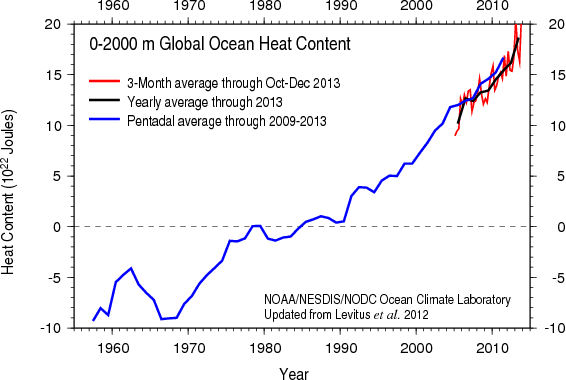
    Think global climate change hasn’t been very noticeable from where you’re standing? Down in the oceans (which is to say, over the majority of Earth’s surface), temperatures spiked last year, as warming proceeding at an incredibly rapid pace.
    Skeptical Science calls attention to the oceans’ temperature rise for the final quarter of 2013, which literally was almost off-the-charts:

    (via the National Oceanic Data Center)

    Put in terms that are easy (if horrifying) to visualize, Skeptical Science explains that the oceans used to be warming at a rate equivalent to about 2 Hiroshima bombs per second. Over the past 16 years, that’s doubled to a rate of 4 bombs per second. But in 2013, the warming became so dramatic that it was equivalent to 12 Hiroshima bombs every second. Seriously.

    When you hear climate skeptics talking about a “pause” in global warming, that’s where the heat is going — 378 million atomic bombs worth of it each year. And as Quartz points out, it’s not like the oceans are just storing all that heat for us and protecting us from the effects of climate change: warmer oceans mean more severe typhoons and hurricanes, rising sea levels and damage to marine life.

  • Australian research will help better locate wind turbines

    Australian research will help better locate wind turbines

    By on 12 February 2014
    Print Friendly

    CleanTechnica

    A new study published by an Australian researcher has determined that small- and medium-sized wind turbines can not only be placed in inefficient locations, but can be installed in locations where they will have no benefit whatsoever.

    The study was authored by Amir Bashirzadeh Tabrizia, from Murdoch University in Perth, Western Australia, who used Computational Fluid Dynamics (CDF) to model wind flows in order to perform a resource assessment for the installation of small wind turbines.

    As Tabrizia and his co-authors noted in their abstract, “the installation of small and medium-size wind turbines on the rooftops of high buildings has been often suggested by architects and project developers as a potential solution for achieving sustainable energy in building design.”

    They add, however, that “because of the presence of buildings and other adjacent obstructions, wind is normally turbulent, unstable and weak, in terms of direction and speed.”

    Quoted by Chris Thomas for the ScienceNetwork WA, Tabrizia notes that “the performance of small wind turbines in the built-environment is really sensitive to the place you put them. If you put them in wrong place, you will not get any power. Unfortunately, there are several bad examples around Perth where they have put the machines in shadow and they don’t work, not even in windy conditions.”

    Not only is there the likelihood that the turbines will have no practical benefit, but there is also the possibility of breaking and damage. Tabrizia noted instances where some of the turbines in “the built-environment … failed and broke.

    “There was even some damage to cars in parking lots, due to broken blades from the small turbines.”

    The aim of the study was to better simulate where wind turbines could be placed to maximise their efficiency, based on Computational Fluid Dynamics.

    “Through wind simulation in the target area, CFD helps to find the right place for the turbine with higher wind speed to avoid re-circulation and shadow zones, also putting the machine where it will generate more power,” Tabrizi said.

     Source: CleanTechnica. Reproduced with permission.


  • Grantham: Wind, solar to replace fossil fuels within decades


    Grantham: Wind, solar to replace fossil fuels within decades

    By on 11 February 2014
    Print Friendly

    Legendary hedge fund investor Jeremy Grantham says there is no doubt that solar and wind energy will “completely replace” coal and gas across the globe, it is just a matter of when.

    The founder of $100 billion funds manager GMO Capital is known as a contrarian. But he suggests that the pace of change in the fuel supply will surprise everyone, and have huge implications for fossil fuel investments.

    “I have become increasingly impressed with the potential for a revolution in energy, which will make it extremely unlikely that a lack of energy will be the issue that brings us to our knees,” Grantham writes in his latest quarterly newsletter.

    “Even in the expected event that there are no important breakthroughs in the cost of nuclear power, the potential for alternative energy sources, mainly solar and wind power, to completely replace coal and gas for utility generation globally is, I think, certain.

    “The question is only whether it takes 30 years or 70 years. That we will replace oil for land transportation with electricity or fuel cells derived indirectly from electricity is also certain, and there, perhaps, the timing question is whether this will take 20 or 40 years.”

    Grantham’s predictions go against the conventional wisdowm of the fossil fuel industry, but they the thoughts of many people, including Stanford researcher Tony Seba, who said last year this could occur within a few decades.

    And Grantham says it could happen quicker than even he believes, and will have major implications for new investments in the fossil fuel industry – a topic very much in mind for project developers and bankers in Australia.

    “I have felt for some time that new investments today in coal and tar sands are highly likely to become stranded assets, and everything I have seen, in the last year particularly, increases my confidence,” Grantham writes.

    “China especially is escalating rapidly in its drive to limit future pollution from coal and gasoline and diesel powered vehicles. Increased smog last year in major cities led to an unprecedented level of general complaint.

    “China simply can’t afford to have Chinese and foreign business leaders leaving important industrial areas in order to protect the health of themselves and their families. Nor are they likely to be comfortable with a high level of sustained complaint from the general public. They have responded in what I consider to be Chinese style, with a growing list of new targets for reducing pollution. A typical example recently was an increase of 60% in their target for total installed solar by the end of 2015! Hardly a month goes by without a new step being announced.”

    He also questioned whether th $650 billion spent by the fossil fuel industry searching for new oil reserves was a smart idea, given his recent experience of a colleague’s Tesla. Grantham, the former onwer of a 12-year-old Volvo, described his journey from New York to Boston as his best ever car experience, and suggested that the slump in battery costs would mean the $75,000 vehicle like Teslas would soon be available at $40,000.

    “One can easily see that in 10 years there could be a new world order in cars. (And if that weren’t enough, there is a wholly different attack on the traditional gasoline engine from an entirely new technology, the hydrogen fuel cell, to be introduced by Toyota this year.)

    In short, with slower global economic growth, more fuel-efficient gasoline and diesel vehicles, more hybrids, cheaper electric cars, more natural gas vehicles, and possibly new technologies using fuel cells and, conceivably, methanol, it is certain that oil demand from developed countries will decline, probably faster than expected.

    “Some emerging countries, notably China, are likely to take more dramatic and faster steps to reduce demand than we have ever thought about. Already they have 200 million electric vehicles – mostly motorbikes – almost as many as the rest of the world squared.

    “Total global oil demand at current prices or higher is likely to peak in 10 years or so. At much lower prices we would fairly quickly lose most of our high-cost production: deep offshore, fracking, and tar sands.

    “Times may be changing faster than we think. My guess is that oil prices will be higher than now in 10 years, but after that, who knows?

    “The idea of “peak oil demand” as opposed to peak oil supply has gone, in my opinion, from being a joke to an idea worth beginning to think about in a single year. Some changes seem to be always around the corner and then at long last they move faster than you expected and you are caught flat-footed.”


  • Australia’s Energy White Paper – a prescription for poor health.


    Australia’s Energy White Paper – a prescription for poor health.

    By on 12 February 2014
    Print Friendly

    The Department of Industry is now collating responses to its Energy White Paper (EWP) and formulating what will likely be a roadmap to Australia’s future energy landscape.

    An overarching plan for the future may be eminently sensible, but only if the information that those plans are based upon is accurate and representative.

    The EWP sets out to address energy security, reliability, transparent and competitive pricing and efficiency including regulatory reform.

    So, to achieve its stated aims the full costs of energy generation including social and environmental costs must be assessed and accounted for.  But herein lies the first major problem with the EWP. These hidden costs, or externalities, are barely considered if mentioned at all.

    Energy and transport related fossil fuel combustion (and extraction) produce the vast majority of Australia’s harmful air pollutants as well as greenhouse emissions.

    Air pollution is a significant contributor to illness and mortality from the major non-communicable diseases that affect our community; heart and lung disease, stroke and lung cancer. Illnesses that result in significant welfare and healthcare costs and reduce worker productivity. The estimated health costs associated with outdoor air pollution in Australia are up to $8.4 billion each year.

    Climate change resulting from greenhouse gas emissions is the dominant long-term factor. The World Bank has described climate change as “a fundamental threat to sustainable economic development and the fight against poverty”.  With just 0.7C of average global warming, health impacts from climate change already contribute to over 140,000 deaths each year according to the WHO, and here in Australia heat-wave mortality and a range of other health impacts are already being observed.

    Coal is the most polluting fossil fuel. Epstein and Harvard colleagues calculated that accounting for its life-cycle externalities conservatively doubles or triples the price of electricity in the US, and notes that many of these costs are also cumulative.

    And US economist Nordhaus found the pollution costs of coal fired generation 0.8 to 5.6 times its value added. In other words, the damage caused is worth at best 80 per cent of the net value of the industry and at worst 5.6 times greater..

    By ignoring these very real and significant costs, especially of air pollution and climate change, the EWP and subsequent papers will be unable to make meaningful comparisons or predictions of energy costs, not to mention the lack of transparency.

    But there are other important aspects of climate change that have been missed in the EWP, relating to energy security and productivity.

    Generation, transport and transmission infrastructure can be highly vulnerable to disruption from extreme weather events including associated flooding and bushfires, and longer term changes such as droughts from changing rainfall patterns. The latter is especially problematic for water intensive thermal power generation.

    Workforce health and productivity is also affected by increasing nocturnal temperatures that facilitate good quality sleep, average daytime and maximum temperatures, particularly with outdoor occupations.

    These are very relevant to energy security, resilience and productivity and as a consequence of omission the potential advantages of alternative decentralized and renewable energy technologies are excluded.

    Concern is raised about the potential effects on further renewable energy growth on electricity costs, “surety of supply” and providing a “regulated return on the existing asset base”, and that the “review of the renewable Energy Target will inform policy development on this issue”. In marked contrast, fossil fuels subsidies and the market distortion and inefficiency they produce, are not included in the report.

    Regulatory reform in the EWP focuses on reducing costs to business. But its importance in protecting environmental and human health glossed over. There are already systemic and major problems with regulatory inadequacies in Australia as we highlighted in a recent report “The Health Factor”. Reducing regulation therefore risks worsening health and environmental outcomes still further.

    Curiously, this anti-regulation focus does not extend to the extraordinary and unjustified over-regulation of wind turbines.

    Gas appears to be a special case in the EWP, with is rapid growth a given and regulatory controls relaxed to facilitate this. It will apparently address both impending energy security and massive export earnings, and assist in more affordable energy, with no significant concerns raised about health and environmental impacts nor implications for greenhouse emissions.

    One cannot help but conclude there is a significant ideological agenda driving this selective choice of information and direction in the EWP.

    This is explored in more detail in our submission to government from Doctors for the Environment Australia.


    Click for DEA’s submission to the EWP

    Dr George Crisp WA representative of Doctors for the Environment Australia