Category: Uncategorized

  • Energy Darwinism to hit Australian utilities – Citigroup


    Energy Darwinism to hit Australian utilities – Citigroup

    By on 12 February 2014
    Print Friendly

    Leading investment bank Citigroup says Australian utilities will be impacted by the ‘energy Darwinism” that is currently sweeping the global electricity industries. And despite the opportunities that the transformation offers, incumbency is not likely to be an advantage and Australian utilities have a high risk that they will come off second best.

    The 72-page report, lead authored by Elaine Prior, says change is already underway with grid-scale plant in Australia losing volume to roof-top solar, and the operations of gas and coal-fired generators being wound back.

    She notes there are numerous factors playing to the major changes taking place in the industry. But the most important of these will be the extent and speed of technology development and cost reductions for solar, battery or other storage solutions, and other distributed generation / smart / renewable technologies and solutions.

    “If costs fall to the extent that these technologies can be competitive, even if network charges are restructured to make renewables more expensive and regulatory support is limited, then the fundamental driver exists for increased adoption,” Prior writes.

    “Technology and new product development appears to be progressing rapidly around the world, and may drive substantial change in Australia sooner than many anticipate.

    Prior notes that storage options and large scale solar are now being trialed, innovation is increasing in the retail space, and new entrants and new products are challenging the incumbents, who are not commanding strong public trust.

    “Big Data will help to create a new and competitive market of services for utilities, where customer service and brand name are key,” it notes. “These are attributes where traditional utilities may lag.”

    The Australian analysis suggests that despite the opportunities offered to utiilties, these are outweighed by the risks because many of the opportunities have lower barriers to entry, meaning more new players. “Competition will be stronger and incumbency may be less of an advantage,” the report notes.

    The analysis notes the “Energy Darwinism” report that Citi prepared last year and looked at global trends, as well as the CSIRO Future Grid report released late last year that predicted rapid change in the way the electricity market is structured


    citi gridsPrior sees the key risks to incumbents in Australia include lower demand, the potential for customers to leave the grid, and potential asset writedowns.

    “In Australia, we see increasing risks to incumbents including: lower grid volumes affecting generators and networks; reduced utilization and closure of gas plant due to higher gas prices, lower carbon prices and higher solar penetration; and the potential for revised pricing and lower cost storage to encourage households to reduce demand at high priced times of day or to leave the grid.

    “Network writedowns are possible, with no indication of whether these might be partly borne by private network operators. Electric vehicles might offset demand shrinkage, but logically would seek low-carbon power. Their batteries might alleviate peak demand pressures, but could reduce revenues from time-of-use pricing and enhance the viability of rooftop solar.”

    However, in our view, the most critical determinant of the medium term trajectory will be the extent and speed of technology development and cost reductions for solar, battery or other storage solutions, and other distributed generation / smart / renewable technologies and solutions. If costs fall to the extent that these technologies can be competitive, even if network charges are restructured to make renewables more expensive and regulatory support is limited, then the fundamental driver exists for increased adoption. Technology and new product development appears to be progressing rapidly around the world, and may drive substantial change in Australia sooner than many anticipate.

    It notes that the list of opportunities include smart meters, distributed generation, EVs, large scale renewables and energy efficiency.

    “Opportunities abound,” Prior writes. “For example: smart meters, smart appliances, communications technology for remote control; distributed generation, including solar; large scale renewables; battery or other storage, both household and grid scale; electric vehicles and support infrastructure; energy efficiency and demand management initiatives.

    “However, in some of these areas there will be low barriers to entry, or new players will have expertise, so incumbent utilities may face substantial competition as they navigate new directions. “

    To what extent the utilities took up these opportunities depended on the initiative of individual companies.

    “We sense that some of the more vociferous industry incumbents would like to see growth of solar and other distributed generation discouraged,” Prior notes,because it could reduce demand from existing generation plant (most likely higher cost intermediate-load plant), and reduce volumes through network assets. If storage gains traction, baseload could also be threatened.”

    She cites two examples, the push by the Electricity Supply Association for higher network charges, and the suggestion from Origin Energy CEO Grant King that the Renewable Energy Target (RET) could be pushed out.

    She says this indicate that both organisations may see potential threats to their existing businesses. smart appliances, communications technology for remote control / and demand management.” Indeed, it is borne out by the recent submissions of a range of generators and network operators – both private and publicly owned – that are calling for the RET to be removed.


  • AGL dives deeper into coal – have renewables lost a friend?


    AGL dives deeper into coal – have renewables lost a friend?

    By on 12 February 2014
    Print Friendly

    The utility that once prided itself on being the cleanest in Australia, and insisted that the best way to prepare for a clean energy future was to invest in renewables, is proposing to dig itself deeper into coal.

    AGL Energy on Wednesday announced it had won the bidding for Macquarie Generation – the largest coal generator in NSW – for the knock down price of $1.5 billion. Like its 2012 purchase of Loy Yang A, the biggest brown coal generator in the country,  AGL has found itself in the right place at the right time.  It’s no doubt terrific news for shareholders, the bigger question is what it means for the future of renewable energy in this country.

    agl hydroAGL has been one utility in the country that has not had an antagonistic attitude towards wind energy and solar. It has supported the renewable energy target, and it chairs the Clean Energy Council, and has been the biggest individual investor in wind and solar farms. Its presentation for the MacGen purchase even begins with a picture of clean running water.

    Now, however, if the purchase of the 2.6GW Bayswater and 2GW Liddell coal-fired generators in the Hunter Valley are approved, its leverage to fossil fuel income over renewables will jump from around 7:1 to 12:1, analysts say. The company that once had an emissions intensity (0.36t/MWh) – little more than one  third the country’s average – will now have one of the highest.

    The proposed purchase will come under scrutiny from the Australian Competition and Consumer Commission (ACCC), which has already flagged its concerns about AGL owning more than one quarter of generation in three key states – NSW, Victoria and South Australia, and being in a position to control market prices.

    But there are broader questions for the renewable energy industry in this country is whether AGL will remain as staunch a supporter of green energy and the rapid transition to a low carbon economy as it has been in the past. It is hard to imagine given it is moving quickly in the opposite direction.

    AGL wasn’t commenting over and above its media statement today. At the time of the Loy Yang A purchase (another knock-down price), CEO Michael Fraser insisted the company had not “changed its stripes” and it was a good thing that it could us “coal cash” to invest in renewables.

    But now that it proposes to further increase its leverage to fossil fuels, and become the largest coal-fired generator in the country, exactly how supportive of renewable will it be.

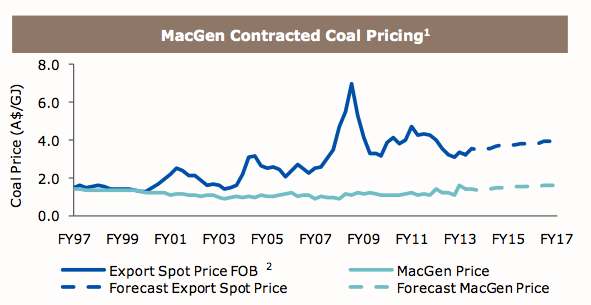
    agl coal priceThe real attraction of the purchase is that MacGen can source its coal so cheaply it can get its money back from the purchase in just 7 years. Thanks to historic contracts, the coal it uses (more than 10 million tonnes a year) is literally shoveled on to conveyor belts at an average cost of just $34/tonne – that is less than one half of the price that those same mines receive for exported coal.

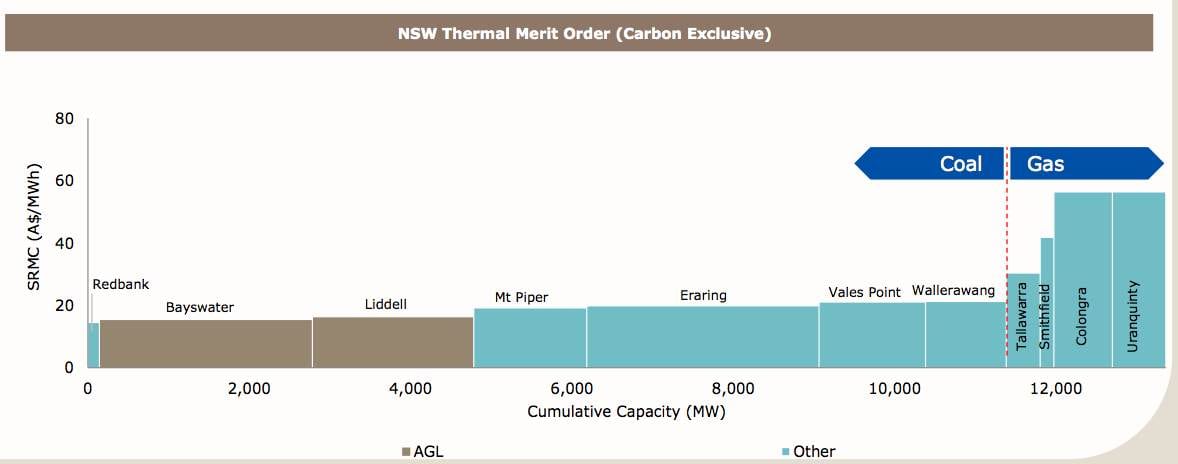
    Even with a predicted 25 per cent increase in those coal contracts in coming years, MacGen will still sit – as Loy Yang A does in Victoria – at the bottom of the “merit order” for thermal generators in the two states.

    That should mean that AGL is better protected from some of the seismic shifts that are sweeping the electricity industry, and which have forced more expensive coal-fired generators such as Tarong, Collinsville, Playford and, imminently, Wallerawang, to be closed or mothballed.

    agl merit order

    It should be noted that Liddell is old and creaking and will possibly be closed well before its due to retirement date of 2022. Last year, because of “availability issues” it had a net capacity factor of just 35 per cent. That hardly makes it baseload – most Australian wind farms – including AGL’s have higher capacity factors.

    Still, AGL has now nearly doubled its exposure to the threat of declining demand and the impact of distributed generation –  the arrival of rooftop solar and the potential addition of battery storage. Even if the purchase is priced that it can get its money back quickly, those revenue streams will be worth protecting.

    AGL has defended the renewable energy target  – and lambasted those who sought to pull it down: Its chairmanship of the CEC would hardly permit it to do anything else.

    But its submission to the energy white paper is informative, and suggests its priorities are shifting. It argues strongly for policies in the gas market, and for deregulation of the retail market, but does not argue a particular position on the RET.

    Instead, AGL adopts the language used by other generators and utilities who argued specifically for the RET to be either dumped altogether, or severely diluted. It warns against the decline in demand, worsened by the influx of renewables, that is causing wholesale electricity pool clearing price to be “sub-economic”.

    AGL wants the gap between the wholesale price addressed, either through some form of capacity payments to keep plant open, and/or a mechanism that helps ageing and/or inefficient plants to exit the market permanently.

    At no point does it argue specifically for the RET target to be retained as is. It says this:

    “The decline in demand has also contributed to the existence of surplus generation capacity, particularly a surplus of baseload capacity. The Renewable Energy Target was designed with a view that new renewable investment would be required to meet increased electricity demand.

    “As demand declined but supply continued to be added, this led to the market becoming oversupplied, with the consequence that current wholesale electricity prices (and a declining real penalty price for LGCs) are unlikely to support new investment in renewable generation.”

    “Accordingly, the Government’s energy reform agenda should incorporate policy measures that create a more sustainable wholesale market that facilitates new investment in an economically optimal generation mix while ensuring appropriate incentives are in place for older, less efficient plan to be withdrawn. A long-term and sustainable climate change policy framework is critical for facilitating efficient investment decisions in long-lived electricity infrastructure.”

    The renewable energy industry in Australia now finds itself in an absolute pickle: Uncertainty about the RET has effectively brought investment to a halt; its strategy of negotiated compromise and its lack of ambition (can anyone name one renewable energy company which has loudly argued for a 40 per cent target by 2030, for instance) has left it little room to manoeuvre. At best, if faces a significant reduction in the target.

    At worst, the industry will simply be brought to a halt. It appears certain that the RET review is to be managed by Prime Minister Tony Abbott’s office and controlled by the hard-liners who surround him and don’t even accept the science of climate change, let alone the need for wind and solar; and now its most powerful and influential facilitator is buried in the profits of coal generation.

    Fraser had spent many years arguing that the best way to prepare for the carbon price was to be in clean energy. (It is sometime said that many of his fellow company executives did not share his enthusiasm for renewables). After the purchase of Loy Yang A, Fraser said the best way to prepare for the clean energy future was to be the cheapest.

    Interestingly, the purchase of MacGen is predicated on there being no carbon price at all, or a market carbon price of just $7 a tonne in 2015. The European carbon price, the one that collapsed so spectacularly last year and presented Tony Abbott with a gift horse in the mouth, is now trading at $10/tonne and is certain to go higher.

    AGL’s proposal looks a short-term winner for shareholders, which is what counts in the way our financial system rewards our board and executives. Time will tell whether its new strategy of fading to black is a long term gain.

    Share this:

    • Sean

      Why is there still no ability for consumers to buy their power directly from the wholesale market? This would provide lower power cost to consumers in times of low demand, and increase generator use.

    • Chris Fraser

      Michael Fraser has said;-
      “policy measures that create a more sustainable wholesale market that facilitates new investment in an economically optimal generation mix while ensuring appropriate incentives are in place for older, less efficient plan to be withdrawn”. Here’s what that means to me …
      Interest in renewables is one noble thing, or noble whenever it suits, but ultimately survivability and self-interest in your business and largely your industry is holds sway over thoughts and eventually words. It goes to show the unanticipated success and popularity of solar and wind, and the ability of a negating government to change your future plan. They really did need a strict clean energy policy !
      Clearly, the arrangement of wholesalers being able to balance their own investment in central generators with demand has been too comfortable. The RET and disruptive solar has diminished their coal energy business. As long as Mum & Dad are putting discretionary amounts into rooftop PV it strikes at the heart of what they do, regardless of how efficiently they do it. It’s not about about investing in clean and removing dirty. If the carbon price goes they want to keep the dirty and close the shop to a few. The purchase of Bayswater and Liddell would be the perfect hedge.

  • Terrorism or Heroism? MONBIOT

    1 of 39
    Why this ad?
    Become a Counsellorwww.opencolleges.edu.au – Study Your Diploma Course Online. Special Course Fee Offer. Ends Soon

    Monbiot.com

    Inbox
    x

    George Monbiot news@monbiot.com via google.com

    6:05 PM (52 minutes ago)

    to me

    Monbiot.com


    Terrorism or Heroism?

    Posted: 10 Feb 2014 12:33 PM PST

    If you join foreign conflicts you’re prosecuted as a terrorist, however just your cause.


    By George Monbiot, published in the Guardian 11th February 2014

    If George Orwell and Laurie Lee were to return from the Spanish Civil War today, they would be arrested under Section 5 of the Terrorism Act 2006. If convicted of fighting abroad with a “political, ideological, religious or racial motive”, a charge they would find hard to contest, they would face a maximum sentence of life in prison(1). That they were fighting to defend an elected government against a fascist rebellion would have no bearing on the case. They would go down as terrorists.

    As it happens, the British government did threaten people leaving the country to join the International Brigades, by reviving the 1870 Foreign Enlistment Act. In 1937 it warned that anyone volunteering to fight in Spain would be “liable on conviction to imprisonment up to two years”(2). This was consistent with its policy of non-intervention, which even Winston Churchill, initially a supporter, came to see as “an elaborate system of official humbug”(3). Britain, whose diplomatic service and military command were riddled with fascist sympathisers, helped to block munitions and support for the Republican government, while ignoring Italian and German deployments on Franco’s side.

    But the act was unworkable, and it was never used – unlike the Crown Prosecution Service’s far graver threat to the British citizens fighting in Syria. In January, 16 people were arrested on terror charges after returning from Syria(4). Seven others are already awaiting trial. Sue Hemming, head of counter-terrorism at the Crown Prosecution Service explained last week that “potentially it’s an offence to go out and get involved in a conflict, however loathsome you think the people on the other side are. … We will apply the law robustly.”(5)

    People fighting against forces which run a system of industrialised torture and murder and are systematically destroying entire communities could be banged up for life for their pains. Is this any fairer than imprisoning George Orwell would have been?

    I accept that some British fighters in Syria could be changed by their experience. I also accept that some are already motivated by the prospect of fighting a borderless jihad, and could return to Britain with the skills required to pursue it. But this is guilt by association. Some of those who go to fight in Syria might develop an interest in blowing up buses in Britain, just as some investment bankers might be tempted to launder cash for drugs dealers and criminal gangs. We don’t round up bankers on the grounds that their experience in one sector might tempt them to dabble in another. (The state won’t prosecute them even when they do launder money for drugs gangs and terrorists, as the HSBC scandal suggests(6)). But all those who leave Britain to fight in Syria face potential terrorism charges, even if they seek only to defend their extended families.

    Last week a British man who called himself Abu Suleiman al-Britani drove a truck full of explosives into the gate of Halab prison in Aleppo(7). The explosion, in which he died, allowed rebel fighters to swarm into the jail and release 300 prisoners(8). Was it terrorism or was it heroism? Terrorism, according to many commentators.

    It’s true that he carried out this act in the name of the Al-Nusrah Front, which the British government treats as synonymous with Al Qaeda(9). But can anyone claim that liberating the inmates of Syrian government prisons is not a good thing? We now know that at least 11,000 people have been killed in these places, and that many of them were tortured to death(10). Pictures of their corpses were smuggled out of Syria by the government photographer employed to record them. There are probably many more. That combination of horror and bureaucracy – doing unspeakable things then ensuring that they are properly documented – has powerful historical resonances. It haunts us with another horror, and the questions which still hang over the Allied effort in the Second World War: how much was known, how much could have been done?

    As no one else is now likely to act, and as the raid on the prison would probably have been impossible without the suicide bomb, should we not be celebrating al-Britani’s act of extraordinary courage? Had Cameron not lost the intervention vote(11), and had al-Britani been fighting for the British army, he might have been awarded a posthumous Victoria Cross.

    When you think of the attempt by the British battalion in the Spanish civil war to defend a place they called “Suicide Hill”, with the loss of 225 out of 600 men(12), do you see this as an act of terror – a suicide mission motivated by an extreme ideology – or as a valiant attempt to resist a terror campaign?

    Sue Hemming claims it is “an offence to go out and get involved in a conflict”, but that is not always true. You can be prosecuted if you possess a “political, ideological, religious or racial motive” for getting involved, but not, strangely, if you possess a financial motive. Far from it: such motives are now eminently respectable. You can even obtain a City & Guilds qualification as a naval mercenary(13). Sorry, “maritime security operative”. As long as you don’t care whom you kill or why, you’re exempt from the law.

    I expect that’s a relief to Sir Malcolm Rifkind, the former foreign secretary who now chairs parliament’s Intelligence and Security Committee, where he ramps up public fears about terrorism. For several years he was chairman of ArmorGroup, whose business was to go out and get involved in conflict(14). The absence of one word from the legislation – financial – ensures that he is seen as a scourge of terrorism, rather than an accomplice to it. The British fighters in Syria should ask their commanders to pay them, then claim they’re only in it for the money. They would, it seems, then be immune from prosecution.

    Talking of which, what clearer case could there be of the “use or threat of action … designed to influence the government … for the purpose of advancing a political, religious, racial or ideological cause”(15) than the war with Iraq? Blair’s ministers were, of course, protected by Crown immunity, but could they have experienced no flicker of cognitive dissonance while preparing the 2006 act?

    Whatever you might think of armed intervention in Syria, by states or citizens, Hemming’s warning illustrates the arbitrary nature of our terrorism laws, the ring they throw around certain acts of violence while ignoring others, the risk that they will be used against brown and bearded people who present no threat. The non-intervention agreement of 1936 was not the last elaborate system of official humbug the British government devised.

    www.monbiot.com

    References:

    1. http://www.legislation.gov.uk/ukpga/2006/11/contents

    2. S.P.Mackenzie, 1999. The Foreign Enlistment Act and the Spanish Civil War, 1936-1939.
    Twentieth Century British History, Vol. 10, No. 1,1999, pp. 52-66.

    3. Antony Beevor, 2012. The Battle for Spain: The Spanish Civil War 1936-1939. Orion.

    4. http://www.dailymail.co.uk/news/article-2551020/Travel-Syria-fight-jailed-LIFE-warns-prosecutor-authorities-try-stem-tide-young-Britons-joining-rebels-against-Assad.html

    5. http://www.standard.co.uk/news/uk/exclusive-brits-who-fight-in-syria-face-life-in-jail-9104171.html

    6. http://www.theguardian.com/business/2012/jul/17/hsbc-executive-resigns-senate

    7. http://www.standard.co.uk/news/uk/london-suicide-bomber-believed-to-be-first-briton-to-carry-out-syria-attack-9114546.html

    8. http://www.mirror.co.uk/news/uk-news/british-extremist-mad-max-suicide-3123448

    9. https://www.gov.uk/government/uploads/system/uploads/attachment_data/file/266038/List_of_Proscribed_organisations.pdf

    10. http://www.theguardian.com/world/2014/jan/20/evidence-industrial-scale-killing-syria-war-crimes

    11. http://www.bbc.co.uk/news/uk-politics-23892783

    12. Antony Beevor, 2012. The Battle for Spain: The Spanish Civil War 1936-1939. Orion.

    13. http://www.theguardian.com/business/2013/jul/11/anti-piracy-arms-trade-somali-pirates

    14. http://www.securitypark.co.uk/rt-hon-sir-malcolm-rifkind-appointed-chairman-of-armorgroup/

    15. http://www.legislation.gov.uk/ukpga/2000/11/part/I

  • Leading Scientists Explain How Climate Change Is Worsening California’s Drought

    Sign up | Login with →

    Posted by: Joseph Romm

    Leading Scientists Explain How Climate Change Is Worsening California’s Drought

    Like it?

    11
    Posted February 4, 2014
    0
    0
    0
    0

    Scientists have long predicted that climate change would bring on ever-worsening droughts, especially in semi-arid regions like the U.S. Southwest. As climatologist James Hansen, who co-authored one of the earliest studies on this subject back in 1990, told me this week, “Increasingly intense droughts in California, all of the Southwest, and even into the Midwest have everything to do with human-made climate change.”

    Why does it matter if climate change is playing a role in the Western drought? As one top researcher on the climate-drought link reconfirmed with me this week, “The U.S. may never again return to the relatively wet conditions experienced from 1977 to 1999.” If his and other projections are correct, then there may be no greater tasks facing humanity than 1) working to slash carbon pollution and avoid the worst climate impact scenarios and 2) figuring out how to feed nine billion people by mid-century in a Dust-Bowl-ifying world.

    Remarkably, climate scientists specifically predicted a decade ago that Arctic ice loss would bring on worse droughts in the West, especially California. As it turns out, Arctic ice loss has been much faster than the researchers — and indeed all climate modelers — expected.

    And, of course, California is now in the death-grip of a brutal, record-breaking drought, driven by the very change in the jet stream that scientists had anticipated. Is this just an amazing coincidence — or were the scientists right? And what would that mean for the future? Building on my post from last summer, I talked to the lead researcher and several other of the world’s leading climatologists and drought experts.

    20140128_west_drought

    First, a little background. Climate change makes Western droughts longer and stronger and more frequent in several ways, as I discussed in my 2011 literature review in the journal Nature:

    Precipitation patterns are expected to shift, expanding the dry subtropics. What precipitation there is will probably come in extreme deluges, resulting in runoff rather than drought alleviation. Warming causes greater evaporation and, once the ground is dry, the Sun’s energy goes into baking the soil, leading to a further increase in air temperature. That is why, for instance, so many temperature records were set for the United States in the 1930s Dust Bowl; and why, in 2011, drought-stricken Texas saw the hottest summer ever recorded for a US state. Finally, many regions are expected to see earlier snowmelt, so less water will be stored on mountain tops for the summer dry season.

    I labeled this synergy Dust-Bowlification. The West has gotten hotter thanks to global warming, and that alone is problematic for California.

    “The extra heat from the increase in heat trapping gases in the atmosphere over six months is equivalent to running a small microwave oven at full power for about half an hour over every square foot of the land under the drought,” climatologist Kevin Trenberth explained to me via email, during a drought. “No wonder wild fires have increased! So climate change undoubtedly affects the intensity and duration of drought, and it has consequences. California must be very vigilant with regard to wild fires as the spring arrives.”

    Climate change undoubtedly affects the intensity and duration of drought, and it has consequences.

    And then we have the observed earlier snow melt, which matters in the West because it robs the region of a reservoir needed for the summer dry season — see “US Geological Survey (2011): Global Warming Drives Rockies Snowpack Loss Unrivaled in 800 Years, Threatens Western Water Supply” and “USGS (2013): Warmer Springs Causing Loss Of Snow Cover Throughout The Rocky Mountains.”

    As climatologist and water expert Peter Gleick noted to me, quite separate from the impact of climate change on precipitation, “look at the temperature patterns here, which are leading to a greater ratio of rain-to-snow, faster melting of snow, and greater evaporation. Those changes alone make any drought more intense.”

    But what of the possibility that climate change is actually contributing to the reduction in rainfall? After all, as Daniel Swain has noted, “calendar year 2013 was the driest on record in California’s 119 year formal record, and likely the driest since at least the Gold Rush era.”

    Trenberth explained that, according to climate models, “some areas are more likely to get drier including the SW: In part this relates a bit to the “wet get wetter and dry get drier” syndrome, so the subtropics are more apt to become drier. It also relates to the expansion and poleward shift of the tropics.”

    Back in 2005, I first heard climatologist Jonathan Overpeck discuss evidence that temperature and annual precipitation had started to head in opposite directions in the U.S. Southwest, which raises the question of whether we are at the “dawn of the super-interglacial drought.” Overpeck, a leading drought expert at the University of Arizona, warned “climate change seldom occurs gradually.”

    What’s going on in the Southwest is what anthropogenic global warming looks like for the region.

    In a major 2008 USGS report, Abrupt Climate Change, the Bush Administration (!) warned:
    “In the Southwest, for example, the models project a permanent drying by the mid-21st century that reaches the level of aridity seen in historical droughts, and a quarter of the projections may reach this level of aridity much earlier.”

    In 2011 US Senate testimony, Overpeck stated:

    There is broad agreement in the climate science research community that the Southwest, including New Mexico, will very likely continue to warm. There is also a strong consensus that the same region will become drier and increasingly snow-free with time, particularly in the winter and spring. Climate science also suggests that the warmer atmosphere will lead to more frequent and more severe (drier) droughts in the future. All of the above changes have already started, in large part driven by human-caused climate change.

    Overpeck told me this week, “because I think the science only gets stronger with time, I’ll stick to my statements that you quote.” He added, “what’s going on in the Southwest is what anthropogenic global warming looks like for the region.”

    Beyond the expansion and drying of the subtropics predicted by climate models, some climatologists have found in their research evidence that the stunning decline in Arctic sea ice would also drive western drought — by shifting storm tracks.

    “Given the very large reductions in Arctic sea ice, and the heat escaping from the Arctic ocean into the overlying atmosphere, it would be surprising if the retreat in Arctic sea ice did *not* modify the large-scale circulation of the atmosphere in some way,” Michael Mann, director of the Earth System Science Center at Pennsylvania State University, told me this week. “We now have a healthy body of research, ranging from Lisa Sloan’s and Jacob Sewall’s work a decade ago, to Francis’s more recent work, suggesting that we may indeed be seeing already this now in the form of more persistent anomalies in temperature, rainfall, and drought in North America.”

    arctic-sea-ice-cubes-2013

    Back in 2004, Lisa Sloan, professor of Earth sciences at UC Santa Cruz, and her graduate student Jacob Sewall published an article in Geophysical Research Letters, “Disappearing Arctic sea ice reduces available water in the American west” (subs. req’d).

    As the news release at the time explained, they “used powerful computers running a global climate model developed by the National Center for Atmospheric Research (NCAR) to simulate the effects of reduced Arctic sea ice.” And “their most striking finding was a significant reduction in rain and snowfall in the American West.”

    “Where the sea ice is reduced, heat transfer from the ocean warms the atmosphere, resulting in a rising column of relatively warm air,” Sewall said. “The shift in storm tracks over North America was linked to the formation of these columns of warmer air over areas of reduced sea ice in the Greenland Sea and a few other locations.”

    Last year, I contacted Sloan to ask her if she thought there was a connection between the staggering loss of Arctic sea ice and the brutal drought gripping the West, as her research predicted. She wrote, “Yes, sadly, I think we were correct in our findings, and it will only be worse with Arctic sea ice diminishing quickly.”

    This week, Sewall wrote me that “both the pattern and even the magnitude of the anomaly looks very similar to what the models predicted in the 2005 study (see Fig. 3a).” Here is what Sewall’s model predicted in his 2005 paper, “Precipitation Shifts over Western North America as a Result of Declining Arctic Sea Ice Cover”:

    Figure 3a: Differences in DJF [winter] averaged atmospheric quantities due to an imposed reduction in Arctic sea ice cover. The 500-millibar geopotential height (meters) increases by up to 70 m off the west coast of North America. Increased geopotential height deflects storms away from the dry locus and north into the wet locus

    “Geopotential height” is basically the height above mean sea level for a given pressure level. The “500 mb level is often referred to as the steering level as most weather systems and precipitation follow the winds at this level…. This level averages around 18,000 feet above sea level and is roughly half-way up through the weather producing part of the atmosphere called the troposphere.”

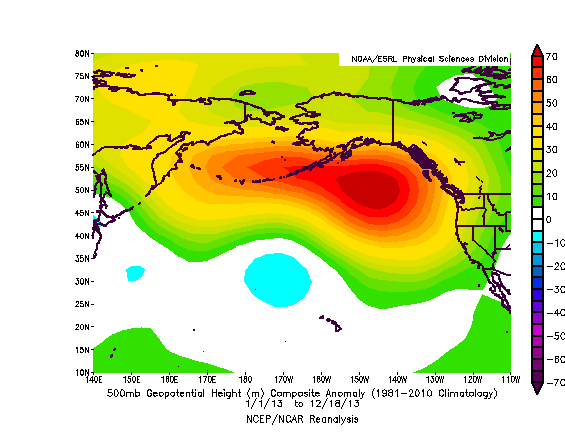
    Now here is what the 500 mb geopotential height anomaly looked like over the last year, via NOAA:

    Look familiar? That is either an accurate prediction or one heck of a coincidence. The San Jose Mercury News described what was happening in layman’s terms:

    … meteorologists have fixed their attention on the scientific phenomenon they say is to blame for the emerging drought: a vast zone of high pressure in the atmosphere off the West Coast, nearly four miles high and 2,000 miles long, so stubborn that one researcher [Swain] has dubbed it the “Ridiculously Resilient Ridge.”

    Like a brick wall, the mass of high pressure air has been blocking Pacific winter storms from coming ashore in California, deflecting them up into Alaska and British Columbia, even delivering rain and cold weather to the East Coast.

    This high pressure ridge is forcing the jet stream along a much more northerly track. Sewall told me that multiple factors are driving drought in California:
    2013 anomaly

    There are, of course, caveats. This is one year, the model studies were looking at averages of multiple decades (20 or 50 years). There are other factors besides the Arctic ice that influence storm tracks; some preliminary work suggests that a strong El Nino overwhelms any influence of the ice. In El Nino “neutral” times (such as recently), the ice impact can have more of an effect.

    And for this year, it looks like ice may well be having more of an effect. The geopotential height anomaly looks very much like what the models predicted as sea ice declined. The storm track response also looks very similar with correspondingly similar impacts on precipitation (reduced rainfall in CA, increased precipitation in SE Alaska). While other factors play an influence, the similarity of these patterns certainly suggests that we shouldn’t discount warming climate and declining Arctic sea ice as culprits in the CA drought.

    NOAA and Prof. Jennifer Francis of Rutgers have more recently shown that the loss of Arctic ice is boosting the chances of extreme US weather.

    …this extremely distorted and persistent jet stream pattern is an excellent example of what we expect to occur more frequently as Arctic ice continues to melt.

    Francis told me this week that “the highly amplified pattern that the jet stream has been in since early December is certainly playing a role in the CA drought.”

    “The extremely strong ridge over Alaska has been very persistent and has caused record warmth and unprecedented winter rains in parts of AK while preventing Pacific storms from delivering rain to CA,” she explained. “But is this pattern a result of human-caused climate change, or more specifically, to rapid Arctic warming and the dramatic losses of sea ice? It’s very difficult to pin any specific weather event on climate change, but this extremely distorted and persistent jet stream pattern is an excellent example of what we expect to occur more frequently as Arctic ice continues to melt.”

    While there is no doubt that climate change is making droughts more intense, the specific connection the loss of Arctic ice is emerging science, and some, like Trenberth, are skeptical that the case has been made.

    Whether or not there is a proven link to the loss of Arctic ice, Senior Weather Channel meteorologist (and former skeptic) Stu Ostro has been documenting “large magnitude ridges in the mid-upper level geopotential height field” lasting as long as many months that “have been conspicuous in the meteorology of extreme weather phenomena.”

    Ostro gave a talk last year (with Franics), and as Climate Desk summarized, “Ostro’s observations suggest that global warming is increasing the atmosphere’s thickness, leading to stronger and more persistent ridges of high pressure, which in turn are a key to temperature, rainfall, and snowfall extremes and topsy-turvy weather patterns like we’ve had in recent years.”

    The climate is changing. “All of our weather is now, and increasingly in the future, influenced by climate change,” Gleick wrote me. “The question about attribution (i.e., is this drought caused by climate change) is, of course, the wrong question — easy for deniers to dismiss because it is not easy to show unambiguous links to some kinds of individual events.”

    What is especially worrisome is that climate change has only just started to have an impact on Western droughts. We’ve only warmed 1.5°F in the past century. Absent strong climate action, we are on track to warm 10°F over the next century!

    We continue to dawdle even though scientists have been warning us of what was coming for decades. Hansen himself co-authored a 1990 study, “Potential evapotranspiration and the likelihood of future drought,” which projected that severe to extreme drought in the United States, then occurring every 20 years or so, could become an every-other-year phenomenon by mid-century.

    All of our weather is now, and increasingly in the future, influenced by climate change.

    So we should listen to Hansen’s current warnings. In 2012 he warned in the NY Times of a return to Dust Bowls, writing, “over the next several decades, the Western United States and the semi-arid region from North Dakota to Texas will develop semi-permanent drought … California’s Central Valley could no longer be irrigated. Food prices would rise to unprecedented levels.”

    Hansen repeated those concerns in an email to me this week, noting that the current drought “will break, of course, likely with the upcoming El Nino, but as long as we keep increasing greenhouse gases, intense droughts will increase, especially in the Southwest. Rainfall, when and where it comes will tend to be in more intense events, with more extreme flooding. These are not speculations, the science is clear.”

    How long can these droughts last? They have lasted for decades in the distant past, and one 2010 study warned that we could see “an unprecedented combination” of multi-decade droughts “with even warmer temperatures.”

    Drought researcher Aiguo Dai was quoted in a 2012 NCAR news release for a 2012 study warning, “The U.S. may never again return to the relatively wet conditions experienced from 1977 to 1999.”

    This week I asked him, “Do you still stand by that statement?” He replied:

    Yes, I still stand by that statement. The model projections have not changed. To the extent we can trust the CMIP [Coupled Model Intercomparison Project] model projections, I still think the U.S. will experience increased risk of drought in the coming decades. What has been happening during recent years in the central and western U.S. is very consistent to what I have been predicting: both the natural variability (IPO [Interdecadal Pacific Oscillation]) and human-induced climate change will increase the risk of drought over these regions for the next 1-2 decades. After that, the IPO may switch to a positive phase that normally would bring more rain over the U.S. regions, but by that time the human-induced warming have over-dominate the natural variability, with the U.S. regions still in drier conditions (compared with the 1980s-1990s).

    Finally, a 2009 NOAA-led paper warned that, for the Southwest and many semi-arid regions around the world, “the climate change that is taking place because of increases in carbon dioxide concentration is largely irreversible for 1,000 years after emissions stop.” Impacts that should be expected if we don’t aggressively slash carbon pollution “are irreversible dry-season rainfall reductions in several regions comparable to those of the ‘dust bowl’ era.”

    When the climate changes, it ain’t gonna change back.

    The post Leading Scientists Explain How Climate Change Is Worsening California’s Epic Drought appeared first on ThinkProgress.


  • Before the last home is torched AVAAZ

    Why this ad?
    EA Solar Panelsenergyaustralia.com.au/solarsaver – Quality Solar Systems from $2,399 We are the Solar Power Experts!

    Before the last home is torched

    Inbox
    x

    Allison Johnson – Avaaz.org

    Feb 10 (1 day ago)

    to me

    Dear friends,

    Heavily armed police just burned 1,000 homes to the ground to force indigenous families out of the Kenyan forest. The World Bank has given millions to the forest police, but is staying quiet. If enough of us supercharge the community’s desperate call for help, we can force the World Bank to demand the government halts these vicious land grabs. Sign now:

    SIGN THE PETITION

    Heavily armed police just burned 1,000 homes to the ground to force indigenous families out of the Kenyan forest where they’ve lived for centuries. This desperate community needs our help to save their homes — and the forest — before it’s destroyed forever.

    The World Bank has given millions of our tax dollars to the Kenyan forest police who are annihilating this ancient community. And — with new funding at stake this year — the Bank has massive leverage over the government. So far the Bank is staying mum, but if enough of us supercharge the community’s call for help, we can force it to demand this horror stops.

    World Bank President Jim Yong Kim says he wants to change the Bank. Let’s hold him to his word, demanding that he call on the Kenyan government to stop these vicious land grabs and commit to new human rights standards for all future grants. When a million of us sign, we’ll grab Kim’s attention by showing burning homes outside the Bank’s Washington HQ. Add your name, then send Kim a message, now:

    http://www.avaaz.org/en/stop_the_forced_evictions_loc/?bhPqncb&v=35579

    The Sengwer people have lived in the majestic Embobut forest for centuries and their rights to their ancestral lands are protected under the Kenyan constitution and international law. They’ve already won a court order to stop the evictions, but the government has ignored it, claiming they need to clear the forest to protect water sources for nearby towns. The Sengwer fear that next, the forest will be decimated for profit.

    The Bank has backed many impressive initiatives, but for too long has blamed the governments and companies it lends to when destructive projects force people off their land. But the tide is turning. After an outcry, the Bank pulled back from projects that were driving 30,000 Cambodians a year from their homes. And it admitted it ignored its own policies when it funded a Honduran palm oil company accused of brutal evictions and assassinations. The Bank is now investigating the Sengwer scandal, but far too slowly to save Kenya’s ancient forest peoples.

    The US Congress has just called on the Bank to stop evictions, or risk losing US money. It’s the perfect moment to stop this brutal land grab in Kenya and get the institution to take human rights seriously. Sign now — when a million of us are on board, we’ll deliver our message straight to President Kim:

    http://www.avaaz.org/en/stop_the_forced_evictions_loc/?bhPqncb&v=35579

    After the Tanzanian government announced plans to kick thousands of Maasai families off their lands to build a hunting reserve, almost two million Avaaz members stood with their community. We kept pushing for over a year until finally the Prime Minister allowed them to stay, helping end a 20 year land battle. The Maasai say they couldn’t have done it without us — now let’s do it again, for the Sengwer people.

    With hope,

    Allison, Alex, Joseph, Emilie, Alice, Sayeeda, Ricken and the rest of the Avaaz team

    More information:

    Kenya: KFS Guards Burn Down Homes in Embobut Forest (The Star)
    http://allafrica.com/stories/201401200456.html

    Kenyan families flee Embobut forest to avoid forced evictions by police (The Guardian)
    http://www.theguardian.com/global-development/2014/jan/07/kenya-embobut-forest-forced-evictions-police

    Kenya defies its own courts (Forest Peoples Programme)
    http://www.forestpeoples.org/topics/legal-human-rights/news/2014/01/kenya-defies-its-own-courts-torc…

    U.S. pushes for outside oversight of World Bank (Washington Post)
    http://www.washingtonpost.com/business/economy/us-pushes-for-outside-oversight-of-world-bank-opposes-push-toward-big-hydro/2014/01/24/fb41bb7c-8516-11e3-8099-9181471f7aaf_story.html

    Kenya / Embobut Forest: UN rights expert calls for the protection of indigenous people facing eviction (UN)
    http://www.ohchr.org/EN/NewsEvents/Pages/DisplayNews.aspx?NewsID=14163&LangID=E

    Indigenous Kenyans evicted in the name of ‘conservation’ (New Internationalist)
    http://newint.org/features/web-exclusive/2014/01/23/sengwer-forest-evictions/

  • Why global water shortages pose threat of terror and war

    Why global water shortages pose threat of terror and war

    From California to the Middle East, huge areas of the world are drying up and a billion people have no access to safe drinking water. US intelligence is warning of the dangers of shrinking resources and experts say the world is ‘standing on a precipice’
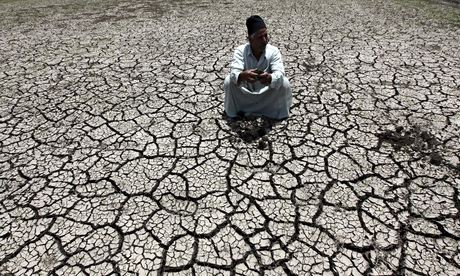
    An Egyptian farmer on cracked soil

    An Egyptian farmer shows the dryness of the land due to drought in a farm formerly irrigated by the river Nile. Photograph: Mohamed Abd El Ghany/Corbis

    On 17 January, scientists downloaded fresh data from a pair of Nasa satellites and distributed the findings among the small group of researchers who track the world’s water reserves. At the University of California, Irvine, hydrologist James Famiglietti looked over the data from the gravity-sensing Grace satellites with a rising sense of dread.

    The data, released last week, showed California on the verge of an epic drought, with its backup systems of groundwater reserves so run down that the losses could be picked up by satellites orbiting 400km above the Earth’s surface.

    “It was definitely an ‘oh my gosh moment’,” Famiglietti said. “The groundwater is our strategic reserve. It’s our backup, and so where do you go when the backup is gone?”

    That same day, the state governor, Jerry Brown, declared a drought emergency and appealed to Californians to cut their water use by 20%. “Every day this drought goes on we are going to have to tighten the screws on what people are doing,” he said.

    Seventeen rural communities are in danger of running out of water within 60 days and that number is expected to rise, after the main municipal water distribution system announced it did not have enough supplies and would have to turn off the taps to local agencies.

    There are other shock moments ahead – and not just for California – in a world where water is increasingly in short supply because of growing demands from agriculture, an expanding population, energy production and climate change.

    Already a billion people, or one in seven people on the planet, lack access to safe drinking water. Britain, of course, is currently at the other extreme. Great swaths of the country are drowning in misery, after a series of Atlantic storms off the south-western coast. But that too is part of the picture that has been coming into sharper focus over 12 years of the Grace satellite record. Countries at northern latitudes and in the tropics are getting wetter. But those countries at mid-latitude are running increasingly low on water.

    “What we see is very much a picture of the wet areas of the Earth getting wetter,” Famiglietti said. “Those would be the high latitudes like the Arctic and the lower latitudes like the tropics. The middle latitudes in between, those are already the arid and semi-arid parts of the world and they are getting drier.”

    On the satellite images the biggest losses were denoted by red hotspots, he said. And those red spots largely matched the locations of groundwater reserves.

    “Almost all of those red hotspots correspond to major aquifers of the world. What Grace shows us is that groundwater depletion is happening at a very rapid rate in almost all of the major aquifers in the arid and semi-arid parts of the world.”

    The Middle East, north Africa and south Asia are all projected to experience water shortages over the coming years because of decades of bad management and overuse.

    Watering crops, slaking thirst in expanding cities, cooling power plants, fracking oil and gas wells – all take water from the same diminishing supply. Add to that climate change – which is projected to intensify dry spells in the coming years – and the world is going to be forced to think a lot more about water than it ever did before.

    The losses of water reserves are staggering. In seven years, beginning in 2003, parts of Turkey, Syria, Iraq and Iran along the Tigris and Euphrates rivers lost 144 cubic kilometres of stored freshwater – or about the same amount of water in the Dead Sea, according to data compiled by the Grace mission and released last year.

    A small portion of the water loss was due to soil drying up because of a 2007 drought and to a poor snowpack. Another share was lost to evaporation from lakes and reservoirs. But the majority of the water lost, 90km3, or about 60%, was due to reductions in groundwater.

    Farmers, facing drought, resorted to pumping out groundwater – at times on a massive scale. The Iraqi government drilled about 1,000 wells to weather the 2007 drought, all drawing from the same stressed supply.

    In south Asia, the losses of groundwater over the last decade were even higher. About 600 million people live on the 2,000km swath that extends from eastern Pakistan, across the hot dry plains of northern India and into Bangladesh, and the land is the most intensely irrigated in the world. Up to 75% of farmers rely on pumped groundwater to water their crops, and water use is intensifying.

    Over the last decade, groundwater was pumped out 70% faster than in the 1990s. Satellite measurements showed a staggering loss of 54km3 of groundwater a year. Indian farmers were pumping their way into a water crisis.

    The US security establishment is already warning of potential conflicts – including terror attacks – over water. In a 2012 report, the US director of national intelligence warned that overuse of water – as in India and other countries – was a source of conflict that could potentially compromise US national security.

    The report focused on water basins critical to the US security regime – the Nile, Tigris-Euphrates, Mekong, Jordan, Indus, Brahmaputra and Amu Darya. It concluded: “During the next 10 years, many countries important to the United States will experience water problems – shortages, poor water quality, or floods – that will risk instability and state failure, increase regional tensions, and distract them from working with the United States.”

    Water, on its own, was unlikely to bring down governments. But the report warned that shortages could threaten food production and energy supply and put additional stress on governments struggling with poverty and social tensions.

    Some of those tensions are already apparent on the ground. The Pacific Institute, which studies issues of water and global security, found a fourfold increase in violent confrontations over water over the last decade. “I think the risk of conflicts over water is growing – not shrinking – because of increased competition, because of bad management and, ultimately, because of the impacts of climate change,” said Peter Gleick, president of the Pacific Institute.

    There are dozens of potential flashpoints, spanning the globe. In the Middle East, Iranian officials are making contingency plans for water rationing in the greater Tehran area, home to 22 million people.

    Egypt has demanded Ethiopia stop construction of a mega-dam on the Nile, vowing to protect its historical rights to the river at “any cost”. The Egyptian authorities have called for a study into whether the project would reduce the river’s flow.

    Jordan, which has the third lowest reserves in the region, is struggling with an influx of Syrian refugees. The country is undergoing power cuts because of water shortages. Last week, Prince Hassan, the uncle of King Abdullah, warned that a war over water and energy could be even bloodier than the Arab spring.

    The United Arab Emirates, faced with a growing population, has invested in desalination projects and is harvesting rainwater. At an international water conference in Abu Dhabi last year, Crown Prince General Sheikh Mohammed bin Zayed al-Nahyan said: “For us, water is [now] more important than oil.”

    The chances of countries going to war over water were slim – at least over the next decade, the national intelligence report said. But it warned ominously: “As water shortages become more acute beyond the next 10 years, water in shared basins will increasingly be used as leverage; the use of water as a weapon or to further terrorist objectives will become more likely beyond 10 years.”

    Gleick predicted such conflicts would take other trajectories. He expected water tensions would erupt on a more local scale.

    “I think the biggest worry today is sub-national conflicts – conflicts between farmers and cities, between ethnic groups, between pastoralists and farmers in Africa, between upstream users and downstream users on the same river,” said Gleick.

    “We have more tools at the international level to resolve disputes between nations. We have diplomats. We have treaties. We have international organisations that reduce the risk that India and Pakistan will go to war over water but we have far fewer tools at the sub-national level.”

    And new fault lines are emerging with energy production. America’s oil and gas rush is putting growing demands on a water supply already under pressure from drought and growing populations.

    More than half the nearly 40,000 wells drilled since 2011 were in drought-stricken areas, a report from the Ceres green investment network found last week. About 36% of those wells were in areas already experiencing groundwater depletion.

    How governments manage those water problems – and protect their groundwater reserves – will be critical. When California emerged from its last prolonged dry spell, in 2010, the Sacramento and San Joaquin river basins were badly depleted. The two river basins lost 10km3 of freshwater each year in 2012 and 2013, dropping the total volume of snow, surface water, soil moisture and groundwater to the lowest levels in nearly a decade.

    Without rain, those reservoirs are projected to drop even further during this drought. State officials are already preparing to drill additional wells to draw on groundwater. Famiglietti said that would be a mistake.

    “We are standing on a cliff looking over the edge and we have to decide what we are going to do,” he said.

    “Are we just going to plunge into this next epic drought and tremendous, never-before-seen rates of groundwater depletion, or are we going to buckle down and start thinking of managing critical reserve for the long term? We are standing on a precipice here.”

    REGIONS AT RISK

    1 CALIFORNIA

    The state’s water resources are at critically low levels and a drought emergency has been declared. The health department says 17 rural areas are dangerously parched.

    2 BRAZIL

    São Paulo, the country’s largest city, is on the verge of water rationing because of a severe drought and shortages are possible when the country hosts the football World Cup in the summer. January was the hottest month on record in the city and water in its main reservoir has fallen to 20.9% of its capacity, the lowest level in a decade.

    3 MIDDLE EAST

    Tehran, the capital of Iran, is facing a shortage so serious that officials are making contingency plans for rationing in an area where 22 million live as well as in other big cities. President Hassan Rouhani has identified water as a national security issue. Shortages are so severe in the United Arab Emirates that the country is using non-conventional resources, including desalination, treated wastewater, rainwater harvesting and cloud seeding. At a a water conference,Crown Prince General Sheikh Mohammed bin Zayed al-Nahyan said: “For us, water is [now] more important than oil.” With the third lowest water reserves in the region, Jordan is struggling to cope with an influx of Syrian refugees. The country is undergoing power cuts because of water shortages. Prince Hassan, uncle of King Abdullah, warned last week that a war over water and energy could be bloodier than the Arab spring.

    4 NORTH AFRICA

    Egypt has demanded that Ethiopia stop construction of a mega-dam on the Nile, vowing to protect its historical rights to the river at “any cost”. The Egyptian authorities have called for a study into whether the project would reduce the river’s flow.

    5 SOUTH ASIA About 600 million people live on the 2,000km swath that extends from eastern Pakistan, across the hot dry plains of northern India and into Bangladesh and the land is the world’s most intensely irrigated. Up to 75% of farmers rely on pumped groundwater.

    6 CHINA

    There is increasing competition for water. More than half the proposed coal-fired power stations are expected to be built in areas of high water stress, thus threatening water insecurity for farms, other industry and the public.