Category: Uncategorized

  • Fish biomass in the ocean may be 10 times higher than estimated: Stock of mesopelagic fish changes from 1,000 to 10,000 million tons

    Featured Research

    from universities, journals, and other organizations

    Fish biomass in the ocean may be 10 times higher than estimated: Stock of mesopelagic fish changes from 1,000 to 10,000 million tons

    Date:
    February 7, 2014
    Source:
    Spanish National Research Council (CSIC)
    Summary:
    With a stock estimated at 1,000 million tons so far, mesopelagic fish dominate the total biomass of fish in the ocean. However, scientists have found that their abundance could be at least 10 times higher. The results are based on the acoustic observations conducted during the circumnavigation of the Malaspina Expedition.

    This image shows a fish captured during Malaspina Expedition circumnavigation between Auckland and Honolulu.
    Credit: CSIC / JOAN COSTA

    With a stock estimated at 1,000 million tons so far, mesopelagic fish dominate the total biomass of fish in the ocean. However, a team of researchers with the participation of the Spanish National Research Council (CSIC) has found that their abundance could be at least 10 times higher. The results, published in Nature Communications journal, are based on the acoustic observations conducted during the circumnavigation of the Malaspina Expedition.

    Mesopelagic fishes, such as lantern fishes (Myctophidae) and cyclothonids (Gonostomatidae), live in the twilight zone of the ocean, between 200 and 1,000 meters deep. They are the most numerous vertebrates of the biosphere, but also the great unknowns of the open ocean, since there are gaps in the knowledge of their biology, ecology, adaptation and global biomass.

    During the 32,000 nautical miles traveled during the circumnavigation, the researchers of the Malaspina Expedition (a project led by CSIC researcher Carlos Duarte) took measurements between 40°N and 40°S, from 200 to 1,000 meters deep, during the day.

    Duarte states: “Malaspina has provided us the unique opportunity to assess the stock of mesopelagic fish in the ocean. Until now we only had the data provided by trawling. It has recently been discovered that these fishes are able to detect the nets and run, which turns trawling into a biased tool when it comes to count its biomass.”

    Transport of organic carbon

    Xabier Irigoyen, researcher from AZTI-Tecnalia and KAUST (Saudi Arabia) and head of this research, states: “The fact that the biomass of mesopelagic fish (and therefore also the total biomass of fishes) is at least 10 times higher than previously thought, has significant implications in the understanding of carbon fluxes in the ocean and the operation of which, so far, we considered ocean deserts.”

    Mesopelagic fish come up at night to the upper layers of the ocean to feed, whereas they go back down during the day in order to avoid being detected by their predators. This behaviour speeds up the transport of organic matter into the ocean, the engine of the biological pump that removes CO2 from the atmosphere, because instead of slowly sinking from the surface, it is rapidly transported to 500 and 700 meters deep and released in the form of feces.

    Irigoyen adds: “Mesopelagic fish accelerate the flux for actively transporting organic matter from the upper layers of the water column, where most of the organic carbon coming from the flow of sedimentary particles is lost. Their role in the biogeochemical cycles of ocean ecosystems and global ocean has to be reconsidered, as it is likely that they are breathing between 1% and 10% of the primary production in deep waters.”

    According to researchers, the excretion of material from the surface could partly explain the unexpected microbial respiration registered in these deep layers of the ocean. Mesopelagic fishes would act therefore as a link between plankton and top predators, and they would have a key role in reducing the oxygen from the depths of the open ocean.


    Story Source:

    The above story is based on materials provided by Spanish National Research Council (CSIC). Note: Materials may be edited for content and length.


    Journal Reference:

    1. Xabier Irigoien, T. A. Klevjer, A. Røstad, U. Martinez, G. Boyra, J. L. Acuña, A. Bode, F. Echevarria, J. I. Gonzalez-Gordillo, S. Hernandez-Leon, S. Agusti, D. L. Aksnes, C. M. Duarte, S. Kaartvedt. Large mesopelagic fishes biomass and trophic efficiency in the open ocean. Nature Communications, 2014; 5 DOI: 10.1038/ncomms4271

    Cite This Page:

    Spanish National Research Council (CSIC). “Fish biomass in the ocean may be 10 times higher than estimated: Stock of mesopelagic fish changes from 1,000 to 10,000 million tons.” ScienceDaily. ScienceDaily, 7 February 2014. <www.sciencedaily.com/releases/2014/02/140207083830.htm>.

  • [New post] Seat #17: Adelaide THE TALLY ROOM

    3 of 37
    Why this ad?
    Get 3 Local Solar Quotessolarquotes.com.au/_3_Best_Quotes – 1 Form + 2 Minutes = 3 Free Quotes. Save Time & Money Now!

    [New post] Seat #17: Adelaide

    Inbox
    x

    The Tally Room donotreply@wordpress.com

    12:00 PM (1 hour ago)

    to me

    New post on The Tally Room

    Seat #17: Adelaide

    by Ben Raue

    Adelaide1-2PPAdelaide is a very marginal Liberal seat, covering the Adelaide city centre.

    The Liberal Party’s Rachel Sanderson won the seat off the ALP’s Jane Lomax-Smith in 2010. She is being challenged by Labor’s David O’Loughlin, the current lord mayor of Adelaide. Sanderson holds Adelaide by a 4.2% margin.

    Read more

     
  • California Drought Inbox x NASA Science News

    Inbox
    x
    NASA Science News noreply@nasascience.org
    9:03 AM (1 hour ago)

    to NASA
    NASA Science News for Feb. 7, 2014California is experiencing an extreme drought–by some measures the deepest in more than a century. NASA researchers are investigating the underlying causes as satellites, aircraft, and high-altitude balloons collect sobering images of the desiccating landscape.

    VIDEO: http://www.youtube.com/watch?v=e5HwRXsw2Q8

    FULL STORY: http://science.nasa.gov/science-news/science-at-nasa/2014/07feb_drought

  • The why and how of radical emissions reductions (2): Corinne Le Quere

    1 of 4
    Why this ad?
    DreamstimeRoyalty Free Stock Images – Over 20M Stock Photos From as Little as $0.20 or Free.
     Courtesy of David Spratt

    climate code red

    Inbox
    x
    Climate Code Red noreply@blogger.com via google.com
    8:25 PM (1 minute ago)

    to me

    climate code red


    The why and how of radical emissions reductions (2): Corinne Le Quere

    Posted: 06 Feb 2014 07:34 PM PST

    Second in a series | Part 1

    On 10-11 December 2013, a Radical Emissions Reduction Conference was held at the Royal Society, London under the auspices of the Tyndall Centre for Climate Change Research at the University of East Anglia. In this blog, we look at a presentation by Professor Corinne Le Quere, of the Tyndall Centre for Climate Change Research, University of East Anglia on “The scientific case for radical emissions reductions”.

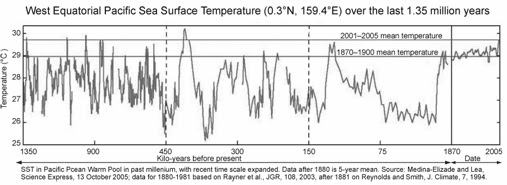
    Le Quere framed “radical emission reductions” as reductions consistent with a two-in-three chance of keeping global warming to less than 2 degrees Celsius (°C), saying that there is no surety that 2°C is a safe threshold, but according to the geological record, there have been periods of up to 2°C warming during the past 800,000 years that did not trigger any “nasty or unexpected” feedbacks, though sea-levels were 5–10 metres higher than today.

    [Note by CCR: Readers of this blog will know well that with less than 1°C of warming so far, there is a good deal of evidence that climate change is already dangerous ,and of the view of leading scientists that 2°C hotter is not an acceptable climate target but a disaster.  In addition, the record is not clear that the warming reached 2°C, with the chart (below), for example, showing sea-surface temperatures in the West Equatorial Warm Pool reached no more than 1.5°C over pre-industrial, around 400,000 years ago.]

    Le Quere told the conference there were no analogues for 4-to-5°C warming in geological record, though there have been coolings of that magnitude, during the last glaciation 20,000 years ago, when environments were transformed. The UK, for example, was covered by ice a mile thick, which may gives an idea of the change that may occur in a world of 9 billion people.

    Thresholds and effects in climate system, such as methane from permafrost and sediments, and Amazon dieback, are poorly known and we don’t really know at what level of warming these occur.

    Warming that has occurred is committed for up to 1000 years. Le Quere said if emissions cease now we get no further warming. Future warming is from future emissions, and near-term emissions cuts decrease the rate of warming immediately.

    [Note by CCR: It is true that if just the present level of atmospheric carbon dioxide is maintained, warming would not exceed 1.4C. However there are other warming gases such as nitrous oxide which have a lifetime of a century and, as well, warming is at present being temporarily reduced by the large amounts of cooling sulphates produced by burning fossil fuels that would cease if emissions were zeroed. See Faustian bargain revisited: study finds zeroed emissions will add 0.25-0.5C of warming as aerosol cooling is lost. ]

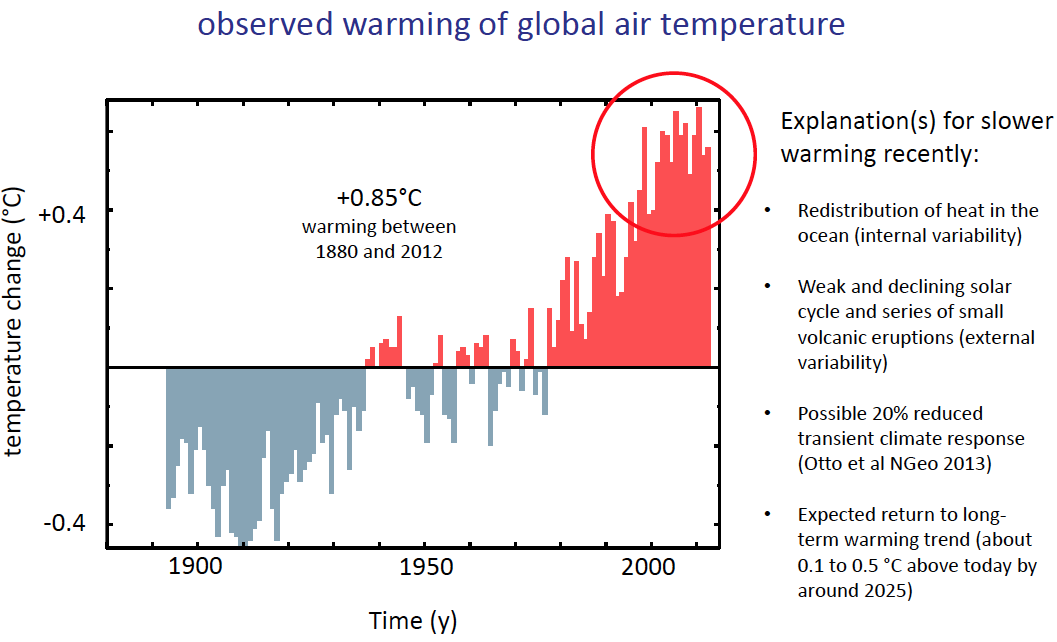
    Le Quere said that since 1880, global warming has been 0.85C, with warming in the past 15 years slower than 15 years prior. The factors are listed here:

    However there is an expectation of return to the longer-term warming trend, with additional warming of 0.1–0.5°C by 2025 compared to today.

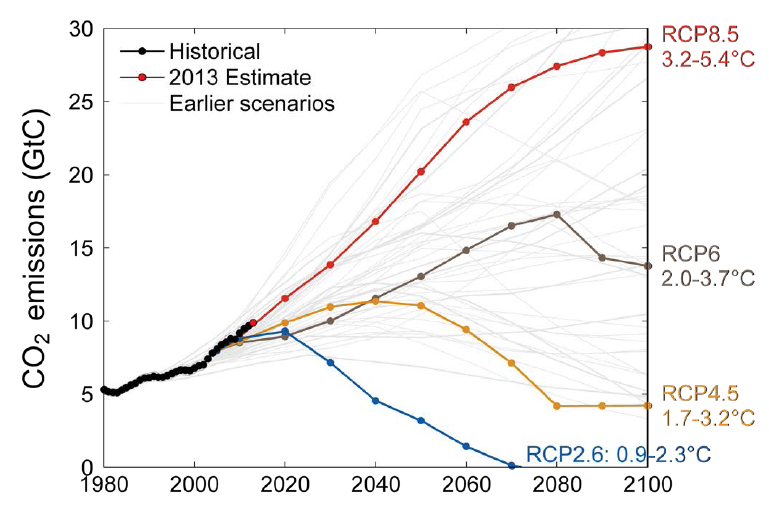
    Looking at emissions so far, against four IPCC scenarios, we are now following the highest and most carbon-intensive scenario (RCP8.5) which leads to 3.2–5.4°C of warming.

    CO2 emissions and projected climate change. Sources: Le Quéré et al. 2013; Peters et al. 2013; Global Carbon Project; CDIAC data

    Our emissions could change rapidly because there are tipping points in society, such as reaction to extreme events, and the likelihood they will recur and increase in severity. The people who are directly affected and pay during these extreme events will do their own sums and determine what it means for their own budgets not to mitigate climate change.

    There have been many such large-scale events, including the 2005 European heatwave, the 2010 crop failure in Russia, the 2012 crop failure in the USA, the Australian 2013 heatwave, and Hurricane Sandy. Although Sandy itself cannot be attributed to climate change, 20 cm of the 1metre storm surge that invaded the subway of New York is directly attributed to climate change. This was the most expensive damage caused by the hurricane, which cost $60 billion in damage in total.

    Academic community must be ready to step in to offer solutions and examples at time when mentality changes, as a result of realisations of the costs caused by damage from continuing emissions.

    So the purposes of the Radical Emissions Conference:

    1. Explore answers to some important questions, including:

    • can a prosperous society be aligned with rapidly reducing demand?
    • which policy options efficiently, effectively and equitably delivery?
    • where can we find example of radical change and why have they worked?
    • what are the impacts and opportunities for scaling up radical change?

    2. Identify key triggers, barriers and/or opportunities, and develop an agenda to progress beyond the Conference.

    3. Generate momentum for radical change thinking, and share ideas and experience between academics and practitioners.

    T

  • Billionaire island owners get microgrids; planet now safe for supermodels

    Billionaire island owners get microgrids; planet now safe for supermodels

    By on 7 February 2014
    Print Friendly

    Greentech Media

    branson_310_207

    NRG Energy’s Twitter feed promised a big announcement this morning. But instead the news is that Sir Richard Branson is liberating the kite-surfers of Necker Island from the oppression of diesel gen-sets.

    Branson, founder of the Virgin Group, along with NRG Energy, is developing “a renewables-driven microgrid for the entire island, supplying high-quality, reliable electricity powered at least 75% by an integrated array of solar, wind and energy storage technologies,” according to a release.

    Necker Island is a 74-acre resort island in the British Virgin Islands owned by Branson. The Necker microgrid will allow 30 guests to reduce their reliance on diesel at a rate of $322,000 for seven nights (five-night minimum stay). There is an odd 2 a.m. peak on Necker island, with guests using energy for things you and I cannot afford or even understand.

    The effort at Necker is connected to the Ten Island Renewable Challenge which is looking to move islands away from fossil fuels.

    A microgrid is a self-contained system of power generation (typically diesel generators or small-scale turbines), along with distribution and load. Adding non-spinning renewable sources such as wind and solar or storage adds a level of complexity to the system, but microgrids are seen as a natural fit for islands.

    David Crane, the CEO of NRG, said, “With oil setting the marginal price of electricity, retail electricity prices in the Caribbean are among the highest in the world, hindering economic development, job creation, and quality of life. By tapping into each island’s specific, readily available and ample renewable energy resources, we can achieve an immediate and significant reduction of operating expenses, imported fuel cost, carbon footprint and other air emissions and noise pollution. The renewables-driven microgrid solution being designed and installed on Necker is intended to demonstrate this and provide a scalable real life application relevant to other islands of the Caribbean.”

    On the subject of billionaire island-owners with microgrids, Larry Ellison’s Hawaiian island, Lanai (population 3,000), will soon boast a microgrid with design help from University of California San Diego Professor Byron Washom, the Director of Energy Initiatives at the school. UCSD’s microgrid generates most of the energy used on campus.

    Billionaire Peter Thiel’s libertarian island’s energy needs could also be helped by a microgrid.

    Vanity projects and nonprofit efforts aside, here is some real microgrid news, as recently reported by GTM:

    • Primus Power, a developer of flow batteries, is going to deploy an energy storage system for a microgrid at the Marine Corps Air Station (MCAS) in Miramar, California. CEO Tom Stepien said that 20 percent of the backup diesel gen-sets at Miramar did not start on the day of the San Diego blackout in 2011. When a military site like MCAS loses power, “Planes are grounded and training missions are canceled. You can’t even open the gates.”
    • New York governor Andrew Cuomo has put $40 million in prize money behind a push to bolster the state’s post-Hurricane Sandy storm resilience with community microgrids, writes GTM’s Jeff St. John. The projects are meant to support communities of about 40,000 residents and to operate in conjunction with the grid most of the time. But during emergencies, the microgrids will be able to disconnect from the grid and power themselves, providing islands of stable power for hospitals, police department, fire stations, gas stations and other critical systems.
    • In 2012, Connecticut created a statewide microgrid program with $18 million dedicated to fund nine projects. Connecticut is considered the leader in the region in terms of microgrid support, although other governments are putting funds behind emergency backup power and community energy sufficiency.
    • New Jersey is partnering with the DOE on a $1 million study aimed at supplying microgrid capabilities for New Jersey Transit.
    • New York City is studying a microgrid project for the Rockaway Peninsula as part of its climate change response plan.
    • ABB’s grid stabilizing generator combines the inertial properties of a flywheel, the power management functions of advanced inverters, and software to make it all work together. This combination is especially important for microgrids. ABB has installed PowerStore devices in a dozen microgrids across the world. The earliest deployments are in Australia, where Powercorp, the developer of the PowerStore technology, used them to integrate wind power into diesel generator-powered remote grids. ABB started working with the technology in 2006, and bought Powercorp in 2011 for an undisclosed sum, as reported by Jeff St. John.
    • Danish utility Dong Energy has an island showcase for its Power Hub technology in the Faroe Islands, a North Atlantic archipelago. This project, dubbed “Grani,” is balancing an increasing amount of wind power with pumped hydro storage, as well as two sets of variable loads on the island: heat pumps for a salmon breeding facility and two cold-storage facilities for the island’s fishing industry. Adjusting the timing and intensity of heating and cooling to match wind power fluctuations is one example of how supply and demand can be matched.
    • ABB and Schneider are collaborating on the Swedish island of Gotland to combine wind and solar power, grid control systems and advanced load management.

    Diesel-dependent grids in remote areas or on islands remain the most economically attractive setting for microgrids, since they’re reliant on expensive imported fuel, which makes the payback on investing in renewables come more quickly.

    Truly modern microgrids are meant to go beyond diesel generators, incorporating clean, renewable energy resources like rooftop solar PV with energy storage and on-site energy management systems. These could offer not just emergency backup power, but could also serve as models for integrating a range of grid-edge technologies into the grid at large.

    That’s how the New York State Smart Grid Consortium, a group including state agencies, universities and research labs, big utilities and smart grid vendors like General Electric and IBM, would like to see Cuomo’s microgrid push develop. It described the promise of community microgrids as “the means to increase reliability and give local communities more control of their energy systems, while also allowing for the adoption of clean and efficient distributed energy sources such as solar or combined heat and power,” not to mention electric vehicle adoption.

    One of the key challenges for the microgrids as grid resilience resources is the fact that they’ve got to find ways to pay for themselves that extend beyond keeping the lights on during emergencies. But many of those alternative revenue streams can come into conflict with existing regulations, as well as posing a threat to utility business models that rely on selling power to customers.

    As Jeff St. John has reported, “To make the system financially viable requires intelligent design to integrate multiple fuel sources seamlessly and optimization through robust demand management to minimize system size. Renewables-driven microgrids typically use diesel generation — which currently is the primary source of electricity on most islands in the Caribbean — as a backup to solar, wind, geothermal and other renewables, drastically reducing diesel consumption while making the model compatible with existing infrastructure.”


  • Australia may lose last mainland state supportive of renewables

    Australia may lose last mainland state supportive of renewables

    By on 7 February 2014
    Print Friendly

    The public feuding within the ruling Labor Party in South Australia in this past week confirmed to many that the last Labor state government in mainland Australia is about to lose power. And with it will go the last government openly supportive of renewable energy.

    Voters go to the polls in South Australia and Tasmania on March 15, and the Labor Premiers in both states may be replaced by their conservative opponents.

    In Tasmania, this may not mean a lot for renewables because the state is mostly powered by hydro anyway, but it will be interesting to see if a Liberal government pursues such projects as the King Island win project and a second interconnector to the mainland (to sell more green energy) with the same vigor, or indeed its aim to be “100% renewable”.

    In South Australia, the circumstances are different. The Labor government has been in power – and the state has become the nation’s leader in both wind energy and rooftop solar PV.

    Former Premier Mike Rann announced a state target of 33 per cent by 2020, an initiative that helped the state gain nearly half of the wind farms in the country, and the highest penetration of rooftop solar, but it has already nearly met its  target giving it a combined contribution of 31 per cent from variable sources in 2012/13.

    The state’s strong push into renewables was made possible by the fact that the local fossil fuel industry in that state is not strong. This is a circumstance shared by Tasmania and the ACT Labor government, the only other with strong renewables policy – 90% renewables by 2020. The other mainland states, WA, Victoria, Queensland and NSW, feature strong fossil fuel interests and conservative governments that have shown – particularly in WA and Queensland, and in Victoria in the case of wind – open hostility towards renewable energy.

    But in the current campaigning South Australia, renewables are hardly mentioned. They do not yet feature in any of the major parties policy platforms, and nor are they likely too. This is despite the fact that in South Australia nearly one in five houses has modules on the roof, and rooftop solar contributes more than 15 per cent of electricity on some days, and recently has been contributing more than 10 per cent for more than 6 daylight hours.

    Even with the likely roll-out of rooftop solar, and more wind farms (depending on the fate of the RET, which is not an election issue yet either), the state is likely to be the first to reach 50 per cent, and could do this by 2020, as several government reports have also concluded.

    The failure to embrace such targets is disappointing, but probably not surprising. Politicians have yet to get their mind around rooftop solar, despite the obvious attraction to households and its ability to reduce bills. And in South Australia, there is plenty to boast about – jobs, the biggest reduction in wholesale prices in any state, less coal-fired electricity made locally and less coal imports, and a big reduction in emissions.

    The issue about solar thermal has also been “neutralized” by an agreement to conduct a two year “feasibility study” co-founded by ARENA and the state government. Essentially, this is designed to postpone any decisions on new technology until after Alinta, the owner of the Port Augusta coal generators where the solar thermal power station could be located, is sold by its private equity owners.

    The one positive note to the campaign so far is the Liberal’s focus on home energy consumption, costs and awareness. It proposes introducing monthly billing, and a voluntary rollout of smart meters.

    It recognizes that the current system of billing and metering is based on an antiquated system that provides little data, and makes it impossible for a family to understand when it is using its energy and how it can shift consumption patterns to get costs down. That awareness will be crucial as more households look to install solar, or even battery storage systems, and distributed energy emerges as a viable alternative in a state with one of the most elongated, and expensive, network of poles and wires in the world.

    It’s interesting, though, to look back at some of the advice that laid the foundation of Rann’s 33 per cent target. At the time, it was thought that a large part of the target (600MW to 900MW) would be met by geothermal energy.  There will probably be little or none by 2020.

    It was also though that solar PV, at most, would contribute 100MW. The state is already at 450MW and likely to at least double that by 2020. And it was thought that wind energy would cause grid instability if it went over 20 per cent. As it turns out it is at 27 per cent, and doing fine – even if it is clipping the earnings of aggrieved coal and gas generators.