Category: Uncategorized

  • No warming “pause” says World Meteorological Organization head

    Why this ad?
    EA Solar Panelsenergyaustralia.com.au/solarsaver – Quality Solar Systems from $2,399 We are the Solar Power Experts!

    Courtesy david spratt

    climate code red

    Inbox
    x
    Climate Code Red noreply@blogger.com via google.com
    8:21 PM (1 hour ago)

    to me

    climate code red


    No warming “pause” says World Meteorological Organization head

    Posted: 05 Feb 2014 10:14 PM PST

    The head of the World Meteorological Organization says there is no standstill in global warming, which is on course to continue for generations to come.
    By Alex Kirby, Climate News Network

    The planet is continuing to warm, with implications for generations ahead, and temperatures are set to rise far into the future, the World Meteorological Organization (WMO) reports.

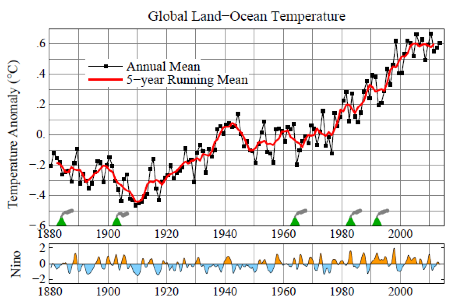
    Global surface temperatures relative to 1951-1980. The Niño index is based on sea surface temperature in the Niño 3.4 area (5N-5S, 120-170W) in the eastern tropical Pacific for 1951-1980 base period. Green triangles mark times of volcanic eruptions that produced an extensive stratospheric aerosol layer.

    It says 2013 was among the ten warmest years since modern records began in 1850, equalling 2007 as the sixth warmest year, with a global land and ocean surface temperature 0.50°C above the 1961–1990 average and 0.03°C higher than the most recent 2001–2010 average.

    Thirteen of the 14 warmest years on record have all occurred in this century. The warmest years on record are 2010 and 2005, with global temperatures about 0.55 °C above the long-term average, followed by 1998, which also had an exceptionally strong El Niño event.

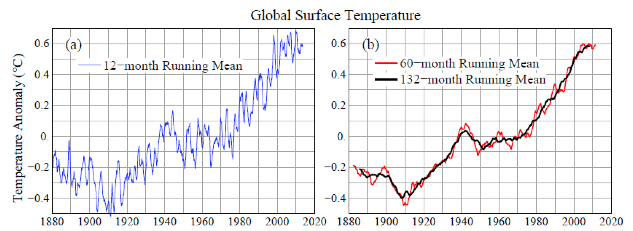
    Global surface temperature relative to 1951-1980 mean for (a) 12-month running mean, and (b) 5- year and 11- year running means

    El Niño events (which intensify warming) and cooling La Niñas are major drivers of natural climate variability. Neither occurred during 2013, which was warmer than 2011 or 2012, when La Niña exerted its cooling influence. 2013 was among the four warmest neutral years recorded, when neither El Niño nor La Niña affected temperatures.

    “The global temperature for the year 2013 is consistent with the long-term warming trend”, said WMO Secretary-General Michel Jarraud:

    The rate of warming is not uniform but the underlying trend is undeniable. Given the record amounts of greenhouse gases in our atmosphere, global temperatures will continue to rise for generations to come.
    Our action – or inaction – to curb emissions of carbon dioxide and other heat-trapping gases will shape the state of our planet for our children, grandchildren and great-grandchildren.

    Asked by Climate News Network how WMO regarded claims by some critics that there has been a “global warming standstill since 1997”, Mr Jarraud said: “Which standstill? The coldest year since 2001 is warmer than any year before 1998:

    Each decade is warmer than the previous one. There is global variability from year to year. You have to look at the longer period. If you do that, then the message is beyond any doubt…Despite the fact that there was no El Niño in 2013, it was still the sixth warmest year. This is significant.

    The WMO says surface temperature is just part of a much wider picture of climate change. “More than 90% of the excess heat being caused by human activities is being absorbed by the ocean”, it says.

    It has released the temperature data in advance of its full Statement on the Status of the Climate in 2013, to be published in March. This will give more details of regional temperatures and other indicators.

    Consistent findings

    In contrast with 2012, when the US in particular experienced record high annual temperatures, the warmth in 2013 was most extreme in Australia, which had its hottest year on record.

    WMO’s global temperature analysis is based mainly on three independent and complementary datasets. One is maintained by two UK centres, the Met Office Hadley Centre and the Climatic Research Unit at the University of East Anglia. The other two are based in the US: NOAA’s National Climatic Data Center, and the Goddard Institute for Space Studies (GISS), operated by NASA.

    Each dataset uses slightly different methods of calculation and so each gave 2013 a different temperature ranking, but they were consistent on the year-by-year changes and the longer warming trends globally.

    WMO also uses reanalysis-based data from the European Centre for Medium-Range Weather Forecasts (ECMWF), which showed annual global land and ocean temperature to be the fourth highest on record.

  • How we can beat this terrible news for the Reef GET-UP

    2 of 35
    Why this ad?
    Landscape Garden Edgingwww.kwikkerb.net.au/Garden-Edging – Make Your Garden Look Amazing. Call Us For Free Onsite Quote!

    How we can beat this terrible news for the Reef

    Inbox
    x
    GetUp!
    7:10 PM (1 hour ago)

    to me
    The legal fighting fund for the Reef is up! An incredible 10,000 GetUp members have donated in just days. 5 million tonnes of dredge spoil has been approved for dumping in World Heritage Area Reef waters, but together our donations are funding legal challenges against the project – and fueling explosive local campaigning too. Will you be part of the citizen-funded fight to protect the Reef? https://www.getup.org.au/reef-legal-battle

    —–

    NEVILLE.

    It’s a terrible moment for the reef — but we have a plan.

    The Great Barrier Reef Marine Park Authority has caved to the pressure of the mining industry and the Federal Government. The agency charged with “the protection, wise use, understanding and enjoyment of the Great Barrier Reef in perpetuity” has allowed it to be sold out for short-term profits.

    Late yesterday, they granted a permit to dump five million tonnes of dredge spoil inside the Great Barrier Reef World Heritage Area.

    This destructive project is now allowed to go-ahead — unless we make a last ditch effort to challenge it in court. Click here to learn more, and help fund the legal challenge to save our Reef:

    https://www.getup.org.au/reef-legal-battle

    We’re not lawyers, but we’ve taken on big legal fights before — and won. In 2010, GetUp members challenged Howard-era electoral laws in the High Court. Together, and with the help of some of the best legal brains in the country, we stopped hundreds of thousands of Australians from losing their right to vote. Now we can step up again, this time to protect our Reef.

    Our lawyers will be the Environmental Defenders Office (EDO) of Queensland, an independent community law centre dedicated to public interest advocacy in environmental matters. They’ll be representing North Queensland Conservation Council. Both groups have got what it takes to tackle the project, but need the backing of GetUp members from right across Australia.

    It’s as if the Federal Government saw this fight coming. Just before Christmas, and without warning, they inexplicably cancelled $10 million in federal funding to EDOs nationwide. But they aren’t expecting people to fight back. Let’s unite, and gather the resources we need to use the full power of the law to protect our Reef. Click here to make it happen: https://www.getup.org.au/reef-legal-battle

    The best legal analysis says this case is strong, and we won’t be alone. Other environmental groups are planning to chip in as well.

    We all know legal battles can be long and expensive. If we can raise $80k together as GetUp members – that’s about 16,000 of us chipping in $5 or more — the project will be confident of covering the considerable legal fees involved in a long fight. That money pays for court fees, printing and overhead costs, and allowing expert witnesses to provide evidence.

    If we raise more than $80k together, we will use the extra to build our Reef Fighting Fund to power further campaigning, or for further legal costs.

    Can you chip in as little as $5 to kick off the all-in citizen-funded legal fight to protect our Great Barrier Reef?

    https://www.getup.org.au/reef-legal-battle

    The mining industry, the Abbott Government, Campbell Newman and everyone else with vested interests expect this decision will be a kick in the guts for the environment movement – something that will deflate us, put us in our place and mark the end of this campaign.

    They obviously don’t know us well enough.

    For everything you’ve done so far — thank you. Now here’s to our Reef and the fight ahead,

  • Our retirement nest eggs: Time to go fossil free! 350 ORG

    Why this ad?
    PhD in Managementtua.edu.au/Management_PhD – Study Online at Torrens University. Request Information Right Now!

    Our retirement nest eggs: Time to go fossil free!

    Inbox
    x
    Charlie Wood – 350.org Australia charlie@350.org
    7:41 PM (30 minutes ago)

    to me

    Dear friend,

    As the managers of our retirement nest-eggs, superannuation funds should be investing in the companies of the future.

    Sadly, most aren’t. In fact, 55% of the world’s pension money is invested in climate-exposed industries, while less than 2% is invested in clean energy. [1] The good news is that all of this money belongs to individuals like you and me. If each of us agitates our super funds to change or moves to a fossil free fund, think of the money we could leverage for climate solutions!

    In 2014, we’ll be supporting you to do just that – ramping up our pressure on Australia’s superannuation funds to stop investing in climate destruction and start investing in climate solutions. This will include a tool to help you rank your fund’s exposure to fossil fuels and pressure them to change or switch to a cleaner fund.

    As part of the campaign, we’ll be putting some extra pressure on the industry’s most fossil-loving funds. In 2014, that fund is UniSuper

    Watch and share this short informational video we made to learn more.

    With 435,000 members spread across 37 universities, UniSuper has more than 3 times the shareholdings of Australia’s universities combined, with over $1 billion invested in the fossil fuel industry. UniSuper’s top investments including some of the world’s largest fossil fuel companies, whose activities will turn the Great Barrier Reef into a dumping ground, forests into coal mines and the climate into a disaster zone.

    If you’re with UniSuper, click here to take action today!

    If that wasn’t troubling enough, most university employees can’t choose their super fund – they’re stuck with UniSuper. Although UniSuper offers a “socially responsible” option, it includes the same companies (including BHP, Woodside Petroleum and Rio Tinto) as their default option and their environmental fund is a high-risk option which invests exclusively in foreign-owned companies. So much for choice!

    We believe that everyone deserves to know and choose where their super is invested. We also believe that, as the stewards of our nest-eggs, superannuation funds like UniSuper should be investing in the companies of the future not companies whose business models assume climate change isn’t happening.

    If you agree, you can join a live webinar tomorrow – Thursday the 6th of February at 1pm AEST with UniSuper’s Chief Investment Officer to ask about UniSuper’s fossil fuel investments. Click here to register a question before the webinar.*

    And if you’re also a UniSuper member, click here to tell UniSuper that it’s time to go fossil free.

    Not a UniSuper member? Stay tuned for our super fund rating tool and action platform, which our elves are busily working on as we speak!

    Yours for a fossil-free future,

    Charlie, Blair, Aaron, Simon and Josh and the rest of the 350.org Australia team

    * You don’t have to be a UniSuper member to register a question


  • Greenland Glacier Races to Ocean at Record Speed

    A photo of the Jakobshavn Glacier.

    Chunks of ice litter the ocean in front of Greenland’s Jakobshavn glacier.

    PHOTOGRAPH BY PAUL SOUDERS

    Jane J. Lee

    National Geographic

    Published February 4, 2014

    A Greenland glacier named Jakobshavn Isbrae, which many believe spawned the iceberg that sank the Titanic, has hit record speeds in its race to the ocean. Some may be tempted to call it the king of the glacier world, but this speedy river of ice is nothing to crow about.

    A new study published February 3 in the journal Cryosphere finds that Jakobshavn’s averaged annual speed in 2012 and 2013 was nearly three times its rate in the 1990s. Its flow rate during the summer months was even faster.

    “We are now seeing summer speeds more than four times what they were in the 1990s on a glacier which at that time was believed to be one of the fastest, if not the fastest, glaciers in Greenland,” Ian Joughin, a researcher at the University of Washington in Seattle, told the BBC.

    In summer 2012, Jakobshavn reached speeds of about 150 feet (46 meters) per day.

    Other glaciers may periodically flow faster than Jakobshavn, but Greenland’s most well known glacier is the bellwether of climate change in the region and likely contributes more to sea-level rise than any other glacier in the Northern Hemisphere—as much as 4 percent of the global total, Joughin and his colleagues found in an earlier study. (Read about glacial meltdown in National Geographic magazine.)

    In Too Deep?

    When glaciers flow into the ocean, their floating edge, or terminus, slows the river of ice behind it. Where the terminus is grounded on the seafloor, it can act like a doorstop, slowing the glacier’s flow even further.

    As warming temperatures in Greenland cause the Jakobshavn glacier to retreat up a long fjord, however—shedding icebergs in the process—the depth of the seafloor directly beneath the terminus varies.

    In 2012 and 2013, the study authors say, the glacier’s terminus retreated over a trough in the fjord that is 4,265 feet (1,300 meters) deep. As ice flowed into this deeper terminus, they think, the glacier behind the terminus accelerated and thinned—much as taffy thins in the middle when it’s pulled from one end. The thinning in turn causes the glacier to melt faster. (See pictures of icebergs from James Balog’s Extreme Ice Survey project.)

    The Jakobshavn terminus now seems to be retreating up a hump in the seafloor, and that may slow the ice loss a bit in the coming years. But beyond that hump lies 30 miles (48 kilometers) of deep fjord.

    The researchers suggest that in the coming decades Jakobshavn’s speed could hit ten times that seen in the 1990s, slowing down only when the glacier has retreated to the head of the fjord.

    The good news, says Penn State glaciologist Richard Alley, who was not involved in the new study, is that “the scariest possibilities are not happening.” The Greenland ice sheet does not seem to be collapsing wholesale into the ocean over a timescale of years or decades.

    Nevertheless, Alley says, the changes detected by Joughin and his colleagues “are not good news for the ice sheet or for people living near sea level.”

    “As the retreat of Jakobshavn ‘unzips’ this part of Greenland to let the warm waters in along the fjord,” Alley says, it will allow more ice from the sides and the head of the glacier to fall into the sea. If other fjords around Greenland follow suit, he explains, the country’s glaciers could accelerate sea-level rise.


  • Heat-related deaths will rise 257% by 2050 because of climate change

    Heat-related deaths will rise 257% by 2050 because of climate change

    Number of heat-related deaths projected to increase in UK as temperature rise, with elderly people most at risk

    An elderly couple enjoy an ice cream on Brighton Pier in the summer heatwave of 2013. Heat-related deaths are expected to rise by 2050, as global warming causes temperatures to rise
    An elderly couple enjoy an ice cream on Brighton Pier in the summer heatwave of 2013. Heat-related deaths are expected to rise by 2050, as global warming causes temperatures to rise Photograph: Keith Larby/Demotix/Corbis

    Deaths as a result of hot weather are to soar over the next four decades as a result of climate change, researchers have predicted.

    The number of annual deaths in the UK that occur as a result of the heat will rise by 257% by 2050, they said. Elderly people are most at risk, according to the new study.

    While the number of excess deaths seen in the summer months will rise, those recorded in winter will actually decrease, they said.

    Researchers wanted to try to determine the effect that climate change will have on temperature-related deaths in the coming decades. Their study, published in the Journal of Epidemiology and Community Health, examined fluctuations in weather patterns and death rates between 1993 and 2006 to characterise the associations between temperature and mortality.

    The researchers, from Public Health England (PHE) and the London School of Hygiene and Tropical Medicine, then looked at projected population and climate increases so they could estimate temperature-related deaths for the UK in coming decades.

    Researchers noted a 2.1% increase in the number of deaths for every 1C rise in the mercury and a 2% increase in mortality for every 1C drop in temperature. The number of hot weather days is projected to rise steeply, tripling by 2080, they said. Meanwhile the number of cold days is expected to fall, though at a less dramatic pace.

    At present there are around 41,000 winter-related deaths and 2,000 excess summer deaths.

    The authors predicted that without adaptation, the number of heat-related deaths will increase by 66% in the 2020s, 257% by the 2050s and 535% by the 2080s. Cold weather-related deaths will increase by 3% in the 2020s, then decrease by 2% in the 2050s and by 12% in the 2080s, they added.

    This means by 2080 there will be around 12,500 heat-related deaths and 36,500 cold-related deaths.

    The authors said that the burden of extreme weather remains such higher in those over the age of 75, particularly in the over-85s.

    At present there are regional variations in excess temperature-related deaths and these are likely to persist, they added. The south and the Midlands are the regions most vulnerable to heat while Wales, the north west, the east of England and the south are most vulnerable to the cold.

    “The most direct way in which climate change is expected to affect public health relates to changes in mortality rates associated with ambient temperature,” they wrote. “In the UK, thousands of preventable deaths occur naturally from cold weather and a smaller burden is also associated with hot weather. Future changes in climate are likely to lead not only to an increase in heat-related deaths in the UK, but also a proportionally smaller decrease in cold-related deaths.”

    They added: “Our results indicate that health protection from hot weather will become increasingly necessary this century, and measures to reduce cold impacts will also remain important. Air conditioning is likely to become more widely used in the UK, which will reduce heat vulnerability. However, the distribution of cooling systems may reflect socio-economic inequalities unless they are heavily subsidised, and rising fuel costs may exacerbate this.”

    Dr Sotiris Vardoulakis, head of the PHE’s air pollution and climate change group and co-author of the paper, said: “During periods of warmer weather higher temperatures can lead to greater-than-usual stress on the body caused by heat and higher levels of air pollution, which can aggravate the symptoms of those with chronic conditions, such as cardiovascular and respiratory conditions.”

    “This paper has again pointed to the anticipated growth of the UK’s elderly population, broadly the most at-risk group from the effects of heat, and again states that because the UK elderly population will grow over the coming years, it will be even more important to plan how the country will cope with forthcoming temperature rises.”

    David Spiegelhalter, professor of the public understanding of risk at the University of Cambridge, said: “It seems clear from this analysis that the reduction in cold-related deaths per 100,000 people in each age group easily outweighs the projected increase in the heat-related death rate.”

    “So, were the population make-up to stay the same into the 2080s, temperature-related deaths would actually fall. “Therefore it would be more accurate to say that increased number of future temperature-related deaths was wholly driven by projected population growth and ageing.”

    Green light

    close

    Sign up for the Green light email

    The most important environment stories each week including data, opinion pieces and guides.

    Sign up for the Green light email

  • Macrosystems ecology: New scientific field looks at the big picture

    Featured Research

    from universities, journals, and other organizations

    Macrosystems ecology: New scientific field looks at the big picture

    Date:
    February 3, 2014
    Source:
    Michigan State University
    Summary:
    Big data is changing the field of ecology. The shift is dramatic enough to warrant the creation of an entirely new field: macrosystems ecology. “Ecologists can no longer sample and study just one or even a handful of ecosystems,” said author and macrosystems ecology pioneer.

    Big data is changing the field of ecology. The shift is dramatic enough to warrant the creation of an entirely new field: macrosystems ecology.

    “Ecologists can no longer sample and study just one or even a handful of ecosystems,” said Patricia Soranno, Michigan State University professor of fisheries and wildlife and macrosystems ecology pioneer. “We also need to study lots of ecosystems and use lots of data to tackle many environmental problems such as climate change, land-use change and invasive species, because such problems exist at a larger scale than many problems from the past.”

    To define the new field and provide strategies for ecologists to do this type of research, Soranno and Dave Schimel from the California Institute of Technology’s Jet Propulsion Lab co-edited a special issue of the Ecological Society of America’s journal Frontiers in Ecology and the Environment.

    They worked with many other researchers, funded from the National Science Foundation’s MacroSystems Biology program, who have written nine papers showing the advantages of taking such an approach to solve many environmental problems. Data-intensive science is being touted as a new way to do science of any kind, and many researchers think it has great potential for ecology, Soranno said.

    “Traditionally, ecologists are trained by studying and taking samples from the field in places like forests, grasslands, wetlands or water and measuring things in the lab,” she said. “In the future, at least some ecologists will need to also be trained in advanced computational methods that will allow them to study complex systems using big datasets at this large scale and to help integrate fine and broad-scale studies into a richer understanding of environmental problems.”

    Ecologists have many decades of accumulated data to which to apply this new perspective. The sources include, many small, individual projects from university researchers, government agencies that have been monitoring natural resources for decades, terabytes of data collected from new or existing field sensors and observation networks, as well as millions of high-definition satellite images, just to name a few.

    Paired with the near-endless data deluge is easy access to supercomputers. Analysis that once took months or years to complete can now be conducted in hours or days. Ecologists also have access to the latest statistical modeling and geographic information system tools.

    “Even ten years ago, it would have been much harder to take this approach,” Soranno said. “We didn’t have the wonderful intersection that we have today of great tools, volumes of data, sufficient computing power and a better developed understanding of systems at broad scales.”

    A significant part of these new approaches involves the integration of biology with other fields, involving scientific, engineering and education areas across NSF, said John Wingfield, NSF assistant director for biological sciences The makeup of newly minted macrosystems ecology research teams should reflect the new demands of data-intensive ecology. Teams should include database managers, data-mining experts, GIS professionals and more.

    “An important question we’re facing right now is whether ecologists will be the leaders in solving many of today’s top environmental problems that need a broad-scale approach,” Soranno said. “Seeing the research that has been done to date by macrosystems ecologists already doing this work and reading the papers that make up this issue, the answer is an emphatic ‘yes’,” Soranno said.


    Story Source:

    The above story is based on materials provided by Michigan State University. Note: Materials may be edited for content and length.


    Journal Reference:

    1. James B Heffernan, Patricia A Soranno, Michael J Angilletta, Lauren B Buckley, Daniel S Gruner, Tim H Keitt, James R Kellner, John S Kominoski, Adrian V Rocha, Jingfeng Xiao, Tamara K Harms, Simon J Goring, Lauren E Koenig, William H McDowell, Heather Powell, Andrew D Richardson, Craig A Stow, Rodrigo Vargas, Kathleen C Weathers. Macrosystems ecology: understanding ecological patterns and processes at continental scales. Frontiers in Ecology and the Environment, 2014; 12 (1): 5 DOI: 10.1890/130017

    Cite This Page:

    Michigan State University. “Macrosystems ecology: New scientific field looks at the big picture.” ScienceDaily. ScienceDaily, 3 February 2014. <www.sciencedaily.com/releases/2014/02/140203122829.htm>.

    Related Topics


    Related Articles