This month, an oil refinery on the Delaware River sought approval from state officials and Army engineers to reinforce its facilities. Why? Because the earth is warming, storms are churning, and the sea level’s already high enough to endanger the oil company’s business.
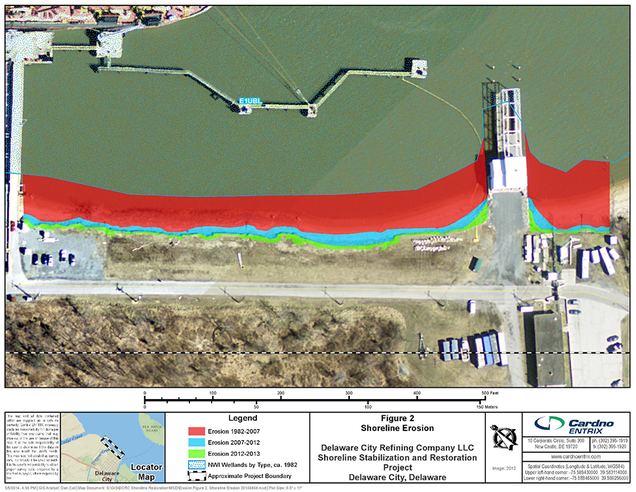
In its filing, the Delaware City Refining Company says its shoreline is disappearing. Rapidly. “The extent of tidal encroachment is obvious,” the report says, adding: “Review of historical photography suggests that the rate of shoreline erosion is increasing.” The only solution, it says, is to build a protective ring of buoys “that has the resilience to deal with Sea Level Rise (SLR) for at least 50 years.”
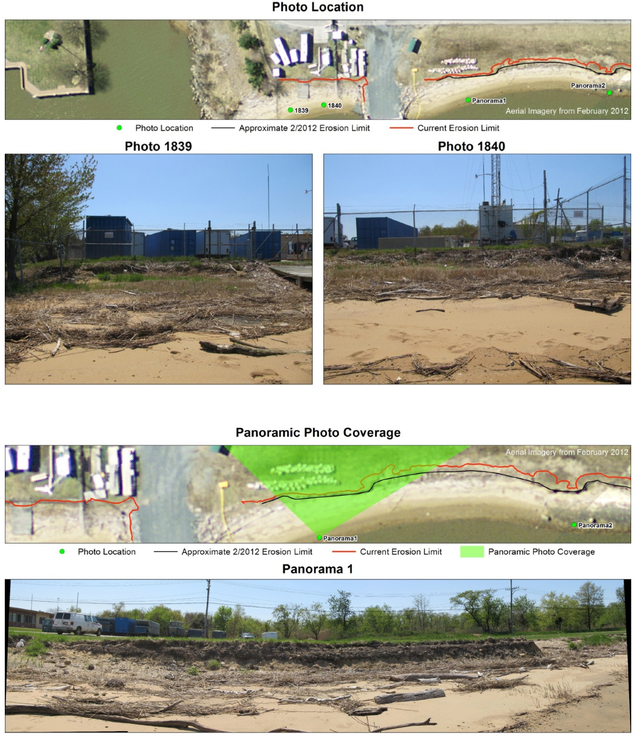
The oil company’s report has some ominous graphics, including the one above, showing the progressive erosion of the waterline by tides and waves, egged on by rising sea levels. In some cases, the refinery’s storage facilities and vehicle lots are already on the mouth of the new shoreline, thanks to that rising tide:
Expand
Once the local Sierra Club managed to stop gloating about the irony of a carbon-producing oil company making preparations to cope with carbon-caused climate changes, it did notice an issue with the company’s plan: The proposed buoys would dissipate wave energy from tides, boats, and storms, but they wouldn’t do much about the actual sea rise, which is accelerating.
“Delaware’s coastal areas could experience sea levels at 0.5 to 1.5 meters above their present level by 2100,” the Sierra Club argues. “Adjusting to the new conditions of higher sea levels, the report suggests, should involve planning for adaptation measures and building adaptive capacity.” The group suggested those measures might include the oil refinery changing the magnitude of its greenhouse gas output.
Regardless of what coping methods it takes, it’s remarkable that a petroleum-producer is acknowledging the effects of climate change on its business. Remarkable, but not unique. For nigh on half a decade now, vintners have been popping up in warmer climes, shippers have been charting new routes through sea lanes once cluttered with ice, and insurance companies are adjusting their actuarials to deal with the new environment.
“Though major international corporations tend to be amoral machines for collecting revenue without regard to fairness or human life,” a colleague of mine once wrote, “they do have one thing going for them: when there’s money on the line, they don’t waste time fucking around”:
You will never see a major international corporation prancing around fancy-free and acting as if the seas aren’t going to rise and whatnot, because they have assets to protect. Failing to plan for global warming due to some weird anti-science bias could potentially cost them billions of dollars. Therefore they will plan.
Is the planning a little more complicated when your business is essentially what’s making the globe warmer? Not especially. Just put out a couple floaters and keep counting the money.
Daily update: Networks to defend grid by adding fees to solar, storage
Inbox
x
Renew Economy editor@reneweconomy.com.au via mail68.us2.rsgsv.net
3:09 PM (26 minutes ago)
to me
Networks to defend grid by adding fees to solar, storage; Solar provides far more jobs in Australia than coal; LEDs could slash street light energy usage by 97%; NSW networks should lead way into solar, storage microgrids; Australia Post and Bird Munchies go solar at NSW HQs; Citizen-funded solar system installed at SA community centre; SolarWorld wins again: US-China solar trade war deepens; and Stanford foresees $25k, 300 mile EV battery range with honeycomb battery.
Network operators still want to address the “death spiral” by penalising solar and battery storage with higher fees and tariffs. But they are doing nothing about the legacy costs of a super-sized and over-capitalised grid.
TAI report says Australian solar industry employs 13,300 people, with another 8,000 to come – an amount “far larger” than its coal-fired power stations.
LED streetlights could achieve efficiencies of 97% by 2020 – much higher than domestic or commercial lamps. But are our governments enlightened enough?
Students have figured out how to stabilize the lithium in a lithium-ion battery, and that could help bring the typical EV down to mainstream affordability.
Despite the Fukushima disaster, Alexander Downer has come out in support of Australia storing the world’s nuclear waste. Sandi Keane looks at the secret plans developed by John Howard and George W. Bush to turn Australia into the world’s radioactive waste dump, with healthy profits for all. Is this how Tony Abbott plans to pay for “direct action”on climate change?
IS THE Fukushima nuclear fallout heading for Australia?
Yes, if Alexander Downer and the Liberal Party have anything to do with it. Not a large, menacing radioactive cloud lighting up our northern skies, but another kind of nuclear fallout from Fukushima: the urgent need to find a place to store the world’s deadly waste.
Fukushima’s reactors were inside thick containment walls but the waste, or to use nuclear spin, spent fuel rods, were out in the open. Two of the three ponds lost their roofs in explosions, exposing the spent fuel pools to the atmosphere, eventually catching fire and spreading the radiation.
Unfortunately, this is the practice followed by many countries around the world. There is simply no safe place to store the waste so it is often stored in cooling ponds at the reactor site.
This is the grim reality of the nuclear experiment. Forty years ago, when the first reactors were built, it was naively assumed that a solution would eventually be found to store or recycle the waste safely – but for 3 million years? Might this not transcend the scale of man’s experience? In hindsight it was a fatal mistake.
We now know that the frequency of earthquakes is increasing due to global warming as is extreme weather. More Fukushimas will happen. Our World Heritage listed national park, Kakadu, is also now threatened with radiation from the Ranger mine due to heavyrain. So we can’t even mine uranium safely any more.
Antinuclear fear in the aftermath of Fukushima has seen public demonstrations in Japan, Germany and France. Many countries may now be moving away from nuclear power in favour of renewables, but the legacy of the toxic waste will last for millions of years.
Generations to come will wonder at the greed and stupidity of their forebears. Build it, make the money and run is the credo of our generation.
So, whilst support for building new nuclear reactors has evaporated, there are a lot of angry citizens around the world demanding their governments do something about the waste. This is where Australia comes in and we will certainly get dragged into the nightmare if the Liberal Party has anything to do with it.
Had the Coalition won the election in 2007, Australia would have become a global nuclear waste dump.
Former Prime Minister Howard’s nuclear ambitions (detailed later in this piece) passed beneath the radar at the time, other than for those of us on the environmental wavelength. Alexander Downer blatantly denied that Australia was considering taking the world’s waste in 2007, as did our then Prime Minister.
So there was no debate. But when you joined the dots, the denials gave lie to the facts. Now Alexander Downer has changed his tune, reigniting the nuclear debate. In the Australian last week, he contradicts his claims in 2007 when he said Australia would not accept nuclear waste from overseas. Now he tells us it would have
“… enormous economic benefits.”
The Australian public needs to know whether the Liberals plan to dust off John Howard’s grand money-making fantasy to turn Australia into repository for the world’s nuclear waste.
The growing stockpile of world nuclear waste, GNEP and the “empty continent”
The US plan proposed that Australia become a one-stop nuclear shop. Through an international consortium of US, UK and Australia interests, Australia would produce, enrich and lease nuclear fuel and make a considerable fortune on storing the world’s waste. That was the plan on the table when John Howard visited Washington in May 2006.
Dr. John White, then Chairman of the PM’s Uranium Industry Framework was also there with Howard. There has been no change to the plan for a one-stop nuclear shop despite the renaming of GNEP to the International Framework for Nuclear Energy Cooperation (IFNEC).
Upon Howard’s return from Washington in May 2006, we saw him move with great speed to reignite the nuclear debate ostensibly to placate community concern about global warming. The talk focused on nuclear reactors but the rhetoric about building nuclear power plants was simply a softening up process for Howard/Bush’s real ambitions: GNEP and insidious agenda.
After years working in the environment movement, my antenna went into overdrive when one of the UK’s leading nuclear waste storage and transport specialists, Serco, under the name, Serco Asia Pacific Pty Ltd, bought the Great Southern Railway (same company which runs our detention facilities and whose handling of recent riots is being investigated).
I started taking a keen interest especially after Prime Minister Howard extended the railway line from Alice Springs to Darwin in 2003. The railway line not only runs past Olympic Dam but could easily run a branch line to Savory Basin in the Pilbara, once proposed by Pangea as a high level nuclear waste dump back in 2003.
The proposal was defeated after the Australian community was alerted to the plan after a promotional video for investors was leaked to the public.
Australian media silence on Howard’s nuclear plans
I searched in vain for news in the mainstream media. Eventually, an advisor to the Australian Greens Climate Change Spokesperson, Senator Christine Milne, referred me to two very detailed and disturbing articles in Fairfax’s Australian Financial Review, written by journalist Julie Macken.
The plan was not an issue for the media at the 2007 federal election
The first, on June 7, 2006, was headed: “John Howard’s grand plan for nuclear energy will involve enrichment and waste disposal in the outback if he follows the lead of US President George Bush”. Further research around the same time, unearthed China’s business newspaper, The Standard, which warned on June 29, 2006, that “Australia is set for nasty debate over plans to use the country as a waste dump”. Pakistan’s Dawn on June 30, asked the same question but said it couldn’t happen without a spirited debate.
So where was the nasty and spirited debate? How many Australians were aware of Howards plans? No-one I knew. Apart from the Australian Financial Review, The Bulletin (November 17, 2006), and The Australian (July 20, 2006), we saw little in the media, although it was patently clear that John Howard was well on his way to developing a nuclear fuel supply industry in Australia which would include leasing, enriching and storing highlevel nuclear waste.
I tried to contact Julie Macken only to be told that she no longer worked for the Australian Financial Review. In a follow-up article on August 3, 2006, Macken had interviewed Hugh Morgan who had just two months before formed a new company, Australian Nuclear Energy Pty Ltd with fellow Liberal luminaries, Ron Walker and Robert de Crespigny. Ron Walker was Chairman of Fairfax at the time. Emails to other Fairfax journalists got the same response: that Prime Minister Howard had denied taking nuclear waste from other countries.
Finally, Sophie Black, now editor of independent onliner, Crikey, responded to my emails, confirmed the evidence I’d supplied her and exposed the sham denials of the Liberals on September 6, 2007 in an excellent piece entitled “Australia: mine one day; nuclear dump the next”.
As for the nasty and spirited debate, the mainstream media went missing in action. Granted, we were never going to get one in the Murdoch press, but Fairfax was a surprise. I speculated on the extent of editorial influence of the chairman, Ron Walker, and his compromised position as Director of a company that stood to benefit from Howard’s nuclear fantasy.
Indignant denial as plans come to fruition
A handful of us in environment movement leapt into the vacuum vacated by the media. Letters went out to local media and local Liberal members. Fierce denials and claims of conspiracy theories followed. Their indignant protests looked rather hollow since all of them had unanimously endorsed the following Policy Resolution at the Liberal Party Federal Council in June 2007:
No. 24:The Federal Council believes that Australia should expand its current nuclear industry to incorporate the entire uranium fuel cycle, the expansion of uranium mining to be combined with nuclear power generation and worldwide nuclear waste storage in the geotechnical stable and remote areas that Australia has to offer.”
All the ducks were lining up for Howard’s big bonanza. The USA was (and still is) desperate to find a permanent high level nuclear waste dump following the decision not to proceed with the storage site at Yukka Mountain. The few high level waste dumps are temporary and several have had contamination problems. The US has no other permanent storage solutions and the interim ones have a life of less than 100 years.
But Howard and his chief nuclear adviser at the time, Dr. John White, were ready to come to the USA’s rescue back in 2006. Both were personally involved in the development of the Global Nuclear Energy Partnership, especially White who came up with the Business Plan.
Julie Macken’s articles in the Australian Financial Review detailed the plan: Nuclear waste, including plutonium from the weapons industry would be transported to Darwin by submarine. From there, it would be transferred to Serco Asia Pacific’s Great Southern Railway and transported by train to a supposedly geologically secure destination. Maralinga or Savoury Basin was the bet.
The extended rail line from Darwin to Adelaide was now in place but further hurdles had to be dealt with. Massive changes to current legislation at the time would be needed.
The Commonwealth Radioactive Waste Management Bill 2005 and subsequent amendments (2006) were passed in December 2006. The Bill effectively overrides territory government laws, neutralizes environment and heritage legislation, limits indigenous land rights and transfers powers to the Minister to nominate nuclear waste dump sites.
The ANSTO Bill passed around the same time gave ANSTO the power to transport and manage nuclear waste dumps. Critically it gave ANSTO the power to accept waste generated outside Australia.
Later legislation removed the last of the obstacles to the plan which included overriding state and territory powers. In overriding the Native Title Act, the Commonwealth Radioactive Waste Management Act prevented traditional owners from appealing against a nuclear waste dump on their land.
Shadow Environment Minister, Peter Garrett’s speech to the House in December 2006 described the bills as a
“sordid and sorry affair”……. “it limits traditional landowner rights, overrides territory government laws and pushes aside Commonwealth environment and heritage legislation at the site selection state…. A deeply disturbing development…. It also allows the Commonwealth to do whatever it likes to establish a nuclear waste dump. It also allows the Commonwealth to take any action to enable nuclear waste to be transported to the site”.
Howard, John White and the vested interests
Howard’s chief nuclear advisor, Dr John White
Whilst the unfolding of Howard’s great nuclear dream caused barely a blip in the mainstream media, plenty of exciting action was happening in Liberal business circles. The same vested interests behind Howard/Bush’s inaction on climate change were now rallying behind this potential nuclear bonanza.
Both Howard and White envisaged that their global nuclear waste dump would be managed by the private sector.
Furthermore, the PM’s task force report said that any nuclear enrichment facility would have a very high level entry and would likely be managed by a multinational corporation and that either a UK or US company would be facilitated in that regard.
White was not only the PM’s Chairman of the Federal Government’s Uranium Industry Framework but was the one who developed it.
White also headed a waste management company, Global Renewables, essentially a nuclear waste company in spite of its eco-friendly sounding name.
But Dr. White was an even bigger player in the international nuclear stakes.
Ten years ago, he set up a UK/US/Australian consortium: the Nuclear Fuel Leasing Group. He and his colleagues invested $45 million in the company. White is no lightweight in the nuclear stakes and is an astute businessman. You need more than a nod and a wink from the government to invest $45 million.
There are four members: along with White are some of the biggest names in the international nuclear industry: David Pentz, Chairman of Pangea Resources whose sole aim is to explore the world for suitable nuclear waste dumps; Daniel Poneman, currently U.S. Deputy Secretary of Energy and principal of the Scowcroft Group whose background is in energy and security; and Mike Simpson, head of business development projects for British Nuclear Fuels.
Plutonium shipped to Darwin in submarines then by rail
The Nuclear Fuel Leasing Group’s submission to Dr. Switkowsky’s Uranium Mining and Processing and Nuclear Energy Review proposed that Australia produce the fuel rods, lease them to the world and take back the spent rods for storage. Nuclear waste would be shipped to Darwin by submarines in specially designed caskets which would then be transferred to the Adelaide-to-Darwin railway line.
It was suggested that the proposed dump be in “restricted” areas, either in South Australia or Western Australia but most likely Maralinga. I rang a friend who was Chairman of the Darwin Port Authority at the time. He was gobsmacked beyond belief at the idea of submarines in Darwin harbour carrying high level waste, not to mention spent plutonium from the weapons industry, until I sent him a copy of White’s submission.
Dr. White’s plan was to bring high level nuclear and plutonium waste by specially designed ship or submarine into the port of Darwin, and then by railway down through central Australia to South Australia (the railway conveniently runs past Maralinga as well as Olympic Dam).
We would be exposed to terrorist threats over 1,000s of kilometres of railway line, not to mention Darwin harbour smack bang in the middle of that city, according to John Large, whose company, Large & Associates handled the salvage of the stricken Russian U sub, Kursk.
“there is simply no way, over a 100,000 year time scale, to stop the fuel leaking out”.
Our Great Artesian Basin is the largest and deepest artesian basin in the world, stretching over a total of 1,711,000 square kilometres over 4 states, including the site of the Roxby Downs, Olympic Dam and Maralinga in South Australia. What happens when the deadly hydrogen eventually leaks into Australia’s largest underground water reservoir? Large was shocked to hear that Australia wanted to go down this path.
Bush’s Global Nuclear Energy Partnership (now IFNEC) was essentially about controlling the proliferation of nuclear weapons with countries such as Australia and Canada leasing fuel rods and taking back the spent rods.
The idea of leasing fuel rods and taking back the waste was the brainchild of White who persuaded Bush several years ago to adopt this as the Business Plan for the GNEP during its development phase. In his interview with the Australian Financial Review on 7 June, 2006, White was enthusiastic about the advantages he sees for Australia in Bush’s GNEP:
“Australia wins on the mining, enriching and leasing, but makes a long-term fortune on the storage.”
In an interview in New Matilda with the same journalist, Julie Macken, on 8 November, 2006, White makes his case for taking US spent plutonium from the US weapons program and high level waste from reactors:
“If we agree to do this for America, we will never again have to put young Australians in the line of fire. We will never have to prove our loyalty to the US by sending our soldiers to fight in their wars, because a project like this would settle the question of our loyalty once and for all.”
The link to major Liberal Party donors
Just a month after Howard’s visit to Washington in May 2006, as mentioned earlier, another link in the nuclear industry chain was established: Australian Nuclear Energy Pty Ltd. Directors, Hugh Morgan, Ron Walker and Robert de Crespigny, are major donors to the Liberal Party. The company’s business is nuclear power plants and an international nuclear waste repository.
In his interview with Katharine Murphy, in The Age, on 5 April, 2007, Morgan declared he was in for the long haul and was considering power plants and waste dumps.
Talking to the Australian Financial Review on August 3, 2006 at a uranium conference in Adelaide in July 2006, he renewed his argument from the early 80’s when WMC examined high-level nuclear waste storage:
“To put together an internationally managed repository would bring great standing in the international community for Australia.”
Morgan has promoted the idea of a global nuclear waste dump for Australia in various other media interviews including the ABC’s Jon Faine.
“Sustainable” nuclear development
Bizarrely, in the light of the above, indignant denials from Prime Minister Howard and his Ministers continued, even after a media release on 28 April 2007 (found on the government’s und in the mainstream media) where words like “sustainable” were a clue to the “cradle to grave” role to be played by Australia:
“In light of the significance of global climate change and as the world’s largest holder of uranium reserves, Australia has a clear responsibility to develop its uranium resources in a sustainable way – irrespective of whether or not we end up using nuclear power.”
His intention to bag one of the biggest trade opportunities for Australia as his legacy regardless of his political fate is evidenced by his dogged determination to clear the decks in readiness to act – now or later:
“A key theme of the advice that the Government has received is that Australia should do what it can to expand our uranium exports and to remove unnecessary barriers that are acting as impediments to the efficient operation and growth of the industry”.
“The Government’s next step will be to repeal Commonwealth legislation prohibiting nuclear activities, including the relevant provisions of the “Environmental Protection and Biodiversity Conservation Act 1999. This will be addressed soon.”
“In light of the significance of global climate change and as the world’s largest holder of uranium reserves, Australia has a clear responsibility to develop its uranium resources in a sustainable way – irrespective of whether or not we end up using nuclear power.”
Mainstream media failure
Why didn’t the mainstream media pick up more on this and get a real debate happening? Was Howard deliberately using stealth to realize his ambitions? The GNEP plan was a triple jackpot: massive fortunes would be made on the mining, enriching and storage.
The most damning betrayal of our trust was Howard’s failure to make public his government’s intentions to sign the Global Nuclear Energy Partnership. The Age journalist, Katherine Murphy, declared you’d have to “follow national political events with abnormal interest” to know about it. The piece written on 27 September 2007 was headed “Don’t Mention the ‘N’ Word!”and went on:
“A COUPLE of weeks ago, a senior Australian official you’ve probably never heard of strapped himself into the comfortable end of an aeroplane bound for Vienna. After the long journey, he went along to an important meeting, and acting with the authority of the Commonwealth, signed a document that commits Australia to being a full partner in a global energy grouping you will know about only if you follow national political events with abnormal interest”.
Peter Garrett’s advisor spoke to me of Labor’s frustrations in getting its press releases of their concerns into the media.
Australian Greens Senator Christine Milne also told me in a radio interview of the same frustrations she had in getting the media to take up the story. Her media release condemning the Howard Government’s action for not making its signing of the GNEP public, like most of the Green’s Press Releases, was only reported by the environment movement.
“Would we be horrified”, she asked, in a Friends of the Earth newsletter,“that we were getting in deeper and deeper?”.
Howard’s legacy lives on
John Howard and Bronwyn Bishop’s lovechild
Howard may have gone but the legacy of his nuclear fantasy lives on in the true style of things radioactive.
Abbott likes to describe himself as John Howard and Bronwyn Bishop’s love child. Like all good male children, he has modeled himself on his father figure. Abbott worships John Howard. In return, like all good fathers, Howard has provided a once in a lifetime opportunity to set Tony Abbott and the Liberal Party up for life—if Tony seizes his big chance before the other contender, Russia, does.
Surely, it was meant to be? The Gods are on his side. The polls are a peach. The Greens will have to be destroyed so that the Coalition regains control of the Senate but TheAustralian is taking good care of that. The independents are easily intimidated and will probably succumb to family pressure to retire at the next election. It’s in the bag!
Unlike Howard, Abbott is a regular, kick-arse kind of guy. He won’t worry about trampling over our democratic sensibilities.
Question is: Is this the sort of US alliance and deadly legacy we, the people, want?
Tony Abbott says he will overturn any market mechanism to limit carbon emissions, but still says the Coalition will still meet the emission reduction though direct action. But how?
We know direct action is costly, hence the need for a market mechanism. Paying polluters to close aluminium smelters and inefficient old coal fired power stations will cost the Government a motza, as will Government directly funding the development of alternative sustainable energy sources.
Is the nuclear dump option, which has never been fully shelved by the Liberals, the secret silver bullet?
We know that storing nuclear waste would be a lucrative industry.
Tony Abbott must be asked to stop the uncertainty and come clean:
Does the Liberal Party plan to turn Australia into the repository for the world’s most dangerous waste? Is not, say so and say it clearly, preferably using “carefully prepared, scripted notes”.
Tony Abbott’s handpicked head of the panel reviewing Australia’s renewable energy target, the self-avowed climate “sceptic” Dick Warburton, is no fan of renewable energy. In an article co-authored for Quadrant in 2011, Warburton insisted that nuclear energy was the only alternative to fossil fuel generation.
The two-part series for the conservative magazine – co-authored by Warburton along with poet and accountant Geoffrey Lehmann and Resmed founder Peter Farrell – is an eye-opening compendium of the major arguments that climate science deniers and fossil fuel lobbyists have ever thrown at climate science, against carbon pricing and against renewable energy.
The title of the two-part series was “An intelligent voter’s guide to global warming” (you can find Part 1 here and Part II here), and the authors pretended to “provide basic information often missing from the debate.” In fact, it is a collection of scientific howlers normally only found in right-wing blogs.
This, though, is the paragraph that might interest those likely to feel the impact of the decisions made by the RET review panel that Warburton now heads:
“Except for nuclear power, there are no straightforward strategies for reducing dependence on fossil fuels without large economic costs. Wind and solar generators often cannot function when needed. Wind machines operate at only about 25 per cent capacity in the UK. Even when the wind is blowing, “back-up capacity, usually gas-fired … had to be kept running, using fuel, generating steam, emitting CO2, ready to ramp up its turbines the moment sufficient supply from the wind machines stopped coming”. Two main obstacles with renewables are the difficulty of establishing transmission lines from sunny or windy places to where the power is needed and the absence of utility-scale storage technology for intermittent renewable energies. A US comparison estimated the following electricity generation costs per kilowatt hour: hydroelectric $0.03; nuclear and coal $0.04; wind power $0.08; natural gas $0.10 (other estimates for gas suggest about $0.04); solar power (construction costs only, ignoring production costs for which reliable data were unavailable) $0.22.”
And, a little later….
“The only current viable alternative to burning fossil fuels is to go nuclear. Although current known reserves of uranium are limited, it is likely that by developing new nuclear technologies and with new sources of uranium, humanity’s electricity needs could be satisfied by nuclear power for many hundreds of years or more.”
Fantastic. In the true sense of the word. One hopes that Warburton has caught up a little on the various technology costs. In the US, where his electricity generation costs are cited, nuclear is four times the price that he quotes. In fact, you would have to go back many, many years to find a time when it was just 4c/kWh.
Ditto with solar. Solar PV, including production costs (for which there is plenty of reliable data), costs around half that quoted by Warburton in the US. Some recent solar PV power purchase contracts, aided by a tax credit, have been at one-quarter of the price he quoted. Wind, according to General Electric, the largest provider of power equipment, is also around half of that quoted by Warburton, and new coal – according to investment bank Citigroup – is also four times the price quoted by Warburton. Even fracked gas is being priced out of the market by utility-scale solar. As Citigroup noted, quite bluntly: Nuclear and coal are not competitive with renewables on cost.
One also assumes that Warburton is aware that the cost of energy storage is falling, and likely to follow the pathway of solar, as Morgan Stanley has pointed out. This is one reason why grid operators in WA and Queensland are looking to reduce their poles and wires delivering centralised fossil fuels, because they cannot compete economically with solar and storage any more.
Warburton can catch up with Australian technology cost estimates at the Bureau of Resource and Energy Economics, which recently doubled its estimated costs of nuclear and dramatically reduced its estimates on the cost of solar.
One also hopes that Warburton is disabused of his idea that “fossil fuel” generation is left running, and polluting, waiting for the sun to stop shining and the wind to stop blowing. Such nonsense is only propagated by the most infamous of blogs haunted by climate science deniers, nuclear boosters and the anti-wind brigade. (Who are often the very same people).
A report by the US Department of Energy’s National Renewable Energy Laboratory puts this myth to rest. Those grids that have high renewables are actually using less fast-response peaking power than those relying almost exclusively on inflexible coal or nuclear generators.
The Quadrant article has some other stunning statements. Just to make their lack of understanding about electricity markets complete, the authors contend …
Energy demand is “pretty inelastic” because people will not choose other goods or services to substitute for energy that keeps them warm or cool, cooks their food and provides transportation.
I wonder how, then, they explain the fact that in Australia and many other countries, demand is falling – with average household demand in Australia falling 10 per cent in a single year in some states. This is not just because they are becoming more efficient, but also because they have found cheaper alternatives … mostly rooftop solar.
And then there is this, on carbon dioxide …
“Carbon in the form of airborne soot is a pollutant. Carbon dioxide is not ….. Carbon dioxide is a crop nutrient without which we would simply perish.”
As we have mentioned before, Warburton is supported in his RET review by fossil fuel lobbyist Brian Fisher, and Shirley In’t Veld, the former head of Verve Energy, who has also expressed a disdain for renewable policies in the past.
But the question that the renewables industry will be asking is this: Given that Warburton says he has investigated the climate science and declares that climate scientists do not know what they are talking about, what are the chances that he will accept the evidence from the renewable energy industry? Ideology, as we have seen with the media and the government since the September poll, is a mighty powerful editor.
Daily update: It’s time for Tony Abbott to dump secret nuclear ambitions
Inbox
x
Renew Economy editor@reneweconomy.com.au via mail200.atl121.mcsv.net Unsubscribe
2:45 PM (11 minutes ago)
to me
Time for Abbott to dump his secret nuclear ambitions; Silex tumbles after solar-nuclear switch hits market roadblock; Ingenero placed in administration; Hunt approves “carbon bomb”; Australia’s first commercial wind farm faces bleak future; Solar boosting jobs/cutting electricity costs according to new study; Rio Tinto’s fossil fuel exposure is rapidly diminishing; Abbott may have delivered the ETS’ last rites, but what did Bernardi’s G8 do?; and The “hidden cost’ of wind power – less than conventional power plants
Tony Abbott has surrounded himself with nuclear advocates. This explains his antipathy towards wind and solar, but as the French government, and Australian nuclear technology developer Silex are discovering – it’s a dead end. It’s time for Abbott to dump his unstated nuclear fantasies.
The Australian solar industry has been rocked by the apparent collapse of one of the country’s largest and most prominent solar developers, the Queensland-based Ingenero.
Australia Institute study says solar is creating jobs and pushing down electricity prices – contrary to the popular belief that renewable energy puts upward pressure on energy prices.
Many revelations have come out with the carbon tax repeal, including disclosures about an inner core or ‘Group of 8’ within the Coalition who have worked tirelessly to kill the carbon tax, the reporting of Rupert Murdoch’s views on climate change and a rearguard pitch by News Corp tabloids to turn the repeal into a rejection of the science.
Geological Processes Ensure Earth Remains Habitable Says Study
21.03.2014
21.03.2014 06:14 Age: 128 days
Scientists explain in a new Nature paper that geological processes are responsible for ensuring that the Earth remains capable of supporting life and does not turn into a hot Venus or cold Mars.
Researcher Josh West treks through a valley in Peru in search of evidence of chemical weathering of rocks as they erode. Courtesy: Mark Torres
by Robert Perkins, University of Southern California
Researchers from the University of Southern California (USC) and Nanjing University in China have documented evidence suggesting that part of the reason that the Earth has become neither sweltering like Venus nor frigid like Mars lies with a built-in atmospheric carbon dioxide regulator — the geologic cycles that churn up the planet’s rocky surface.
Scientists have long known that “fresh” rock pushed to the surface via mountain formation effectively acts as a kind of sponge, soaking up the greenhouse gas CO2. Left unchecked, however, that process would deplete atmospheric CO2 levels to a point that would plunge the Earth into an eternal winter within a few million years during the formation of large mountain ranges like the Himalayas — which has clearly not happened.
And while volcanoes have been pointed to as a source of carbon dioxide, alone they cannot balance out the excess uptake of carbon dioxide by large mountain ranges. Instead, it turns out that “fresh” rock exposed by uplift also emits carbon through a chemical weathering process, which replenishes the atmospheric carbon dioxide at a comparable rate.
“Our presence on Earth is dependent upon this carbon cycle. This is why life is able to survive,” said Mark Torres, lead author of a study disclosing the findings that appear in Nature on March 20. Torres, a doctoral fellow at the USC Dornsife College of Letters, Arts and Sciences and a fellow at the Center for Dark Energy Biosphere Investigations (C-DEBI), collaborated with Joshua West, professor of Earth sciences at USC Dornsife, and Gaojun Li of Nanjing University.
CO2 Balance
While human-made atmospheric carbon dioxide increases are currently driving significant changes in the Earth’s climate, the geologic system has kept things balanced for million of years.
“The Earth is a bit like a big, natural recycler,” West said.
Torres and West studied rocks taken from the Andes mountain range in Peru and found that weathering processes affecting rocks released far more carbon than previously estimated, which motivated them to consider the global implications of CO2 release during mountain formation.
The researchers noted that rapid erosion in the Andes unearths abundant pyrite — the shiny mineral known as “fool’s gold” because of its deceptive appearance — and its chemical breakdown produces acids that release CO2 from other minerals. These observations motivated them to consider the global implications of CO2 release during mountain formation.
Like many other large mountain ranges, such as the great Himalayas, the Andes began to form during the Cenozoic period, which began about 60 million years ago and happened to coincide with a major perturbation in the cycling of atmospheric carbon dioxide.
Using marine records of the long-term carbon cycle, Torres, West and Li reconstructed the balance between CO2 release and uptake caused by the uplift of large mountain ranges and found that the release of CO2 release by rock weathering may have played a large, but thus far unrecognized, role in regulating the concentration of atmospheric carbon dioxide over the last roughly 60 million years.
Abstract
The observed stability of Earth’s climate over millions of years is thought to depend on the rate of carbon dioxide (CO2) release from the solid Earth being balanced by the rate of CO2 consumption by silicate weathering. During the Cenozoic era, spanning approximately the past 66 million years, the concurrent increases in the marine isotopic ratios of strontium, osmium and lithium suggest that extensive uplift of mountain ranges may have stimulated CO2 consumption by silicate weathering, but reconstructions of sea-floor spreading do not indicate a corresponding increase in CO2 inputs from volcanic degassing. The resulting imbalance would have depleted the atmosphere of all CO2 within a few million years. As a result, reconciling Cenozoic isotopic records with the need for mass balance in the long-term carbon cycle has been a major and unresolved challenge in geochemistry and Earth history. Here we show that enhanced sulphide oxidation coupled to carbonate dissolution can provide a transient source of CO2 to Earth’s atmosphere that is relevant over geological timescales. Like drawdown by means of silicate weathering, this source is probably enhanced by tectonic uplift, and so may have contributed to the relative stability of the partial pressure of atmospheric CO2 during the Cenozoic. A variety of other hypotheses have been put forward to explain the ‘Cenozoic isotope-weathering paradox’, and the evolution of the carbon cycle probably depended on multiple processes. However, an important role for sulphide oxidation coupled to carbonate dissolution is consistent with records of radiogenic isotopes, atmospheric CO2 partial pressure and the evolution of the Cenozoic sulphur cycle, and could be accounted for by geologically reasonable changes in the global dioxygen cycle, suggesting that this CO2 source should be considered a potentially important but as yet generally unrecognized component of the long-term carbon cycle.
Citation
Sulphide oxidation and carbonate dissolution as a source of CO2 over geological timescales by Mark A. Torres, A. Joshua West & Gaojun Li and published in Nature 507, 346–349 (20 March 2014) doi:10.1038/nature13030


 Expand
 Expand