Category: Uncategorized

  • An analysis of global temperatures by NASA scientists shows that 2013 was the seventh warmest year since 1880 (tied with 2006 and 2009). Nine of the 10 warmest years on record all have occurred since 2000, w

    2013 Continued the Long-Term Warming Trend

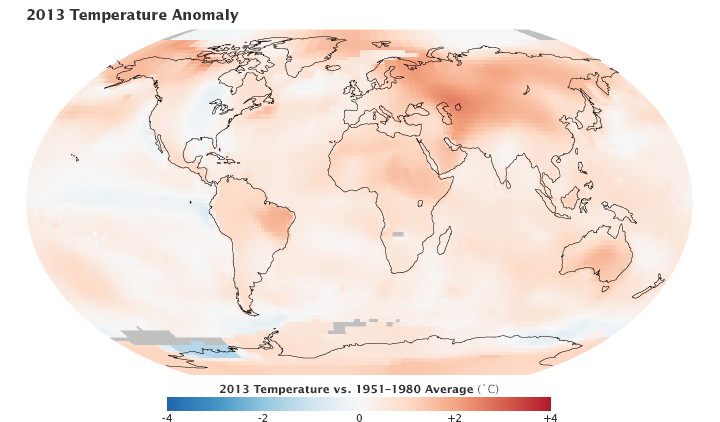
    acquired January 1 – December 31, 2013 download large image (1 MB, TIFF)

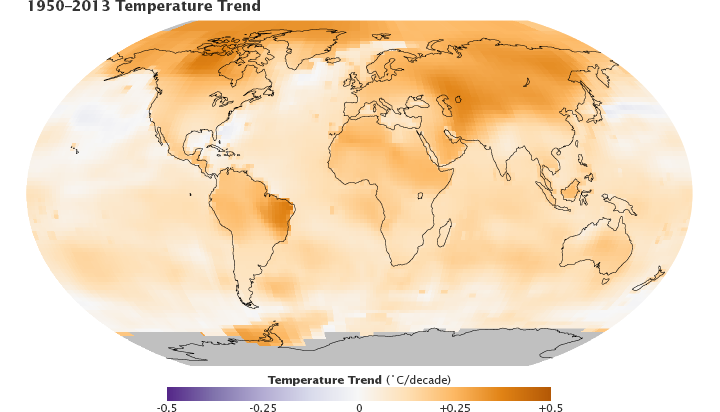
    acquired January 1, 1950 – December 31, 2013 download large image (1 MB, TIFF)
    acquired January 1, 1880 – December 31, 2013 download web-resolution animation (1 MB, QuickTime)

    An analysis of global temperatures by NASA scientists shows that 2013 was the seventh warmest year since 1880 (tied with 2006 and 2009). Nine of the 10 warmest years on record all have occurred since 2000, with 2010 and 2005 ranking as the warmest. Scientists at NASA’s Goddard Institute for Space Studies (GISS) reported that 2013 continued the long-term trend of rising air temperatures over the land and sea surface.

    The top map above depicts global temperature anomalies in 2013. It does not show absolute temperatures, but instead shows how much warmer or cooler the Earth was compared to an averaged base period from 1951 to 1980. The GISS team assembles its analysis with publicly available data from roughly 6,300 meteorological stations around the world; ship-based and satellite observations of sea surface temperature; and Antarctic research station measurements. For more explanation of how the analysis works, read World of Change: Global Temperatures.

    The global average temperature for 2013 was 14.6° Celsius (58.3° Fahrenheit), which is 0.6°C (1.1°F) warmer than the mid-20th century baseline. The average global temperature has risen about 0.8°C (1.4°F) since 1880. Exact rankings for individual years are sensitive to data inputs and analysis methods.

    “Long-term trends in surface temperatures are unusual, and 2013 adds to the evidence for ongoing climate change,” said GISS climatologist Gavin Schmidt. “While one year or one season can be affected by random weather events, this analysis shows the necessity for continued, long-term monitoring.”

    Weather patterns and other natural cycles cause fluctuations in average temperatures from year to year. This is especially the case on regional and local levels. For instance, while the globe experienced notably warm temperatures in 2013, the continental United States had its 42nd warmest year, according to GISS analysis. On the other hand, 2013 was the hottest year in Australia’s recorded history.

    Regardless of the regional differences in any year, continued increases in greenhouse gas levels in Earth’s atmosphere are driving a long-term rise in global temperatures. Each calendar year will not necessarily be warmer than the year before. But with the current level of greenhouse gas emissions, scientists expect each decade to be warmer than the previous one. The decade-by-decade temperature trend is depicted in the second map above and in the downloadable animations.

    It has been 38 years since the recording of a year with cooler than average temperatures. The graph below shows how the long-term temperature trend has continued to rise even when El Niño and La Niña events skew temperatures warmer or colder in any one year. Orange bars represent global temperature anomalies in El Niño years, with the red line showing the longer trend. (The classification of years comes from the NOAA Oceanic Niño Index.) Blue bars depict La Niña years, with a blue line showing the trend. El Niño/La Niña neutral years are shown in gray, and the black line shows the overall temperature trend since 1950. Note that even the La Niña years are warmer than they used to be.
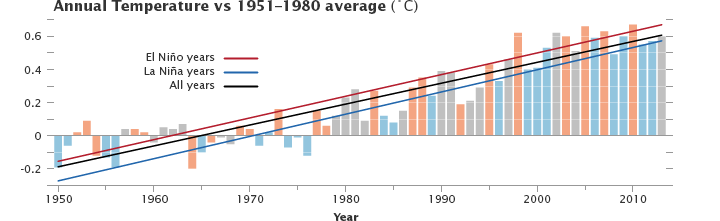
    acquired January 1 – December 31, 2013 download large image (1 MB, TIFF)
    acquired January 1, 1950 – December 31, 2013 download large print-quality figures image (1 MB, PDF)

    Scientific evidence says the level of carbon dioxide in Earth’s atmosphere presently is higher than at any time in the past 800,000 years. In 1880, the first year included in the GISS analysis, the global carbon dioxide level was about 285 parts per million; by 2013, it peaked at more than 400 parts per million. Carbon dioxide is a greenhouse gas that traps heat and plays a major role in controlling changes to Earth’s climate. It occurs naturally and also is emitted by the burning of fossil fuels.

    1. Related Reading

    2. NASA Earth Observatory (2012) World of Change: Global Temperatures.
    3. NASA Goddard Institute for Space Studies GISS Surface Temperature Analysis (GISTEMP).
    4. NASA Earth Observatory (2011, January 14) Different Records, Same Warming Trend.
    5. NASA Earth Observatory (2007, November 5) Earth’s Temperature Tracker.
    6. NASA Earth Observatory (2010, June 3) Global Warming.
    7. NASA Earth Observatory (2013, March 26) Arctic Amplification.
    8. NASA Earth Observatory (2013, September 27) Global Patterns of Carbon Dioxide.
    9. NASA Earth Observatory (2011, June 16) The Carbon Cycle.

    NASA images by Gavin Schmidt and Robert Simmon, based on data from the NASA Goddard Institute for Space Studies. Caption by Mike Carlowicz and Michael Cabbage.

    Instrument: 
  • Exclusive: Climate scepticism blamed as Owen Paterson slashes spending on global warming

    Exclusive: Climate scepticism blamed as Owen Paterson slashes spending on global warming

    Environment Secretary faces criticism as he cuts the budget for domestic initiatives by 41 per cent

    Environment Editor

    Sunday 26 January 2014

    Owen Paterson has been accused of “incredible complacency” over climate change after new figures showed his department has slashed spending on helping Britain cope with global warming.

    The Department for Environment, Food & Rural Affairs (Defra) will spend just £17.2m on domestic “climate change initiatives” this financial year, a 41 per cent decline on the previous 12 months, according to its response to a freedom of information request.

    The figures will fuel fears that the Environment Secretary’s personal climate-change scepticism could be exposing the UK to a higher risk of flooding and other global warming consequences.

    Bob Ward, policy director at the London School of Economics’ Grantham Research Institute, said: “These shocking figures should worry everyone in the UK. Defra is the lead government department for climate change adaptation and is primarily responsible for making the UK resilient to the impacts of global warming, such as increased flood risk,”

    Maria Eagle, shadow Environment Secretary, said such a steep drop in domestic climate change initiatives “reveals an incredible level of complacency about the threat to the UK from climate change”.

    She added:“This is further evidence that Owen Paterson’s unwillingness to accept the science on climate change is leading him to make the wrong choices on spending cuts within his department,.”

    Lest we forget: see the damage that flooding can do


    Most of the money has been spent helping Britain adapt to cope with the effects of global warming, such as by investing in research projects and giving advice on how to deal with water shortages, soil erosion, and extreme weather.

    The rest is being spent on curbing the extent of climate change, for example by monitoring and capturing methane emissions which contribute to global warming and ensuring carbon emissions from agriculture comply with UN and EU regulations.

    The dramatic cut in domestic climate change spending comes in Mr Paterson’s first full-year as Environment Secretary – he took up the post in September 2012 . The spending now represents just 0.7 per cent of the department’s total budget for the year, down from 1.2 per cent last year.

    Defra is in charge of preparing, or adapting, Britain for global warming, while the Department for Energy and Climate Change is responsible for mitigating the risks.

    Environmental folly: Cutting the domestic climate change budget is a mistake

    One source who worked with the Environment Secretary said: “Adapting to climate change in itself is not a priority for Owen Paterson. He doesn’t believe that floods have anything to do with climate change, so he calls the biggest aspect of adaptation ‘flood management’. When you talk to him, you don’t use words like ‘adaptation’ – instead you talk about the economic impacts and opportunities and present it as a market solution.”

    This month, Mr Paterson was asked in Parliament whether he agreed with David Cameron’s “suspicion” that climate change was partly to blame for the ferocity of the recent storms – and he failed to answer.

    Guy Shrubsole, a Friends of the Earth campaigner, said: “By cutting Defra’s work to protect the UK from climate change and extreme weather events, Owen Paterson has shown that he’s unfit for  office. He continues to put more people and their livelihoods at risk.”

    The freedom of information figures obtained from Defra only relate to spending where the primary aim is to tackle climate change, so exclude some investments which could indirectly help Britain deal with global warming.

    A Defra spokesman said: “Defra funds programmes that help protect international forests, cut greenhouse gas emissions and help the UK adapt to a changing climate.”

    Defra’s decreased domestic spending came as its spending overseas increased, from £20.1m last year to £30m this year – almost the same amount as the decline in domestic spending.

    But much of this increase can be put down to an agreement before Mr Paterson took over the department in September 2012, following the UN Climate Change Conference in Cancun in 2010. This requires Defra to give £140m to the International Climate Fund, which helps the world’s poorest adapt to climate change, between April 2011 and March 2016 – primarily through forest protection.

  • Climate change is spoken of in hushed tones, but it wasn’t always this way

    Farming communities still differ widely in their opinions on the environment, despite clear awareness some years ago

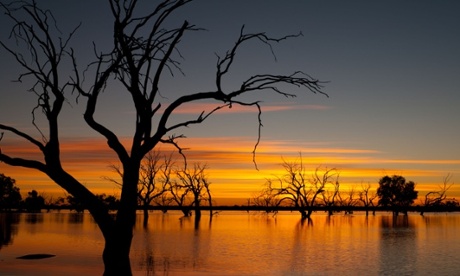
    Sunrise over Lake Pinaroo in Sturt National Park, outback Australia.
    Those in agriculture are not universally dismissive of the need to act on climate change, despite the perception it is linked to the left side of politics. Photograph: Ashley Whitworth/Alamy

    There is a term that is not generally used in polite company in the bush. That term is climate change.

    To an outsider’s eyes, it might seem to be counterintuitive. Here are people whose living is mostly dependent on the vagaries of the weather. Yet you will hear more conversation about climate change at a city dinner party than a lazy Sunday afternoon lunch in the bush.

    The publicly reported attitudes to climate change in rural Australia have been just as confusing.

    That is, rural Australians are less likely to be concerned about climate change, less likely to agree it poses a serious threat to our way of life and less likely to trust the science that suggests human activity is responsible for change. Country people are also more likely to think the seriousness of the issue is exaggerated and less likely to think governments need to do more to address climate change. At least, these were the findings of a report last year by the Climate Institute into attitudes towards climate change.

    Malcolm Turnbull notwithstanding, climate change has been inextricably linked with one side of politics – Labor – through the emissions trading scheme. Tony Abbott successfully managed to tie climate change to Labor and drag it down by campaigning against the carbon tax. Hence, in conservative country Australia, there is a reticence to discuss the topic. But don’t be fooled. There is still a lot happening away from the public gaze.

    It was not always this way. In 2006, the National Farmers’ Federation’s policy-makers made a unanimous call for early action on climate change. From a media release, dated 6 December 2006, the then NFF president, David Crombie, announced the federation’s policy council would be joining the Australian business roundtable calling for early action.

    “NFF believes that climate change may be the greatest threat confronting Australian farmers and their productive capacity … now and in the future,” Crombie said at the time. “Today’s announcement, and our keenness to engage, reflects this reality. It threatens Australia’s agricultural productive base – an important contributor to the national economy, the ability for Australian farmers to put food on the table of Australian families, and the long-term sustainability of at least 60% of Australia’s landmass.”

    That was a while ago. As in metropolitan Australia, the climate change issue has dropped down the priority list in the country.

    By 2009, the public mood had changed and the NFF was welcoming the contribution of Ian Plimer, lending support to other voices in the debate.

    Crombie said: “We’ve heard ad nauseam from those scientists convinced that climate change will ruin us all and, seemingly, hellbent on making grim doomsday predictions. But we’ve heard precious little from those experts for whom the jury is still out, or, in the case of Professor Plimer say their research shows extreme climate change predictions are overstated.

    “Now, before I’m carted to a stake for public torching, I’m not saying Professor Plimer is right, nor that his colleagues with differing views are wrong. Just that it’s about time we had a balanced, informed discussion and debate … free from vilification of those who dare to question conventional wisdom.”


    Among the farming community there is a range of views from accepting climate change science to entrenched opposition. In most cases, though, the community tends to prefer the term “climate variability” than “climate change”.

    Corey Blacksell is a grain farmer on the South Australian side of the Victorian border who grabs modern farming practice and technologies with relish. An active member of the Liberal party, he holds a masters in agribusiness and also trades grain. He believes arguing over what is happening to the climate and why it’s happening is pointless for farmers. A bit like arguing why the baby is crying. You just have to deal with the consequences.

    “Most farmers would accept the climate is changing but would rather not argue over why. We just have to do everything to ensure we make the right decisions for our businesses,” he said. “Farmers are now managers of capital and we must ensure we have mitigated the risks until the odds are in our favour. If we can’t, and that means in some years you don’t even sow a crop and go on holidays instead, then we should consider that.”

    When I suggest one of the reasons for farmers openly debating the causes of climate change may be to bring about changes in farming practices, Blacksell disagrees.

    “If it is the case [that human activity is causing it], then it’s so much bigger than agriculture and it has to be debated at a much higher level. Farmers have adapted over time, history tells us this,” he said. “Climate change is a gradual change, it’s not X today and Y tomorrow. Agriculture can manage any change [or variability] in climate because of this. ”

    Closer to home, farmer Peter Holding is one of my neighbours in southern New South Wales. He is a participant in the Climate Champions program, which gives farmers the latest research from climate scientists and provides scientists with farmers’ experiences. It is funded by the Grains Research and Development Corporation, Meat & Livestock Australia and Australian Wool Innovation.

    The program is unequivocal in its information booklet on the scientific basis of climate change. The first line: “The scientific evidence is clear: our climate is changing and humans are mostly to blame.”

    Holding is one of the few I have heard actively use the term “climate change” as a serious threat to food supply. He is also involved in Landcare and the Rural Fire Service.

    He says while farmers deal with climate conditions every day, the larger issue of why the climate changes is overwhelming for people running complex businesses.

    “They don’t need any more stress in their lives. They don’t know the answer so they just do what they can do,” Holding says. “I see people are very, very stressed. They are like timid dogs. Belt a dog around enough and it will sit down and go quiet. Twenty or 30 years ago, farmers would fight and protest. Now they have just gone quiet.”

    Holding believes climate change has real implications for drought policy. If the climate is getting hotter, drought policy, which is currently getting an overhaul for a government white paper, will have to change.

    “I cannot for the life of me understand how you can expect governments to provide drought assistance if you don’t accept there is an ongoing climate change,” he says.

    And that is what worries me about the muted public participation by agriculture in the climate change discussion. If the farmers who have a vast knowledge and an economic interest in climate policy don’t take part in the public debate, they will kiss goodbye to the chance to influence policy for their industry.

    But Blacksell begs to differ, saying farmers are such a small part of the population, their voice on many policy issues is drowned out.

    “We only have to look at the live export ban,” he says. “As such I question whether agriculture can have any great influence in policy debate until the supply and demand equation for food becomes a lot tighter.

    “That’s how agriculture will alter the declining terms of trade it’s suffering from.

    On News

    Jan 2014 Previous
    M T W T F S S
    30 31 1 2 3 4 5
    6 7 8 9 10 11 12
    13 14 15 16 17 18 19
    20 21 22 23 24 25 26
    27 28 29 30 31 1
  • ‘Pakistan worst affected by climate change’

    ‘Pakistan worst affected by climate change’

    KARACHI: Agriculture is extremely vulnerable to climate change globally and in Pakistan, which is the one of the worst hit countries of climate change, agriculture is badly affected, said climate change experts and nature conservationists on Saturday.
    Addressing a conference on climate change organised by the Habib University, experts said water availability, food security and human healthcare were most likely to be negatively affected by climate change, ie, erratic weather patterns, changing rainfall trends and extreme weather events including floods which have been plaguing the countryside for the past few years.
    Experts also said that beside Pakistan, other developing countries, several of them in the Asia Pacific region, are also likely to face the brunt of the environmental, social and economic impacts of climate change. There are assertions that greenhouse gas emissions were a major factor in climate change; however, developing countries contribute only 10 percent of the annual global carbon dioxide emissions. In fact, Pakistan, the sixth most populous country in the world, ranks 135th in carbon dioxide emissions.
    Quoting recent report from the World Bank, climate change experts warned Pakistan of the existence of five major risks related to climate change. Those include rise in sea level, glacial retreats, floods, higher average temperature and higher frequency of droughts.
    These raise major challenges for current and future decision-making and have multifaceted impact on the economy, agriculture, water resources and urban management.
    Experts estimate the country incurs financial losses of $5.2 billion annually as a result of environmental degradation.
    The speakers added that Pakistan had witnessed devastating floods and droughts. The seesaw weather patterns are a new phenomenon but the term ‘climate change’ was neither widely recognised nor completely understood in the country. In fact, global warming and climate change is still seen as a global issue and policy makers and stakeholders in Pakistan have been unable to root it in the indigenous context. This hampers discussions and consensus building on the subject and exacerbates the problem.
    Dr Bruce A McCarl, Regents Professor, Department of Agricultural Economics, Texas A&M University, while delivering the presentation, “Climate Change and Decision Making: An Economic and Agricultural Perspective” said as a result of climate change, there had been increases in rainfall intensity and dry periods between events and Pakistan suffered more than any place in the world. “Due to the impacts of the climate change, crop yield will reduce drastically by 2030 in many regions of the world,” he said.
    He added that the number of the warmest years was increasing, which in turn accelerated evaporation from the ocean, increasing the annual rainfall. “But Pakistan has seen a decline in recent years,” he said.
    “All 12 years since 2000 are among the 14 warmest years since 1879 and only one year during 20th century-1998-was warmer than 2012,” he said, adding that the year 2012 was the 36th consecutive year with global temperatures above the 20th century average.
    Dr Muhammad Mohsin Iqbal, Head of Agriculture Section at Global Change Impact Studies Center, Islamabad Pakistan in his address, “Climate Change: Vulnerability of Pakistan and Impacts on Agriculture,” said the growing season length of wheat and rice in Pakistan will be reduced as a result of climate change with negative effects on yield. He said the reduction was greatest in the semi-arid areas and rice seemed to be more sensitive to climate changes than wheat, as evidenced by greater yield reduction of rice under the same scenarios.
    Quoting data, he said Pakistan had continuously witnessed history’s worst disasters since 2001. “Both irrigated and rain-fed agriculture were vulnerable to climate extreme events. “In 1949-50, the agriculture sector was contributing 53 percent in the country’s GDP, which dropped to 31 percent during 1980-81, and during 2012-13 it has dropped drastically to only 21.4 percent.”
    Dr Shoaib Zaidi, Dean of School of Science & Engineering, Habib University, Professor Ilan Chabay, Dr Balgis Osman-Elasha and Dr Heinz Gutscher of the University of Zurich

  • [New post] Seat #6: Florey The Tally Room

    1 of 51
    Why this ad?
    Need Legal Representationwww.hcdlaw.com.au – Ensure you are prepared for Court. Experienced lawyer for best outcome

    [New post] Seat #6: Florey

    Inbox
    x
    The Tally Room donotreply@wordpress.com
    9:32 AM (22 minutes ago)

    to me

    New post on The Tally Room

    Seat #6: Florey

    by Ben Raue

    Florey1-2PPFlorey is a marginal Labor seat in northeastern Adelaide, covering Modbury and surrounding areas.

    The ALP’s Frances Bedford has held the seat since 1997, but only holds the seat by a 3.6% margin. Florey has been held by the ALP at all but one election since its creation in 1970.

    Read more