Category: Uncategorized

  • Atlantic Ocean Currents Cause Climate Change in the Antarctic

    Atlantic Ocean Currents Cause Climate Change in the Antarctic

    First Posted: Jan 23, 2014 09:28 AM EST
    Antarctica Ice

    As our oceans heat up, warm currents travel across the globe. These currents, though, now seem to be contributing to climate change in icier regions. Scientists have discovered that the gradual warming of the North and Tropical Atlantic Ocean is contributing to ice melt in Antarctica. (Photo : Reuters)

    As our oceans heat up, warm currents travel across the globe. These currents, though, now seem to be contributing to climate change in icier regions. Scientists have discovered that the gradual warming of the North and Tropical Atlantic Ocean is contributing to ice melt in Antarctica.

    Like Us on Facebook

    Over the past few decades, Antarctica has experienced dramatic climate change. In fact, its peninsula has felt the strongest warming of any region on the planet. Summer months have resulted in greenhouse gas increase and stratospheric ozone loss. Yet scientists have wondered exactly what might be behind climate changes that occur during Antarctica’s winter.

    In order to find that out, the researchers decided to take a closer look at the Atlantic Ocean. More specifically, they examined the North and Tropical Atlantic’s Sea Surface Temperature (SST) variability. Before now, the Atlantic Ocean has largely been overlooked as a driver behind Antarctic climate change.

    The scientists used a time-series analysis to better study warming trends. They matched changes in the North and Tropical Atlantic’s SST with subsequent changes in Antarctic climate. In the end, they found strong correlations; warming Atlantic waters were followed by changes in sea-level pressure in the Antarctic’s Amundsen Sea. The scientists also found that these warming patterns preceded the redistribution of sea ice between the Antarctic’s Ross and Amundsen-Bellingshausen-Weddell Seas.

    While this correlation provided some evidence of warming trends, the researchers decided to investigate a bit further. They used a global atmospheric model which allowed them to create a simulated warming of the North Atlantic. This revealed that warming in this ocean did cause climate change in Antarctica.

    “From this study, we are learning just how Antarctic sea-ice redistributes itself, and also finding that the underlying mechanisms controlling Antarctic sea ice are completely distinct from those in the Arctic,” said David Holland, one of the researchers, in a news release.

    The findings reveal a bit more about how climate change in one area can impact even the far reaches of the globe. The study also raises a number of deeper questions, such as if the Antarctic sea ice change is fundamentally different from the well-reported changes in the Arctic. The research paves the way for future studies that will hopefully assess the impact and distribution of climate change.

    The findings are published in the journal Nature.

  • NEVILLE vs the vested interests GET-UP

    1 of 47
    Why this ad?
    Community Service Courseswww.seeklearning.com.au/Community – Get TAFE Qualified. Online Community Services Courses.

    NEVILLE vs the vested interests

    Inbox
    x
    GetUp!
    3:12 PM (32 minutes ago)

    to me
    NEVILLE –

    Your MP is counting on you not to ask.

    They’re busy. They’ve got lunches with the big end of town, and galas funded by the Minerals Council. The Hotels Association, the tobacco lobby and Business Council are on their case, too. Not to mention the powerbrokers and party elders to appease so as to make sure their next pre-selection is in the bag.

    That’s a lot of vested interests for your MP to fit in one day, NEVILLE. That’s why they’re counting on not having to hear from you too. People like us are supposed to remain the silent minority, and to leave lobbying to lobbyists, so that they can get on with business as usual.

    But in this still new Parliament, more than most that have come before it, we need to make sure that the voices of the 650,000 Australians behind the GetUp movement are heard loud and clear over the special interests of a select few. Because if we don’t, the agenda will be set without us.

    Together we can set out a progressive mandate on the issues we care about by sitting down to meetings with every MP in the country. For us to reach the 150 MPs in our Federal Parliament, GetUp members are banding together in every electorate, forming local teams and holding face-to-face meetings with their MPs. That’s how we can make sure our issues are on the minds of decision-makers in 2014.

    The good news is that a GetUp member in your electorate has already volunteered to be a team leader in your community. That means there’s someone taking care of contacting your MP, and booking in a meeting time for the whole team. All you need to do is volunteer some time and energy to meeting up with nearby GetUp members so together you can plan your sit-down with your MP.

    Can you join your electorate team, and help to organise a meeting with your MP? Click the link to find and join your local team:

    https://www.getup.org.au/meet-your-mp

    So far, Federal MPs from both sides of the aisle have been meeting with GetUp members, from Christopher Pyne to Andrew Fraser, Melissa Parke to Anthony Albanese. And each meeting has had its own impact. Here’s what Kate Ellis, the MP for Adelaide, tweeted after meeting GetUp members Deanna, Jeff and Abby:

    “Great to meet with some of the 8500 #Adelaide based @GetUp members and hear their views & concerns – passionate community members speaking up.”

    And GetUp members have been enjoying the meetings too. Local GetUp member Juanita in Wide Bay didn’t expect to see eye-to-eye with her Liberal MP, Deputy Prime Minister Warren Truss, but was surprised how well the meeting went:

    “Mr Truss gave our team a full half hour, listened politely and the meeting was really pleasant. Best of all, this whole experience brought me in contact with a whole bunch of vibrant people who it has been a pleasure to meet and swap ideas with!”

    Meeting your MP isn’t as scary as you might think. In fact, chances are your MP would love to hear from you over the lobbyists they’re usually stuck with. And you don’t need any experience to take this project on: just a little time, passion and energy to work with a local team of GetUp members to organise and carry out a 30 minute meeting with your MP.

    Sound like something you can do? Click the link to find and join your electorate team:

    https://www.getup.org.au/meet-your-mp

    Meeting with your MP is how we ensure our views on the issues that matter to the silent majority aren’t lost on the bottom of the pile. Issues like real action on climate change, a better approach for asylum seekers a more equitable taxation system, and an independent media we can all enjoy.

    But it’s also our best chance yet to build meaningful relationships with our politicians, relationships we can revisit well into the future. This is how we build community power from the ground up. Inch-by-inch, meeting-by-meeting. So NEVILLE, are you in?

    Thanks for all that you do,
    Jess, Carl, Emma and Sophie, for the GetUp team.


    GetUp is an independent, not-for-profit community campaigning group. We use new technology to empower Australians to have their say on important national issues. We receive no political party or government funding, and every campaign we run is entirely supported by voluntary donations. If you’d like to contribute to help fund GetUp’s work, please donate now! If you have trouble with any links in this email, please go directly to www.getup.org.au. GetUp has recently updated our Privacy Policy, to read the policy go to: www.getup.org.au/about/privacy-policy. To unsubscribe from GetUp, please click here. Authorised by Sam Mclean, Level 2, 104 Commonwealth Street, Surry Hills NSW

  • Stand in Santos’ way 350 org

    More

    1 of 46
    Why this ad?
    Community Service Courseswww.seeklearning.com.au/Community – Get TAFE Qualified. Online Community Services Courses.

    Stand in Santos’ way

    Inbox
    x
    Charlie Wood – 350.org Australia charlie@350.org
    2:32 PM (6 minutes ago)

    to me

    Dear friend,

    As the fossil fuel divestment movement grows, the fossil fuel industry digs itself deeper into the quagmire by focusing its attention on unconventional resources like coal seam gas, shale gas and deep-sea oil drilling.

    Each of these energy sources requires highly risky extraction methods such as hydraulic fracturing (fracking) which puts our climate, ecosystems, water, communities and land in danger.

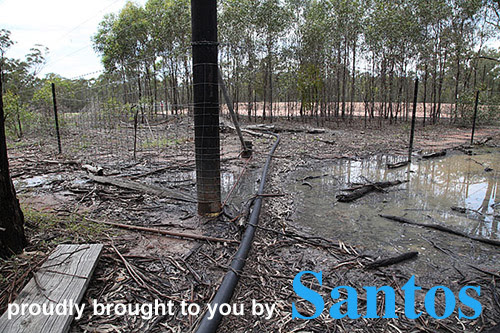
    Santos, an Australian oil and gas company, is all aboard the unconventional oil and gas ship – with plans that will send the mercury rising and devastate some of Australia’s most precious ecosystems.

    As we speak, Santos is drilling exploration wells deep into NSW’s Pilliga Forest – one of the key recharge areas of the Great Artesian Basin and home to numerous threatened species, including our beloved koala. Despite longstanding community opposition, Santos plans to drill a whopping 850 of these wells throughout the forest and surrounding farmland.

    But it doesn’t end there. Santos also plans to frack shale gas wells in the Wild Rivers of Queensland’s Channel Country. And, they’re buddying up with BP and Chevron to explore for oil in the Great Australian Bight, placing our unique marine wildlife and the climate directly in the firing line.

    Unfortunately, we can’t rely on our government to stand up for our climate or environment. It’s going to come down to us to stand in Santos’ way.

    If you are a Santos shareholder, we need your help. Our friends at the Wilderness society are helping shareholders to move a resolution against drilling in the Pilliga at Santos’ 2014 AGM. But we need to act fast – the resolution deadline is mid February and it’s going to take 100 shareholders to get this over the line.

    If you’re a shareholder, please sign up today and share this email with others. If you’re not a shareholder, you can still sign up here for updates about other ways you can get involved. Click here to share the above picture on Facebook.

    Let’s show Santos that we are > than fossil fuels. 

    Yours for a safe climate,

    Charlie


    350.org is building a global movement to solve the climate crisis. Connect with us on

  • Seat #5: Newland by Ben Raue The Tally Room

    Seat #5: Newland

    by Ben Raue

    Newland1-2PPNewland is a marginal Labor seat in northeastern Adelaide, covering Banksia Park, Fairview Park, Redwood Park, Ridgehaven, St Agnes and Tea Tree Gully.

    The seat has been held by Tom Kenyon since 2006, and he will have a fierce fight to hold on to the seat.

    Read more

  • Average Swings at Federal By-elections 1983-2013 antony green

    « 2013 Federal Election Offcuts | Main

    January 23, 2014

    Average Swings at Federal By-elections 1983-2013

    Since 1983, the average swing against the government of the day in by-elections that finished as two-party contests has been 5.1 percentage points. The average swing against first term governments was a smaller 1.7 percentage points. The swing has been against the government at six of the eight first term two-party by-elections held since 1983.

    Altogether there were 36 by-elections held between 1983 and 2013. Of these, 18 finished as two-party contests between Labor and the Coalition, two saw one of the major party candidates excluded, and 16 by-elections were not contested by the government of the day.

    It has become more common in recent years for governments to not contest by-elections in safe Opposition seats. Labor under Hawke and Keating contest 16 of the 22 by-elections between 1983 and 1996, the Coalition under John Howard contested three of nine by-elections, and Labor under Kevin Rudd contested one of five by-elections.

    Looking at the 18 two-party by-elections between 1983 and 2013, the average swings were as follows:

    • The average swing against the government after preferences for all 18 by-elections was 5.1 percentage points. The average change in first preference votes was 6.2 percentage points against the Government, 4.2 percentage points towards the Opposition, and 2.0 percentage points to Others. Governments tended to get their best by-election results in their first term.
    • The sample includes eight by-election in the first term of a government. The average swing against the government after preferences in the first term was 1.7 percentage points. The change in first preference vote share was Government -1.9, Opposition +3.3, Others -1.4.
    • The sample includes three by-elections held in the second term of a government. The average swing against the government after preferences in the second term was 5.9 percentage points. The change in first preference vote share was Government -6.7, Opposition +3.7, Others +3.0.
    • The sample includes three by-elections held in the third term of a government. The average swing against the government after preferences in the third term was 10.4 percentage points. The change in first preference vote share was Government -12.0, Opposition +8.0, Others +3.9.
    • The sample included no by-election in a fourth term but four by-elections held in the fifth term of a government. The average swing against the government after preferences in the fifth term was 7.3 percentage points. The change in first preference vote share was Government -10.2, Opposition +3.8, Others +6.4.
    • There were only three by-elections that recorded a swing to the government. These were a 0.5% swing to Labor at the 1984 Richmond by-election, retained by the National Party. There was a 1% swing to Labor at the 1994 Fremantle by-election when popular former WA Premier Carmen Lawrence was elected to Federal Parliament. There was a 5.0% to the Liberal Party at the 1996 Lindsay by-election when Jackie Kelly was re-elected after her general election victory had been voided by the Court of Disputed Returns.
    • Despite massive leads in opinion polls, the Hawke government sufferred swings against it at five of the six by-elections held in its first term 1983-84.
    • Despite a massive lead in opinion polls, the Rudd government suffered an 8.1% swing against it at the Gippsland by-election in 2008.

    While it can be argued there is no such thing as an ‘average’ by-election, the above figures provide some historical context for the upcoming Griffith by-election.

    For background on the Griffith by-election and profiles of the candidates, check out my Griffith by-election page at http://www.abc.net.au/elections/federal/2014/griffith/. The site also includes more detail on past elections, including the source data from which the above by-election analysis has been compiled.

    Posted by on January 23, 2014 at 10:48 PM in By-election,

  • Australia’s drinking water is at risk from extreme weather, a new study says.


    8

    8

    1

    0

    SYDNEY, Jan. 22 (UPI) — Australia’s drinking water is at risk from extreme weather, a new study says.The study, commissioned by the United States-based Water Research Foundation, says flooding, prolonged rainfall, drought, cyclones and bush fires impact surface water quality. Such weather events, it says, are predicted to become more frequent and intense in many parts of Australia due to climate change.

    “We need to focus on building resilience into our future supplies,” said Stuart Khan, an associate professor of the school of civil and environmental engineering at the University of New South Wales, and lead author of the report, in a news release.

    “This means designing systems that are more protected from the impacts of climate change and that have greater flexibility to respond to extreme weather events. This could be partially brought about through a diversification of water sources.”

    The report comes as Australia broke another heat wave record, with the temperature in Adelaide, the capital of South Australia, reaching 114.8 degrees Friday. Bush fires raged across the southeast last week, with more than 100 blazes in South Australia, Victoria and New South Wales.

    In Queensland, 26 local government areas are now drought declared, covering almost 65 percent of the state.

    Bush fires, for example, can cause ash and phosphorus to enter waterways which feed drinking water catchments, while extreme hot weather speeds up the growth of bacteria that can prove harmful to humans.

    Although Australian water utilities are “reasonably well prepared to respond to extreme weather events” because of an industry-wide focus on risk assessment and risk management, Khan said, the vulnerability of the country’s water systems requires urgent action.

    Australia has for the most part avoided potable water emergencies.

    Amid heavy flooding last year, Brisbane came close to running out of drinking water when the city’s main water treatment plant was knocked out by a huge volume of silt that had washed down from catchments.

    “The one thing that saved them was the ability to ramp up water production from the Gold Coast desalination plant at that time,” Khan told the Sydney Morning Herald.

    The biggest risk to water supply follows a combination of extreme weather events, such as a drought followed by bush fires and then a flood, rather than an extreme but isolated event.

    In 2009, Melbourne’s water supplies avoided a major threat after massive bush fires because heavy rain did not follow those blazes.

    But Hahn warns, “As we see these events happening more frequently, it’s likely the impacts will become more severe.”