Category: Uncategorized

  • What’s the Difference Between a Snowstorm and a Blizzard?

    Michelle Kottke shovels snow with the help of her dog Harlee in Barrington, Ill., Thursday, Jan. 2, 2014.

    A woman shovels snow with the help of her dog after a New Year’s Day snow in the Chicago suburbs.

    PHOTOGRAPH BY BOB CHWEDYK, Daily Herald/AP

    Jane J. Lee

    National Geographic

    Published January 3, 2014

    Happy New Year! Things got off to a roaring start for people in the path of a brutally cold snowstorm that plowed this week across the U.S. Midwest and East Coast.

    From Chicago to Boston to Washington, D.C., folks were treated to up to a foot (0.3 meters) of snow, with windchill dipping into the negative digits. So far, nine deaths have been blamed on the storm.

    Long Island, New York, and parts of coastal Massachusetts experienced blizzard conditions, said Chris Vaccaro, a spokesperson with the National Weather Service. Other parts of the country suffered under a nor’easter.

    Nor’easters are simply storms that affect the northeastern part of the U.S., move in a northeasterly direction, and produce winds coming from the northeast. “That’s the trifecta,” said Vaccaro.

    In the months of October or November, they can produce rain, while in January or February, they can produce snow.

    They differ from blizzards in that—according to the National Weather Service—blizzards involve large amounts of snow, winds in excess of 35 miles (56 kilometers) an hour, and visibilities of less than a quarter mile (half a kilometer).

    Visibility is the most important element in the mix, said meteorologist Matt Kelsch, with the University Corporation for Atmospheric Research, in an interview last year. “Usually, it takes that strength of wind—[35 miles (56 kilometers) an hour]—to pick enough snow off the ground to reduce visibility that much,” he said.

    “[But] it doesn’t always have to be snowing to be a blizzard,” Kelsch added. In the U.S., areas of the Great Plains and western states can get something called “ground blizzards”: storms in which high winds pick up snow from the ground and whip it around, greatly reducing visibility.

    Will blizzards become more frequent in the future as a result of climate change? That’s difficult to know for sure, said Kelsch, but warming oceans may increase the contrast between warm coastal air and cooler air over land, which could increase the frequency of storms.

    “Weather and climate are directly connected. You can’t change one and not expect an effect on the other,” Kelsch said.


  • Maurice Newman’s flat-earth thinking ignores climate change facts

    Maurice Newman’s flat-earth thinking ignores climate change facts

    Date
    January 1, 2014 – 12:57PM
    Category
    Opinion

    David Karoly

    Professor David Karoly says the evidence of climate change is clear.Professor David Karoly says the evidence of climate change is clear. Photo: Craig Abraham

    Maurice Newman is chairman of the Prime Minister’s Business Advisory Council. He must have thought that December 31 was April Fool’s Day when he wrote an opinion piece in The Australian headed “Crowds go cold on climate cost”.

    He once again revealed his opinions on climate change science when he wrote “the scientific delusion, the religion behind the climate crusade, is crumbling” and “Australia, too, has become hostage to climate change madness”.

    Tony Abbott's top business adviser Maurice Newman says climate change policies have ruined Australia's manufacturing sector.Tony Abbott’s top business adviser Maurice Newman says there is no evidence that climate change policies are needed. Photo: Rob Homer

    His piece is a mix of common climate change myths, misinformation and ideology. While Mr Newman is welcome to his opinions, his writing reveals his sad misunderstanding of the facts about climate change.

    Advertisement

    As Upton Sinclair wrote, “It is difficult to get a man to understand something, when his salary depends upon his not understanding it!”

    Fortunately, the Prime Minister Tony Abbott, the Minister for the Environment Greg Hunt and the Australian government say they accept the science of climate change, as do the Australian Labor Party and the Greens.

    The key conclusions on climate change science from the Australian Academy of Science, the Royal Society of London and the US National Academy of Science have been confirmed with even greater confidence by the latest report of the Intergovernmental Panel on Climate Change (IPCC), released in September 2013.

    They include:

    • There is no doubt that the climate system has warmed over the past 100 years and continues to warm.
    • It is beyond reasonable doubt that human influences, through burning fossil fuels, industrial activity and land clearing, have been the main cause of the observed global warming since the mid 20th century.
    • Continued emissions of greenhouse gases from human activity will cause further warming and changes in all components of the climate system.
    • Limiting climate change will require substantial and sustained reductions of greenhouse gas emissions.

    Mr Newman writes that “global temperatures have gone nowhere for 17 years”, but the global average surface temperature has warmed over the period 1997 to 2013, ocean heat content has increased significantly, and Arctic sea ice extent has declined, all showing clearly the continued warming of the climate system.

    Australia has just set a new record in 2013 for the hottest calendar year temperature averaged across the whole country, unprecedented in more than a hundred years of instrumental observations and outside the range that can be explained by natural variability alone.

    He also writes “when necessary the IPCC resorts to dishonesty and deceit”, but none of the many independent inquiries in the US and the UK into scientists involved in the IPCC have found any evidence to support these claims.

    Unlike Mr Newman, leading international energy and economic organisations, such as the International Energy Agency and the World Bank, have accepted the science of climate change and released reports recently on the opportunities for business and industry around the world to transform to a new sustainable, low-carbon economy and away from the old fossil fuel driven economy.

    Indeed, Mr Abbott, Mr Hunt and the Australian government have accepted that action on reducing greenhouse gas emissions in Australia is needed because it is in Australia’s national interest as part of global action to minimise dangerous climate change.

    I would not choose a person who believes that the Earth is flat to advise Australian shipping or airline businesses on how to plan routes to travel around the world. It is clearly not sensible to have a person who believes that climate change science is a delusion as leader of the Prime Minister’s Business Advisory Council.

    Mr Newman has contradicted the Prime Minister and argued against the government’s commitments to take action to fight climate change by reducing Australia’s greenhouse gas emissions.

    David Karoly is Professor of Atmospheric Science at the University of Melbourne and a member of the Climate Change Authority, which provides independent advice to the government on Australia’s emissions reduction targets, and other climate change initiatives.

    34 comments so far

    • I wonder in 18 months to 2 years time how much trouble the Liberals are going to have in removing Abbott as leader. Will he go voluntarily as it becomes obvious that things have gone pear shaped, or will he hold on?

      Commenter
      russ
      Location
      melb
      Date and time
      January 01, 2014, 2:03PM
      • Are you suggesting that in 18 months climate change will have made that much difference?

        WOW!

        # Change your name to flannery and see if you can wrangle some dollars from the gullible…

        Commenter
        Alex
        Location
        Finley
        Date and time
        January 01, 2014, 2:26PM
      • it is irrational to think that we can, as a planet, reduce demand for electricity or mobility when half the planet’s population is only going to increase its consumption of such things. at this time both of these largely depend on fossil fuels. governments mandating targets etc is not going to solve the problem of emissions. this can only be solved by a switch to zero or low emissions energy source that can provide base load power (iirc approx. 70% of our grid enegy use is base load) and/or we find a way to capture carbon emissions that does not consume (and thus require) large amounts of energy.
        one of those exists already – nuclear either powered by uranium or possibly thorium and the other is a research/scientific solution.
        we should also always remember that the earth has been both warmer and colder at various stages in our past – both during recent history (while humans have been around to observe and record) and over the much longer history of the planet.
        some of these hotter periods also seem to correlate with much greener periods too…

        Commenter
        interested observer
        Location
        sydney
        Date and time
        January 01, 2014, 2:38PM
    • Why should this surprise anyone. Our PM described climate change as ‘crap’. His sycophants will follow that line.

      Commenter
      An ordinary Aussie
      Date and time
      January 01, 2014, 2:06PM
      • no surprises government

        Commenter
        nkelly
        Location
        Date and time
        January 01, 2014, 2:25PM
      • Other way around: Newman is one of Abbott’s masters, not one of his offsiders.

        Commenter
        Lewis Winders
        Location
        Tasmania
        Date and time
        January 01, 2014, 2:25PM
      • As well as the WB et al, agreeing climate change is real, so also do insurance companies. A quick check anyone can do on climate change reality, is the rising insurance premiums, especially in FNQ where we expect cyclone intensity to increase, and with this, property damage.

        Commenter
        John
        Location
        townsville
        Date and time
        January 01, 2014, 2:47PM
    • Perhaps you should have read the article before writing this. He didn’t deny climate change, he rightly pointed out that the overreaction to it has been ridiculous and hilarious.

      And he’s quite right. Although at least it’s given all the lefties a cause.

      Commenter
      Hacka
      Location
      Canberra
      Date and time
      January 01, 2014, 2:08PM
      • Off to a positive start in the new year I see Hacka. Interesting that you think climate change is a leftie cause. Consider this: a University of Queensland-led study surveyed the abstracts of almost 12,000 scientific papers from 1991-2011 and claims to be the largest peer-reviewed study of its kind. Of those who a stated a position on the evidence for global warming, 97.1 per cent endorsed the view that humans are to blame. Just 1.9 per cent rejected the view. Add to this list the Australian Academy of Science, the Royal Society of London and the US National Academy of Science – along with those known leftie institutions the World Bank and the International Energy Agency. Just saying…

        Commenter
        marcus
        Location
        west coast
        Date and time
        January 01, 2014, 2:30PM
      • How can you be certain that there’s been an “overreaction”, when you are not a scientist?

        Commenter
        DanB
        Date and time
        January 01, 2014, 2:35PM

    More comments

  • State of the Climate

    State of the Climate

    The State of the Climate is a collection of monthly summaries recapping climate-related occurrences on both a global and national scale.

    • Global
    • Global Analysis — a summary of global temperatures and precipitation, placing the data into a historical perspective
    • Upper Air — tropospheric and stratospheric temperatures, with data placed into historical perspective
    • Global Snow & Ice — a global view of snow and ice, placing the data into a historical perspective
    • Global Hazards — weather-related hazards and disasters around the world
    • El Niño/Southern Oscillation — atmospheric and oceanic conditions related to ENSO
    • National
    • National Overview — a summary of national and regional temperatures and precipitation, placing the data into a historical perspective
    • Drought — drought in the U.S.
    • Wildfires — a summary of wildland fires in the U.S. and related weather and climate conditions
    • Hurricanes & Tropical Storms — hurricanes and tropical storms that affect the U.S. and its territories
    • National Snow & Ice — snow and ice in the U.S.
    • Tornadoes — a summary of tornadic activity in the U.S.
    • Synoptic Discussion — a summary of synoptic activity in the U.S.

    Global Summary Information – November 2013

    November 2013 global temperature highest on record

    Year-to-date global temperature ties for fourth highest on record

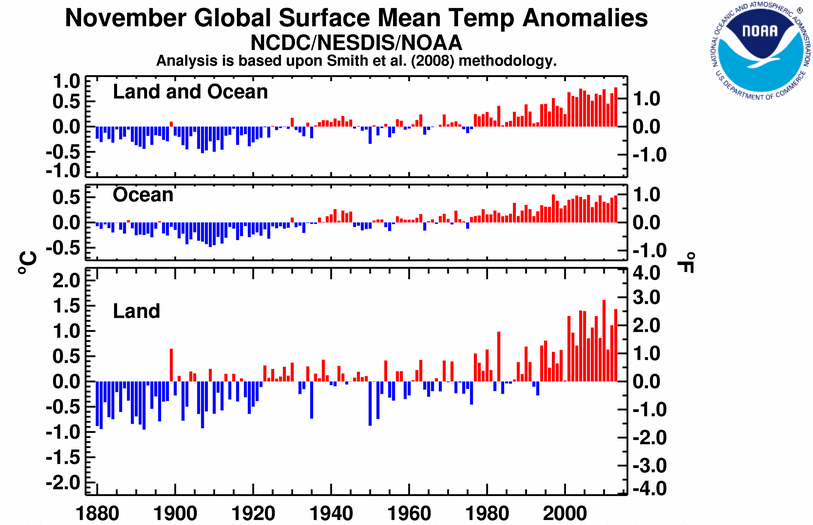
    The globally-averaged temperature for November 2013 was the highest for November since record keeping began in 1880. November 2013 also marks the 37th consecutive November and 345th consecutive month with a global temperature above the 20th century average.

    Many areas of the world experienced higher-than-average monthly temperatures, including: much of Eurasia, coastal Africa, Central America, central South America, parts of the North Atlantic Ocean, the south west Pacific Ocean, and the Indian Ocean. Much of southern Russia, northwest Kazakhstan, south India, southern Madagascar, parts of the central and south Indian Ocean, and sections of the Pacific Ocean were record warm. Meanwhile, northern Australia, parts of North America, south west Greenland, and parts of the Southern Ocean near South America were cooler than average. No regions of the globe were record cold.

    Global temperature highlights: November

      • The combined average temperature over global land and ocean surfaces during November was record highest for November, at 56.60°F (13.68°C) or 1.40°F (0.78°C) above the 20th century average. The margin of error associated with this temperature is ±0.13°F (0.07°C).
    November Blended Land and Sea Surface Temperature Percentiles
    November 2013 Blended Land and Sea Surface
    Temperature Percentiles
    November 2013 Blended Land & Sea Surface Temperature Anomalies in °C
      • November marked the 37th consecutive November and 345th consecutive month with a global temperature above the 20th century average. The last below-average temperature for November was November 1976 and the last below-average temperature for any month was February 1985.
      • The global land temperature was the second highest for November on record, behind 2010, at 2.57°F (1.43°C) above the 20th century average. The margin of error is ±0.20°F (0.11°C).
      • Some national highlights are included below:
        • Russia observed its warmest November since national records began in 1891. Some areas of the Urals, Siberia, south of the Far East region, and on the Arctic islands in the Kara Sea had temperatures that were more than 14°F (8°C) higher than the monthly average.
        • Spain was 0.9°F (0.5°C) below its 1971–2000 average for the month, although the first half was (4°–5°F) 2°–3°C above average while the second half was 5°–7°F (3°–4°C) below average, the coolest such period since 1985.
        • November temperatures were 7.0°–9.4°F (3.9°–5.2°C) above average across the Republic of Moldova. According to the country’s national meteorological service, Serviciul Hidrometeorologic de Stat, this type of event in the north occurs every 20–30 years and every 10–15 years in the south.
        • According to the Fiji Meteorological Service, most regions of the country were considerably warmer than the 1971–2000 average, with maximum and minimum temperature anomalies exceeding 1°C at more than half of the official (21) monitoring stations. New November monthly minimum temperature records were set at four stations.
        • For the ocean, the November global sea surface temperature was 0.94°F (0.52°C), above the 20th century average, tying with 2009 as the third highest for November on record. The margin of error is ±0.07°F (0.04°C).
        • Neither El Niño nor La Niña conditions were present across the central and eastern equatorial Pacific Ocean during November. According to NOAA’s Climate Prediction Center, neutral conditions are favored into the Northern Hemisphere summer 2014.


    Global temperature highlights: September–November

      • The combined average temperature over global land and ocean surfaces for September–November was the second highest on record for this period, behind 2005, at 1.22°F (0.68°C) above the 20th century average of 57.1°F (14.0°C). The margin of error associated with this temperature is ±0.16°F (0.09°C).
      • The global land temperature was the third highest for September–November on record, at 1.94°F (1.08°C) above the 20th century average of 48.3°F (9.1°C). The margin of error is ±0.32°F (0.18°C).
        • Record warmth continued in Australia towards the latter part of 2013, as the country observed its highest average and maximum spring (September–November) temperatures in its 104-year period of record at 2.83°F (1.57°C) and 3.73°F (2.07°C) above the 1961–1990 average, respectively. The nationally-averaged minimum spring temperature was fourth highest on record, at 1.93°F (1.07°C) above normal.
        • Fall was 2.5°F (1.4°C) above the 1961–1990 average in Norway, with the southern mountains and some regions in the north observing temperature departures of +3.6°F (+2.0°C).
      • For the ocean, the September–November global sea surface temperature was 0.94°F (0.52°C), above the 20th century average of 60.7°F (16.0°C), tying with 2009 and 2012 as the fourth highest for September–November on record. The margin of error is ± 0.07°F (0.04°C).

    Polar ice highlights: November and Seasonal

    November 2013 Northern Hemisphere Sea Ice Extent
    November 2013 Southern Hemisphere Sea Ice Extent
    Arctic and Antarctic sea ice extent, from the November 2013 Global Snow & Ice Report
    • According to data from the National Snow and Ice Data Center, the average November Arctic sea ice extent was 3.95 million square miles, 290,000 square miles (6.8 percent) below the 1981–2010 average of 4.24 million square miles. This was the sixth smallest November Arctic sea ice extent since satellite records began in 1979.
    • The November Antarctic sea ice extent of 6.63 million square miles was 340,000 square miles (5.3 percent) above the 1981–2010 average of 6.29 million square miles. This was the largest November Antarctic sea ice extent on record, surpassing the November 2010 sea ice extent by 90,000 square miles.
    • The globally combined Arctic and Antarctic sea ice extent during November was 13.42 million square miles, 111,000 square miles (0.4 percent) above the 1981–2010 average of 10.62 million square miles. The global sea ice extent during November tied as the 12th largest in the 45-year period of record and was the largest since 1998.
    • According to data from the Rutgers Global Snow Lab, the Northern Hemisphere snow cover extent during November was 13.42 million square miles, 310,000 square miles above the 1981–2010 average of 13.11 million square miles, and the 16th largest November snow cover extent in the 48-year period of record. The North American monthly snow cover extent was the third largest on record, behind November 1985 and 1996. The Eurasian November snow cover extent was below average and the 18th smallest on record.
    • The average Northern Hemisphere snow cover extent during autumn was 7.54 million square miles, 710,000 square miles above the 1981–2010 average of 6.83 million square miles. This was the sixth largest snow cover extent during the autumn season for the Northern Hemisphere and the largest since 2002. North America had its seventh largest autumn snow cover extent, while Eurasia had its 10th largest.


    Precipitation highlights: November and Seasonal

    • Record wetness was observed during November over sections of coastal China, central Japan, north central Australia, and north central Mexico. Record dryness was scattered across different parts of the globe, including some small sections of coastal South America, parts of north west Africa, a few regions of central and southern Asia, and parts of far west and southern Australia.
    • Austria observed precipitation that was 160 percent of the 1981–2010 average for November, making this the country’s wettest November since 2002. Regions from Unterkärnten to Middle Burgenland saw November precipitation totals that were their highest since 1949.
    • The September–November period was about 40 percent wetter than average across The Netherlands. De Bilt had its third wettest fall since records began in 1906.

    Global temperature highlights: Year-to-date

    • The first 11 months of 2013 tied with 2002 as the fourth warmest such period on record, with a combined global land and ocean average surface temperature of 1.12°F (0.62°C) above the 20th century average of 57.0°F (13.9°C). The margin of error is ±0.18°F (0.10°C).
    • The January–November worldwide land surface temperature was 1.76°F (0.98°C) above the 20th century average, also tying with 2002 as the fourth warmest such period on record. The margin of error is ±0.38°F (0.21°C).
    • The global ocean surface temperature for the year-to-date was 0.86°F (0.48°C) above average, tying with 2006 as the eighth warmest such period on record. The margin of error is ±0.07°F (0.04°C).
    • A supplemental page shows three potential annual temperature outcomes for 2013, based on three simple
  • Methane Hydrates and Global Warming

    Science News

    … from universities, journals, and other research organizations

    Methane Hydrates and Global Warming

    Jan. 2, 2014 — Off the coast of Svalbard methane gas flares originating from gas hydrate deposits at depth of several hundred metres have been observed regularly. A new study conducted by an international team under the leadership of scientists from GEOMAR Helmholtz Centre for Ocean Research Kiel and MARUM — Center for Marine Environmental Sciences in Bremen shows, that the observed outgassing is most likely caused by natural processes and can not be attributed to global warming.


    Share This:

    The study has been recently published in the scientific journal Science.

    Methane hydrates are fragile. At the sea floor the ice-like solid fuel composed of water and methane is only stable at high pressure and low temperature. In some areas, for instance in the North Atlantic off the coast of Svalbard, scientists have detected gas flares regularly. The reasons for their occurrence were still unclear but one hypothesis was that global warming might cause the dissolution of gas hydrates. Over the past years, comprehensive investigations by an international team of researchers led by scientists from GEOMAR Helmholtz Centre for Ocean Research Kiel have now shown that it is very likely that the gas flares are caused by natural processes.

    “In 2008, when we observed the outgassing of methane for the first time, we were alarmed,” reports Professor Christian Berndt, lead author of the study from GEOMAR. “The gas originates from depths where the hydrates should normally be stable. But we knew that a relatively small warming might melt the hydrates,” Berndt explains. Thus, the key question was to find out what causes the outgassing. Step by step, several expeditions that took place in the following years helped to solve the mystery.

    One of the most obvious assumptions was that the increasing global warming has already extended into these regions of the North Atlantic. However, the investigations partly carried out with the German research submersible JAGO, pointed clearly to natural causes. “On one hand, we have found that the seasonal variations in temperature in this region are sufficient to push the stability zone of gas hydrates more than a kilometre up and down the slope,” Professor Berndt explains. “Additionally, we discovered carbonate structures in the vicinity of methane seeps at the seafloor,” Dr. Tom Feseker from MARUM adds. “These are clear indicators that the outgassing likely takes place over very long time periods, presumably for several thousand years,” Feseker continues.

    Does this mean that global warming has no impact on potential methane release from the seafloor off Svalbard? Certainly not, because over long periods of time the deep ocean will also warm up and in particular the polar regions are affected. Here, enormous amounts of methane hydrate are stored in the ocean floor. “As a powerful greenhouse gas methane represents a particular risk for our climate. A release of large amounts of the gas would further accelerate global warming,” says Prof. Berndt. “Therefore, it is necessary to continue long-term monitoring, particularly in such critical regions as off Svalbard,” the Geophysicist concludes.


  • Stop the dolphin massacre AVAAZ

    Stop the dolphin massacre

    Inbox
    x
    Zoe Massey – with Avaaz
    3:33 PM (4 hours ago)

    to me
    Dear friends in the Avaaz Community,

    Up to 15,000 dolphins are being killed every year in Peru’s waters — for bait to catch endangered sharks. A new report has forced the government to respond but they’re not taking enough action yet and meanwhile the dolphins and the sharks are being killed. We can stop the massacre by threatening Peru’s international reputation as a tourism destination. Sign now and share: 

    SIGN THE PETITION

    I just saw a report on the news in Peru showing how fishermen are slaughtering up to 15,000 dolphins every year — for bait to catch endangered sharks. The entire story made me sick — and now I’m fighting to end this nightmare. Will you join me?

    My government is starting to react, but they’re not taking enough action yet. Dolphin hunting is already illegal and punishable with several years in prison, but authorities are turning a blind eye — allowing thousands of dolphins and sharks to be butchered. The government cares a lot about Peru’s international reputation, especially for tourism, and if we can make them feel embarrassed with a massive global campaign, I’m sure they’ll start taking action to end the massacre.

    Once I deliver a million signatures from all over the world to the government of Peru, Avaaz will place ads in tourism magazines in countries where most of our tourists come from and the government won’t be able to ignore us! Help me stop the brutal slaughter by signing now:

    http://www.avaaz.org/en/dolphin_hunt_peru/?bhPqncb&v=33625

    When I saw this horrific hunt I realised I needed to do something about it before our dolphins and sharks are gone forever. So I decided to set up a petition and shared it with my friends and in less than 24 hours over 10,000 people had signed it!

    Our oceans are under attack. Sharks and dolphins already face threats from pollution, climate change and entanglement in fishing gear. They play an important role as ocean predators and need to be protected — not butchered. Many marine ecosystems are on the verge of collapse from which they won’t recover and they will not wait while our politicians dither around making empty statements.

    Tourism is Peru’s third largest industry, growing faster than any other South American country. Visitors are coming to see our pristine wilderness and eco-tourism is very important. We can create a serious threat by taking out hard-hitting ads in key countries where most visitors are coming from. Our government will realise people not only love our country because of the Machu Picchu and local gastronomy but also because they love our oceans and wildlife. Sign now and share this with everyone:

    http://www.avaaz.org/en/dolphin_hunt_peru/?bhPqncb&v=33625

    As an Avaaz member I’ve been truly amazed at our ability to help protect our oceans. At first, I wanted to get 15,000 signatures to represent the 15,000 dolphins that are killed every year but together we can represent all the dolphins and the sharks that can be saved in Peru’s waters!

    With hope and excitement,

    Zoe — together with the Avaaz Community Petitions Team

    This petition was started on the Avaaz Community Petitions Site. It’s quick and easy to start a petition on any issue you care about, click here: http://avaaz.org/en/petition/start_a_petition/?30311

    MORE INFORMATION:

    Dolphins killed for shark bait in Peru (CNN)
    http://edition.cnn.com/2013/10/22/world/americas/dolphins-killed-peru/

    Dolphin Slaughter Fueled by Illegal Shark Trade (National Geographic)
    http://newswatch.nationalgeographic.com/2013/10/24/dolphin-slaughter-fueled-by-illegal-shark-trade/

    Revealed: brutal reality of world’s ‘biggest dolphin hunt’ (The Ecologist)
    http://www.theecologist.org/News/news_analysis/2122747/revealed_brutal_reality_of_worlds_biggest_dolphin_hunt


    Avaaz.org is a 32-million-person global campaign network
    that works to ensure that the views and values of the world’s people shape global decision-making. (“Avaaz” means “voice” or “song” in many languages.) Avaaz members live in every nation of the world; our team is spread across 18 countries on 6 continents and operates in 17 languages. Learn about some of Avaaz’s biggest campaigns here, or follow us on Facebook or Twitter.

    You are getting this message because you signed “Save our dying planet!” on 2011-12-08 using the email address nevilleg729@gmail.com.
    To ensure that Avaaz messages reach your inbox, please add avaaz@avaaz.org to your address book. To change your email address, language settings, or other personal information, contact us, or simply go here to unsubscribe.

    To contact Avaaz, please do not reply to this email. Instead, write to us at www.avaaz.org/en/contact or call us at +1-888-922-8229 (US).

    Click here to Reply or Forward
    Zoe Massey – with Avaaz
    3:33 PM (4 hours ago)

    to me
    Dear friends in the Avaaz Community,

    Up to 15,000 dolphins are being killed every year in Peru’s waters — for bait to catch endangered sharks. A new report has forced the government to respond but they’re not taking enough action yet and meanwhile the dolphins and the sharks are being killed. We can stop the massacre by threatening Peru’s international reputation as a tourism destination. Sign now and share: 

    SIGN THE PETITION

    I just saw a report on the news in Peru showing how fishermen are slaughtering up to 15,000 dolphins every year — for bait to catch endangered sharks. The entire story made me sick — and now I’m fighting to end this nightmare. Will you join me?

    My government is starting to react, but they’re not taking enough action yet. Dolphin hunting is already illegal and punishable with several years in prison, but authorities are turning a blind eye — allowing thousands of dolphins and sharks to be butchered. The government cares a lot about Peru’s international reputation, especially for tourism, and if we can make them feel embarrassed with a massive global campaign, I’m sure they’ll start taking action to end the massacre.

    Once I deliver a million signatures from all over the world to the government of Peru, Avaaz will place ads in tourism magazines in countries where most of our tourists come from and the government won’t be able to ignore us! Help me stop the brutal slaughter by signing now:

    http://www.avaaz.org/en/dolphin_hunt_peru/?bhPqncb&v=33625

    When I saw this horrific hunt I realised I needed to do something about it before our dolphins and sharks are gone forever. So I decided to set up a petition and shared it with my friends and in less than 24 hours over 10,000 people had signed it!

    Our oceans are under attack. Sharks and dolphins already face threats from pollution, climate change and entanglement in fishing gear. They play an important role as ocean predators and need to be protected — not butchered. Many marine ecosystems are on the verge of collapse from which they won’t recover and they will not wait while our politicians dither around making empty statements.

    Tourism is Peru’s third largest industry, growing faster than any other South American country. Visitors are coming to see our pristine wilderness and eco-tourism is very important. We can create a serious threat by taking out hard-hitting ads in key countries where most visitors are coming from. Our government will realise people not only love our country because of the Machu Picchu and local gastronomy but also because they love our oceans and wildlife. Sign now and share this with everyone:

    http://www.avaaz.org/en/dolphin_hunt_peru/?bhPqncb&v=33625

    As an Avaaz member I’ve been truly amazed at our ability to help protect our oceans. At first, I wanted to get 15,000 signatures to represent the 15,000 dolphins that are killed every year but together we can represent all the dolphins and the sharks that can be saved in Peru’s waters!

    With hope and excitement,

    Zoe — together with the Avaaz Community Petitions Team

    This petition was started on the Avaaz Community Petitions Site. It’s quick and easy to start a petition on any issue you care about, click here: http://avaaz.org/en/petition/start_a_petition/?30311

    MORE INFORMATION:

    Dolphins killed for shark bait in Peru (CNN)
    http://edition.cnn.com/2013/10/22/world/americas/dolphins-killed-peru/

    Dolphin Slaughter Fueled by Illegal Shark Trade (National Geographic)
    http://newswatch.nationalgeographic.com/2013/10/24/dolphin-slaughter-fueled-by-illegal-shark-trade/

    Revealed: brutal reality of world’s ‘biggest dolphin hunt’ (The Ecologist)
    http://www.theecologist.org/News/news_analysis/2122747/revealed_brutal_reality_of_worlds_biggest_dolphin_hunt


    Avaaz.org is a 32-million-person global campaign network
    that works to ensure that the views and values of the world’s people shape global decision-making. (“Avaaz” means “voice” or “song” in many languages.) Avaaz members live in every nation of the world; our team is spread across 18 countries on 6 continents and operates in 17 languages. Learn about some of Avaaz’s biggest campaigns here, or follow us on Facebook or Twitter.

    You are getting this message because you signed “Save our dying planet!” on 2011-12-08 using the email address nevilleg729@gmail.com.
    To ensure that Avaaz messages reach your inbox, please add avaaz@avaaz.org to your address book. To change your email address, language settings, or other personal information, contact us, or simply go here to unsubscribe.

    To contact Avaaz, please do not reply to this email. Instead, write to us at www.avaaz.org/en/contact or call us at +1-888-922-8229 (US).

    Click here to Reply or Forward
  • Major Reductions in Seafloor Marine Life from Climate Change by 2100

    Science News

    … from universities, journals, and other research organizations

    Science News

    … from universities, journals, and other research organizations

    Major Reductions in Seafloor Marine Life from Climate Change by 2100

    Dec. 31, 2013 — A new study quantifies for the first time future losses in deep-sea marine life, using advanced climate models. Results show that even the most remote deep-sea ecosystems are not safe from the impacts of climate change.


    Share This:

    An international team of scientists predict seafloor dwelling marine life will decline by up to 38 per cent in the North Atlantic and over five per cent globally over the next century. These changes will be driven by a reduction in the plants and animals that live at the surface of the oceans that feed deep-sea communities. As a result, ecosystem services such as fishing will be threatened.

    In the study, led by the National Oceanography Centre, the team used the latest suite of climate models to predict changes in food supply throughout the world oceans. They then applied a relationship between food supply and biomass calculated from a huge global database of marine life.

    The results of the study are published this week in the scientific journal Global Change Biology.

    These changes in seafloor communities are expected despite living on average four kilometres under the surface of the ocean. This is because their food source, the remains of surface ocean marine life that sink to the seafloor, will dwindle because of a decline in nutrient availability. Nutrient supplies will suffer because of climate impacts such as a slowing of the global ocean circulation, as well as increased separation between water masses — known as ‘stratification’ — as a result of warmer and rainier weather.

    Lead author Dr Daniel Jones says: “There has been some speculation about climate change impacts on the seafloor, but we wanted to try and make numerical projections for these changes and estimate specifically where they would occur.

    “We were expecting some negative changes around the world, but the extent of changes, particularly in the North Atlantic, were staggering. Globally we are talking about losses of marine life weighing more than every person on the planet put together.”

    The projected changes in marine life are not consistent across the world, but most areas will experience negative change. Over 80 per cent of all identified key habitats — such as cold-water coral reefs, seamounts and canyons — will suffer losses in total biomass. The analysis also predicts that animals will get smaller. Smaller animals tend to use energy less efficiently, thereby impacting seabed fisheries and exacerbating the effects of the overall declines in available food.

    The study was funded by the Natural Environment Research Council (NERC) as part of the Marine Environmental Mapping Programme (MAREMAP), and involved researchers from the National Oceanography Centre, the Memorial University of Newfoundland, Canada, the University of Tasmania, and the Laboratoire des Sciences du Climat et de l’Environnement, France.

    S

    Dec. 31, 2013 — A new study quantifies for the first time future losses in deep-sea marine life, using advanced climate models. Results show that even the most remote deep-sea ecosystems are not safe from the impacts of climate change.


    Share This:

    An international team of scientists predict seafloor dwelling marine life will decline by up to 38 per cent in the North Atlantic and over five per cent globally over the next century. These changes will be driven by a reduction in the plants and animals that live at the surface of the oceans that feed deep-sea communities. As a result, ecosystem services such as fishing will be threatened.

    In the study, led by the National Oceanography Centre, the team used the latest suite of climate models to predict changes in food supply throughout the world oceans. They then applied a relationship between food supply and biomass calculated from a huge global database of marine life.

    The results of the study are published this week in the scientific journal Global Change Biology.

    These changes in seafloor communities are expected despite living on average four kilometres under the surface of the ocean. This is because their food source, the remains of surface ocean marine life that sink to the seafloor, will dwindle because of a decline in nutrient availability. Nutrient supplies will suffer because of climate impacts such as a slowing of the global ocean circulation, as well as increased separation between water masses — known as ‘stratification’ — as a result of warmer and rainier weather.

    Lead author Dr Daniel Jones says: “There has been some speculation about climate change impacts on the seafloor, but we wanted to try and make numerical projections for these changes and estimate specifically where they would occur.

    “We were expecting some negative changes around the world, but the extent of changes, particularly in the North Atlantic, were staggering. Globally we are talking about losses of marine life weighing more than every person on the planet put together.”

    The projected changes in marine life are not consistent across the world, but most areas will experience negative change. Over 80 per cent of all identified key habitats — such as cold-water coral reefs, seamounts and canyons — will suffer losses in total biomass. The analysis also predicts that animals will get smaller. Smaller animals tend to use energy less efficiently, thereby impacting seabed fisheries and exacerbating the effects of the overall declines in available food.

    The study was funded by the Natural Environment Research Council (NERC) as part of the Marine Environmental Mapping Programme (MAREMAP), and involved researchers from the National Oceanography Centre, the Memorial University of Newfoundland, Canada, the University of Tasmania, and the Laboratoire des Sciences du Climat et de l’Environnement, France.

    S