Category: Uncategorized

  • Labor’s new democracy faces its first tests

    Header PromoThe Drum on ABC News 24

    Labor’s new democracy faces its first tests

    Posted Fri Jul 12, 2013 6:52am AEST

    The big unresolved issue with Labor’s leadership ballot reform is the unions. Kevin Rudd may have neatly cut them out of his plans, but this isn’t the end of the matter, writes Barrie Cassidy.

    Kevin Rudd’s proposal to give rank-and-file ALP members a say in leadership ballots partly reflects his loathing of factional heavies and his ambivalence towards trade unions.

    In that sense, it represents a fair degree of self-interest.

    The changes, if adopted, will give leaders a sense of security that none in the past have enjoyed. As Rudd said, no longer can people “just wander in one day, and say, ‘OK sunshine, it’s over.’”

    What he didn’t say is that neither will it any longer be worth the while of any leadership aspirant to run the sort of destabilisation campaign that Julia Gillard had to endure for the best part of three years.

    But having said all that, it’s a good idea whose time has come. The move should energise the Labor Party at branch level, grow the membership, strengthen the hand of the leader, and remove much of the intrigue and instability that has been a constant for years.

    Australia has had four prime ministers since 2007, the biggest turnover since Bob Menzies quit in 1966 and Harold Holt drowned two years later, triggering a run of five prime ministers in six years.

    The proposal on the face of it seems radical. However, Australia’s major parties are in fact the last across comparable countries to give the rank-and-file a say in the leadership.

    In the United States, Republican and Democrat candidates for the presidency face off across the country in primary and caucus ballots, all determined by registered party members.

    The primary system is enthusiastically embraced by political tragics and the media who in equal measure love the intense politicking and the changing fortunes.

    The system is flawed to this extent. The ballots are staggered between January and June. Small states like Iowa and New Hampshire go early, giving them more clout than California and Florida.

    Often candidates drop out before the big states get involved. It may be that the United States will eventually move to a national primary day, especially given the ability now for online voting.

    In Britain, the Labor Party gives equal weighting in leadership ballots to the politicians, the rank-and-file, and the unions.

    The most recent ballot did underline one of the problems with Rudd’s reform: will the leader lack authenticity and authority if the MPs vote one way and the rank-and-file another?

    The current leader, Ed Miliband, went up against his brother, David. Ed lost in the party room 122 votes to 140, and lost in the popular members vote, 56,000 to 67,000, and yet secured the top job courtesy of the unions voting 119,000 to 80,000 in his favour.

    Once all three constituents were given equal weight, Ed beat David by 50.65 per cent to 49.35 per cent, and ever since questions have been raised as to whether the party chose the right brother.

    On the Conservatives side, the party room reduces the field to two candidates and then the 300,000 party members determine the winner.

    The system works well and it gave David Cameron a decisive victory over his opponent, David Davis. The one criticism of the formula is that it can potentially reflect a narrow ideological view rather than broader community sentiment, but that is probably true anyway of any ballot, no matter what the rules.

    In Canada, the New Democratic Party, the official opposition in the current parliament, chooses its leader at party conventions. Delegates drawn from the various branches and associations have one vote, the same as members of parliament and the various executives at national and provincial level.

    The Liberal Party, the most successful in Canada’s history, does much the same thing, forcing MPs to look inward and pay attention to the concerns of the party membership.

    The Conservative Party, an amalgamation of two-right wing parties, won majority government under Stephen Harper’s leadership in 2011. It too involves members by giving every branch 100 points in a leadership ballot, no matter their size.

    So the Labor Party in Australia is going down a familiar international path. However, the big unresolved issue is union involvement.

    Rudd neatly cut them out altogether, and caucus could well endorse that approach on July 22. But that won’t be the end of the matter. Eventually a national conference will decide the balance, free of pre-election restrictions. The last time they looked at it – in 2010 – it went nowhere.

    In any case, unions retain much of the control over pre-selections and through that process, they have considerable clout in the caucus. By extension, then, they will have influence over the leadership.

    As it turned out, Rudd faced the risk of losing the benefits of party reform because of the bewildering development in the pre-selection battle for Julia Gillard’s seat of Lalor in Victoria.

    The factional bosses, or some of them, persuaded a junior diplomat, Lisa Clutterham, to nominate, even though she has only ever visited Victoria on holidays and has been a member of the party for three weeks. Most recently, she has lived and worked in Papua New Guinea.

    Locals in Lalor immediately asked, how could it be that not a single Victorian is capable of representing their electorate in the federal Parliament?

    The move was backed by Rudd supporters and yet it was the antithesis of what he is trying to do at the leadership level. It would have gone against the wishes of the branch and given a victory to factional bosses; and in this case, given it to somebody who knows next to nothing about the electorate.

    Locals want some control over pre-selections precisely for that reason. They want representatives who know something about their specific and unique needs and concerns.

    Rudd appears to have killed off the idea at the National Press Club, describing Clutterham’s interview with Jon Faine as curious and surprising. Just as well, because the introduction of Clutterham’s name into the mix was more than a distraction. It was a major miscalculation that threatened to offend the rank-and-file, place messy pre-selections at the top of the agenda, and potentially reopen the wounds that have been plastered over since Julia Gillard’s sacking.

    As it is, the rank-and-file have been cut out of key pre-selection contests in safe seats, with the executive handing responsibility to party officials.

    The outcomes still have the potential to dampen Rudd’s notion of a new democracy at work within the Labor Party.


  • Confirmed: Fracking triggers quakes and seismic chaos

    Confirmed: Fracking triggers quakes and seismic chaos

    By Kate Sheppard, Brett Brownell, and Jaeah Lee

    Click to embiggen.
    Shutterstock
    Click to embiggen.

    Major earthquakes thousands of miles away can trigger reflex quakes in areas where fluids have been injected into the ground from fracking and other industrial operations, according to a study published in the journal Science on Thursday.

    Previous studies, covered in a recent Mother Jones feature from Michael Behar, have shown that injecting fluids into the ground can increase the seismicity of a region. This latest study shows that earthquakes can tip off smaller quakes in far-away areas where fluid has been pumped underground.

    The scientists looked at three big quakes: the Tohuku-oki earthquake in Japan in 2011 (magnitude 9), the Maule in Chile in 2010 (an 8.8 magnitude), and the Sumatra in Indonesia in 2012 (an 8.6). They found that, as much as 20 months later, those major quakes triggered smaller ones in places in the Midwestern U.S. where fluids have been pumped underground for energy extraction.

    “[The fluids] kind of act as a pressurized cushion,” lead author Nicholas van der Elst of the Lamont-Doherty Earth Observatory at Columbia University explained to Mother Jones. “They make it easier for the fault to slide.”

    The finding is not entirely surprising, said van der Elst. Scientists have known for a long time that areas with naturally high subsurface fluid pressures — places like Yellowstone, for example — can see an uptick in seismic activity after a major earthquake even very far away. But this is the first time they’ve found a link between remote quakes and seismic activity in places where human activity has increased the fluid pressure via underground injections.

    “It happens in places where fluid pressures are naturally high, so we’re not so surprised it happens in places where fluid pressures are artificially high,” he said.

    The study looked specifically at Prague, Okla., which features prominently in Behar’s piece. The study links the increased tremors in Prague, which has a number of injection wells nearby, to Chile’s Feb. 27, 2010, quake. The study also found that big quakes in Japan and Indonesia triggered quakes in areas of Western Texas and Southern Colorado with many injection wells. The study is “additional evidence that fluids really are driving the increase in earthquakes at these sites,” said van der Elst.

    Drillers inject high-pressure fluids into a hydraulic fracturing well, making slight fissures in the shale that release natural gas. The wastewater that flows back up with the gas is then transported to disposal wells, where it is injected deep into porous rock. Scientists now believe that the pressure and lubrication of that wastewater can cause faults to slip and unleash an earthquake.
    Leanne Kroll / Brett Brownell
    Drillers inject high-pressure fluids into a hydraulic fracturing well, making slight fissures in the shale that release natural gas. The wastewater that flows back up with the gas is then transported to disposal wells, where it is injected deep into porous rock. Scientists now believe that the pressure and lubrication of that wastewater can cause faults to slip and unleash an earthquake.

  • The Peak Oil Crisis: China at a turning point.

    Share This Print  28  21

    This spring, I spent three weeks traveling around China and needless to say, I, along with every other visitor, was impressed by the economic progress the Chinese have made in the years since the Cultural Revolution. Tens of millions have been moved from rural villages into megacities of gleaming skyscrapers, apartments, modern subways, and traffic jams of sleek, late model cars. The jams have become so bad that China’s major cities have had to implement restrictions on driving and on new car registrations.

    There are of course downsides to this marvel which many believe will propel China into number one position in terms of economic and political power within a decade or two. On many days, the air in major Chinese cities is approaching lethality. Most rivers are cesspools, tap water is undrinkable, dangerous metals are building up in agricultural soil and starting to make their way into the food chain, and to top it all off nobody really gets to vote for leaders or on policy. The Chinese Communist Party rules with its own version of the “social contract” – shut up about “democracy, human rights, justice,” and all that western claptrap; let us rule as we see fit; and in return we are delivering world-beating economic growth so that someday you will all be rich.

    In recent months, however, there has been increasing evidence that the good times may be in danger. One simply cannot grow an economy at circa 10 percent a year while ignoring the environment. Last winter air pollution in the major cities occasionally reached nearly 15 times the acceptable level. It is likely that thousands with respiratory problems died, but in China one does not talk about things like that.

    The redeeming side of air pollution is that it affects rich and the poor, the powerful and the powerless alike, so that in recent months China’s new leadership vowed to take action against pollution after years of neglect in the name of economic growth. Remember that the US started passing clean air legislation in 1955 and got really serious with the EPA 43 years ago.

    China’s pollution problem is rather simple; they now burn half the world’s coal – some 4.3 billion tons a year and 10 million barrels of oil a day. To cut pollution they have to cut coal consumption and at least put some controls on motor fuels, but to grow their economy at the targeted 7.5 percent a year, they almost certainly will have to increase coal consumption. Hydro, nuclear, and other renewables take too long to build or produce too little electricity. Something has got to go – breathable air or rapid economic growth.

    This year another problem has arisen – China simply is not growing as fast as it used to. For weeks now the financial press has been wringing its hands over the lackluster numbers coming out of Beijing and their impact on the global economy. Although Beijing still claims to be growing its GDP at 7.7 percent a year, these numbers are becoming increasingly suspect. While the central government may see the merits of accurate growth statistics, those at lower levels have a great incentive to look as good as possible. Some recent numbers such as the growth in electricity production in the 1st quarter suggest that China’s economy may now be growing at a rate closer to three percent.

    Part of the current problem dates back to 2008. In order to sidestep the effects of the global recession, Beijing undertook a $2.5 trillion stimulus program so that whatever was dear to local officials’ hearts was built with borrowed money no matter the economic benefit. Airports, apartments, high-speed rail lines, shopping malls sprang up everywhere. Many of these projects are seriously underutilized and are unlikely to ever pay back the money invested.

    While the exact numbers are unknown, the debt acquired by China’s local governments is thought to be on the order of $2-3 trillion while much of debt has been off the books through “shadow financing.” This surge in local government spending amounted to a Chinese version of America’s sub-prime lending debacle, except this one went for public works and apartment buildings rather than single-family housing.

    Unregulated off-the-books “shadow banking,” which has doubled in the last three years, is now thought to total some $6 trillion. Government officials are concerned that it is out of control. Last month efforts to clamp down resulted in a spike in inter-bank interest rates and fears of a liquidity crisis. Whether China has the tools to work its way out of all this without a major economic slowdown has yet to be seen — but many observers are worried.

    The impact on the global oil market of efforts to control pollution and unwind excessive debt could be considerable. For the last decade, Beijing has been increasing its demand for oil by circa 500,000 barrels a day or more in most years. Until recently projections had China’s demand for oil increasing at this pace indefinitely, surpassing US oil consumption by the end of the decade and buying up all the oil OPEC and other exporters can produce soon thereafter.

    In last six months, however, reasons to rethink these projections are rising. Although China’s leaders want to grow their economy, the reality of un-breathable air should be enough to slow or even halt these ambitions. There are technologies out there which would allow China to produce increasing amounts of energy while maintaining air quality, but they will take years and much money to implement on the scale need to clean-up China’s air.

    While chaos in the Middle East is threatening to curtail oil supplies from the region, the end of rapid growth in China is threatening to restrain a major source of increasing demand for oil. How these balance out and whether oil prices go up or down in the next few years remains to be seen.

    Originally published at Falls Church News-Press

    T

    – See more at: http://www.economonitor.com/blog/2013/07/the-peak-oil-crisis-china-at-a-turning-point/#sthash.GJOyAXpH.KHOxgilY.dpuf

  • Council adopts sea level benchmark

    Council adopts sea level benchmark

    By SALLY FOY

    July 12, 2013, 6 a.m.


    A controversial policy that sets the planning benchmark for sea level rise across the shire was recently passed by Eurobodalla Council.

    Last year the State Government withdrew legislation for a uniform approach to sea level rise and put the onus on local councils, taking into consideration regional variations.

    Until now, Eurobodalla’s Interim Sea Level Rise Adaption Policy 2010 has applied and developers were responsible for meeting the cost of preparing hazard assessment reports.

    Planning and sustainability services director Lindsay Usher said council must adopt “a consistent and defensible position on hazard risk management associated with sea level rise (that) will provide clarity to applicants”.

    He said coastal councils were obliged to prepare a coastal zone management plan to manage development and community use but Eurobodalla’s process had been frustrated by the ongoing amendments of successive state governments.

    “(The) State’s withdrawal from advising local councils on appropriate benchmarks and guidelines … has resulted in loss of a definitive long-term policy position on which councils can rely,” Mr Usher said.

    “To reinitiate progress towards the preparation of the Eurobodalla coastal zone management plan, council must make a decision and adopt appropriate sea level rise planning benchmarks.”

    Council was given four options: to adopt the current Interim Sea Level Rise Adaption Policy that reflects previous State Government advice; to collaborate with adjoining councils and engage an

    independent consultant to examine

    an appropriate benchmark; to proceed independently and engage an independent consultant; or to maintain existing policy.

    At the most recent policy and strategy meeting, council endorsed a motion to collaborate with adjoining councils and engage an independent consultant.

    “The proposed approach will facilitate more flexibility in the assessment of development through consideration of a wider range of planning periods, development designs and projected risk over the proposed development life,” Mr Usher said.

    Decision could be ‘our most important’

    Two lengthy submissions were put to Eurobodalla Council for consideration before the shire’s sea level rise policy was debated on July 2.

    Peter Bernard of Dalmeny described it as “the most important decision to come before this council” while Long Beach Community Association’s David Lambert said, “I urge council to reject those recommendations”.

    Mr Lambert argued the Interim Sea Level Rise Adaption Policy was no longer valid and that the annotations made to Section 149 certificates on 6003 properties in the Eurobodalla could also be considered as being invalid.

    He also quoted Mike Sharpin from the Department of Environment who made a presentation to council last year during stage one of State coastal reforms.

    According to Mr Lambert, Mr Sharpin said, “two of the outcomes from stage one of the NSW coastal reforms were the removal of the 40cm and 90cm state-wide benchmarks for sea level rise; and that planned retreat was the least favoured option for coastal planning.”

    Mr Bernard said the report before council used references to obscure the facts.

    “You were told that advice is no longer available to facilitate the preparation of a coastal zone management plan,” he said.

    “This, according to advice received by me, like that presented to this council on community lands, appears not to be correct. It is not up to the citizens of this shire, by way of an unconstitutional form of government, to shoulder all of the responsibility.

    “It is about time that this council on behalf of its citizens denied any responsibility for sea level rise. We are not the owners of the sea, its surface or bed. We do not control the sea or air temperatures, we are not generally responsible for any regional damage as a result of sea level rise,” he said.

    Save today
    • 1.5kW Solar System

      (6 panels)

      Save up to $1,147.

      with solar incentives.

    • 3.0kW Solar System

      (12 panels)

      Save up to $2,294.

      with solar incentives.

    • 5.0kW Solar System

      (20 panels)

      Save up to $3,811.

      with solar incentives.

  • Action needed on action plan

    Action needed on action plan

    July 12, 2013, 1:06 p.m.
    •   

    The claim about acceleration of sea level rise began in about 2008 as an extension of the catastrophic anthropogenic global warming claim that man-made emissions of carbon dioxide would heat the Earth to an unliveable state this century.

    This alarmism was perpetrated by the IPCC, and echoed by the ALP government and its Climate Commission.

    Yet, after hundreds of billions of dollars have been spent globally, no compelling empirical evidence exists to prove those claims.

    But, Eurobodalla Shire Council’s adopted Greenhouse Action Plan is a reflection of the IPCC’s alarmist claims.

    It states “Eurobodalla Shire Council is now pla-

    nning to accommodate projected sea level rise of 40cm by 2050 and 90cm by 2100 against the 1990 mean” (that is five times greater than its estimated sea level rise for the last century).

    The Greenhouse Action Plan relies on a notional global average sea level projection (not prediction) from IPCC flawed computer models only.

    The Greenhouse Action Plan has no relationship to local sea level rise.

    The rate of local sea level rise change varies widely around the world, rising in many places and falling in others: what counts is what happens locally.

    This requires taking into account the factors influencing the local uplift or subsidence of the substrate and the changes in sediment delivery, and what observations are available to demonstrate that there is a problem for the Eurobodalla Shire’s coast.

    The emerging studies confirm that these claims in the Greenhouse Action Plan are manifestly wrong.

    The State Government has begun to introduce changes to meet these realities.

    But, council seems paralysed: it will not repeal its Greenhouse Action Plan and its planners seem determined not to lose their control of things.

    Council should heed that information presented by Mr Lambert and Mr Bernard.

    Above all, council and its planners need to get ethical advice from scientific authorities that are not beholden to the IPCC or the Climate Commission.

    Neville Hughes

    Surf Beach

    Save today
    • 1.5kW Solar System

      (6 panels)

      Save up to $1,147.

      with solar incentives.

    • 3.0kW Solar System

      (12 panels)

      Save up to $2,294.

      with solar incentives.

    • 5.0kW Solar System

      (20 panels)

      Save up to $3,811.

      with solar incentives.

  • What Triggered Antarctic Glaciation – Insert Your Hypothesis Here

    What Triggered Antarctic Glaciation – Insert Your Hypothesis Here
    By News Staff | July 11th 2013 05:01 PM | Print | E-mail | Track Comments

    New geologic evidence that casts doubt on one of the conventional explanations for how Antarctica’s ice sheet began forming, says a team of researchers writing in Geology.

    The Antarctic Circumpolar Current (ACC), an ocean current flowing clockwise around the entire continent, insulates Antarctica from warmer ocean water to the north, helping maintain the ice sheet.

    For several decades, scientists have surmised that the onset of a complete ACC played a critical role in the initial glaciation of the continent about 34 million years ago.

    Now, rock samples from the central Scotia Sea near Antarctica reveal the remnants of a now-submerged volcanic arc that formed sometime before 28 million years ago and might have blocked the formation of the ACC until less than 12 million years ago. Hence, the onset of the ACC may not be related to the initial glaciation of Antarctica, but rather to the subsequent well-documented descent of the planet into a much colder “icehouse” glacial state.

    “If you had sailed into the Scotia Sea 25 million years ago, you would have seen a scattering of volcanoes rising above the water,” says co-author Ian Dalziel, research professor at The University of Texas at Austin’s Institute for Geophysics. “They would have looked similar to the modern volcanic arc to the east, the South Sandwich Islands.”

    Using multibeam sonar to map seafloor bathymetry, which is analogous to mapping the topography of the land surface, the team identified seafloor rises in the central Scotia Sea. They dredged the seafloor at various points on the rises and discovered volcanic rocks and sediments created from the weathering of volcanic rocks. These samples are distinct from normal ocean floor lavas and geochemically identical to the presently active South Sandwich Islands volcanic arc to the east of the Scotia Sea that today forms a barrier to the ACC, diverting it northward.

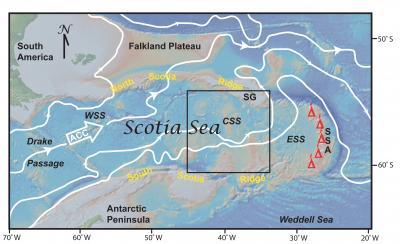
    This is a physiographic map of the present-day Scotia Sea, Drake Passage and adjacent land masses. The white arrows show the present path of the several branches of the deep Antarctic Circumpolar Current (ACC) centered on its core. The area of study in the central Scotia Sea (CSS) is shown by the black box to the south of South Georgia island (SG). The volcano symbols mark the active South Sandwich volcanic arc (SSA). (WSS = western Scotia Sea; ESS = eastern Scotia Sea). Credit: University of Texas at Austin

    Using argon isotopic dating, the researchers found that the samples range in age from about 28 million years to about 12 million years. The team interpreted these results as evidence that an ancient volcanic arc, referred to as the ancestral South Sandwich arc (ASSA), was active in the region during that time and probably much earlier. Because the samples were taken from the current seafloor surface and volcanic material accumulates from the bottom up, the researchers infer that much older volcanic rock lies beneath.

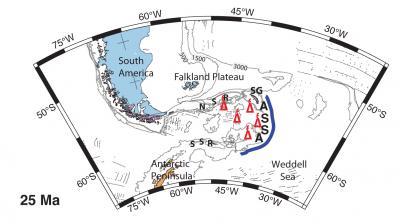
    A reconstruction of the Scotia Sea area 25 million years ago, showing volcanoes of the ancestral South Sandwich arc (ASSA). They are now submerged, but were active at that time and possibly emergent. They may have blocked the onset of the Antarctic Circumpolar Current. (NSR = North Scotia Ridge; SSR = South Scotia Ridge; SG = South Georgia island). Credit: University of Texas at Austin

    Combined with models of how the seafloor sinks vertically with the passage of time, the team posits that the ASSA originally rose above sea level and would have blocked deep ocean currents such as the ACC.

    Two other lines of evidence support the notion that the ACC didn’t begin until less than 12 million years ago. First, the northern Antarctic Peninsula and southern Patagonia didn’t become glaciated until less than approximately 12 million years ago. And second, certain species of microscopic creatures called dinoflagellates that thrive in cold polar water began appearing in sediments off southwestern Africa around 11.1 million years ago, suggesting colder water began reaching that part of the Atlantic Ocean.