Category: Uncategorized

  • What does ocean acidification mean for our coasts?

    A news stream provided by the Ocean Acidification International Coordination Centre (OA-ICC)

    What does ocean acidification mean for our coasts?

    Published 12 August 2014 Web sites and blogs Leave a Comment

    This post is a collaboration between Sarah Cooley, Ph.D. (Ocean Conservancy) and Meredith White, Ph.D. (Bigelow Laboratory for Ocean Sciences).

    As we dig deeper into how ocean acidification will affect our oceans, many scientists are also starting to talk about how it affects our coasts. This is a new focus for scientists and one ripe for new learning. In this post, we will give you a window into the coastal factors that are driving acidification and the solutions at hand.


    Here’s how it breaks down. When people refer to ‘ocean acidification,’ they are usually talking about changes in water chemistry that happen when the ocean takes up carbon pollution from fossil fuels. Scientists can see this very clearly at study sites in the middle of the ocean, far away from land. But, ocean acidification is having an impact closer to shore as well. The impacts from acidification to West Coast oyster growers and the losses they suffered are well-known. It’s one of the reasons East Coast states are deciding to act. Just last week, a Maine commission held its first meeting to figure out what the state can do about acidification. Maryland’s task force meets this week. Much of their focus will be on the near-shore drivers of acidification.

    Absorption of carbon pollution from the atmosphere isn’t the only thing that affects seawater acidity. In coastal areas, differences in the makeup or amount of river discharge and heavy pollution from land (e.g., stormwater and agricultural run-off) also change water acidity. Most rivers naturally increase seawater acidity and worsen ocean acidification. Other activities can make things worse by increasing runoff (e.g., from a large parking lot or by melting glaciers) or by changing the natural balance of rock particles carried in the river (e.g. erosion from development projects). These rivers then acidify the coastal ocean at higher rates than before. In addition, fertilizer pollution or sewage runoff can cause huge algae blooms. In the worst case, some of the blooms could be toxic, similar to what has impacted Toledo, Ohio’s water supply over the last four days. When the algae die, they release huge amounts of extra carbon dioxide that also acidify the water. Recent research shows that this makes the water even less able to naturally balance out these disruptions.

    In the past few years scientists have started to focus on coastal factors that worsen acidification, as our ability to measure these changes near the shore has grown. When we started working on ocean acidification about eight years ago, coastal issues weren’t really a focus for the ocean acidification community. But now, addressing these coastal factors is a key part of dealing with ocean acidification. Communities have a lot of options available to them, starting with local actions like reducing coastal pollution and wisely managing polluted runoff. While these coastal factors are critical, they are just a first step. To fully address ocean acidification, we will also need to reduce the amount of carbon we’re putting into the atmosphere. By taking care of our coasts and keeping the big picture of reducing carbon in mind, we can ensure that our oceans are healthy and productive.

    Sarah Cooley, The Bloc Aquatic, 7 August 2014. Article.

  • New on the Left Flank: Ukraine, the sanctions war & 21st century imperialism

    2 of 5
    Why this ad?
    Gosford Residentsnbnco.com.au/Service_Providers – Enjoy the NBN like 1000s of Aussies Find a Service Provider Here.

    New on the Left Flank: Ukraine, the sanctions war & 21st century imperialism

    Inbox
    x

    Left Flank tadtietze@gmail.com via mail76.atl11.rsgsv.net

    6:02 PM (15 minutes ago)

    to me
    Email newsletter for subscribers to Left Flank. Features the latest post/s.
    View this email in your browser

    Left Flank

    Latest posts from on 08/12/2014

    Excerpts:

    Ukraine, the sanctions war & 21st century imperialism

    We live in dangerous times. The last week has seen Russia impose trade sanctions on Australia, in a quite understandable response to the sabre rattling over Ukraine by our idiot politicians, and in particular, the enthusiasm displayed by Julie Bishop in backing sanctions against Russia. Sanctions and counter sanctions. The European Union and Russia are […]

    The post Ukraine, the sanctions war & 21st century imperialism appeared first on Left Flank.
    Read on »

    Share
    Tweet
    +1
    Forward to Friend

    Recent posts at the Left Flank:

    Trust Me (I hate you)
    Brutal asylum policies & the Left’s ‘blame voters’ moralism
    Free PDF version of On Utøya available
    Post-Budget: Just what the hell is Abbott up to?
    Europe: Political decay, Right fractures & Left strategy

    Copyright © 2014 Left Flank, All rights reserved.
    You are receiving this email because you opted in at our website.

    Our mailing address is:

    Left Flank

    14/97-99 Macleay St
    Potts Point

    Sydney, NSW 2011

    Australia

    Add us to your address book

  • Daily update: Why solar may not be biggest threat to energy utilities

    1 of 1
    Why this ad?
    Solar power 3kw $2899www.spacesolar.com.au – Electricity Prices continue to Rise Get a Solar Now and Save Money!

    Daily update: Why solar may not be biggest threat to energy utilities

    Inbox
    x

    Renew Economy editor@reneweconomy.com.au via mail142.us4.mcsv.net Unsubscribe

    3:04 PM (14 minutes ago)

    to me
    Why solar may not be biggest threat to energy utilities; Gas could cost 40% more than renewables in low-carbon shift; Another 16k homes add rooftop in July; Japan challenges China to be world’s biggest solar market in 2014; China looks to renewables target, as Australia looks to hobble RET; Wind energy to rescue as EDF takes part of UK’s nuclear fleet offline; ACT solar farm proposal riles Uriarra residents; Thomas Piketty, climate change and discounting our future; Using your smoking habit to make renewable energy; Barcelona – Spain’s city of the sun; and Germany hits new renewables record.
    Is this email not displaying correctly?
    View it in your browser.
    RenewEconomy Daily News
    The Parkinson Report
    Solar is a major threat to energy business models. But its impact may pale to that of major firms such as Apple and Google and their promotion of “megawatts” through smart software. Citigroup predicts a battle of “epic” proportions between tech giants and the conventional energy producers.
    UNSW study says relying on ‘risky, uncertain’ gas-fired electricity to clean up Australia’s power sector could cost 40% more than shift to renewables.
    Another 16,000 Australian homes added rooftop solar in July, but commercial scale installations grabbed a larger share.
    BNEF predicts Japan solar boom could deliver 10.3-11.9GW of added PV capacity this year – only slightly less than China, the world’s largest market.
    As Australia’s RET hangs in the balance, China looks to introduce a policy to set quotas for renewable energy capacity and use.
    EDF forced to shut down four nuclear reactors in UK, but grid operator says all good because there is plenty of back-up – from wind energy.
    A proposed 7MW solar farm near Uriarra has become the first in Australia to attract mass objections from locals.
    The prevailing view at the international level about action on climate change seems to be, “Why should I care about future generations?” It’s those views about what future generations are worth that will determine climate change policy in 2014 and beyond.
    To help break the world’s addiction to fossil fuels, scientists are channeling another harmful addiction: smoking cigarettes.
    Barcelona is famous for Gaudí’s architecture and a world-class Picasso museum, but it should also be known for its commitment to sustainability, and solar.
    A new record in Germany as renewable energy produced about 81 TWh, or 31% of the nation’s electricity during the first half of 2014
  • Extreme weather becoming more common, study says

    Extreme weather becoming more common, study says

    Rise in blocking-patterns – hot or wet weather remaining stuck over regions for weeks – causing frequent heatwaves or floods

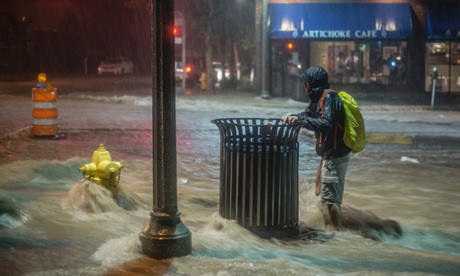
    A pedestrian hangs on to a trash can along Central Avenue as rainwater flows towards downtown Albuquerque, N.M.,  August 1, 2014.  Heavy rains late Friday night caused the flash flooding and road closures in parts of downtown and in other areas.
    A man hangs on to a trash can as rainwater gushes towards Albuquerque in New Mexico, US. Heavy rains caused flash flooding and road closures in the city earlier this month. Photograph: Roberto E. Rosales/AP

    Extreme weather like the drought currently scorching the western US and the devastating floods in Pakistan in 2010 is becoming much more common, according to new scientific research.

    The work shows so-called “blocking patterns”, where hot or wet weather remains stuck over a region for weeks causing heatwaves or floods, have more than doubled in summers over the last decade. The new study may also demonstrate a link between the UK’s recent flood-drenched winter and climate change.

    Climate scientists in Germany noticed that since 2000 there have been an “exceptional number of summer weather extremes, some causing massive damage to society”. So they examined the huge meanders in the high-level jet stream winds that dominate the weather at mid-latitudes, by analysing 35 years of wind data amassed from satellites, ships, weather stations and meteorological balloons. They found that blocking patterns, which occur when these meanders slow down, have happened far more frequently.

    “Since 2000, we have seen a cluster of these events. When these high-altitude waves become quasi-stationary, then we see more extreme weather at the surface,” said Dr Dim Coumou, at the Potsdam Institute for Climate Impact Research. “It is especially noticeable for heat extremes.” The intense heatwaves in Russia in 2010, which saw 50,000 people die and the wheat harvest hit hard, and in western Europe in 2003, which saw 30,000 deaths, were both the result of blocking patterns. The Intergovernmental Panel on Climate Change concluded in 2011 that extreme weather would become more common as global warming heats the planet, causing both heatwaves and increasingly severe rain storms.

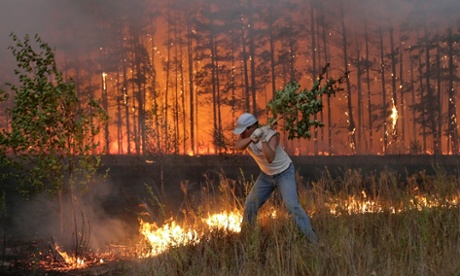
    A Russian man tries to stop fire near village Dolginino on August 4, 2010. Russia's worst heatwave for decades shows no sign of relenting, officials warned as firefighters battled hundreds of wildfires in a national disaster that has claimed at least 40 lives.
    In 2010, heatwaves caused hundreds of wildfires across Russia. Above, a man tries to stop a fire near Dolginino village. Photograph: Artyom Korotayev/AFP/Getty Images

    The rise in blocking patterns correlates closely with the extra heating being delivered to the Arctic by climate change, according to the research which is published in the journal Proceedings of the National Academies of Science (PNAS). Coumou and his colleagues argue there are good physical reasons to think there is a causal link, because the jet streams are driven by the difference in temperature between the poles and the equator. As the Arctic is warming more quickly than lower latitudes, that temperature difference is declining, providing less energy for the jet stream and its meanders, which are called Rossby waves.

    Prof Ted Shepherd, a climate scientist at the University of Reading, UK, but not involved in the work, said the link between blocking patterns and extreme weather was very well established. He added that the increasing frequency shown in the new work indicated climate change could bring rapid and dramatic changes to weather, on top of a gradual heating of the planet. “Circulation changes can have much more non-linear effects. They may do nothing for a while, then there might be some kind of regime change.”

    Shepherd said linking the rise in blocking events to Arctic warming remained “a bit speculative” at this stage, in particular because the difference between temperatures at the poles and equator is most pronounced in winter, not summer. But he noted that the succession of storms that caused England’s wettest winter in 250 years was a “very good example” of blocking patterns causing extreme weather during the coldest season. “The jet stream was stuck in one position for a long period, so a whole series of storms passed over England,” he said.

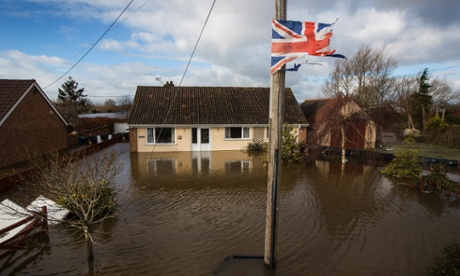
    Flooding in the town of Northmoor Green (Moorland), where almost all residents have now been evacuated, Somerset, 10 February 2014
    Flooding in Northmoor Green (Moorland) in Somerset, UK, in February this year. Photograph: David Levene for The Guardian

    Coumou acknowledges his study shows a correlation – not causation – between more frequent summer blocking patterns and Arctic warming. “To show causality, computer modelling studies are needed, but it is questionable how well current climate models can capture these effects,” he said.

    Prof Tim Palmer, at the University of Oxford, wrote in a PNAS article in 2013 that understanding changes to blocking patterns may well be the key to understanding changes in extreme weather, and therefore to understanding the worst impacts of climate change on society. But he said climate models might have to run down to scales of 1km to do so. “Currently, national climate institutes do not have the high-performance computing capability to simulate climate with 20km resolution, let alone 1km,” he wrote. “[I] look forward to the day when governments make the same investment in climate prediction as they have made in finding the Higgs boson.”

  • How much oil do we have left?

    5

    How much oil do we have left?

    USA Today, news source 8:32 p.m. MDT August 9, 2014
    36 CONNECT 8 TWEET 1 LINKEDIN 5 COMMENTEMAILMORE

    USA TODAY – The year 1981 just called and said that we are out of oil. Well, according to estimates from the time, we should be.

    Back then the world consumed just under 60 million barrels per day, and global proved reserves for oil stood at almost 700 billion barrels. At that rate, the world should have exhausted all its proved reserves sometime in December 2013. But instead of the last drop of oil being squeezed out of the Earth, global production has increased by 46%, and global reserves now stand 1 trillion barrels higher than they did 33 years ago.

    Did some geological miracle more than double the amount of oil we have produced in the past three-plus decades? No. It’s more of a disconnect between how much oil is physically left in the world and how data related to oil reserves is reported. Let’s look at why these numbers have been misleading for so long and why today’s current projection of 53 years of oil remaining — based on recent numbers from BP — is likely wrong as well.

    Somewhere between 53 and 250 years, take your pick

    There are a multitude of ways to describe the amount of oil remaining, but the most common is known as proved reserves. When you divide proved reserves by total production, you get the reserves-to-production ratio. This is where the 53-year estimate comes from and where that 32-year estimate originated in 1981. While the number is easy to understand, it’s a red herring because it assumes production will remain constant forever and that the current proved reserves estimates represent all the oil left. As we all know, this simply isn’t the case.

    The problem with the term “proved reserves” is that many assume it describes a physical limitation on oil, but it is actually a calculated economic limitation. Every country has a slightly different way of calculating the amount, but the basic gist is that proved reserve estimates are what companies assume they can pull from the ground using existing technology while still generating a profit, which is based on the price of oil or gas over the past year.

    This estimate can be impacted by several things: new technology that makes oil recovery less expensive, new reservoirs that were not considered economical at the time, or simply that a rising price of oil makes those once unattainable resources attainable. Overall, this is a relatively small amount of oil compared to the total physical amount of petroleum that is in the ground. The following image from the U.S. Energy Information Administration gives a visual idea of this concept. It is not to scale.

    In fact, looking at the historical trend of the world’s reserve-to-production ratio since 1980, we are actually at one of our most abundant times in terms of proved reserves.

    This is only the tip of the iceberg, though, because these projections don’t include technically recoverable resources that are not yet deemed economical at today’s prices. Considering all of the technically recoverable resources, we have enough oil to last us over 100 years at current production levels. Furthermore, if we also include more complicated oil reservoirs such as kerogen deposits, then we may have more than 250 years of oil supply. It all depends on how much consumers are willing to pay for that oil.

    What a Fool believes

    I’m not here to thumb my nose at peak oil theories, because there is an actual physical limit to the amount of oil in the ground. In fact, there are trillions of potential barrels of oil in Mother Nature’s pressure cooker as we speak, but it will likely take thousands of years before they become oil reservoirs like those we are accustomed to drilling today. It is much more likely, however, that we will reach the economic limits of extracting oil from the ground before we reach the physical limits.

    As investors, it is important to understand this dynamic because it prevents us from making hasty decisions about long-term investments. Is it possible that we will no longer use oil 53 years from now? That’s not likely, but if it happens it will be because we have developed alternatives that are more economical, rather than running up against the physical limitations of what’s underground.

    The Motley Fool is a USA TODAY content partner offering financial news, analysis and commentary designed to help people take control of their financial lives. Its content is produced independently of USA TODAY.

  • Coal bed methane: sorting the information from misinformation

    Join us on Linkedin

    Coal bed methane: sorting the information from misinformation

    Sam Dodson looks to sieve through the reams of misrepresented facts and misinformation in the hunt for accurate data on the benefits – or otherwise – of coalbed methane.


    A recently published report in the Proceedings of the National Academy of Sciences (PNAS) in the US has extolled some of the benefits of coalbed methane (CBM) and other unconventional resources, while also noting the need for further study to determine both the benefits and risks associated with developing such fuel sources.

    The report has been held up by industry lobbyists as a sign of the potential benefits of CBM: for example, the report noted that CBM would release “half the CO2 of coal”.  Meanwhile, activists pitted against the development of unconventionals have either refuted the report or drawn attention to its stance that further study into the industry is needed.

    Both groups would look to sway public opinion to their own way of thinking and, as such, choose to grasp at and support any report or news development that would appear to back up their claims, regardless of how accurate any such thing may be.

    Indeed, there is a growing body of research showing that, when a person’s worldview is threatened by scientific evidence, they interpret the science in a biased manner. People choose the data that supports their views, or views of those closest to them, and place greater weight on evidence that confirms those beliefs, while ignoring or resisting conflicting evidence.

    Mass communication and social media

    With the advent of mass communication, activists and lobbyists are able to spread the evidence that supports their views with ease. Both groups will also respond to each other’s actions in kind: an industry lobby group posts an article extolling the benefits of CBM, and attacking those that refute such benefits; activists post information that claims the opposite is true.

    As Michael Roche, CEO of Queensland Resources Council (QRC), at last year’s Coaltrans World Coal Conference in Berlin explained: “with so much of the world now connected and active on social media platforms,” it is easy to “hi-jack the good will of social media users and exploit this in order to spread a false message to serve [a group’s] own purpose.”

    In a classic example of the way groups can spread disinformation, a number of activist “eco groups” spread false or doctored images that claim to show the negative effects of dredging and seaborne coal transport. Roche said that to believe this was in any way the case was entirely false, explaining that the coal and shipping industries have worked alongside reef authorities and their interaction with the Great Barrier Reef has been under close scrutiny for many years with no evidence that the industry does any damage. Roche also said it would not make sense for any industry professional to claim otherwise or do anything that in anyway endangered the reef: “We all have a vested interest in ensuring the reef continues to survive,” Roche said.

    Roche, of course, has his own vested interest in supporting the coal industry – evidence indicates that the QRC receives AU$ 103 million from the coal industry to press the case for the state’s coal miners. Attacking the source of this income does not necessarily pay such rich dividends.

    Another example, is the recent spat between the Australian Petroleum Production & Exploration Association (APPEA) and the Australian Medical Association (AMA). The AMA had recently suggested that natural gas from coal seams poses a risk to human health, a claim the APPEA accused of having more political overtones than scientific foundation. The AMA, in turn, argued that the opposite was the case.

    Trying to find true, real and accurate information among all the misinformation can therefore be a significant challenge.

    Fact and fiction

    Alex Wonhas, from the Gas Industry Social and Environmental Research Alliance (GISERA), explains that: “deciding whether CBM is good or bad is wholly dependent on the individual’s definition of the words ‘good’ or ‘bad’.”

    “It is in the interests of the industry to make you believe that CBM is good, while the opposite is true for other groups. The role of scientists and organisations such as the Commonwealth Scientific and Industrial Research Organisation (CSIRO) is to act as an honest broker and try to bring some clarity to the debate,” Wonhas adds.

    CSIRO is currently set to investigate whether CBM activity is causing methane seeps in Queensland’s Surat Basin. The study will give authorities baseline data to compare over the life of the CBM industry. “We’ll be able to follow the eventual impacts on methane seeps to the atmosphere from these sources,” Dr Damian Barrett, Spokesman for Australia’s national science agency, said.

    The project will be funded through a partnership between CSIRO and CBM companies operating in Australia.

    It is through scientific research, such as that conducted by the CSIRO, as well as by gathering information in reports, such as the one released in the PNAS, that the information needed to ground our opinions in fact will be provided; rather than selectively choosing the misinformation generated by activists on both sides of the argument.

    One thing else is clear: the world needs energy, yet the fact that human activity (including the creation of energy) effects climate change is almost universally accepted. A balance between these two pressing matters must therefore be struck – and struck quickly. As demand for power and electricity around the globe grows, energy production must increase. All sources of energy – from CBM and other unconventionals to mainstays like coal and gas, as well as renewables – must be considered as viable options in meeting energy needs until scientific fact proves otherwise. To spend time trying to win battles – be they with activists or lobbyists – to conjecture and form biased opinions over a subject as crucial to global development as energy resources is to only ever be on the losing side of an entirely bigger struggle.