Category: Uncategorized

  • The Threat of Storms Wreaking Havoc in the Arctic Ocean

    Posts    FAQ    Myths    About    Contact    Tweets    Plan

    Friday, July 4, 2014

    The Threat of Storms Wreaking Havoc in the Arctic Ocean

    Arctic sea ice extent is close to a record low for the time of the year, as the image below shows.

    Furthermore, the current decline in sea ice extent is much steeper than it used to be for this time of the year, raising the specter of sea ice hitting an absolute record low later this year. Moreover, a total collapse of sea ice may occur if storms continue to develop that push the remaining ice out of the Arctic Ocean into the Atlantic Ocean.

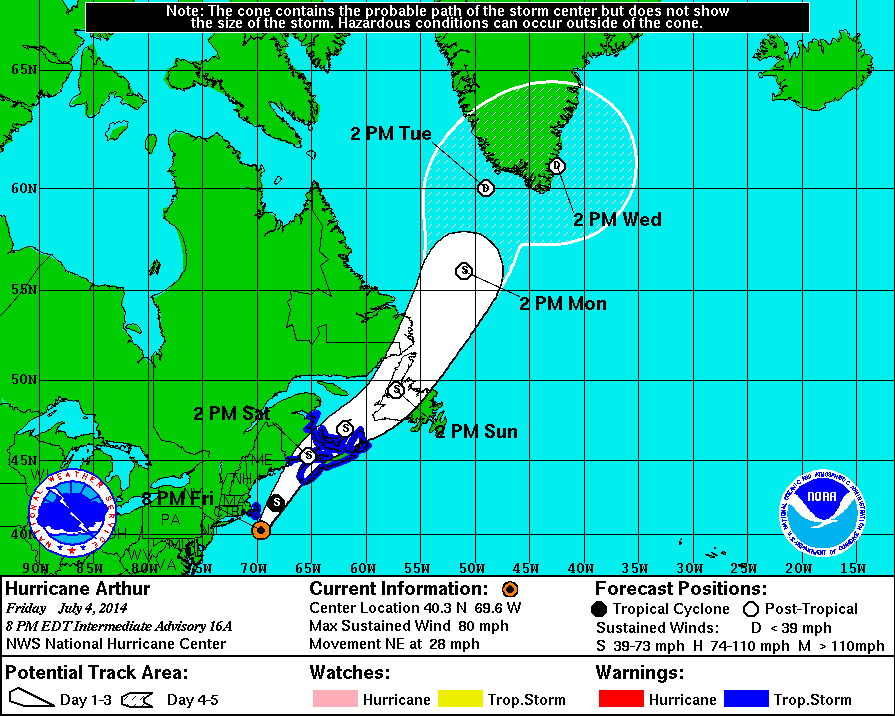
    The threat posed by storms is illustrated by the track projected to be followed by Hurricane Arthur over the next few days, as shown on above NOAA image.

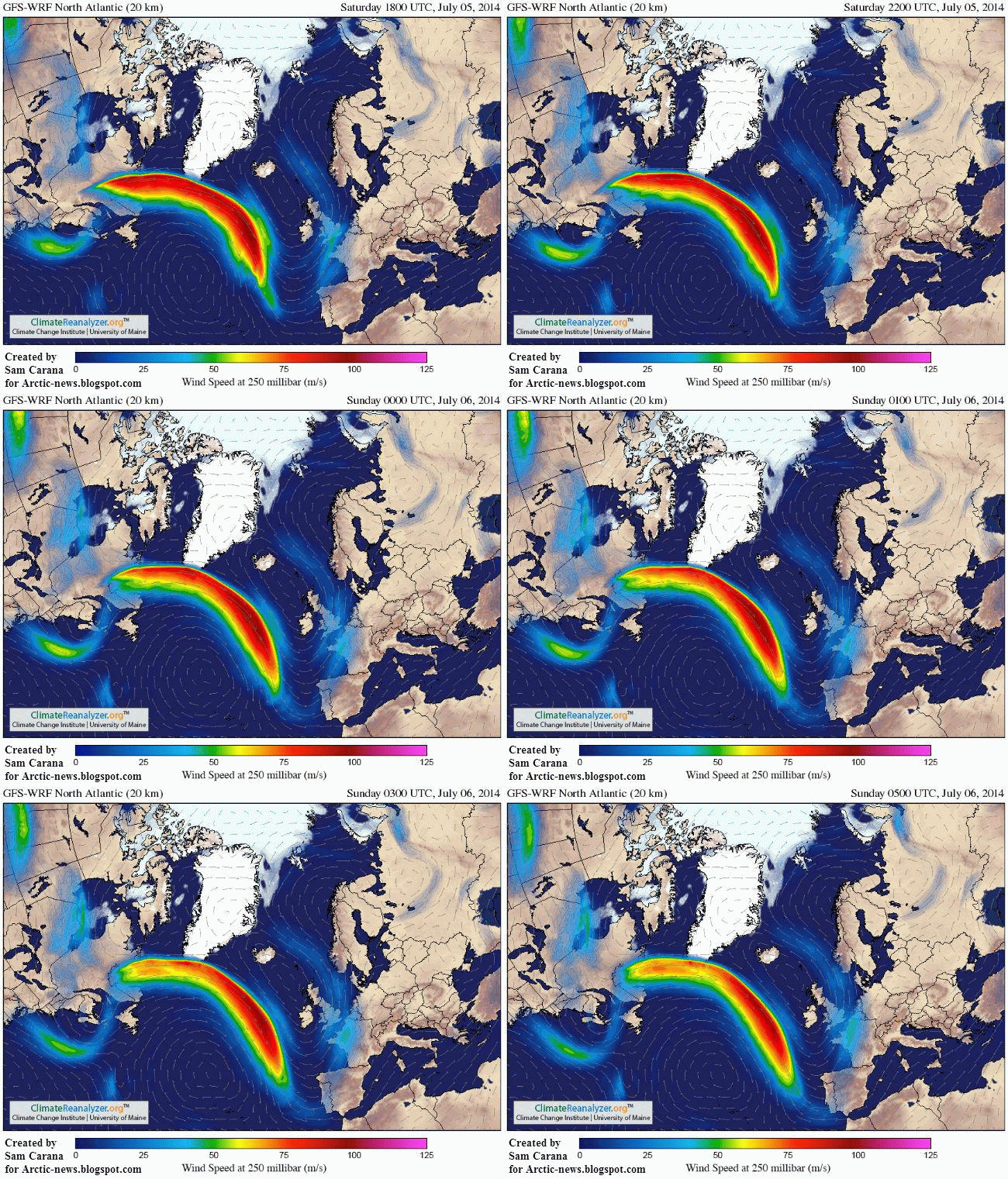
    The path followed by Hurricane Arthur is influenced by the current shape of the jet stream. As the animation below illustrates, the jet stream looks set to prevent Hurrican Arthur from moving to the east and instead make it move into the Labrador Sea to the west of Greenland and – partly due to the high mountains on Greenland – continue to wreak havoc in Baffin Bay further north.

    [ Note: this animation is a 1.87 MB file that may take some time to fully load ]

    Last month, the June heat record broke in Greenland. Very high temperatures are currently recorded all over North America, as the image below shows.

    Furthermore, sea surface temperature anomalies in the Arctic are currently very high, as the image below shows.

    Finally, the sea ice is currently very thin, as shown by the Naval Research Laboratory animation below.

    The above animation further shows that there now is very little sea ice left in Baffin Bay, making it easier for storms to cause very high waves that could enter the Arctic Ocean and break the sea ice north of Greenland and Canada.

    Arctic sea ice volume minimum is typically reached around halfway into September. This is still months away, but the prospect of an El Niño event striking this year now is 90%, according to predictions by the European Centre for Medium-range Weather Forecasts.

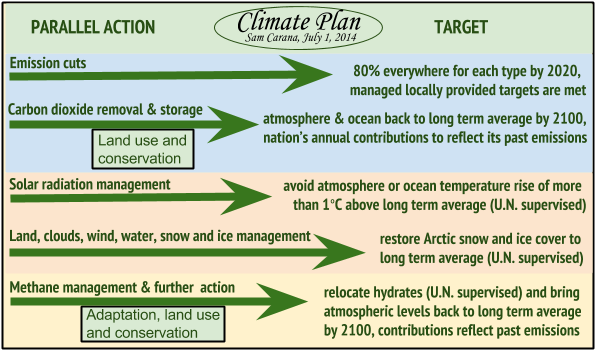
    All this combines into a growing threat that hydrates contained in sediments will destabilize and that huge quantities of methane will be released abruptly from the seafloor of the Arctic Ocean. The risk that this will eventuate is intolerable and calls for parallel lines of action as pictured in the image below.

  • Another climate scientist joins calls for nuclear

    Another climate scientist joins calls for nuclear

    Professor Ove Hoegh-Guldberg of the Global Change Institute has become the latest climate scientist to make an open call for the use of nuclear power to combat climate change.

    OveHoegh-Guldberg, a well-known Australian marine scientist who will be remembered by many for his confrontations with climate change denier Andrew Bolt, has made a direct call for the use of nuclear energy in Australia and globally to improve our chances of preserving the Great Barrier Reef.

    In a lengthy column in today’s issue of The Australian , co-authors Hoegh-Guldberg and Eric McFarland of the Dow Centre for Sutainable Engineering, take aim at both the misinformation that has slowed the uptake of nuclear energy and lack of transparency from within the nuclear industry itself.

    “Our understanding and control of nuclear reactions is among the greatest intellectual triumphs of human beings and it provides us today with the one real option to significantly reduce global carbon emissions”

    “Unfortunately, public focus has been only on risks to human populations highlighted by tragic incidents at Three Mile Island, Chernobyl and Fukushima, rather than the hundreds of reactors that have been operating safely for decades. Nuclear power can provide low-cost, carbon free electricity improving the lives of billions of people. For too long this has been the butt of scaremongering and misinformation that has all but stopped widespread deployment”.

    In a separate article, Hoegh-Guldberg was frank about the challenge in changing his position on nuclear energy.

    “I have definitely changed my position on this. In all these debates it’s really important that one gets guided not by the position you have taken and stick to it- it’s about looking at the evidence and really thinking the issue through”.

    Hoegh-Guldberg joins a growing list of scientists, environmentalists, experts and progressives calling for the deployment of nuclear power to meet the clean energy challenge this century.

    Both articles can be found in today’s issue of The Australian

    Like what you see here? Please subscribe to the blog, Like Decarbonise SA on Facebook and follow @BenThinkClimate on Twitter. Read more about the potential for nuclear power in Australia at Zero Carbon Options.

  • Nuclear Power for Australia?

    NWR

    Global News and World Report

    Monday, June 16, 2014

    Nuclear Power for Australia?


    Should the electricity production in Australia go nuclear?

    In this entry we’ll calculate the number of reactors that would be required to produce 50% of the electricity in Australia.

    Before even starting, here we state two facts:

    1. Australia is the Saudi Arabia of Uranium reserves: they have 31% of the world total. The country in second place, Kazakhstan, has less than HALF Australia’s reserves.*

    2. Australia has the 4th largest global reserves of Thorium.**

    Other countries would certainly kill to own these amounts of fissile material.

    Now, let’s make the math.

    According to the IEA, Australia produced 228,152 GWh of electricity in 2013.  Let’s convert this to average power:

    228,152 GWh / 24 hours / 365 days = 26.045 GW.  For simplicity, let’s leave it at 26 GW.

    50% of the above power is 13 GW. So now let’s calculate how many 1 GWe nuclear power plants would be required to supply 13 GW of electrical power.

    To be conservative, let’s say that the capacity factor of these reactors is 85%. Thus:

    13 GW / 0.85 / 1GWe = 15.29 nuclear reactors.  Let’s round it up to 16.

    That’s it! 16 reactors is all that Australia needs to replace 50% of its electricity and thus dramatically reduce its carbon emissions (in 2013, 86.4% of Australia’s electricity was produced with combustible fuels).***

    With their current reserves, Australia essentially has enough U / Th to power a civilization “forever.”

    Sure, the Australian coal industry would suffer greatly, but this is probably the price that has to be paid to reduce emissions Down Under.

    The growth in Australia’s electricity consumption is projected to amount to only 1.4% per year, so by 2035 they would need 22 reactors to supply 50% of its electricity. China today is building 28, so 22 should be a perfectly achievable objective for a developed country like Australia.

    Feel free to add to the conversation on Twitter: @luisbaram

    Thank you.

    *
    http://www.world-nuclear.org/info/Nuclear-Fuel-Cycle/Uranium-Resources/Supply-of-Uranium/

    **
    http://www.world-nuclear.org/info/current-and-future-generation/thorium/

    ***
    http://www.iea.org/statistics/relatedsurveys/monthlyelectricitysurvey/

    ****
    http://www.bree.gov.au/sites/default/files/files//publications/aep/australian-energy-projections-report.pdf

    Labels: , , , , , , ,

    posted by Luis B. Aramburu @ 11:39 AM   2 comments

    2 Comments:

    At 6:20 PM, Anonymous actinideage said…
    I’m not claiming it’ll be simple, but it’s pretty straightforward, isn’t it Luis? We have your chinese example but also the french who built many more reactors then we would need even for 80 percent capacity like they have. The coal industry need not shut completely: coal is still a rich chemical feedstock but unfortunately there is much environmental impact related to its mining and when the concept of synfuel manufacturing and the like was raised with industry people by an acquaintance they showed no interest in such opportunities.

    The party which holds power here currently is historically friendly to at least the idea of nuclear energy but unfortunately they are very happy with coal and are unlikely to be swayed on this issue (or any issue for that matter). The most damaging aspect of this is the tall order of amending the specific legislation prohibiting fuel production and nuclear generation (unique within the OECD) which is the main target of my advocacy efforts.

    At 9:54 PM, Anonymous Ruth Sponsler said…
    As the saying goes, the Liberals and Abbott are killing nuclear with faint praise.

    It’s the same thing that Reagan and both Bushes did in the US.

    Mind you, I’m not discussing the overt anti-nuclearism of elements of Labour and the US Democrats.

    I’m talking about conservatives’ (Liberal in Australia) faint praise that amounts to lip service.

    I think a direct policy is needed akin to the Gaullism that got France where she is today.

    Post a Comment

  • What should Labor stand for?

    What should Labor stand for?

    The best way forward for Labor doesn’t fit well with structures inherited from the past, writes Geoff Gallop

    04 July 2014

    Print this article Print this article

    Tags: , , , ,

    Bookmark and Share

    A working class party?
    Mugley/ Flickr


    In many ways the question of what Labor should stand for is pretty easy to answer. It’s all there in the National Platform. There are the “enduring values,” the “vision for Australia’s future” and, tucked away in chapter 12, our “objectives” and “principles of action” as a “democratic” and “socialist” party. That’s all very well, but I want to dig deeper and see if we can sort out the essential from the peripheral and come up with a definition that continues to work for participants and those who analyse their behaviour.

    Although there are differences among Labor members about what all of this means, there is one commitment that shines through, and that is the commitment to the theory and practice of democracy. Labor is a party for democracy – for political rights, for fair elections and for accountability in government. The trade unionists who formed the party saw democracy not just as a means to an end, but also as the best way to resolve conflict in society. It is true that early on they did flirt with the idea of direct democracy but it was the belief in equal representation that won out in the end.

    Competing for the hearts and minds of the working class in the twentieth century were the ideas of fascism and communism. These ideas – and the concept of revolution they produced – were never supported by Labor. As Lenin said in 1913, “The Australian Labor Party does not even call itself a socialist party. Actually it is a liberal-bourgeois party, while the so-called Liberals in Australia are really conservatives.” Labor’s leaders, he continued, were “altogether peaceable, purely liberal.”

    Those words may not be perfect for the task at hand but you can see why Lenin said such things. Labor’s commitment to electoral politics was a principled rather than a tactical one. The party was willing to compromise not just in the interests of building alliances but also because peaceful existence rested on mutual respect and accommodation. Note too that although Labor objected to monopoly power it didn’t view the capitalist class as a mortal enemy. It was, in other words, reformist or, as the Marxists put it, “revisionist.” It certainly wasn’t revolutionary in organisation or outlook.

    This takes us to a question: if Labor is a democratic party, what sort of democracy does it support? Three answers have been given to this question: first, it is a “democratic socialist” party; second, it is “social democratic”; and third, it’s neither of the above, but rather a “Labor” or “working-class” party.

    A socialist party?

    The National Platform mentions both “democratic socialist” and “social democratic.” I would contend there is a problem with the use of the term “democratic socialist” and it relates to the so-called Blackburn Declaration of 1921, which qualified Labor’s commitment to socialisation. This was a major event in the party’s history and put it on a solid foundation for the future. “Socialisation of industry, production, distribution and exchange,” we read in the Platform today, is proposed not outright but “to the extent necessary to eliminate exploitation and other anti-social features in these fields.”

    This is a brilliant resolution of a problem that bedevilled other parties of the democratic left for much of the twentieth century. It provides criteria for assessing the relevance of intervention and by using the term “socialisation” rather than “nationalisation” doesn’t narrow down the debate to the role of the state. And it focuses not just on production but also on distribution and exchange. My only complaint is that it doesn’t make any reference to protecting the environment, but that would be an easy fix.

    If you look at Labor’s history and its platform you would be hard-pressed to conclude it was a socialist party. It does believe in what we used to call a mixed economy rather than in a fully privatised or a fully socialised one. Private, public and community-based enterprises have all been supported, a good mix between the three being seen as the best to produce good outcomes from an economic system. Sometimes that has meant bringing enterprises and activities into the public sector and sometimes the reverse through privatisation or contracting arrangements.

    Support for competition as opposed to monopoly led some of the first Labor governments to create public enterprises to provide choice for consumers and better working conditions for workers. In the 1970s Gough Whitlam proposed freer trade, as did his successors in the 1980s and early 1990s, but they added to the mix what came to be known as national competition policy.

    Nor could it be said that Labor has been a proponent of equality of outcomes. It has always supported fair wages for work performed, and a tax and public expenditure mix that evens things out in the interests of equality of opportunity and social mobility. The approach taken by the philosopher John Rawls is a good, if not perfect, description of what Labor has represented in Australian political economy. All offices and positions, he said, should be open to all – and effectively, not just formally, so. Inequality was justified but only to the extent that it worked to the advantage of the worst-off in society. It’s not a socialist but rather a fair society to which Labor is attracted.

    A working-class party?

    That leaves us then with “Labor” or “social democracy” to describe the party. Speaking in 2013, Julia Gillard came down strongly for the former. Labor, she said, was just that – a Labor Party rather than a “progressive” or a “moderate” or a “socialist democratic party.” She went on: “I’m a leader of a party called the Labor Party deliberately because that is what we come from. That is what we believe in and that is who we are.” There can be no mistaking the words she used, and the impression she wanted to leave. Labor is a party of and for the working class.

    We all know, of course, that the working class is defined by its position in the economic system. Workers – unskilled or skilled, blue collar or white collar – are employed by others who own the means of production. They are employees who work for a wage and there are plenty of them, even though self-employment has gained added traction in our economy and society. It is true that Labor was formed from the movement created by such workers in the late nineteenth century, and they have continued to play a role – directly and indirectly – in the party.

    But can we say that this is the beginning and the end of any discussion about what Labor does or should stand for? The working class in Australia takes shape in many ways, industrial, political and cultural. Its politics have largely been democratic but not always progressive, White Australia being an illustration of the latter. Not all unions are affiliated with the party and some have favoured direct action rather than government action as the best way to ensure just outcomes for workers. Labor’s base has also been divided on a range of other things, including national security on the one hand and social, political and environmental policy on the other.

    In some ways the idea in play when describing Labor as a working-class party is a pretty simple one. Labor should provide a framework within which this working class in all its manifestations works out a set of policies to take to an election. In other words it should be a party owned by the working class and controlled by the majority view therein.

    There is an important difference emerging on the question of how to ensure that control. Traditionally it was to be done through internal democracy guaranteed effective from a working-class point of view through the privileged position of trade unions, or at least a significant number of them, in the party structure. When Labor was a mass membership party and unions carried great influence in the hearts and minds of workers this made a lot of sense. In fact the complex relationship between leaders, unions and members was a constructive one that had its limits but didn’t prevent change.

    In more recent times it’s not been internal democracy that holds the key to finding “working-class opinion” but rather scientific polling instituted by parliamentary and party leaders operating relatively free of internal constraint. This is not far from the position that in order for Labor to be truly democratic and working-class its leaders need to be completely free to gauge majority opinion (assumed to be working-class opinion) and then to act accordingly. This is a tendency rather than a settled position, and the unions that are still a force within Labor insist on certain no-go zones when it comes to policy development and implementation.

    What it seems to come down to is this: Labor is a party of working-class values as expressed in the marketplace of public opinion and interpreted by the party leadership, but limited in scope by the specific interests of the unions that are affiliated. It’s a long way from the party that Labor once was, but it’s functional as a system of control and accountability in an organisation with few members.

    The problem with both of these accounts of Labor as working-class – the traditional one based on a genuine and vigorous form of internal democracy, and the more recent one based on negotiated outcomes within a top-heavy political class – is that the working class doesn’t exist in a vacuum and nor is its future immune from technological and social change, be it global or local.

    It’s certainly less of a problem to describe the party in this way if your framework is the traditional model of working-class politics. However, even then it is an issue. There are – and always have been – many differences within the working class, some easy to resolve, some not so easy. Nor does the working class exist in isolation but rather in an economy and society alongside others with whom it needs to determine and construct its relationships. Like other classes in our society it needs leadership – and hopefully that leadership will not just project the party’s interests today but also urge it to think ahead and plan for tomorrow.

    That, I believe, is the way Hawke and Keating saw their task – not to mirror working-class opinion but rather to engage it around a national narrative that showed an understanding of working-class needs but also challenged workers and their unions to accept change.

    A social democratic party?

    It seems to me that Labor has always worked best when it’s been more than just the sum of its parts. It is – but it is not just – an organisation for workers and their unions. It is also, importantly, a party that can “think big” about minorities as well as majorities, about the environment as well as the economy and about the future as well as the present.

    Indeed it’s been a good thing that the structure of the party was such that intellectuals, the self-employed, small business people, professionals and the well-intentioned wealthy were given the chance to influence its development. Indeed, they were part of the dynamic that helped push Labor into new areas of policy and also into thinking more broadly than its working-class base might allow. Importantly, as well, they added to and complemented a bohemian and libertarian element that existed in parts of the working class.

    How, then, do we bring this together? Labor is clearly for democracy and equal representation. Sometimes radical but sometimes conservative, it has been influenced by socialism but isn’t socialist. It’s strongly influenced by the working class but isn’t just a working-class party. It’s connected to unions but not all unions are affiliated. There have been libertarian, socialist, environmental and communitarian influences on the development of the Platform but none of them on their own describes what the party has represented in Australian history. I’m led, therefore, to favour social democracy as the preferred description – a party of democracy that brings the social question to the table, and more recently the environmental one as well.

    Reform implications

    I’m left with a problem. The preferred description I have given for Labor doesn’t fit well with the structures inherited from the past. Indeed the party’s organisational structure is out of tune – and radically so – with the world in which it seeks support. In a party with many members and strongly supported unions social democracy was well-placed to succeed against other tendencies, and not just in the working class. Labor could produce personnel and craft policies that attracted majorities at the local, state and national levels of government. In a sense, Labor was a mini political and democratic system working within the larger system that was Australian democracy.

    Today the working class still exists and needs support in the interests of fairness, but it is a different beast which both the party and trade unions find harder to engage. In fact the task of engagement has become more complicated all round and throughout the community. Both Labor and unions need more democracy, not less, if they are to attract not just workers and their families but also others in our society. Today this has to mean party structures that put members on an equal base and that create new community-based methods of preselection. In such a world Labor’s distinctive policy platform should be viewed as the basis for attracting members, not as an inconvenience to be discarded when it suits. It is true that specific powerful interests may lose out in this process but they will not include, I would contend, the working class or social democracy and the ideas it favours. The reason for that is simple – they are good ideas and we should be confident of their capacity to win over a majority. •

    Geoff Gallop, a former premier of Western Australia, is Professor and Director of the Graduate School of Government at the University of Sydney. This is an edited version of the speech he gave last month at the John Cain Foundation in Melbourne.

    – See more at: http://inside.org.au/what-should-labor-stand-for/?utm_content=buffera4f7c&utm_medium=social&utm_source=twitter.com&utm_campaign=buffer#sthash.KNJOfnys.dpuf

  • A partial list of products made from Petroleum (144 of 6000 items)

                                             Return

    A partial list of products made from Petroleum (144 of 6000 items)

    One 42-gallon barrel of oil creates 19.4 gallons of gasoline. The rest (over half) is used to make things like:

    Solvents Diesel fuel Motor Oil Bearing Grease
    Ink Floor Wax Ballpoint Pens Football Cleats
    Upholstery Sweaters Boats Insecticides
    Bicycle Tires Sports Car Bodies Nail Polish Fishing lures
    Dresses Tires Golf Bags Perfumes
    Cassettes Dishwasher parts Tool Boxes Shoe Polish
    Motorcycle Helmet Caulking Petroleum Jelly Transparent Tape
    CD Player Faucet Washers Antiseptics Clothesline
    Curtains Food Preservatives Basketballs Soap
    Vitamin Capsules Antihistamines Purses Shoes
    Dashboards Cortisone Deodorant Footballs
    Putty Dyes Panty Hose Refrigerant
    Percolators Life Jackets Rubbing Alcohol Linings
    Skis TV Cabinets Shag Rugs Electrician’s Tape
    Tool Racks Car Battery Cases Epoxy Paint
    Mops Slacks Insect Repellent Oil Filters
    Umbrellas Yarn Fertilizers Hair Coloring
    Roofing Toilet Seats Fishing Rods Lipstick
    Denture Adhesive Linoleum Ice Cube Trays Synthetic Rubber
    Speakers Plastic Wood Electric Blankets Glycerin
    Tennis Rackets Rubber Cement Fishing Boots Dice
    Nylon Rope Candles Trash Bags House Paint
    Water Pipes Hand Lotion Roller Skates Surf Boards
    Shampoo Wheels Paint Rollers Shower Curtains
    Guitar Strings Luggage Aspirin Safety Glasses
    Antifreeze Football Helmets Awnings Eyeglasses
    Clothes Toothbrushes Ice Chests Footballs
    Combs CD’s & DVD’s Paint Brushes Detergents
    Vaporizers Balloons Sun Glasses Tents
    Heart Valves Crayons Parachutes Telephones
    Enamel Pillows Dishes Cameras
    Anesthetics Artificial Turf Artificial limbs Bandages
    Dentures Model Cars Folding Doors Hair Curlers
    Cold cream Movie film Soft Contact lenses Drinking Cups
    Fan Belts Car Enamel Shaving Cream Ammonia
    Refrigerators Golf Balls Toothpaste Gasoline
  • Is the Abbott Government in a Position to Request a Double Dissolution?

    « Napthine Government Starts from Behind in Key Marginal Seats | Main

    July 04, 2014

    Is the Abbott Government in a Position to Request a Double Disslution?

    Several weeks ago Green’s Leader Senator Christine Milne announced that her party had delivered the Abbott government a trigger for a double dissolution by helping to block, for a second time, legislation to repeal the Clean Energy Finance Corporation.

    While it is true blocking the legislation created a double dissolution trigger, is is unlikely that the Prime Minister yet has constitutional justification to request double dissolution. That is assuming he was of a mind to do so.

    An overlooked aspect of calling a double dissolution, and an aspect that tripped up Malcolm Fraser in 1983, is that while possession of a trigger is necessary for calling a double dissolution, on its own a trigger is not a sufficient reason.

    This necessary but not sufficient condition relating to double dissolution triggers goes back to legal advice at the time of the first double dissolution one hundred years ago this month in 1914.

    June/July this year is not only the centenary of the path to the First World War. The same two months in 1914 saw the debate that led to the proroguing of the Parliament in 29 June 1914, followed by the proclamation of the parliament’s dissolution on 30 July 1914.

    The power of a Governor-General to dissolve both houses of the Commonwealth Parliament for an election is not one inherited from the British Crown. It is a power created by the deadlock provisions of the Constitution (Section 57) and is bound by interpretation of that section’s wording.

    When the Cook Liberal government was elected at the 1913 Commonwealth election, it had a one seat majority in the House (38-37) but was in a significant minority in the Senate (7-29). By May 1914 the government had created a trigger based on legislation blocked twice by the Senate, and in June announced that the Governor-General had agreed to a double dissolution, pending the passage of supply to carry on government until the new parliament could convene after the election.

    This supply issue meant that the calling of the first double dissolution received a thorough debate in the Parliament, with the Senate addressing the Governor-General on the matter and requesting that correspondence be released. The Governor-General did not respond, referring to the statement made to the House by the Prime Minister.

    With supply passed, both houses were prorogued on 29 June 1914, not long after a certain event took place on the other side of the world in Sarajevo. The proclamation of dissolution was issued on 30 July 1914. For unrelated reasons, five days later Britain and Australia were at war with Germany.

    Labor won the election on 5 September, but by then the political and international situation had changed dramatically from when former Prime Minister Cook had written to the Governor-General on 4 June requesting the double dissolution.

    On 8 October new Prime Minister Andrew Fisher released all correspondence between Prime Minister Cook and Governor-General Sir Ronald Munro-Ferguson. It set a precedent that has resulted in correspondence for all subsequent double dissolutions being made public.

    For this first first use of the novel double dissolution power, the Governor-General requested, with Prime Minister Cook’s consent, advice from Chief Justice of the High Court Sir Samuel Griffith on the use of the power granted to the Governor-General by Section 57.

    Griffith was in a unique position to offer advice, having attended the 1890s Constitutional Conventions and been one of the authors of the Constitution’s several drafts.

    In the released advice, Griffith advised Munro-Ferguson that the exercise of power under Section 57 was not automatic based on the existence of a trigger, but required the Governor-General to be personally satisfied of several conditions related to the trigger. To quote from the advice –

    An occasion for the exercise of the power of double dissolution under Section 57 formally exists … whenever the event specified in that Section has occurred, but it does not follow that the power can be regarded as an ordinary one which may properly be exercised whenever the occasion formally exists. It should, to the contrary, be regarded as an extraordinary power, to be exercised only in cases which the Governor-General is personally satisfied, after independent consideration of the case, either that the proposed law as to to which the Houses have differed in opinion is one of such public importance that it should be referred to the electors of the Commonwealth for immediate decision by means of a complete renewal of both Houses, or that there exists such a state of practical deadlock in legislation as can only be ended in that way. As to the existence of either condition he must form his own judgment. Although he cannot act except upon advice of his Ministers, he is not bound to follow their advice but is in the position of an independent arbiter.

    Since 1914 there have been five further double dissolutions, one in 1951, and four in 13 years in 1974, 1975, 1983 and 1987.

    As with the 1914 double dissolution, the 1951 request related to a single piece of legislation that the government argued had recently met the requirements of Section 57 of the Constitution. As with 1914, Menzies in 1951 also faced a Senate under control of the Opposition, 34-26.

    The 1974 request was different, resting on six pieces of legislation for which triggers had been built up over the previous 18 months. The 1974 double dissolution led to the only use of the second part of the deadlock provision, a joint sitting of the houses to deal with the disputed legislation. The process ran in parallel with a series of High Court cases that clarified the meaning of Section 57.

    One of the Justices who sat on those High Court cases in 1974 was Sir Ninian Stephen. In July 1982 he was appointed Governor-General, which meant he was particularly well informed on the operation of Section 57 when Malcolm Fraser made the next request for a double dissolution on 3 February 1983.

    The background to Fraser’s request was the political situation surrounding the Labor leadership that day. Labor’s National Executive was due to meet in Brisbane that morning, and an acrimonious debate was expected in defending Bill Hayden’s leadership against supporters of Bob Hawke.

    What Fraser did not know was that Bill Hayden had already made up his mind to stand aside in favour of Bob Hawke. What Labor did not know as they started their meeting was the Malcolm Fraser had headed out to the Governor-General’s residence with a request for a double dissolution. Such were the joys of politics before mobile phones and twitter.

    Embarrassingly for Fraser, Sir Ninian Stephen also did not know Fraser was on his way to Yarralumla. Fraser arrived with his listing of double dissolution triggers, but his advice lacked argument on the existence of practical deadlock. Knowing well the legal position related to Section 57, Stephen asked Fraser to provide further advice.

    Fraser had already called an unscheduled press conference for 12:30, at which he expected to announce a double dissolution. However, he had left the Governor-General no time to consider his request, especially as he was about to engage in an important diplomatic lunch with the Polish Ambassador. Fraser was forced to return to Parliament House, by which time knowledge of his request had leaked and Labor had resolved that Bob Hawke would be the new Labor leader.

    Through the afternoon Fraser provided further advice on the parliamentary situation to the Governor-General, and by evening had been granted his request for a double dissolution. But by then Bill Hayden had resigned, Labor had not imploded in acrimony, and Fraser had four weeks to try and destroy Bob Hawke’s Labor leadership. He failed.

    The relevance of this story is that while the Abbott government now has a double dissolution trigger on legislation to repeal the Clean Energy Finance Corporation, it has no grounds to argue that a situation of practical deadlock exists with the Senate.

    The trigger was achieved in a Senate that ceased to exist on 30 June. The new Senate’s term began in 1 July and new Senators will be sworn in next week.

    If in the highly unlikely situation that the Abbott government were to suddenly request a double dissolution based on this legislative trigger, the Governor-General would be entirely entitled to ask for evidence that a practical deadlock exists with the Senate. As the new Senate has yet to meet, and as the new Senate has not debated the legislation, the Governor-General would be entitled to say a practical deadlock does not exist.

    But beyond these constitutional issues, there are more practical issues about why we are not going to see a double dissolution election any time in the near future. These are

    • There is no way the Abbott government would call a double dissolution based on one part of the carbon legislation. It will build up triggers on all the different pieces of rejected carbon legislation before it even considers a double dissolution.
    • The government would also be keen to gather as many other legislative triggers, to have as many irons in the fire as it can before listing all as triggers for a double dissolution.
    • A double dissolution under the current electoral laws would be a farce. There will not be a double dissolution until the senate’s electoral system is changed.
    • The government would be wary of a double dissolution until it knows how it can work with the new balance of power Senators.
    • The government would want to know whether the Palmer United Party has a long term future, something that will take time and several state elections to assess.


    The option for a double dissolution is available until mid-May 2016. There is no reason to rush to a double dissolution early, especially before assessing the performance of the new Senate.

    Above all, those pining for an early double dissolution need to remember that while the Senate can put the bullets in the double dissolution gun, it is entirely the Prime Minister’s choice whether and when he fires the loaded gun.

    Overlooking the event of November 1975 (which as always is the exception to the rule), governments are never forced to a double dissolution. It is a government’s choice to call double dissolution, and it is the government’s choice to do so at a time most advantageous to its chances of re-election.

    Given the tough budget it introduced in May, the Abbott government shows little sign of firing the gun to start a double dissolution at any time in the near future.

    Posted by on July 04, 2014 at 04:25 PM in Double Dissolutions,