Category: Uncategorized

  • Global Cooling as Significant as Global Warming, Study of Marine Ecosystems During Cretaceous Period Shows

    Global Cooling as Significant as Global Warming, Study of Marine Ecosystems During Cretaceous Period Shows

    June 16, 2013 — A “cold snap” 116 million years ago triggered a similar marine ecosystem crisis to the ones witnessed in the past as a result of global warming, according to research published in Nature Geoscience.


    Share This:

    The international study involving experts from the universities of Newcastle, UK, Cologne, Frankfurt and GEOMAR-Kiel, confirms the link between global cooling and a crash in the marine ecosystem during the mid-Cretaceous greenhouse period.

    It also quantifies for the first time the amplitude and duration of the temperature change. Analysing the geochemistry and micropaleontology of a marine sediment core taken from the North Atlantic Ocean, the team show that a global temperature drop of up to 5oC resulted in a major shift in the global carbon cycle over a period of 2.5 million years.

    Occurring during a time of high tectonic activity that drove the breaking up of the super-continent Pangaea, the research explains how the opening and widening of new ocean basins around Africa, South America and Europe created additional space where large amounts of atmospheric CO2 was fixed by photosynthetic organisms like marine algae. The dead organisms were then buried in the sediments on the sea bed, producing organic, carbon rich shale in these new basins, locking away the carbon that was previously in the atmosphere.

    The result of this massive carbon fixing mechanism was a drop in the levels of atmospheric CO2, reducing the greenhouse effect and lowering global temperature.

    This period of global cooling came to an end after about 2 million years following the onset of a period of intense local volcanic activity in the Indian Ocean. Producing huge volumes of volcanic gas, carbon that had been removed from the atmosphere when it was locked away in the shale was replaced with CO2 from Earth’s interior, re-instating a greenhouse effect which led to warmer climate and an end to the “cold snap.”

    The research team highlight in this study how global climate is intrinsically linked to processes taking place in Earth’s interior at million year time scales. These processes can modify ecospace for marine life, driving evolution.

    Current research efforts tend to concentrate on global warming and the impact that a rise of a few degrees might have on past and present day ecosystems. This study shows that if global temperatures swing the other way by a similar amount, the result can be just as severe, at least for marine life.

    However, the research team emphasise that the observed changes of the Earth system in the Cretaceous happened over millions of years, rather than decades or centennial, which cannot easily be related to our rapidly changing modern climate conditions.

    “As always it’s a question of fine balance and scale,” explains Thomas Wagner, Professor of Earth Systems Science at Newcastle University, and one of the leaders of this study.

    “All earth system processes are operating all the time and at different temporal and spatial scales; but when something upsets the balance — be it a large scale but long term natural phenomenon or a short and massive change to global greenhouse gases due to anthropogenic activity — there are multiple, potential knock-on effects on the whole system.

    “The trick is to identify and quantify the initial drivers and consequences, which remains an ongoing challenge in climate research.”

    Share this story on Facebook, Twitter, and Google:
  • Government says coal industry vital despite Climate Commission’s warnings against fossil fuels

    Government says coal industry vital despite Climate Commission’s warnings against fossil fuels

    ABCUpdated June 17, 2013, 3:53 pm

    The Government has rejected calls to wind down the coal industry, after a Climate Commission report suggested the majority of the world’s coal must be left unburned.

    The report says global carbon dioxide emissions cannot exceed 600 billion tonnes between now and 2050 if the climate is to stay within 2 degrees Celsius of pre-industrial levels.

    It says that 600 billion tonne budget is being used far too quickly, and global emissions need to trend downward by the end of the decade to keep temperatures at a manageable level.

    Co-author of the report Professor Lesley Hughes says there will be catastrophic consequences for the environment if action is not taken.

    “In order to achieve that goal of stabilising the climate at 2 degrees or less, we simply have to leave about 80 per cent of the world’s fossil fuel reserves in the ground,” she said.

    “We cannot afford to burn them and still have a stable and safe climate.”

    Minister says Australian coal helping millions out of poverty

    Federal Resources Minister Gary Gray says he acknowledges the need for clean energy, but says coal is still vital to the global economy.

    He says while Australia can turn to natural gas, it should still export its coal reserves.

    “There is no solution to global baseload energy generation that does not figure a big contribution by coal,” he said.

    “It’s also important for us to have investments in smart coal technologies to ensure that we can capture CO2 in the flue.”

    Mr Gray says Australia’s coal is helping nations like India and China bring hundreds of millions of people out of poverty.

    “We do have to accept that in a growing region there are still countries that need these resources in order to draw hundreds of millions of people out of poverty,” he said.

    “That’s why we also invest in the technologies of the future, not just the minerals processes of the future.”

    Coalition says real change depends on global action

    Opposition environment spokesman Greg Hunt also ruled out closing the coal industry in a bid to reduce carbon emissions.

    Mr Hunt says the Coalition supports Australia’s emissions reduction target, but that real change will not happen until there is a global agreement.

    “The key for the world is a global agreement between the big G4 of China and the United States, India and the EU,” he said.

    Greens Leader Christine Milne says the Government and the Coalition are showing they do not accept the climate change science.

    “You either [accept] climate science and you understand those coal reserves have to stay in the ground or, if you’re going to back those coal reserves and the ports in Queensland, then you don’t believe the climate science,” she said.”

  • Backlash awaits party that ‘saves the furniture’

    17 June 2013

    Kevin Rudd and Julia Gillard (AAP: Dan Peled/Paul Miller)

    Backlash awaits party that ‘saves the furniture’

    458 Comments

    Mary Delahunty

    Mary Delahunty

    What if the herd does stampede this last parliamentary sitting fortnight and Labor MPs move on the Prime Minister? There will be a swingeing backlash and there will be palpable anger in the party, writes Mary Delahunty.

    So it’s all about Saving The Furniture! This little homily rolls around the political echo chamber as the press gallery parrots the mantra and Caucus members supposedly hover in the shadows of doubt.

    STF actually means hanging on to enough seats in the right places so a few factional warlords can control the party from opposition.

    It certainly doesn’t mean an electoral win and typically presages a loss of soul, just as the Beazley-led Labor Party in trying to Save The Furniture in the Tampa election 12 years ago opened a vein of votes bleeding to the Greens from which the ALP has never recovered.

    The other furphy doing the rounds is that Rudd is now not ‘destabilising’ or ‘stealing’ the Government’s oxygen. Oh really. So who is this indulgent backbencher cavorting in front of the camera, “Look at me, look at Me” like a spoilt kid at a school fete. The confected glee of some of the crowd ignores the reality of Rudd as a weak PM unable or unwilling to make hard policy decisions or even front up for a leadership ballot he had contrived his acolytes to engineer.

    And his “I’m Kevin and I’m here to help” routine certainly distracted from Julia Gillard’s victory in manoeuvring Tony Abbott into a corner where he committed to not doing a deal with DLP senator John Madigan on abortion to get key legislation, such as the repeal of the carbon tax, through the Senate, should Abbott become prime minister and Madigan hold the balance of power.

    This is really Saving the Furniture, the policy furniture. Just as the Prime Minister is relentless in getting her education reform through the Parliament and progressively signing up the states to a national school improvement plan and needs based funding. Julia Gillard signed South Australia up to Gonski this week but it hardly rated a mention in a feverish week where governing and politics seemed to be in parallel universes.

    What if the herd does stampede this last parliamentary sitting fortnight and, as the boosters hope, they move on the PM?

    There will be a swingeing backlash.

    Thousands of decent Australian will be sickened by the indulgence of the political class. If they were bewildered in 2010 with the ALP leadership change, the February 2012 decisive 40-vote margin Caucus decision for Gillard, then the bizarre spill-call in March, Rudd no-show and ministers peeling off the front bench, they will be disgusted with another leadership merry-go-round.

    There will be palpable anger in the party.

    Women and men will baulk at staffing the booths. Many will refuse to hand out How to Vote cards with Rudd’s face on them.

    Decent party members will struggle with the direction of their vote, The Greens will reap a harvest of Labor refuseniks in the senate.

    Tony Abbott and the LNP will launch a blitzkrieg of anti-Rudd ads featuring his own ministers skewering the man and his dysfunctional time in office. And don’t think the clip of a furious and swearing Rudd won’t get re-run on a loop throughout the campaign. These images will stand in coarse contrast to the jolly mate on the hustings today where he seems moved to almost concede that ‘his government’, not him, made a few mistakes.

    Present ministers will resign. New/old ministers and parliamentary secretaries will be recycled. Toxic recriminations will leach out onto a public despairing.

    Labor’s tatty façade will be rent and the whole show will fall apart.

    Of course the echo chamber assumes that a crescendo of crisis polling will stampede MPs from a Prime Minister who has resolutely delivered on milestone policy such as national disability insurance, paid parental leave and a strikingly strong economy into the arms of a narcissist who offered the great symbolic value of The Apology but not much more.

    MPs in risky seats like Gary Gray in Western Australia are not lemming-like rushing to Rudd, instead Gray is calling for calm and the end to instability. The worst of the noise is coming from NSW.

    NSW, that bellowing branch of the Labor party which fostered a hardy and virulent form of political corruption, the branch that pioneered the revolving leadership syndrome and that held at its bosom the likes of Eddie Obeid and Ian MacDonald. And this discredited branch now dares to try and call the shots in a dispirited caucus.

    Meanwhile the Liberal National coalition can’t believe their luck. They are coasting towards the green leather seats of government unobserved, unscrutinised, untested. And if they get there they will certainly bulldoze the furniture.

    Mary Delahunty is a Gold Walkley award-winning journalist, former minister in the Victorian Labor government and the author of Public life: Private Grief. View her full profile here.

  • Abbott business advisor threatens to sue farmer if windfarm does him harm

    Abbott business advisor threatens to sue farmer if windfarm does him harm

    Maurice Newman, chairman of Coalition’s proposed business advisory council, sends legal warning over windfarm

    Maurice Newman

    Maurice Newman, seen here at the ABC, of which he was formerly chair. He will chair Tony Abbott’s business advisory council Photograph: JEREMY PIPER/AAPIMAGE

    The man who will chair Tony Abbott‘s business advisory committee is among a group of country landholders threatening to sue a neighbouring farmer for “substantial damages” if their health or property values are harmed by his agreement to allow wind turbines to built on his property.

    Maurice Newman, former chairman of the Australian Stock Exchange and the ABC and chair of Abbott’s three person panel of business advisors, was one of seven families in the Crookwell area who signed a legal letter to local farmer Charlie Prell threatening to sue if the wind farm went ahead and caused them nuisance or harm, including to their health or property values.

    The letter urged Prell to seek legal advice as to whether he could break his contract with the wind farm proponent Union Fenosa.

    Newman last week described subsidies for renewable energy as “a crime against the people” because higher energy costs hit poorer households the hardest and, in his opinion, the science of global warming was “somewhat in tatters” so there was no longer any logical reason to have them.

    The letter, from law firm Piper Alderman on behalf of Newman and the other landholders, states, “Our clients wish to inform you…that they consider that the proposed wind farms, if erected, are likely to constitute a common law nuisance, and therefore an infringement of their rights as neighbouring landowners to have their reasonable enjoyment of their land not disrupted by the wind farm on your land. Our clients also wish you to be in no doubt that they will if necessary take steps to protect their rights, all of which rights are reserved, including to seek compensation for infringement of those rights.”

    “…we suggest that, if wind turbines commenced operation on your land, the likely impact on our clients and other neighbours will constitute actionable nuisance for which you will be liable and they would be entitled to recover substantial damages from you.”

    The letter says such a lawsuit has not been taken before regarding a wind farm because “of the reluctance of rural people to sue their neighbours, rather than any comment on the law” and warns “please note that our clients are not so reluctant and are ready, willing and able to litigate in order to enforce their proprietary rights to be protected from nuisance caused by you and other hosts.”

    The letter also warns Prell that the wind farm operator might not be able to remove the turbines and “remediate’ his property if it suffers financial difficulty “for example because of a change in government energy policy, technical difficulties with the wind farm, or obsolescence.”

    Prell says he has no intention of breaking his legal contract with the company, which will help him secure a regular income and “drought proof” his property.

    But Prell, who will speak at a pro wind farm rally held in central Canberra on Tuesday, says he is concerned that wind farm projects that could help rural communities like his own might not proceed under a Coalition government.

    The Coalition is under intense pressure to back a moratorium on new wind farms and to wind back or scrap the renewable energy target, both from some of it’s own MPs and Senators and from the active anti wind farm lobby that is holding a rally outside Parliament House on Tuesday.

    The Coalition has already promised to impose new continuous noise monitoring rules on windfarms that the industry says will inflict crippling costs and provide no useful information but several MPs and Senators are pressing for a moratorium on new wind farms and a scaling back or scrapping of the renewable energy target.

    Industry spokesman Ian Macfarlane says the backlash against wind farms is so strong that the new noise policy is the only way to calm “community divisions” .

    “If we don’t do this my concern is that the issues around wind farms have the potential to escalate into a community divide similar to coal seam gas,” he told Guardian Australia.

    Maurice Newman, chairman of Coalition’s proposed business advisory council, sends legal warning over windfarm

    Maurice Newman

    Maurice Newman, seen here at the ABC, of which he was formerly chair. He will chair Tony Abbott’s business advisory council Photograph: JEREMY PIPER/AAPIMAGE

    The man who will chair Tony Abbott‘s business advisory committee is among a group of country landholders threatening to sue a neighbouring farmer for “substantial damages” if their health or property values are harmed by his agreement to allow wind turbines to built on his property.

    Maurice Newman, former chairman of the Australian Stock Exchange and the ABC and chair of Abbott’s three person panel of business advisors, was one of seven families in the Crookwell area who signed a legal letter to local farmer Charlie Prell threatening to sue if the wind farm went ahead and caused them nuisance or harm, including to their health or property values.

    The letter urged Prell to seek legal advice as to whether he could break his contract with the wind farm proponent Union Fenosa.

    Newman last week described subsidies for renewable energy as “a crime against the people” because higher energy costs hit poorer households the hardest and, in his opinion, the science of global warming was “somewhat in tatters” so there was no longer any logical reason to have them.

    The letter, from law firm Piper Alderman on behalf of Newman and the other landholders, states, “Our clients wish to inform you…that they consider that the proposed wind farms, if erected, are likely to constitute a common law nuisance, and therefore an infringement of their rights as neighbouring landowners to have their reasonable enjoyment of their land not disrupted by the wind farm on your land. Our clients also wish you to be in no doubt that they will if necessary take steps to protect their rights, all of which rights are reserved, including to seek compensation for infringement of those rights.”

    “…we suggest that, if wind turbines commenced operation on your land, the likely impact on our clients and other neighbours will constitute actionable nuisance for which you will be liable and they would be entitled to recover substantial damages from you.”

    The letter says such a lawsuit has not been taken before regarding a wind farm because “of the reluctance of rural people to sue their neighbours, rather than any comment on the law” and warns “please note that our clients are not so reluctant and are ready, willing and able to litigate in order to enforce their proprietary rights to be protected from nuisance caused by you and other hosts.”

    The letter also warns Prell that the wind farm operator might not be able to remove the turbines and “remediate’ his property if it suffers financial difficulty “for example because of a change in government energy policy, technical difficulties with the wind farm, or obsolescence.”

    Prell says he has no intention of breaking his legal contract with the company, which will help him secure a regular income and “drought proof” his property.

    But Prell, who will speak at a pro wind farm rally held in central Canberra on Tuesday, says he is concerned that wind farm projects that could help rural communities like his own might not proceed under a Coalition government.

    The Coalition is under intense pressure to back a moratorium on new wind farms and to wind back or scrap the renewable energy target, both from some of it’s own MPs and Senators and from the active anti wind farm lobby that is holding a rally outside Parliament House on Tuesday.

    The Coalition has already promised to impose new continuous noise monitoring rules on windfarms that the industry says will inflict crippling costs and provide no useful information but several MPs and Senators are pressing for a moratorium on new wind farms and a scaling back or scrapping of the renewable energy target.

    Industry spokesman Ian Macfarlane says the backlash against wind farms is so strong that the new noise policy is the only way to calm “community divisions” .

    “If we don’t do this my concern is that the issues around wind farms have the potential to escalate into a community divide similar to coal seam gas,” he told Guardian Australia.

  • Fight the Future (New York Times)

    Op-Ed Columnist

    Fight the Future

    By
    Published: June 16, 2013 Comment
    • Facebook
    • Twitter
    • Google+
    • Save
    • E-mail
    • Share
    • Print
    • Reprints

    Last week the International Monetary Fund, whose normal role is that of stern disciplinarian to spendthrift governments, gave the United States some unusual advice. “Lighten up,” urged the fund. “Enjoy life! Seize the day!”

    Fred R. Conrad/The New York Times

    Paul Krugman

    Opinion Twitter Logo.

    Connect With Us on Twitter

    For Op-Ed, follow @nytopinion and to hear from the editorial page editor, Andrew Rosenthal, follow @andyrNYT.

    Readers’ Comments

    Share your thoughts.

    O.K., fund officials didn’t use quite those words, but they came close, with an article in IMF Survey magazine titled “Ease Off Spending Cuts to Boost U.S. Recovery.” In its more formal statement, the fund argued that the sequester and other forms of fiscal contraction will cut this year’s U.S. growth rate by almost half, undermining what might otherwise have been a fairly vigorous recovery. And these spending cuts are both unwise and unnecessary.

    Unfortunately, the fund apparently couldn’t bring itself to break completely with the austerity talk that is regarded as a badge of seriousness in the policy world. Even while urging us to run bigger deficits for the time being, Christine Lagarde, the fund’s head, called on us to “hurry up with putting in place a medium-term road map to restore long-run fiscal sustainability.”

    So here’s my question: Why, exactly, do we need to hurry up? Is it urgent that we agree now on how we’ll deal with fiscal issues of the 2020s, the 2030s and beyond?

    No, it isn’t. And in practice, focusing on “long-run fiscal sustainability” — which usually ends up being mainly about “entitlement reform,” a k a cuts to Social Security and other programs — isn’t a way of being responsible. On the contrary, it’s an excuse, a way to avoid dealing with the severe economic problems we face right now.

    What’s the problem with focusing on the long run? Part of the answer — although arguably the least important part — is that the distant future is highly uncertain (surprise!) and that long-run fiscal projections should be seen mainly as an especially boring genre of science fiction. In particular, projections of huge future deficits are to a large extent based on the assumption that health care costs will continue to rise substantially faster than national income — yet the growth in health costs has slowed dramatically in the last few years, and the long-run picture is already looking much less dire than it did not long ago.

    Now, uncertainty by itself isn’t always a reason for inaction. In the case of climate change, for example, uncertainty about the impact of greenhouse gases on global temperatures actually strengthens the case for action, to head off the risk of catastrophe.

    But fiscal policy isn’t like climate policy, even though some people have tried to make the analogy (even as right-wingers who claim to be deeply concerned about long-term debt remain strangely indifferent to long-term environmental concerns). Delaying action on climate means releasing billions of tons of greenhouse gases into the atmosphere while we debate the issue; delaying action on entitlement reform has no comparable cost.

    In fact, the whole argument for early action on long-run fiscal issues is surprisingly weak and slippery. As I like to point out, the conventional wisdom on these things seems to be that to avert the danger of future benefit cuts, we must act now to cut future benefits. And no, that isn’t much of a caricature.

    Still, while a “grand bargain” that links reduced austerity now to longer-run fiscal changes may not be necessary, does seeking such a bargain do any harm? Yes, it does. For the fact is we aren’t going to get that kind of deal — the country just isn’t ready, politically. As a result, time and energy spent pursuing such a deal are time and energy wasted, which would have been better spent trying to help the unemployed.

    Put it this way: Republicans in Congress have voted 37 times to repeal health care reform, President Obama’s signature policy achievement. Do you really expect those same Republicans to reach a deal with the president over the nation’s fiscal future, which is closely linked to the future of federal health programs? Even if such a deal were somehow reached, do you really believe that the G.O.P. would honor that deal if and when it regained the White House?

    When will we be ready for a long-run fiscal deal? My answer is, once voters have spoken decisively in favor of one or the other of the rival visions driving our current political polarization. Maybe President Hillary Clinton, fresh off her upset victory in the 2018 midterms, will be able to broker a long-run budget compromise with chastened Republicans; or maybe demoralized Democrats will sign on to President Paul Ryan’s plan to privatize Medicare. Either way, the time for big decisions about the long run is not yet.

    And because that time is not yet, influential people need to stop using the future as an excuse for inaction. The clear and present danger is mass unemployment, and we should deal with it, now.

    • Save
    • E-mail
    • Share
  • Great Barrier Reef on the brink as politicians bicker

    Great Barrier Reef on the brink as politicians bicker

    Environment minister Tony Burke says the government has done its best to stop downgrading of UN heritage status

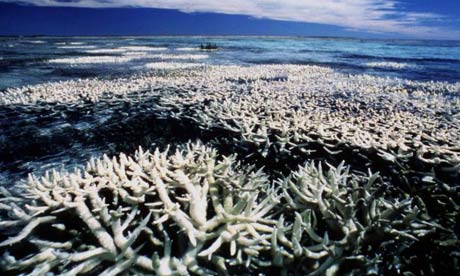
    Coral bleaching on the Great Barrier Reef.

    Coral bleaching on the Great Barrier Reef. Photograph: Reuters

    The federal government insists it is striving to avoid the Great Barrier Reef being listed “in danger” ahead of a crunch UN meeting, after rejecting a Senate recommendation to block new port developments near the World Heritage ecosystem.

    The world heritage committee begins an 11-day conference in Cambodia this week, where the UNESCO body will review the status of various prized ecological areas.

    The committee is expected to recommend that the Great Barrier Reef, which has been listed as a World Heritage site since 1981, be placed on the “in danger” list next year due to concerns over coal and gas expansion, increased shipping and water quality.

    A draft World Heritage report produced in May noted “concern” over water quality monitoring and the lack of a “a clear commitment toward limiting port development to existing port areas”. Unless “urgent and decisive action” was taken, the reef should be considered in danger, it said.

    The federal environment minister, Tony Burke, told Guardian Australia improvements made since May showed the government was committed to safeguarding the Reef.

    “I’m certainly hopeful that we can get some progress on what was in the draft report,” he said. “We committed a further $200 million for Reef Rescue in the budget, which was since the report. That’s one clear example of where they’ve expressed concern over water quality and we’ve acted.

    “It’ll be presumptuous to say what the world heritage committee will decide but I’m confident that we have evidence to show that Australia takes management of the reef seriously.”

    But Burke said the government would not support a Senate committee recommendation that a temporary halt be placed on new port developments in Queensland until an assessment, conducted by both state and federal governments, is released in 2015.

    The committee, which considered a bill introduced by Greens senator Larissa Waters, said in its report that existing regulations “may not be sufficient to protect the Great Barrier Reef’s outstanding values”.

    Burke said the move was unnecessary as there were no new developments planned before 2015. He said it was not straightforward to fulfill UNESCO’s key recommendation of banning substantial new infrastructure outside existing port areas.

    “I will follow the process properly, under law,” he said. “If I pre-judge applications, it’ll get thrown out in court. [UNESCO] understands the limits we have under Australian law. It’s a nuanced situation.

    “But they also understand that nothing has since been approved in pristine areas, and none was more sensitive than the proposed Xstrata development on Balaclava Island, which was cancelled after the draft report.”

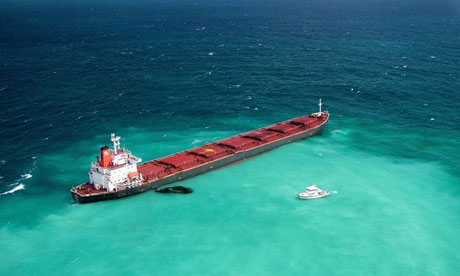
    Fuel oil leaks from a Chinese bulk coal carrier grounded on the reef in 2010. Fuel oil leaks from a Chinese bulk coal carrier grounded on the reef in 2010. Photograph: GettyIt is understood that several World Heritage delegates have been dismayed by what they see as a politicisation of the reef, with Burke involved in a series of public ructions with the Queensland government over the management of the vast coral ecosystem.

    Last week, Queensland’s deputy premier, Jeff Seeney, said Burke had been “held ransom” by “radical Greens”.

    “Mr Burke is beholden to the Greens who feed him dishonest and deceitful assertions about our government’s actions,” Seeney said. “It’s time Mr Burke represented every person in this state, rather than those he believes will keep the Gillard government in power.”

    But Burke has also come under fire from the Greens and environmental groups, who accuse him of doing little to safeguard the reef and caving into the demands of the mining industry, with eight ports planned or expanded during his tenure.

    Burke told Guardian Australia: “I find some of the political points quite bewildering. Jeff Seeney’s comments were just odd, certainly one of the weirder moments in Australian politics. I can’t understand what was going on in his head when he launched that diatribe.

    “Larissa Waters, the Greens and Greenpeace are, in a large part, using the reef as a proxy for an anti-coal campaign. Those groups say the best way to limit emissions is to price carbon and then they ask for a regulatory mechanism too. They can’t have it both ways.”

    Waters said it would be a “disaster” if the reef was placed on the “in danger” list, alongside sites predominantly found in developing or war-torn countries.

    “Tony Burke isn’t acting like an environment minister,” she said. “He says a lot of strong things and then doesn’t deliver.

    “The UNESCO report was clear that there should be no new ports but there are no state or Commonwealth moves to limit these ports. Responsibility lies on both sides so it’s farcical to see them pointing the finger at each other.

    “It’s amazing that it had to come down to me, a new member of the Senate, to draft a bill to protect the seventh wonder of the world because the government won’t do it.

    “The world heritage committee aren’t idiots. This is their area of expertise. I imagine the Australian delegation will be pressuring other delegates to water down the criticism because it’s embarrassing.”

    The reef faces a number of threats, including chemicals that flow onto it from agricultural land, a plague of crown-of-thorns starfish and climate change, which has been blamed for an increase in coral bleaching and severe weather events such as cyclones, which further damage the ecosystem.

    Another potential risk is the dredging of the seabed to allow ships access to new ports. The Great Barrier Reef Marine Park Authority recently warned MPs that the impact of dumping dredging spoil onto the reef could be worse than previously thought.

    The reef has lost half its coral cover in the past 27 years, the Australian Institute of Marine Sciences says. Last week, 150 Australian and international scientists signed a letter warning the reef was in crisis and required urgent action to protect it.

    The Queensland environment minister, Andrew Powell, told Guardian Australia the state government’s policy was consistent with UNESCO’s demand for ports to be kept to existing areas.

    “The Newman government firmly believes that we can have sustainable economic development and strong environmental protection – the two concepts are not mutually exclusive,” he said.

    “The Newman government is aware of the potential impacts of dredging which is one of the many reasons why we scaled back the previous Labor government’s crazy proposals for a massive multi-cargo facility at Abbot Point.”

    “We want to ensure any development occurs in a considered and measured way and as such all development applications are subject to a stringent environmental impact assessment process.”